In short
Walmart has enabled Meta’s Muse to search for and buy Black Friday deals through its Agent Gateway, marking a major step toward AI-led retail checkout. The rollout includes spending caps, purchase approval and privacy controls, but access remains tightly managed.
- Walmart has live-enabled Agent Gateway support for Meta’s Muse.
- The rollout lets Muse search products and buy Black Friday deals on Walmart.com and, per Crypto Briefing, Sam’s Club.
- Walmart’s Agent Profiles let shoppers set spending caps, approve purchases and review buy history.
- The company says purchase-history data is not shared with agents.
- Reporting differs on rollout scope, with Unite.AI describing the Gateway as invitation-only beta.
Walmart has begun letting Meta’s Muse AI agent browse and buy Black Friday deals on its site, a move that pushes AI shopping from recommendation into actual checkout. The rollout, reported by The Verge, Crypto Briefing and Unite.AI, matters because it turns Walmart into one of the first major retailers to support agent-led transactions with explicit controls around spending and privacy.
What Walmart just enabled
According to The Verge, Walmart has live-enabled its Agent Gateway for Muse, the shopping assistant Meta launched earlier this year. That means the AI agent can search for products and complete purchases on Walmart’s platform during the retailer’s Black Friday push.
Crypto Briefing reported that the live rollout covers Walmart.com and Sam’s Club. The site also said Walmart is using the Model Context Protocol, or MCP, to give the agent direct access to the shopping flow, a technical step that makes the integration more than a simple chatbot overlay.
Unite.AI added that Walmart announced Agent Gateway, Agent Profiles and its agent terms on Oct. 21, 2026. In other words, the retailer spent weeks laying out the rules before opening the door to a live shopping experience.
How the checkout flow works
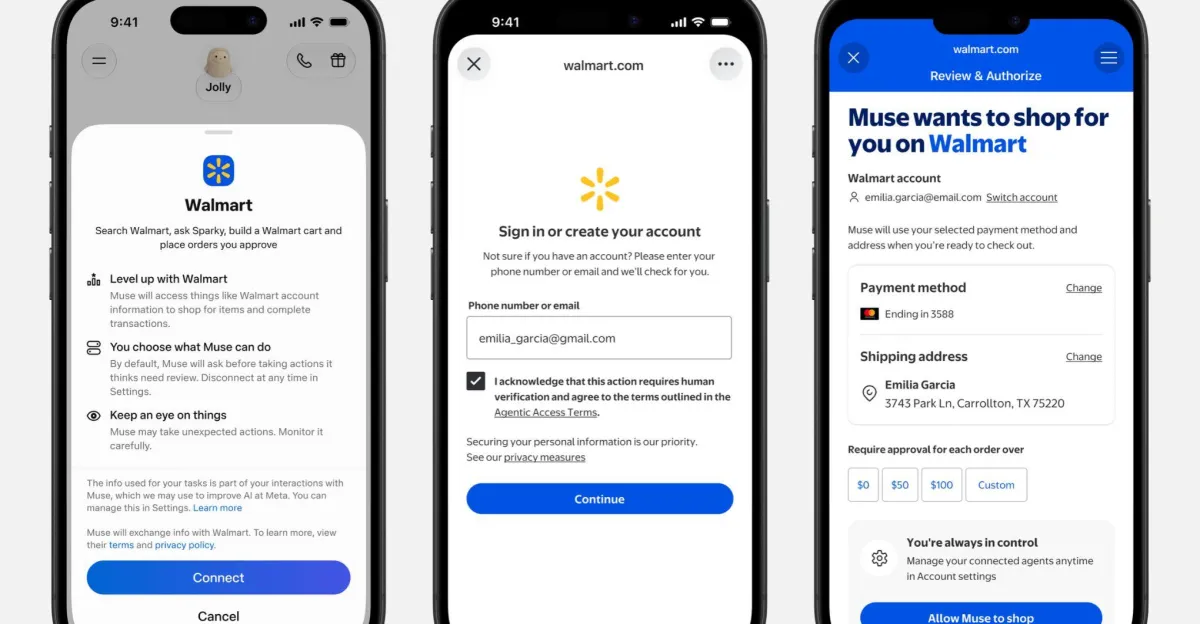
The clearest change is that shopping can now happen inside the Muse conversation instead of forcing the user to leave the AI interface. Unite.AI said checkout stays inside Muse using a card already saved in the Walmart account, which means the AI can move from product search to payment without handing off to a separate browser step.
Walmart’s Agent Profiles are designed to keep that process under user control. The Verge reported that shoppers can set spending caps, approve purchases and review Muse’s buy history. Crypto Briefing likewise said users can monitor transactions and restrict payment access through Agent Profiles.
Walmart also says the setup keeps purchase-history data from being shared with agents, a privacy guardrail that matters if AI tools are to become regular shopping intermediaries rather than occasional assistants.
Why it matters
This is more than a holiday-season convenience feature. Retail is testing whether AI agents can become a new transaction layer between shoppers and stores, and Walmart is making a strong case that the answer can be yes — as long as the retailer controls the terms.
For consumers, the appeal is obvious: a shopper can ask an agent to find Black Friday deals, compare options and buy without re-entering payment details each time. For retailers, the stakes are more complicated. Whoever controls the agent interface may influence what gets seen, what gets bought and how often customers return.
That is why Walmart’s rules around spending limits, purchase approval and payment controls are so central. The company is not just allowing AI traffic; it is setting the conditions under which that traffic is allowed to convert into sales.
The timing also matters. Black Friday remains one of the biggest retail events of the year, and Crypto Briefing noted that the 2026 sales window runs Nov. 23-29. Introducing agent-led checkout during that period gives Walmart a real-world stress test with a large pool of deal-seeking shoppers.
How the outlets differ
The reporting across the three outlets is broadly aligned, but each emphasized different pieces of the rollout.
The Verge focused on the live Agent Gateway support for Muse, the ability to search products and buy Black Friday deals, and Walmart’s statement that more AI apps and agents will be supported later. It also highlighted two company quotes from Walmart: “just the beginning” and “on the way.”
Crypto Briefing framed the move as a broader commerce integration across Walmart.com and Sam’s Club, with an emphasis on MCP, price parity between human and agent shoppers, and Muse’s rapid growth. The outlet said Muse launched Sept. 8, 2026 and reached more than 10 million users across the U.S. and Canada within weeks.
Unite.AI focused on policy and plumbing: the October announcement, the invitation-only beta status of the Gateway, and the fact that Walmart’s agent terms may be suspended or changed. That reporting adds an important caveat — this is a live rollout, but not necessarily a permanently open one.
Background: how Walmart and Meta got here
AI shopping agents have been building momentum because they promise to do something ordinary chatbots cannot: act. They can search, compare and, if allowed, complete transactions on behalf of a user. The idea has been around in concept for a while, but retailers have been selective about which agents they permit to touch their storefronts.
Meta’s Muse is one of the newer entrants in that market. Crypto Briefing reported that it launched on Sept. 8, 2026 and quickly topped 10 million users across the U.S. and Canada. That scale helps explain why a retailer like Walmart would be interested in making the agent transactional rather than merely conversational.
At the same time, retailers have been wary of giving outside agents free rein. Crypto Briefing said Amazon restricted Muse on its platform, underscoring that not every major seller wants to open its catalog and checkout systems to the same AI tools. Walmart’s decision therefore stands out not just for the technology, but for the willingness to let an external agent participate in the sale.
Model Context Protocol is part of that technical backdrop. As noted by Crypto Briefing, MCP is the framework Walmart is using to connect the agent directly to its shopping environment. In practical terms, the protocol helps an AI tool interact with outside services and data sources in a standardized way, which makes the agent gateway less like a one-off integration and more like an extensible channel for future tools.
| Milestone | Date | What happened |
|---|---|---|
| Agent Gateway announcement | Oct. 21, 2026 | Walmart introduced Agent Gateway, Agent Profiles and its agent terms. |
| Muse launch | Sept. 8, 2026 | Meta launched Muse, which later grew to more than 10 million users across the U.S. and Canada. |
| Live shopping rollout | Nov. 23, 2026 | Walmart’s live Agent Gateway support for Muse began during the Black Friday period. |
| Black Friday sales window | Nov. 23-29, 2026 | Walmart is targeting the busiest holiday discount period. |
What the controls mean for shoppers
The headline feature is AI-assisted checkout, but the real story is how carefully Walmart has boxed it in. That caution reflects a broader tension in agent commerce: users want convenience, while retailers want assurance that orders are legitimate, payments are authorized and sensitive data stays put.
Agent Profiles appear to be Walmart’s answer to that tension. They let users put guardrails around agent behavior, including spending limits and purchase approval. If an AI agent is going to act like a shopping proxy, the retailer seems to be saying, then the shopper should still hold the steering wheel.
There is also a price question. Crypto Briefing reported that Walmart guarantees the same prices for human and agent shoppers. That promise is important because it reduces the fear that AI-assisted shopping might come with a separate pricing tier or hidden markup. It also signals that Walmart wants the agent channel to be seen as an extension of normal retail rather than a premium service layer.
At the same time, Unite.AI’s reporting on Walmart’s agent terms shows the company is preserving flexibility. If the Gateway is invitation-only beta and can be suspended or changed, then the retailer retains the ability to adjust quickly if the system creates fraud, trust or operational issues.
Why the Black Friday timing is strategic
Black Friday is not a random launch window. It is the most visible stress test for a retail checkout system, with high traffic, time pressure and customers hunting for the fastest path to a good deal.
For Walmart, that makes the period useful in two ways. First, it gives the company a chance to show that AI shopping can handle real demand at scale. Second, it lets Walmart see whether users trust an agent enough to let it make purchase decisions in a live promotions environment.
For shoppers, the timing may make the feature feel immediately practical. Deal seekers often compare similar products quickly and buy only when the price is right. An AI agent that can search and purchase inside one conversation could shave friction off that process, especially if the shopper already knows what category they want.
For competitors, the rollout is a sign that agent commerce is moving from demos and partnerships into retail operations. If Walmart can make it work during the year’s biggest discount event, other merchants may face pressure to define their own rules for AI agents rather than leaving the channel to the platforms.
What happens next
Several questions remain open. The first is which other AI apps and agents Walmart will support next. The Verge said more are coming, but neither the company nor the reporting in the fact sheet names them.
The second question is access. Unite.AI said the Gateway is invitation-only beta, which raises the possibility that Walmart could widen the rollout later or keep it tightly controlled. That will matter if agent shopping proves popular during the holiday rush.
The third issue is whether Amazon changes course. Crypto Briefing said Amazon restricted Muse on its platform, and that leaves unresolved whether broader retailer support for the agent will emerge or whether the current split between open and closed platforms will harden.
The fourth question is user behavior. Even with guardrails, it is not yet clear how many shoppers will actually hand over purchase authority to an AI agent during Black Friday. Convenience alone does not guarantee trust, especially when the tool is spending real money from a saved card.
What is clear is that Walmart has moved the conversation from “Can AI find products?” to “Can AI complete the sale?” That is a much bigger step, and one that could shape how retailers think about agent access going into the rest of the holiday season and beyond.
By the numbers
- 10 million+ users — Muse’s reported user base across the U.S. and Canada within weeks of launch.
- Sept. 8, 2026 — the reported launch date of Muse.
- Oct. 21, 2026 — Walmart’s announcement date for Agent Gateway, Agent Profiles and agent terms.
- Nov. 23-29, 2026 — the Black Friday sales window Walmart is targeting.
Quotes and company stance
The Verge reported that Walmart described the rollout as “just the beginning” and said more is “on the way.” Those remarks suggest the retailer sees this as a platform, not a one-off experiment.
That framing fits the rest of the reporting. The live Gateway, the privacy limits, the spending controls and the invitation-only beta all point to a company trying to make AI shopping usable without surrendering control of the transaction.
The bigger retail question
The most important issue is not whether Muse can buy a discounted item. It is whether retailers can make agent commerce safe enough, predictable enough and profitable enough to become routine.
Walmart’s answer, at least for now, is to try it with clear boundaries: direct access through a gateway, user-set rules through Agent Profiles, checkout tied to an existing card, no sharing of purchase history with agents and the same prices for human and AI shoppers. That combination is designed to make the experience feel natural without giving up the retailer’s leverage.
If the rollout works, it may be remembered less as a Black Friday novelty than as an early proof point that AI agents can become part of the retail checkout stack. If it stumbles, the limits and controls may look like warning signs of how difficult that transition remains.
Frequently asked questions
What is Walmart doing with Meta’s Muse AI agent?
Walmart is allowing Meta’s Muse to use its Agent Gateway to search for products and complete Black Friday purchases on Walmart’s site. The rollout marks a move from AI-assisted browsing to agent-led checkout, with controls for spending, approvals and privacy.
How does Walmart keep AI shopping under user control?
Walmart uses Agent Profiles to let shoppers set spending caps, approve purchases and review the agent’s buy history. The company also says purchase-history data is not shared with agents, and Unite.AI reported that checkout uses a card already saved in the Walmart account.
Why is this rollout significant for retail?
This is one of the clearest signs that AI agents are becoming a transactional retail channel, not just a product-discovery tool. It matters because it could change how shoppers buy during major sales events and how retailers manage access, pricing and data.
Is Walmart’s AI shopping rollout open to everyone?
Not necessarily. Unite.AI said Walmart’s Gateway is invitation-only beta and may be suspended or changed, which suggests access could be limited or adjusted. The reporting indicates a controlled rollout rather than an unrestricted launch.
Will other AI agents be able to shop at Walmart?
Walmart says more AI apps and agents will be supported later, according to The Verge, but no additional names have been confirmed in the fact sheet. The next phase will depend on how the current Muse rollout performs and how Walmart manages its terms.