In short
Apple is rolling out Live Rewind and Siri Recap for newer Apple Watch models, letting users rewind and summarize nearby conversations. The features promise convenience but also raise fresh watch privacy concerns about consent, retention and bystander recording.
- Apple’s new Watch tools can rewind and summarize nearby speech.
- Live Rewind covers the previous 15 seconds of conversation.
- Siri Recap uses opt-in listening and short retention windows.
- Privacy advocates say bystanders may be recorded without consent.
- The features are limited to newer Watch and iPhone hardware.
Apple has added two conversation-recall tools to the Apple Watch that can record, transcribe and summarize what people around you just said, a move that could make meetings and quick reminders easier while sharpening questions about consent and ambient surveillance. The features, called Live Rewind and Siri Recap, are limited to newer Watch models and require Apple Intelligence, iPhone 16 hardware and opt-in use, according to WIRED and Android Authority.
What Apple just added to the Watch
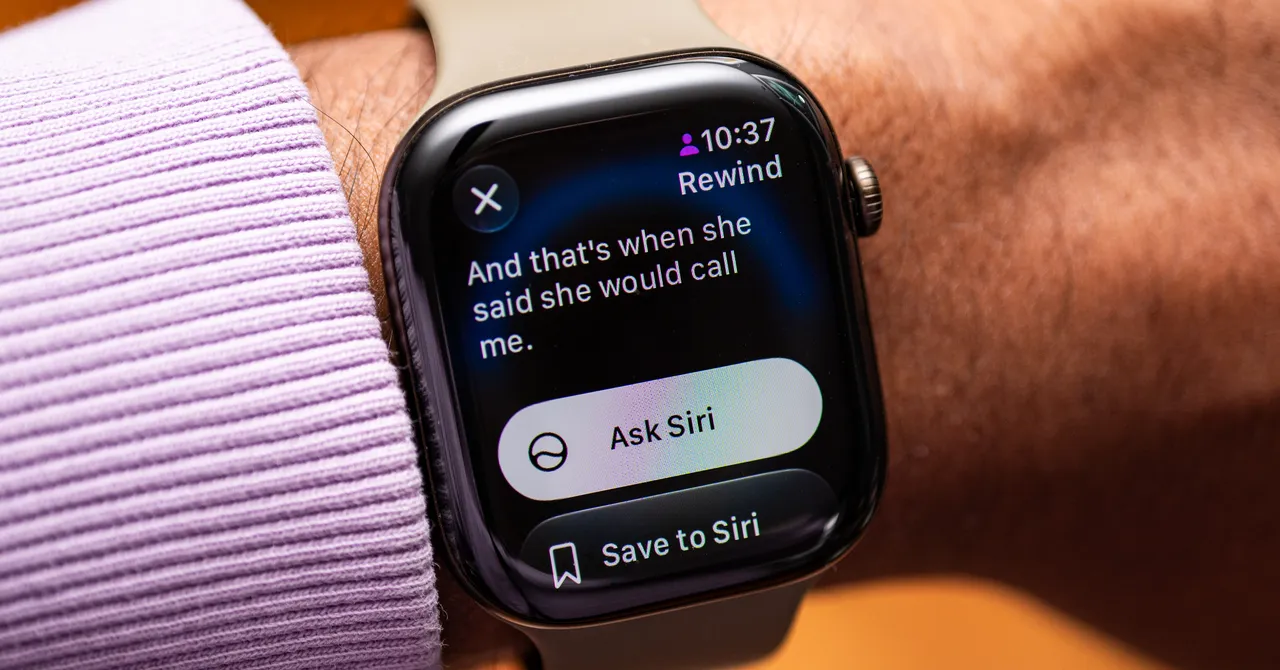
Apple’s new watch-based tools are built around a simple promise: if you missed something a moment ago, the Watch can help you get it back. Live Rewind offers a transcript of the previous 15 seconds of conversation, while Siri Recap is designed to summarize ambient conversations after the user opts in to listening, according to WIRED.
The timing matters. WIRED says Live Rewind is already available in public beta in watchOS 27.3, with an official launch expected before the end of the year. Android Authority, meanwhile, reported that Apple introduced the feature with the Apple Watch Series 12 and Apple Watch Ultra 4. WIRED also says the tools are limited to those two watch models, so both outlets point to the same narrow hardware window even as they frame the rollout differently.
How does Live Rewind work?
Live Rewind is the more straightforward of the two features. According to WIRED, it captures the last 15 seconds of conversation and turns them into a transcript. Android Authority says it can be activated by double-pressing the Digital Crown, and that Apple adds an audible chime even when the Watch itself is silenced.
That chime is not a small detail. It signals that the device is listening and recording, and it gives nearby people some notice that the Watch is doing something beyond normal passive wearables. Android Authority also says a full-screen animation and microphone indicator make the feature visible to people nearby.
WIRED says the audio for Live Rewind is processed on-device and is not accessible to Apple. Android Authority adds that saved snippets are end-to-end encrypted in the Siri app and through iCloud sync. Taken together, the reporting suggests Apple is trying to keep the feature framed as local, private and user-controlled, even as it opens the door to recording speech in places where other people may not realize it is happening.
What is Siri Recap supposed to do?
Siri Recap goes a step farther than rewinding a few seconds. WIRED reports that it can summarize ambient conversations after opt-in listening, then present a concise recap for the wearer. The company has designed it to avoid dumping raw chatter back at the user: WIRED says the feature omits speakers and sensitive content in an effort to create factual summaries rather than a verbatim replay.
WIRED also says Siri Recap uses Private Cloud Compute, with data neither stored nor logged on Apple servers. Unsaved recaps are deleted after seven days, and users can set schedules or location triggers, such as having the feature activate when they arrive at the office. That gives the tool a more practical shape for workdays and commuting, but it also makes the product feel more like a standing recording system than a one-off utility.
The report also notes a wrinkle that may matter to users who assume the feature only captures speech. In some testing, Recaps sometimes picked up media audio from YouTube or Instagram, not just live conversation. That kind of spillover is exactly the sort of edge case privacy advocates have been warning about, because it blurs the line between a useful memory aid and a device that is constantly sampling the environment.
Why it matters
Apple is not just adding a convenience feature. It is helping normalize a new expectation for wearables: that a watch can briefly, or even continuously, listen in and reconstruct what happened around you. For users, that can be useful in a meeting, on the street or in a noisy room. For everyone else nearby, it raises the question of whether they agreed to be part of the recording.
This is the bigger issue behind the headlines. The smartphone era already made casual recording easy. A watch makes it easier still, because it is always there, often ignored, and small enough to avoid drawing attention. Privacy advocates quoted by WIRED argue that the risk is not just storage or hacking. It is the social effect of making ambient recording feel normal.
Reem Suleiman, senior campaign director at Fight for the Future, told WIRED, “we don’t know what the watch is picking up on” and “you’re not getting consent from everybody who you walk around.” Those concerns go to the center of the product debate. Even if the feature is opt-in for the wearer, bystanders cannot opt in or out in real time, and they may not realize a conversation is being captured at all.
For Apple, the calculation is straightforward: convenience sells, and productivity features help justify premium hardware. But the company is also testing how far consumers will go in accepting always-available AI help on a body-worn device. If the feature catches on, other wearable makers may follow. If it sparks backlash, Apple may be forced to tighten visibility, consent and retention controls faster than planned.
Background: how Apple got here
Apple Watch has long been tied to the iPhone and iCloud, and that ecosystem is what makes this rollout possible. Apple Intelligence, the company’s on-device and cloud AI layer for supported devices, underpins the new features. In other words, this is not just a watch update; it is a sign that Apple is trying to push AI deeper into the products people wear all day rather than only the devices they actively open.
That direction fits a wider industry trend. AI notetaking tools have already trained users to expect speech capture, automatic transcription and summary generation. The unresolved problem has always been consent: who is being recorded, who keeps the data, and how long it survives. Apple’s approach attempts to answer those questions with on-device processing, Private Cloud Compute and short retention windows, but the core trade-off remains.
There is also a practical design story here. Apple is limiting the feature set to the Apple Watch Series 12 and Apple Watch Ultra 4, requiring an iPhone 16 or newer with iOS 27 and Apple Intelligence, and restricting access to users 18 and older in English only, according to WIRED. That means this is not a broad public rollout. It is a tightly gated test of a new class of wearable AI.
Who gets the features, and who does not?
The short answer is that Apple is keeping access narrow. WIRED says both Live Rewind and Siri Recap require an iPhone 16 or newer running iOS 27, plus Apple Intelligence. The Watch side is limited to Apple Watch Series 12 and Apple Watch Ultra 4. The features are opt-in, unavailable to users under 18 and currently English-only, according to WIRED.
That approach reduces Apple’s exposure in the early stages, but it also tells us something about the company’s confidence. By restricting the feature set to newer hardware and a limited language pool, Apple can control performance, battery drain and legal risk while it learns how people actually use the tools.
By the numbers
| Feature or limit | Number | What it means | Source |
|---|---|---|---|
| Conversation history | 15 seconds | Live Rewind can reconstruct the last few moments of speech | WIRED |
| Beta software | watchOS 27.3 | The feature is already in public beta | WIRED |
| Supported watches | Apple Watch Series 12 / Apple Watch Ultra 4 | Apple is limiting support to newer models | WIRED, Android Authority |
| Minimum phone | iPhone 16 | The Watch features require a recent iPhone | WIRED |
| Minimum software | iOS 27 | Apple Intelligence must also be available | WIRED |
| Retention window | 7 days | Unsaved Siri Recaps are deleted automatically | WIRED |
| Battery life in testing | a day and a half | WIRED says impact was minimal in testing on Series 12 | WIRED |
What WIRED and Android Authority agree on — and where they differ
Both outlets describe the same broad product idea: Apple is using the Watch to capture and reconstruct nearby speech, and it is doing so in a way that tries to preserve user privacy while still delivering an AI convenience feature. They also agree that the capability is restricted to newer hardware and that Apple adds an audible cue even when the watch is silenced.
The differences are mostly about emphasis. Android Authority focuses more on the mechanics of activation and visibility, including the double-press of the Digital Crown and the on-screen indicators. WIRED spends more time on the software stack, retention rules and practical limitations, including the fact that Live Rewind transcripts degrade in noisy environments and that Recaps can occasionally pull in media audio instead of just live speech.
That split matters because it highlights two different versions of the story. One is about product design and consumer usefulness. The other is about the social consequences of making listening hardware more capable and more discreet at the same time. Both are true, and both are central to understanding why this launch is getting attention.
Privacy concerns are not theoretical
The privacy debate around the new Watch features is not coming from abstract fear. It is rooted in ordinary situations: a coffee shop conversation, a quick hallway exchange at work, a family discussion in a public place. When a device can record and summarize what is said nearby, bystanders may have no clear warning that the tool is active, even if the wearer opted in.
Apple has tried to build guardrails. Live Rewind is processed on-device, Recaps are handled through Private Cloud Compute, features are age-gated and language-limited, and retention is capped. Those measures matter, and they are stronger than the defaults many users encounter elsewhere. But they do not remove the central concern that ambient AI can normalize recording in spaces where people do not expect it.
That tension is why the reaction from privacy advocates is so sharp. The concern is not simply that Apple can hear too much. It is that ordinary social settings could gradually become treated as fair game for AI-assisted memory tools. Once that expectation sets in, it becomes harder for users to know when they are being recorded and harder for bystanders to object in real time.
What happens next
The immediate question is timing. WIRED says Live Rewind is in public beta in watchOS 27.3, and the official launch is expected before year-end. That suggests Apple will use the beta period to refine the feature, observe battery behavior and watch for complaints about accuracy or accidental capture.
Several questions remain open:
- Will Apple expand Live Rewind and Siri Recap beyond English?
- Will the company add stronger warnings or consent prompts for people nearby?
- Will Apple address the fact that Recaps can pick up media audio from apps like YouTube or Instagram?
- Will users and regulators treat this as a useful productivity feature or as another step toward normalized surveillance?
Apple’s likely next move is incremental rather than dramatic. The company appears to be testing the appetite for wearable AI that remembers conversation, while keeping the audience small and the controls tight. If the beta goes smoothly, the features could become another quiet addition to the Apple ecosystem. If not, the privacy debate may define them before most users ever get a chance to try them.
Timeline
| Date | Event | Why it matters |
|---|---|---|
| 2026-09-09 | Android Authority reports Apple announced Live Rewind with Apple Watch Series 12 and Apple Watch Ultra 4 | First public signal of the feature set |
| 2026-11-17 | WIRED publishes hands-on review of Live Rewind and Siri Recap | Shows how the tools behave in practice |
| before year-end 2026 | WIRED says Live Rewind is expected to launch officially | Marks the likely next release window |
For Apple, the appeal is obvious: a Watch that can help you recover a missed sentence, a forgotten detail or a meeting note without reaching for your phone. For everyone else in earshot, the feature is a reminder that the line between assistance and surveillance is getting thinner, not thicker.
Frequently asked questions
What is Apple’s Live Rewind feature on the Watch?
Apple’s Live Rewind feature lets supported Apple Watch models capture and transcribe the previous 15 seconds of conversation. WIRED says it is in public beta in watchOS 27.3, while Android Authority reported it can be activated by double-pressing the Digital Crown.
Does Apple store the audio from these Watch features?
Apple says it does not store or log the relevant data on its servers for Siri Recap, according to WIRED, and Live Rewind audio is processed on-device. Android Authority also says saved snippets are end-to-end encrypted in the Siri app and through iCloud sync.
Which Apple devices support the new conversation features?
WIRED says the features are limited to Apple Watch Series 12 and Apple Watch Ultra 4 and require an iPhone 16 or newer running iOS 27 with Apple Intelligence. WIRED also says the features are English-only and unavailable to users under 18.
Why are privacy advocates worried about Apple Watch listening tools?
Privacy advocates worry that the features normalize ambient surveillance and may record bystanders without consent. Reem Suleiman of Fight for the Future told WIRED, “we don't know what the watch is picking up on” and “you're not getting consent from everybody who you walk around.”
When will Live Rewind launch publicly?
WIRED says Live Rewind is already in public beta and is expected to launch officially before the end of the year. The exact launch date has not been announced yet, and it is still unclear whether Apple will change the feature before release.