In short
Apple has launched a U.S.-only health AI study with OpenEvidence to see how people trust, judge and use AI answers to medical questions. The project may shape future Apple health features, but the company is starting with research rather than a consumer rollout.
- Apple launched the Apple Health AI Usage Study in the U.S. with OpenEvidence as its partner.
- The study will examine trust, comprehension, response quality and how users evaluate AI health answers.
- Up to 200,000 U.S. residents age 21 and older can join if they have newer Apple hardware and Apple Intelligence enabled.
- Apple says study data will be anonymized and not used to train AI models.
- The launch could inform future Apple health features, but the company has not said if or when that will happen.
Apple has launched the Apple Health AI Usage Study in the United States with OpenEvidence as its partner, starting a controlled test of how people use conversational AI for health questions and how much they trust the answers. The move matters because Apple is gathering real-world evidence before deciding whether health AI should become a broader feature in its products.
What Apple launched
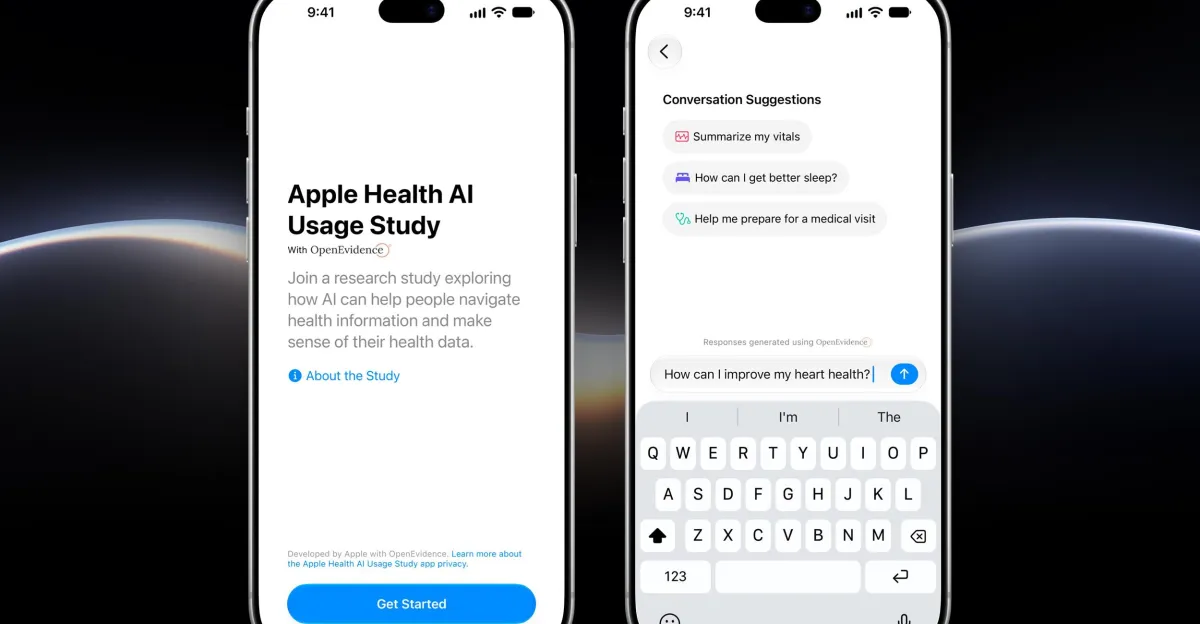
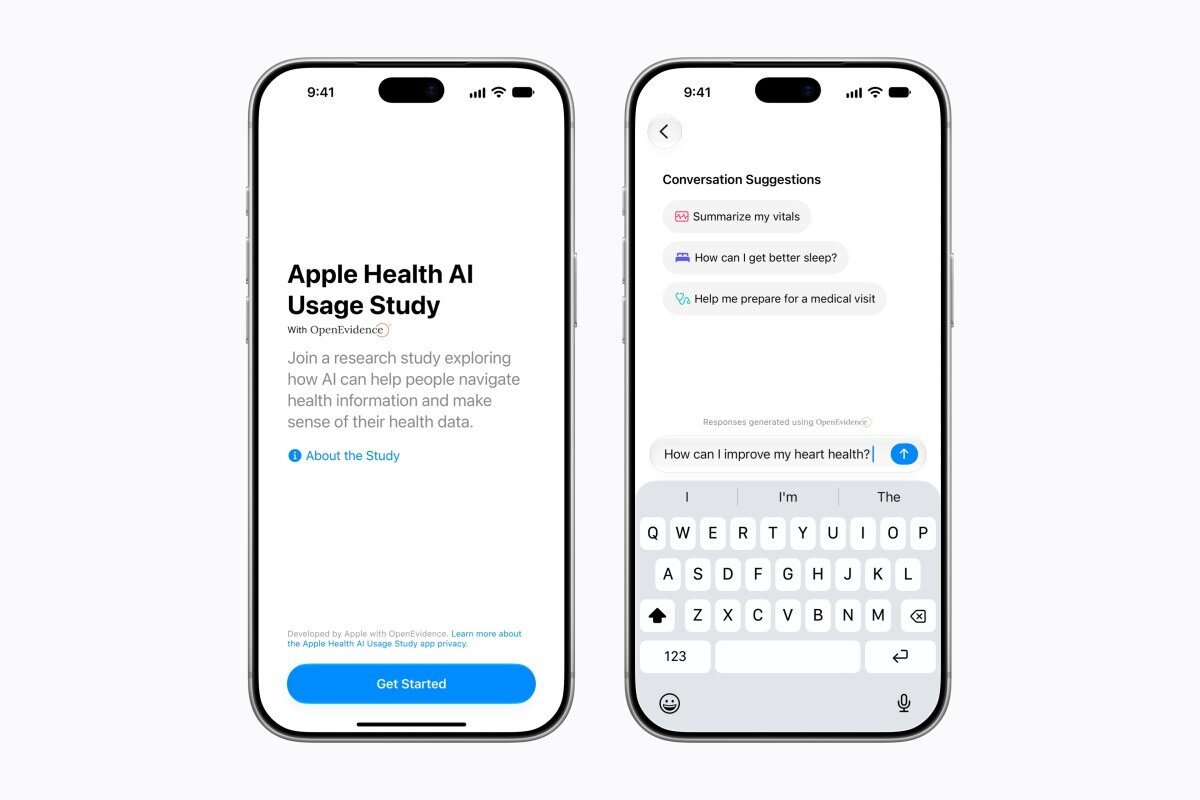
Apple’s new study is a U.S.-only research program built around a companion app that lets eligible users ask health questions and evaluate the responses they receive. According to TechCrunch, the app became available on the announcement day for U.S. users, while the company framed the project as a way to learn how people interpret, assess and rely on AI-generated health information.
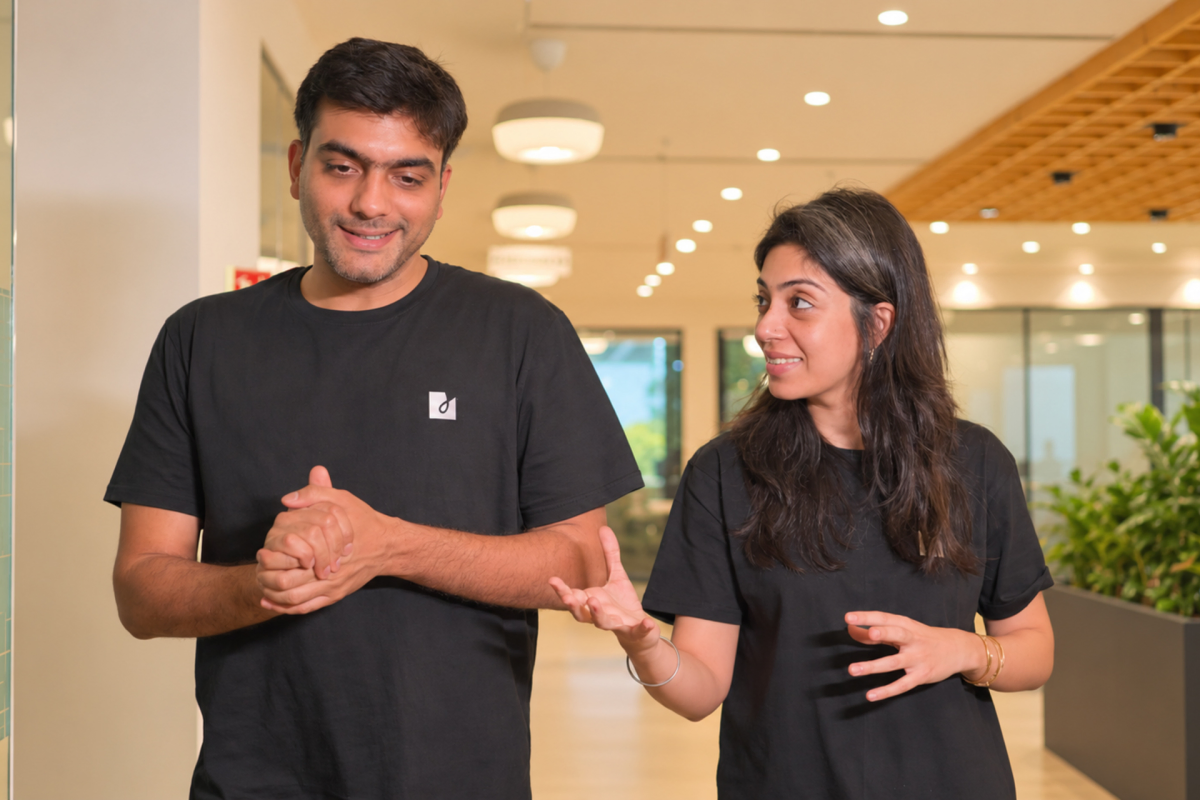
The study is tied to OpenEvidence, a healthcare-focused clinical AI company and platform. Apple says the program is designed to inform responsible health AI design for both Apple and the wider industry, while also helping the company understand how a consumer-facing health experience might work in practice.
How the study works
Participants can use the app to ask health-related questions and receive answers drawn from clinically grounded sources, including The New England Journal of Medicine, the Journal of the American Medical Association and Nature, according to TechCrunch. Users can then rate the responses, send feedback and take part in monthly surveys.
Apple also says users may choose to share HealthKit data such as resting heart rate, activity, sleep and lab results. The company says that, in some cases, the app may help people prepare for doctor visits or point concerning issues toward a healthcare provider.
Who can join?
The study is limited to U.S. residents age 21 and older. Apple said the program can include up to 200,000 participants, and the app requires an iPhone 15 or later, iOS 26 or later and Apple Intelligence to be turned on. MarketScreener described the device requirement slightly differently, saying participants need an iPhone 15 Pro or later, which is one of the few points where the reporting does not fully align.
| Study detail | Apple / outlet-reported requirement | Why it matters |
|---|---|---|
| Maximum participants | Up to 200,000 | Signals a large-scale consumer research effort |
| Eligibility | U.S. residents, 21+ | Limits the first phase to adult users in one market |
| Device requirement | iPhone 15 or later; MarketScreener says iPhone 15 Pro or later | Shows the study is tied to newer Apple hardware |
| Operating system | iOS 26 or later | Points to a very recent software baseline |
| Data handling | Anonymous transfer to a secure third-party cloud provider; no model training | Addresses privacy concerns around health data |
| Retention at OpenEvidence | Queries and responses deleted after 24 hours | Short retention window may reassure participants |
Why it matters
This is more than another app launch. Apple is using a research study to probe a problem that has become central to consumer AI: people already ask chatbots for health guidance, but there is still no broad consensus on how accurate, understandable or trustworthy those answers are. TechCrunch cited OpenAI’s estimate that people send 300 million health-related queries each week, a number that helps explain why large technology firms are treating this category as strategically important.
For Apple, the timing is significant. The company has spent years building Health and HealthKit into a personal-data platform, and it now appears to be testing whether a health AI layer could fit into that ecosystem without sacrificing trust. A carefully designed study lets Apple measure behavior before shipping a consumer product, instead of launching first and trying to fix the risks later.
The study also gives Apple an unusual chance to observe how users interact with AI in a sensitive context. Health questions are not like restaurant recommendations or trip planning; they can involve fear, uncertainty and decisions that affect care. That makes the quality of the response, the sources behind it and the user’s interpretation of it especially important.
What readers should watch for
- Whether Apple turns the study into a consumer feature in Health, Siri or another product.
- Whether the findings point to stronger demand for AI-assisted health summaries, triage or visit preparation.
- Whether Apple broadens the study beyond the U.S. or beyond newer iPhones.
- How Apple balances clinical grounding with simplicity for everyday users.
Background: how we got here
Big AI companies have been moving toward health use cases for some time, but the category remains unusually sensitive. The appeal is obvious: people want faster answers, easier explanations and help organizing their own medical information. The risk is equally obvious: a system can sound confident while still being wrong, incomplete or too vague to act on safely.
Apple already sits on an important pile of consumer health data through Health and HealthKit, subject to user permission. That makes the company different from many AI developers, because it can potentially connect conversational tools with wearable and device-derived information. Even so, the company appears to be approaching the field cautiously, using a structured study instead of jumping straight into a mass-market rollout.
OpenEvidence is a logical partner for that approach. The company is known as a clinical AI tool used by healthcare professionals and grounded in medical literature. Its role in the study suggests Apple wants the answers to rest on sources that clinicians would recognize, not just general web content.
That mix of consumer hardware, medical literature and real-world user feedback is what makes the study notable. Apple is not only asking whether people want health AI; it is also asking what kind of health AI they will trust, how they judge it and whether it changes what they do next.
How the study handles trust and safety
Apple and OpenEvidence appear to be building several guardrails into the project. Apple says study data will be anonymized before it is transferred to a secure third-party cloud provider, and the company says the information will not be used to train AI models. OpenEvidence, meanwhile, deletes query and response data after 24 hours.
Those choices matter because health data is among the most sensitive information a company can collect. Users may be more willing to test a health assistant if they believe the company is not building a permanent behavioral profile from private medical concerns. The 24-hour retention claim is especially important because it suggests the partner platform is minimizing the lifespan of the raw interaction data.
The app also seems designed to produce measurable feedback. According to Crypto Briefing, participants rate answers for accuracy, detail and relevance. That gives Apple a more structured way to compare response quality than casual app reviews or customer support complaints would allow.
What Apple says the app can do
Apple says the app may help users prepare for doctor visits and flag concerning issues for providers. That is a narrower and more cautious promise than a diagnosis engine, and it is likely intentional. The company seems to be testing assistance and comprehension rather than trying to replace clinical judgment.
MarketScreener reported that participants can view linked peer-reviewed clinical citations with each response. If that is the experience Apple ultimately wants to study, it would put the project closer to a guided research tool than a free-form chatbot. That distinction matters because citation-backed answers may help users judge where the information comes from, not just what it says.
What is different about Apple’s approach?
Apple’s strategy stands out because it is framed as research first and product second. Rather than announcing a finished AI health feature, the company is setting up a controlled environment to observe behavior, evaluate responses and understand whether people find the system usable in everyday life.
Sumbul Desai, Apple’s vice president of Health and Fitness, said the company believes “responsible innovation starts with scientific rigor and clinical grounding.” She also said “conducting a dedicated research study is the most thoughtful way” to move forward, underscoring that Apple sees this as an evidence-gathering exercise rather than a marketing campaign.
“responsible innovation starts with scientific rigor and clinical grounding”
“conducting a dedicated research study is the most thoughtful way”
That language is consistent with Apple’s wider brand positioning, which often emphasizes privacy, hardware integration and controlled rollout. In this case, the company is also trying to answer a practical question: can people understand AI health responses well enough to make use of them without over-trusting them?
Industry context: the rise of health AI
Health care has become one of the most closely watched AI use cases because it combines demand, data and risk in the same product category. The promise is easy to see in routine tasks such as explaining test results, summarizing symptoms or helping a user prepare questions for a clinician. The danger is also clear: errors in health advice can lead to confusion, unnecessary worry or delayed care.
That is why the study focuses on trust, comprehension and response quality. Crypto Briefing said the program examines trust, response quality, comprehension and effects on health decisions, which broadens the inquiry beyond simple satisfaction. Apple is not just asking whether users like the output; it is asking what the output does to their decisions.
Robert M. Wachter, the UCSF professor and chair of medicine, captured the industry’s split perfectly when he said: “Patients and clinicians are both turning to AI, but the tools they use are being built and tested in separate worlds.” His point highlights a major gap in the market: consumer AI is advancing quickly, while clinical evaluation standards remain much stricter and more fragmented.
Apple’s study looks like an attempt to bridge that gap without pretending the problem is solved. By connecting a consumer-facing app to clinically grounded content and asking users to rate what they see, Apple can gather data on how ordinary people respond to a medical-style AI experience.
By the numbers
The scale of the project and the backdrop around it are easier to grasp in a few concrete figures.
| Number | What it refers to | Source in reporting |
|---|---|---|
| 200,000 | Maximum number of participants Apple says may join | TechCrunch |
| 21+ | Minimum age for participation | TechCrunch |
| 24 hours | OpenEvidence’s retention period for query and response data | TechCrunch |
| 300 million | Health-related queries per week cited by TechCrunch from OpenAI | TechCrunch |
| 355 | OpenEvidence monthly active U.S. clinicians in January 2024 | Crypto Briefing |
| 703,265 | OpenEvidence monthly active U.S. clinicians by June 2026 | Crypto Briefing |
| $250 million | OpenEvidence funding round in September 2026 | Crypto Briefing |
| $15 billion | OpenEvidence valuation after that funding round | Crypto Briefing |
What happens next
The first thing to watch is enrollment. Apple says the study opened on November 15, 2026, and the app was made available the same day to eligible U.S. users. TechCrunch said the study begins in November 2026 and is expected to run for more than 12 months, which suggests Apple wants enough time to collect behavior across a meaningful period rather than a short pilot.
The second thing to watch is whether Apple reveals how it plans to use the findings. The most obvious question is whether the company is testing a future feature for Health, Siri or another Apple surface. The fact sheet does not answer that, and Apple has not publicly mapped the study to a specific product launch.
The third question is whether the data will change anything outside Apple. Because the company says the project is intended to inform responsible health AI design for the industry as well as for Apple, the results may influence expectations around citations, transparency, retention periods and study design more broadly. Even if the study stays internal, the structure itself could become a reference point for competitors.
There are also open questions around geographic expansion and hardware access. At launch, the study is U.S.-only, and the reporting leaves one small but notable discrepancy on device eligibility: TechCrunch says iPhone 15 or later, while MarketScreener says iPhone 15 Pro or later. That will matter to users trying to determine whether they can participate and, later, to anyone reading the final study design as a product signal.
What the launch signals for Apple
Apple’s move suggests that the company is treating health AI less like a standalone novelty and more like a long-term feature category that must earn trust before it reaches mainstream users. The choice of partner, the emphasis on citations and the insistence on anonymization all point in the same direction: Apple wants to be seen as deliberate, not reckless.
That cautious posture may also be strategic. Health is one of the few consumer categories where being early is not automatically an advantage. A rushed product could do reputational damage if users perceive it as unreliable, while a slower rollout backed by clinical grounding could give Apple a stronger foundation for a more ambitious launch later.
For now, the Apple Health AI Usage Study is both a research project and a market probe. It asks a basic question with high-stakes implications: when people turn to AI for health guidance, what do they believe, what do they ignore and what do they do next?
Source notes
This article synthesizes reporting from TechCrunch, MarketScreener and Crypto Briefing. The outlets broadly agree on the purpose of the study and its partnership with OpenEvidence, while differing on a few details, including the exact iPhone model requirement and the way some of the evaluation metrics are described.
Frequently asked questions
What is Apple’s health AI study?
Apple’s health AI study is a U.S.-only research program that lets eligible users ask health questions in a companion app and rate the answers they receive. Apple says the goal is to learn how people trust, understand and evaluate AI-generated health information.
Who can participate in the Apple Health AI Usage Study?
The study is open to U.S. residents who are 21 or older. Apple says the app also requires newer Apple hardware, iOS 26 or later and Apple Intelligence enabled, with reporting differing slightly on whether the minimum device is an iPhone 15 or an iPhone 15 Pro.
How does Apple handle user data in the study?
Apple says study data will be anonymized before being sent to a secure third-party cloud provider, and it says the data will not be used to train AI models. OpenEvidence also deletes query and response data after 24 hours, according to TechCrunch.
Why is Apple doing a dedicated health AI study instead of launching a product right away?
Apple is using the study to measure trust, comprehension and response quality before committing to a broader consumer feature. That approach lets the company test a sensitive health use case with guardrails instead of rolling out a product first and learning from mistakes later.
Will Apple turn the study into a feature in Health or Siri?
Apple has not said that it will. The company says the study is meant to inform responsible health AI design for Apple and the industry, but it has not announced whether the findings will become a consumer feature in Health, Siri or another product.