In short
Google has launched Gemini 4 Hydrogen in Search, making it the default model for the hardest AI Mode questions and promising faster, richer answers. The rollout extends across Search and several Gemini products, with Google pitching better multi-part reasoning, more visuals, and broader link coverage.
- Google launched Gemini 4 Hydrogen in Search on Nov. 12, 2026.
- The model is now the default for the hardest questions in AI Mode and AI Overviews.
- Google says Hydrogen is 2.5x faster than Gemini 3.8 Flash.
- The rollout includes richer visuals, more link coverage and support across several Gemini products.
Google launched Gemini 4 Hydrogen in Search on Nov. 12, 2026, making it the company’s latest attempt to speed up complex queries and widen the use of AI Mode across Search. The update matters because Google is not just tweaking rankings or interface design; it is changing which model answers the hardest questions and how those answers are assembled.
What Google changed
According to The Verge, Gemini 4 Hydrogen began rolling out in Search starting Nov. 12, 2026. Google says the model is designed for prompts that are messy, multi-part, typo-heavy, or highly specific, and it can split a question into pieces before answering each part separately. That approach is a more structured version of search: instead of one response to one query, the system appears to decompose the request and assemble the result from several smaller searches.
The company is also using Hydrogen as the default model in AI Mode for the hardest questions in AI Overviews, according to The Verge. Robby Stein, Google’s vice president of product for Search, described Hydrogen as “now the new default model in AI Mode & being used for your hardest questions in AI Overviews.”
TechCrunch reported that Google is positioning Hydrogen as the “biggest model improvement to Search yet,” and said the company is pitching it as a faster model that can handle harder questions while also supporting broader AI Mode usage.
How Gemini 4 Hydrogen is different
Hydrogen is not being sold as a single-purpose reasoning engine. Google says it is meant to improve speed, answer quality, and presentation at the same time. That means quicker results, but also more ways to display them.
Why this model matters for complex searches
The clearest functional change is the model’s handling of multi-part prompts. Google says Hydrogen can break a query into separate pieces and answer each one individually. For users, that could mean less need to reformulate a search three or four times when asking a complicated question that spans several topics.
Google also says Hydrogen expands link coverage by running simultaneous searches across related subtopics. That matters because the broader the search fan-out, the more chances there are for Search to surface relevant sources, not just a single synthesized answer.
More than text: visuals are part of the pitch
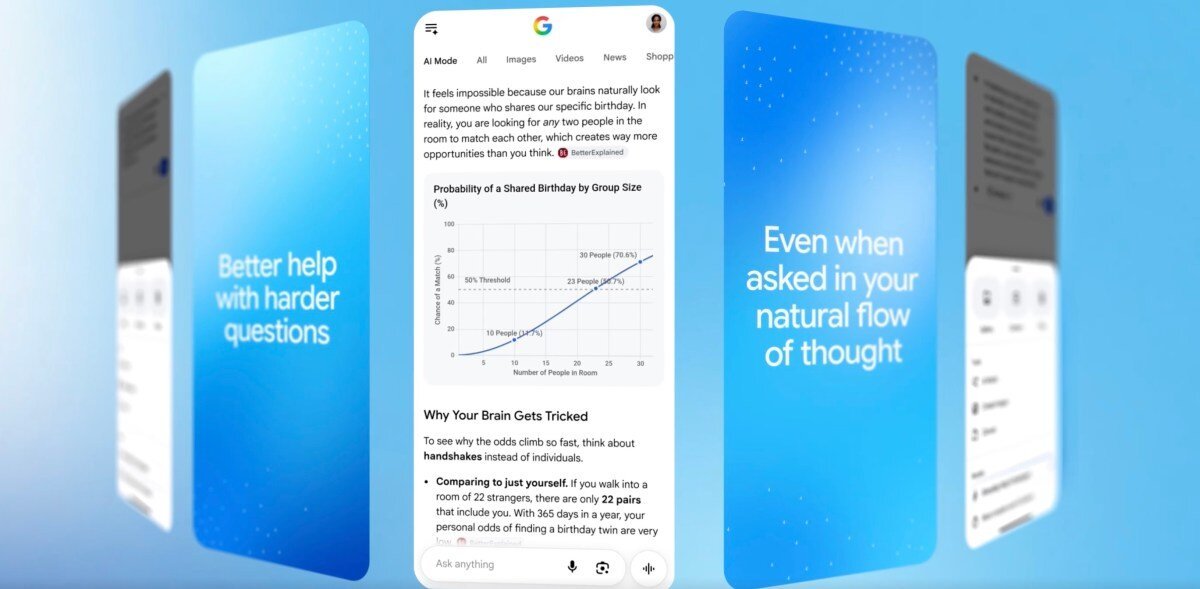
Hydrogen responses include more visuals, according to The Verge, with images, comparison tables, graphs, maps, and interactive tools all part of the new presentation layer. That pushes Search farther away from a plain list of blue links and closer to an answer interface that mixes synthesis, source links, and visual explanation.
The company is also improving language understanding across all supported AI Mode languages. That detail suggests Google is not treating Hydrogen as an English-only experiment or a narrow feature for power users. It is being rolled out as a broader Search layer.
How fast is Hydrogen?
Google says Hydrogen has low, medium, high, and new xhigh thinking levels, giving the company more control over the balance between speed and reasoning depth. In practical terms, that means Search can decide when to move quickly and when to spend more compute on a harder query.
TechCrunch reported that Google says Hydrogen is 2.5 times faster than Gemini 3.8 Flash. That speed claim is important because Search products are judged not just by answer quality but by friction: if an AI response feels slow, users are less likely to trust it for everyday use.
TechCrunch also said Hydrogen beat Gemini 4 Argon on the Artificial Analysis Intelligence Index at default high thinking. That puts Google’s internal model lineup into sharper focus: Hydrogen is not simply a side project, but part of a broader family of models with different tradeoffs for speed, reasoning, and workflow design.
Where Hydrogen fits in Google’s model lineup
One reason this launch stands out is that Hydrogen appears to be built for more than deep reasoning alone. TechCrunch reported that Google has tuned the model for fast agentic workflows, not just the hardest analytical tasks. That is a significant clue about how Google wants Search to behave going forward: less like a static answer engine and more like a system that can carry out multi-step tasks efficiently.
Google says Hydrogen can also handle everyday coding tasks, tests, and code verification, according to TechCrunch. That puts the model in a practical category for technical users who may want Search to help with smaller, task-oriented programming work rather than only general information requests.
TechCrunch further reported that Hydrogen can pair with Carbon and Argon in multi-model workflows. That suggests Google is not locking every search interaction to one model tier. Instead, it appears to be building a system where different models can be used together depending on the question and the needed depth of reasoning.
Why it matters
Hydrogen’s rollout matters for at least three groups: users, publishers, and Google itself. For users, the promise is a faster Search experience that can answer complicated questions without repeated retries. For publishers, the significance is less clear and potentially more consequential, because broader link coverage may increase the number of visible sources while AI-generated summaries still sit between the user and the original page.
For Google, the launch is a sign that the company is trying to keep Search relevant in a market where people increasingly expect conversational answers, not just keyword matching. That has been the direction of Google’s Search product for some time through AI Mode and AI Overviews, but Hydrogen moves the company further toward model-driven search behavior.
The changes also touch discovery. If Hydrogen really does run simultaneous searches across related subtopics and return a richer mix of links, visuals, maps, and tools, then Search could become a more layered gateway to the web. That could help users, but it also raises familiar questions about how much traffic reaches the original sources behind the answers.
| Feature | What Google says Hydrogen does | Why it matters |
|---|---|---|
| Multi-part queries | Splits a prompt into parts and answers each separately | Helps with complex or highly specific questions |
| AI Mode placement | Default model for the hardest questions in AI Overviews | Moves the model into Google’s most visible AI Search surface |
| Speed | 2.5x faster than Gemini 3.8 Flash, per Google | Improves responsiveness for everyday use |
| Thinking levels | Low, medium, high, and xhigh | Lets Google tune speed versus reasoning depth |
| Visual results | Images, comparison tables, graphs, maps, and interactive tools | Makes answers easier to scan and act on |
| Availability | Rolling out globally to Search users | Signals a broad product change, not a limited test |
Background: how Google got here
Google has spent the past several years adding generative AI features to Search, including AI Mode and AI Overviews. Those additions marked a shift away from the classic search page as a simple directory of links and toward a system that summarizes, synthesizes, and sometimes answers directly.
The concept behind Hydrogen’s fan-out behavior is not new, but it is now being pushed more visibly into product form. Fan-out search means taking one query and breaking it into several related subqueries so the system can gather a broader set of results. In theory, that helps Search understand context, ambiguity, and the different angles hidden inside a single sentence.
The thinking-level framework also reflects a broader industry pattern. Models that can trade off cost, speed, and reasoning depth are easier for large platforms to deploy across different tasks. Rather than using the same expensive reasoning setup for every query, companies can route requests to lighter or heavier versions depending on need. Hydrogen’s low, medium, high, and xhigh settings fit neatly into that logic.
This launch also follows a familiar Google pattern: unveil a model improvement, then thread it into multiple products. According to The Verge, Hydrogen is available not only in Search but also in the Gemini app, all tiers of Google AI Studio, the Gemini API, Gemini for business, and Google Antigravity for AI Pro and Ultra subscribers. That breadth suggests the model is being treated as a platform component, not a standalone feature.
What the outlets agree on — and where they differ
The Verge and TechCrunch agree on the broad story: Google has introduced Gemini 4 Hydrogen, it is tied to Search and AI Mode, and it is meant to improve performance on difficult questions. They also agree that the model is being pushed beyond a narrow beta and into wider use.
Where the coverage differs is in emphasis. The Verge focused more on the Search experience itself — the rollout date, the default placement in AI Mode, and the richer visual presentation. TechCrunch put more weight on model performance and product architecture, including speed claims, benchmark comparisons, and the possibility that Hydrogen is optimized for fast agentic workflows.
That split matters because it reflects two sides of the same product. The visible side is what users see in Search. The invisible side is the model infrastructure that determines how quickly, and how intelligently, those answers are assembled.
By the numbers
Here is a compact look at the figures and settings Google attached to Hydrogen:
- Nov. 12, 2026: The date Google announced Hydrogen for Search and began rollout coverage.
- 2.5x: Google’s claimed speed advantage over Gemini 3.8 Flash.
- 4 thinking levels: low, medium, high, and xhigh.
- No. 5: Hydrogen’s reported rank on Agent Arena benchmarks for multi-step tasks, per Google.
What happens next
The most immediate question is whether users will notice a meaningful change in Search behavior once Hydrogen is broadly active. Google says the model is already rolling out globally to all Search users, so the test will move from presentation to usage fairly quickly.
Another open question is whether broader link coverage changes publisher referral patterns. If Search surfaces more supporting links and richer visual modules, some publishers could gain visibility even as AI summaries become the first touchpoint for users. Others may see the opposite if the answer box absorbs more of the session.
Benchmark performance is another watch point. TechCrunch noted Google’s comparisons, but independent testing will matter more than launch-day claims. Hydrogen’s ranking versus other models, and versus Google’s own Argon and Carbon systems, will help show whether the model’s speed comes with any tradeoff in answer quality.
Finally, it remains to be seen how Google balances the different model settings in practice. The presence of low, medium, high, and xhigh thinking levels suggests a more configurable Search stack, but the user experience will depend on how often Google chooses one setting over another behind the scenes.
What users should look for
If you use Google Search frequently, the changes to watch are practical rather than abstract:
- Whether complex questions produce cleaner, more complete answers on the first try.
- Whether Search shows more source links, not fewer.
- Whether visual elements like maps, tables, and graphs appear more often.
- Whether responses feel faster when AI Mode is handling harder questions.
- Whether the same query behaves differently across Search, Gemini, and Google’s developer tools.
For now, the story is less about a single feature than about a shift in how Google wants Search to work. Hydrogen is being introduced as a faster model, but the broader ambition is clearer: make Search better at deconstructing messy questions, supporting multi-step reasoning, and presenting answers in formats that are easier to use.
“now the new default model in AI Mode & being used for your hardest questions in AI Overviews”
“biggest model improvement to Search yet”
Frequently asked questions
What is Gemini 4 Hydrogen in Google Search?
Gemini 4 Hydrogen is Google’s new Search model for harder AI questions. Google says it can split complex prompts into parts, improve answer speed, and surface richer results with visuals, links and interactive tools.
When did Google launch Gemini 4 Hydrogen?
Google launched Gemini 4 Hydrogen on Nov. 12, 2026, with rollout in Search starting that day. TechCrunch said the update is also rolling out globally to all Search users.
How is Hydrogen different from other Google models?
Hydrogen is designed for speed and multi-step search workflows, not just deep reasoning. Google says it has low, medium, high and xhigh thinking levels, and TechCrunch reported it can work with Carbon and Argon in multi-model workflows.
Why does Google’s AI Search update matter?
It matters because Google is changing how Search answers difficult questions and how it presents sources. The update could affect user behavior, search engagement and referral patterns for publishers if AI answers and expanded link coverage become the norm.