In short
Plurai has raised a $13 million seed round to build a simulation layer for enterprise AI agents. The startup says digital-twin testing can improve reliability and lower deployment costs.
- Plurai raised $13 million in seed funding led by Team8.
- The startup uses digital-twin simulations to test AI agents before deployment.
- Its system works with tools including Claude Code, Codex, Copilot and Cursor.
- Plurai says its smaller, customer-tuned models can cost far less than frontier models.
- The company’s biggest test now is proving real enterprise deployments and independent validation.
Plurai has raised a $13 million seed round to build a simulation layer for AI agents, aiming to make enterprise automation more reliable and cheaper to deploy. The company, which TechCrunch reported closed the round on Wednesday, wants to use digital-twin-style environments to test how agents behave inside company systems before they are turned loose on real workflows.
What Plurai is trying to fix
AI agents promise to do more than answer questions. They can take actions across tools, databases and software stacks. That is also the problem: once an agent starts operating in live systems, small mistakes can become expensive, messy or hard to reverse.
Plurai’s pitch is that the industry needs a safer middle layer between model capability and production deployment. Instead of asking companies to trust a general-purpose model to handle their internal processes perfectly on day one, the startup simulates those systems, generates edge-case data and evaluates how agents perform under conditions that resemble the real environment.
TechCrunch reported that the platform maps agent flows using synthetic data from production-like systems. In practical terms, that means Plurai is not just scoring a model on abstract benchmarks; it is trying to reproduce the kinds of failures that matter inside a specific business, from unusual branches in a workflow to policy-sensitive decisions.
How does Plurai’s approach work?
Plurai says it simulates a company’s digital systems to create edge-case training and evaluation data for agents. The company’s platform is designed to work with existing agentic tools, including Claude Code, Codex, Copilot and Cursor, which suggests it is aiming to sit alongside the current developer and enterprise AI stack rather than replace it.
The company’s core idea is to post-train smaller open-weight models for each customer. That strategy matters because it aims to tailor the model to a particular business’s rules, systems and language, while avoiding the expense of leaning on the largest frontier models for every task.
Co-founder Ilan Kadar told TechCrunch, “it is very easy to build a demo, but [hard] to get something that will be reliable and cost effective”. He also said, “we can take a large language model, we can take the task, decompose it into a smaller task”.
That framing places Plurai squarely inside one of enterprise AI’s biggest unresolved questions: not whether a model can appear capable in a demo, but whether it can keep behaving correctly after hundreds or thousands of real transactions, prompts and exceptions.
Why simulation has become such a valuable tool
Plurai’s method borrows from a playbook that has already been proven in autonomous driving. In that field, simulation and synthetic data are standard tools for testing rare or dangerous edge cases that are too hard, too risky or too expensive to collect in the real world.
Plurai is applying that logic to enterprise AI agents. The company’s argument is that business software, like roads and vehicles, contains enough unusual scenarios that real-world-only testing is too slow and too brittle. Synthetic data lets the company stress-test workflows before deployment, while the digital-twin layer aims to make those tests resemble the customer’s actual operating environment.
That approach also speaks to the reliability problem that has dogged agentic AI more broadly. Models may perform well on generic reasoning tests, but enterprise use cases depend on domain rules, permissions, business logic and company-specific policies. Those are the details that determine whether an agent is useful or merely impressive in a demo.
Who is behind Plurai?
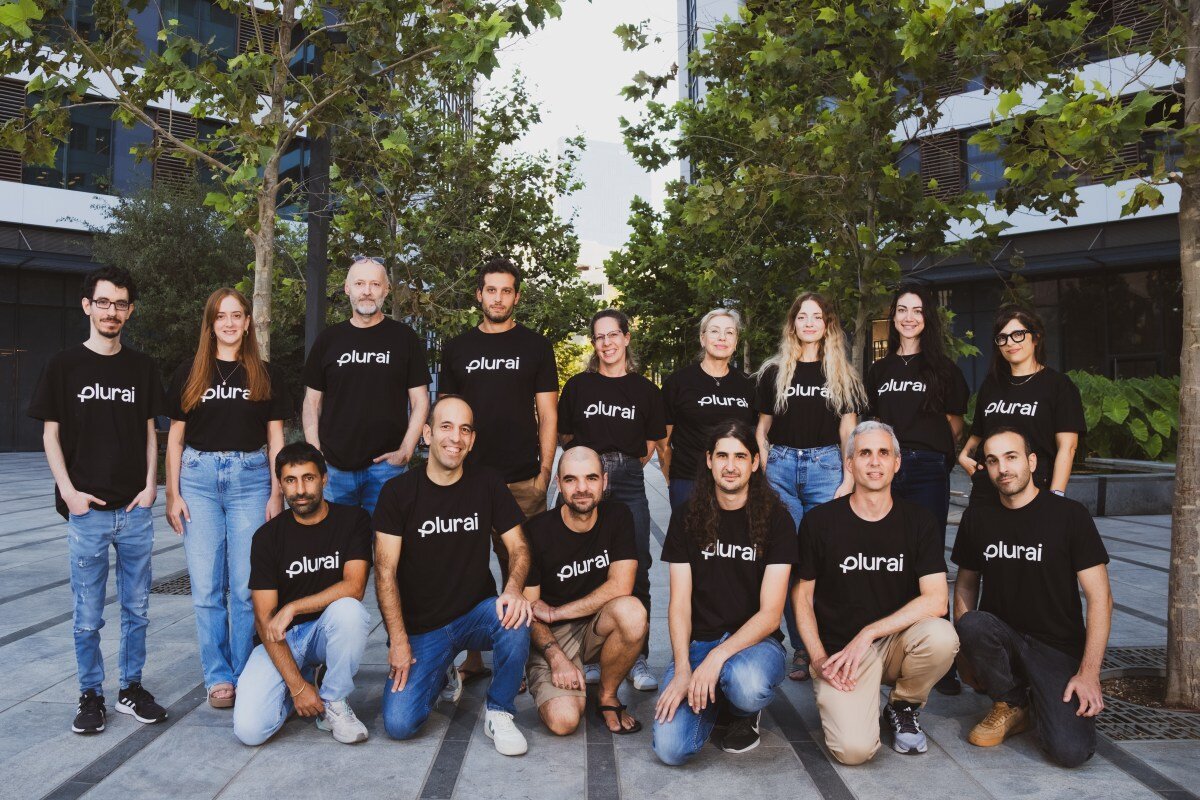
Plurai was founded by Ilan Kadar and Elad Levi, both of whom previously worked at Nexar, according to TechCrunch. Kadar also previously worked with Waymo on simulation and evaluation of end-to-end driving software, a background that helps explain why the company is leaning so heavily on simulation as its technical wedge.
The round was led by Team8, with participation from U&I, Velocity and Mercer. TechCrunch also reported that Google DeepMind researcher Reah Miyara backed Plurai as an angel investor.
Miyara’s support is notable because it ties the startup’s pitch to a broader research view of model limitations in real enterprise settings. According to TechCrunch, Miyara said Plurai’s edge is understanding production failure modes and generating synthetic data for tuning. She also said, “frontier-capable models are out of distribution with my specific data”.
That line gets at the core of Plurai’s thesis: even powerful models can miss the mark when they face a company’s own data, workflows and policy rules. The problem is not just raw intelligence; it is fit.
Why it matters
Plurai’s seed round matters because it reflects a broader shift in enterprise AI spending. Companies are no longer only asking whether an AI model can answer questions. They are asking whether it can be trusted to take action, follow policy, and do so without becoming too expensive to run at scale.
That combination of reliability and cost is where many agent projects struggle. A model that is smart enough may still be too unpredictable. A model that is stable may still be too costly if it requires a frontier-class system for every step in a workflow. Plurai is trying to attack both problems at once by shrinking the task and tailoring the model to the customer.
The company’s claim that it can deliver results at a lower cost is especially important for enterprise buyers, because deployment economics often decide whether a pilot becomes a real product. Kadar said tests with Nvidia and Nebius showed Plurai models beating mid-tier frontier models at lower cost, and the company says its approach can reduce costs by an order or two orders of magnitude. Those are large claims, but if they hold up, they point to a significant shift in how businesses might buy and run AI agents.
There is also a competitive implication. If simulation and synthetic data become central to enterprise AI deployment, then the winner may not be the company with the biggest model, but the company that can make a model behave reliably inside a specific operating environment. That would favor tools that understand workflows, exceptions and production failure modes, not just benchmark scores.
By the numbers
Plurai’s raise and performance claims can be summarized in a few key figures reported by TechCrunch.
| Metric | Figure | What it refers to |
|---|---|---|
| Seed funding | $13 million | Plurai’s round announced Wednesday |
| LiveBench 2.0 | 82.9/100 | Score for Claude Fable 5.2 on complex tasks |
| LiveBench 2.0 | 75.6/100 | Score for ChatGPT-6 Astra on complex tasks |
| EON corporate-environment accuracy | 76.8% | Score for Claude Opus 4.8 in simulated corporate tasks |
| Cost reduction | One to two orders of magnitude | Plurai’s claimed reduction from its model approach |
The benchmark figures in the fact sheet underline the pressure on enterprise AI vendors to prove value beyond generic capability. Even strong models can look very different once the setting changes from open-ended tasks to structured business work.
Background: how enterprise AI got here
The current wave of AI adoption has moved quickly from chat-style assistance to agentic systems that can act on a user’s behalf. That shift raises the stakes. A chatbot can be corrected. An agent that changes a record, moves money, sends a message or updates a workflow can create real operational consequences.
At the same time, open-weight models have become increasingly attractive to companies because they can be customized and are often cheaper to run than frontier proprietary models. That makes them a natural fit for Plurai’s strategy of post-training smaller models for individual customers.
But customization creates a new challenge: every company’s digital environment is different. Systems, permissions and policies vary widely, and the same model can behave well in one company and poorly in another. That is why Plurai is focusing on production-like simulation rather than generic model improvement alone.
In that sense, the startup is trying to bring a self-driving industry mindset into enterprise software. Autonomous vehicles rely on simulation because rare failures are too costly to wait for in the real world. Plurai is making a similar case for business automation, where the rare failure might be a wrong approval, a broken workflow or a policy violation.
What makes Plurai different from a model company?
Plurai is not positioning itself as a general-purpose model lab. Its pitch is narrower and, in some ways, more practical: use digital twins, synthetic data and customer-specific tuning to make existing agent tools safer and cheaper to deploy.
That distinction matters because enterprise customers are already being flooded with models, copilots and agent frameworks. A company building on top of those tools has to answer a simple question: what does it do that the model itself cannot?
Plurai’s answer appears to be evaluation, tuning and environment-specific reliability. The company wants to map agent flows, generate realistic test data and then adapt smaller models to the customer’s own business logic. In theory, that should reduce both the number of errors and the cost of running the system.
It also means Plurai’s value may depend less on raw model quality and more on how well it understands the enterprise context. Kadar’s comment that frontier models “will not know your business and your policy” captures that logic. The most capable model in the world is still blind to the rules it has not been taught.
What the investor mix signals
Team8 leading the round suggests there is investor appetite for infrastructure that sits between foundational models and enterprise deployment. The participation of U&I, Velocity and Mercer broadens that signal, indicating interest from backers who see a market in operationalizing agentic AI rather than simply building bigger models.
The presence of a DeepMind researcher as an angel investor adds another layer of credibility to the simulation-first thesis. It suggests that at least some people inside the research community believe enterprise AI will need more than benchmark-driven progress to become dependable in production.
That matters because enterprise AI buyers are increasingly sensitive to proof. They want more than claims about intelligence; they want evidence that an agent can be evaluated in conditions that resemble their own systems. Investors appear to be betting that companies such as Plurai can package that proof into a product.
What happens next?
The biggest question is whether Plurai can show real deployments, not just promising tests. TechCrunch reported that open questions remain about which specific customer pilots, if any, the startup already has. Without named deployments, the company will need to rely on technical credibility and performance claims to win early adopters.
Another issue is independent validation. Kadar said tests with Nvidia and Nebius showed Plurai models outperforming mid-tier frontier models at lower cost, but the market will want to know how those results compare in outside testing and whether they hold across different enterprise workflows.
Pricing is another watch item. Plurai says its approach can cut costs dramatically, but the company has not yet detailed how it will price product access or how much work customers need to do to simulate their own systems. Those details will shape whether the platform is a niche technical tool or a broad enterprise product.
Finally, there is the question of scope. The company says its system can work with existing tools such as Claude Code, Codex, Copilot and Cursor, but enterprise environments differ widely. The broader the platform’s compatibility, the more valuable it could become; the narrower it is, the more specialized its market may be.
What to watch in the months ahead
- Whether Plurai announces customer pilots or named enterprise deployments.
- Whether the company releases more technical detail on its simulation and tuning process.
- Whether independent benchmarks support its lower-cost performance claims.
- Whether the platform expands beyond a narrow set of workflows into broader enterprise systems.
For now, Plurai is making a clear bet: enterprise AI agents will not become truly useful until they are tested in digital twins, tuned to customer-specific behavior and priced in a way that makes them practical for everyday business use. The seed round gives the startup the capital to prove whether that bet can hold.
Frequently asked questions
What does Plurai do?
Plurai builds a simulation layer for AI agents. The startup uses digital-twin-style environments and synthetic data to test how agents behave inside production-like enterprise systems before they are deployed.
How much funding did Plurai raise?
Plurai raised $13 million in seed funding, according to TechCrunch. The round was announced on Wednesday and was led by Team8.
Why is simulation important for AI agents?
Simulation matters because AI agents can take real actions across tools and databases, so failures can have operational costs. Testing them in synthetic, production-like environments helps surface edge cases and policy problems before deployment.
What tools does Plurai work with?
Plurai says its platform works with existing agentic tools including Claude Code, Codex, Copilot and Cursor. That suggests the company is designed to sit alongside current enterprise and developer workflows.
What is Plurai’s main advantage?
Plurai says its main advantage is post-training smaller open-weight models tailored to each customer. The company argues this can improve reliability while lowering deployment costs compared with using frontier models for every task.