In short
OpenAI launched a beta Business Hub for ChatGPT that lets companies verify profiles, update business information and track limited analytics. The move pushes ChatGPT further into search and discovery while OpenAI separately tweaks GPT-5’s personality after user backlash.
- OpenAI launched a beta Business Hub for ChatGPT on Tuesday.
- The hub lets verified companies manage profiles, update details and access limited analytics.
- Eligible businesses can also create a specialized agent for user Q&A.
- OpenAI previously retired an earlier ChatGPT commerce push in March.
- Mint reported OpenAI also made GPT-5 warmer and friendlier after backlash.
OpenAI has launched a new Business Hub for ChatGPT, giving companies a way to create verified business profiles, update product and service information, and, for eligible firms, set up a specialized business agent to answer user questions. The feature arrived on Tuesday in beta and marks another step in OpenAI’s effort to turn ChatGPT into a place where businesses and consumers connect through AI.
What OpenAI launched
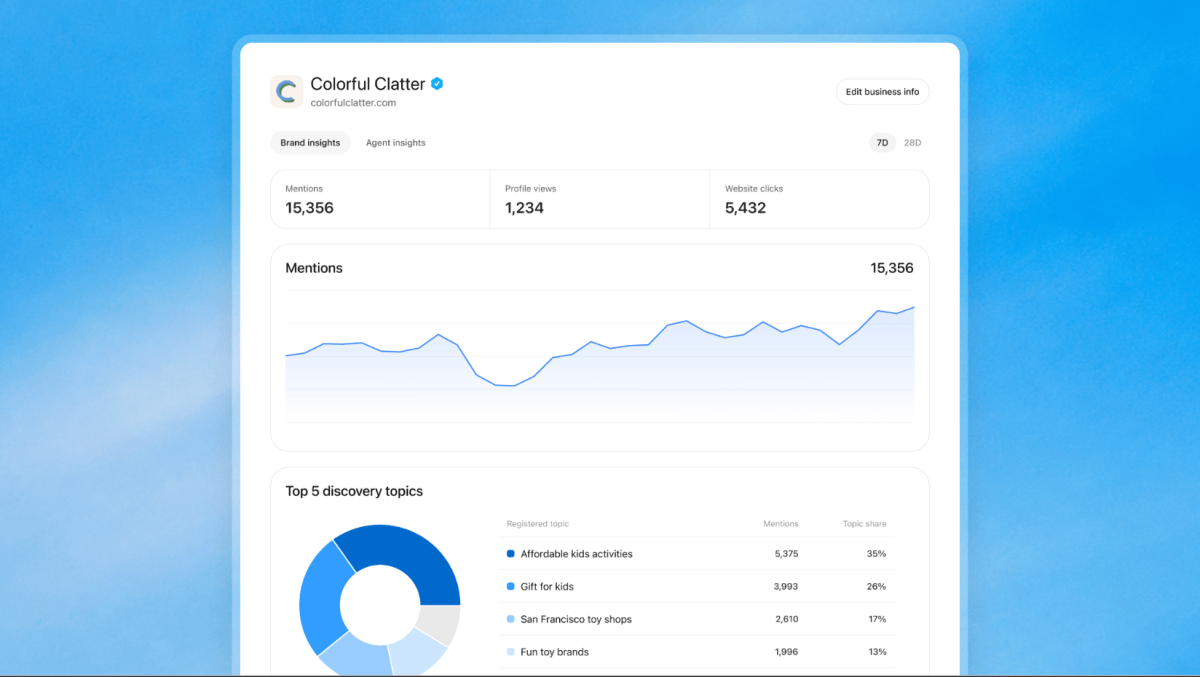
The Business Hub is designed to give companies more control over how they appear inside ChatGPT. According to TechCrunch, the hub lets enterprises manage ChatGPT-facing profiles and keep details about their products or services current. The rollout also includes limited analytics so businesses can see profile views, business mentions, website clicks and similar measures of attention.
OpenAI said the move is meant to make ChatGPT more useful for businesses as well as users. In the company’s framing, the assistant is not just a conversational tool but a place where customers can discover and evaluate companies. OpenAI described the launch as an early stage of that effort, saying:
“Today’s announcement is an early step in bringing businesses more deeply into ChatGPT.”
How the Business Hub works
The new hub adds a layer of identity and control that businesses have not had inside ChatGPT before. Instead of leaving the model to surface company information from scattered sources, verified businesses can supply their own information through the profile system. That includes basic details about products and services, which can then be updated as offerings change.
Why verification matters
OpenAI says formal verification is required for business profiles, although it has not publicly spelled out the full process. Benji Shomair, OpenAI’s vice president of monetization, said the company uses “multiple verification methods that we use for different types of business in different markets,” suggesting the process will vary depending on the company and geography.
That matters because the Business Hub is not just a listing page. If ChatGPT becomes a place where users ask what to buy, which service to use, or where to click next, then the question of who gets to control the business record becomes central. Verification is OpenAI’s answer to that trust problem, at least for now.
What analytics businesses get
The first version of the hub appears limited but practical. TechCrunch reported that businesses can see a small set of metrics, including profile views, mentions of the business, and website clicks. Those signals will not replace a full customer-relationship or ad platform, but they do give companies a clearer view of whether ChatGPT is sending attention their way.
| Feature | What it does | Status |
|---|---|---|
| Verified business profiles | Lets companies manage public-facing details in ChatGPT | Available in beta |
| Product and service updates | Allows businesses to update information users may see | Included at launch |
| Specialized business agent | Provides user Q&A for eligible companies | Available to eligible firms |
| Limited analytics | Shows profile views, mentions and website clicks | Included at launch |
Why it matters
This launch pushes ChatGPT further away from the image of a pure chatbot and closer to a discovery platform. That shift has consequences for businesses, users and the broader market for search and recommendations.
For companies, the Business Hub could become a new way to shape how they are presented to prospective customers. If a user asks ChatGPT about a product, service or company, the quality of the company’s profile and the reliability of its verification process may influence what the user sees and how confident they feel acting on it.
For OpenAI, the move suggests a longer-term play to make ChatGPT more commercially relevant without relying entirely on direct checkout or ads. The company has already signaled that ChatGPT can be a place for business discovery. The hub makes that ambition more concrete.
For the broader industry, the rollout also intensifies the competition between AI assistants and search engines. Google has long offered business profiles in Search, giving companies a way to manage public information that appears in results. OpenAI’s version is not the same product, but the resemblance is clear: both aim to mediate how people discover businesses online.
Background and context
OpenAI’s latest move fits into a wider pattern. ChatGPT has been steadily expanding beyond plain conversation into product discovery, shopping and recommendation use cases. That evolution has not been linear, and it has included some false starts.
According to TechCrunch, OpenAI retired an earlier direct-commerce push in March after it failed to gain traction. That effort had used commissions and a checkout cart and was intended to make ChatGPT function more like an Amazon-style storefront. The new Business Hub looks less like a checkout machine and more like an information layer: profile, verification, analytics, and a business-facing agent rather than a built-in cart.
That distinction matters. The earlier commerce effort tried to close the transaction inside ChatGPT. The Business Hub seems to stop short of that, at least for now, and instead focuses on making businesses visible, credible and measurable inside the product.
How the new approach differs from the old one
The difference is easy to see when placed side by side:
| OpenAI effort | Main goal | Status | What changed |
|---|---|---|---|
| Earlier ChatGPT commerce push | Enable direct purchases inside ChatGPT | Retired in March | Used commissions and a checkout cart |
| Business Hub | Let businesses manage profiles and respond to users | Launched Tuesday in beta | Focuses on verification, updates and analytics |
That shift may reflect what OpenAI learned from the earlier experiment: people may be more willing to use ChatGPT as a guide than as a storefront. If so, profile management and business Q&A may prove easier to adopt than embedded checkout.
What happened with GPT-5
The Business Hub launch came as Mint reported a separate OpenAI adjustment aimed at ChatGPT’s personality. According to Mint, OpenAI updated GPT-5 to feel “warmer and friendlier” after backlash over its tone and behavior.
Mint reported that the update adds light praise without increasing sycophancy, and that it is rolling out to all users over about a day. The outlet also said ChatGPT’s personality can be customized through Custom Instructions, while paid users can choose among four personalities: Cynic, Robot, Listener and Nerd.
The timing is notable because the reaction to GPT-5 was not just about model quality; it was also about experience. Mint said backlash followed GPT-5’s shorter responses and the removal of older models. OpenAI later restored the model picker and raised rate limits for ChatGPT Plus users, which Mint said costs $20 a month.
Why the personality update belongs in this story
The Business Hub and the GPT-5 personality changes are separate product moves, but they point in the same strategic direction: OpenAI is trying to make ChatGPT feel more useful, more trustworthy and more tailored to what different users want from it.
On the business side, that means more structured information and controlled profiles. On the consumer side, it means a model that feels less abrupt and more responsive to user preference. Together, they suggest OpenAI is still working out the right balance between efficiency, personality and utility.
What does this mean for businesses?
For companies, the Business Hub could become a small but important part of their digital presence. A verified profile in ChatGPT may eventually matter in the same way a company listing matters in search results: not because it replaces a homepage, but because it can shape first impressions.
The limited analytics are especially telling. If businesses start seeing profile views, mentions and clicks, they will have a new incentive to manage their presence inside ChatGPT carefully. That could lead to more competition for visibility, better-maintained information, and eventually more pressure on OpenAI to expand the dashboard.
There is also a second-order effect. Once businesses begin tracking ChatGPT-driven attention, the platform becomes harder to treat as a neutral assistant. It starts to resemble a discovery channel with measurable traffic. That may help OpenAI justify future monetization without immediately forcing users into a checkout flow.
How does this compare with Google Search profiles?
It is not a direct copy, but the parallel is obvious. Google Search business profiles let companies manage public information that appears in search results. OpenAI is moving toward a similar model inside ChatGPT, where business information can be verified and updated rather than left to chance.
The differences are just as important as the similarities. Google’s business tools sit inside a mature search ecosystem with years of local listings, maps and review behavior. OpenAI’s Business Hub is only in beta, and it is still unclear how much control businesses will really have, how the verification process will work in practice, or how broadly the feature will be opened.
That uncertainty leaves open a larger question: is ChatGPT becoming a substitute for search, or simply another front end for discovery? The answer may depend on how OpenAI develops the Business Hub over the next few months.
What happens next
The immediate next steps are straightforward but unresolved. OpenAI has not said when the Business Hub will leave beta, and it has not detailed the exact verification steps businesses must complete. It also has not said which companies will be eligible for the specialized business agent or whether the limited analytics will expand.
There are also broader product questions to watch:
- Whether OpenAI opens the Business Hub to more businesses after the beta period
- Whether the analytics expand beyond profile views, mentions and website clicks
- Whether the business agent becomes a central part of ChatGPT’s commercial strategy
- Whether the GPT-5 personality changes affect free users in the same way as paid users
- Whether OpenAI revisits direct commerce inside ChatGPT in a new form
The product roadmap suggests OpenAI is still testing what users and businesses will accept. The company has already backed away from one commerce model. Now it is trying a more restrained version that focuses on information, trust and engagement rather than immediate checkout.
For now, the Business Hub is a beta feature with a narrow but meaningful purpose: give businesses a verified place inside ChatGPT and let them see whether users are paying attention. If it works, it could become a core part of how companies present themselves in AI-powered search and discovery. If it does not, it may join the earlier commerce experiment as another marker of how difficult it is to turn conversational AI into a durable marketplace.
By the numbers
A few concrete figures and dates help show how quickly OpenAI is iterating:
| Item | Detail |
|---|---|
| Launch day | Tuesday |
| Prior commerce project retired | March |
| GPT-5 rollout window | About a day |
| Paid-user personality choices | Four |
| ChatGPT Plus price mentioned in backlash | $20/month |
The new Business Hub may be small at launch, but it points to a bigger ambition: making ChatGPT a place where businesses can be found, verified and evaluated, not just chatted with. That is a meaningful step in OpenAI’s attempt to widen the product’s role in how people search, compare and decide.
Frequently asked questions
What is OpenAI’s Business Hub for ChatGPT?
OpenAI’s Business Hub is a beta feature that lets companies create verified business profiles inside ChatGPT, update product and service information and access limited analytics. It is aimed at making businesses easier to discover and evaluate through the app.
Why did OpenAI launch a Business Hub now?
OpenAI launched it as part of a broader push to make ChatGPT a place where businesses and consumers connect through AI. The company appears to be shifting from direct commerce toward a profile-and-discovery model after an earlier shopping effort failed to gain traction.
What analytics do businesses get in ChatGPT?
Businesses get limited metrics, including profile views, business mentions and website clicks. TechCrunch reported that the dashboard is relatively narrow at launch, but it gives companies a first look at how much attention they are getting inside ChatGPT.
Did OpenAI change GPT-5 at the same time?
Yes. Mint reported that OpenAI made GPT-5 warmer and friendlier after backlash over its shorter responses and the removal of older models. The outlet said the update adds light praise without increasing sycophancy and is rolling out over about a day.