In short
New York City Mayor Zohran Mamdani used a Manhattan forum to argue that AI should not be treated as inevitable and that federal leaders have failed to create meaningful oversight. He pointed to New York’s school ban and real estate disclosure rules as examples of local action.
- Mamdani urged New Yorkers to resist the idea that AI must be accepted everywhere by default.
- He said the federal government has not created adequate AI safeguards, leaving cities to act.
- New York has already moved on AI rules for schools and real estate listings.
- The mayor linked AI accountability to broader concerns about safety, deception, and public consent.
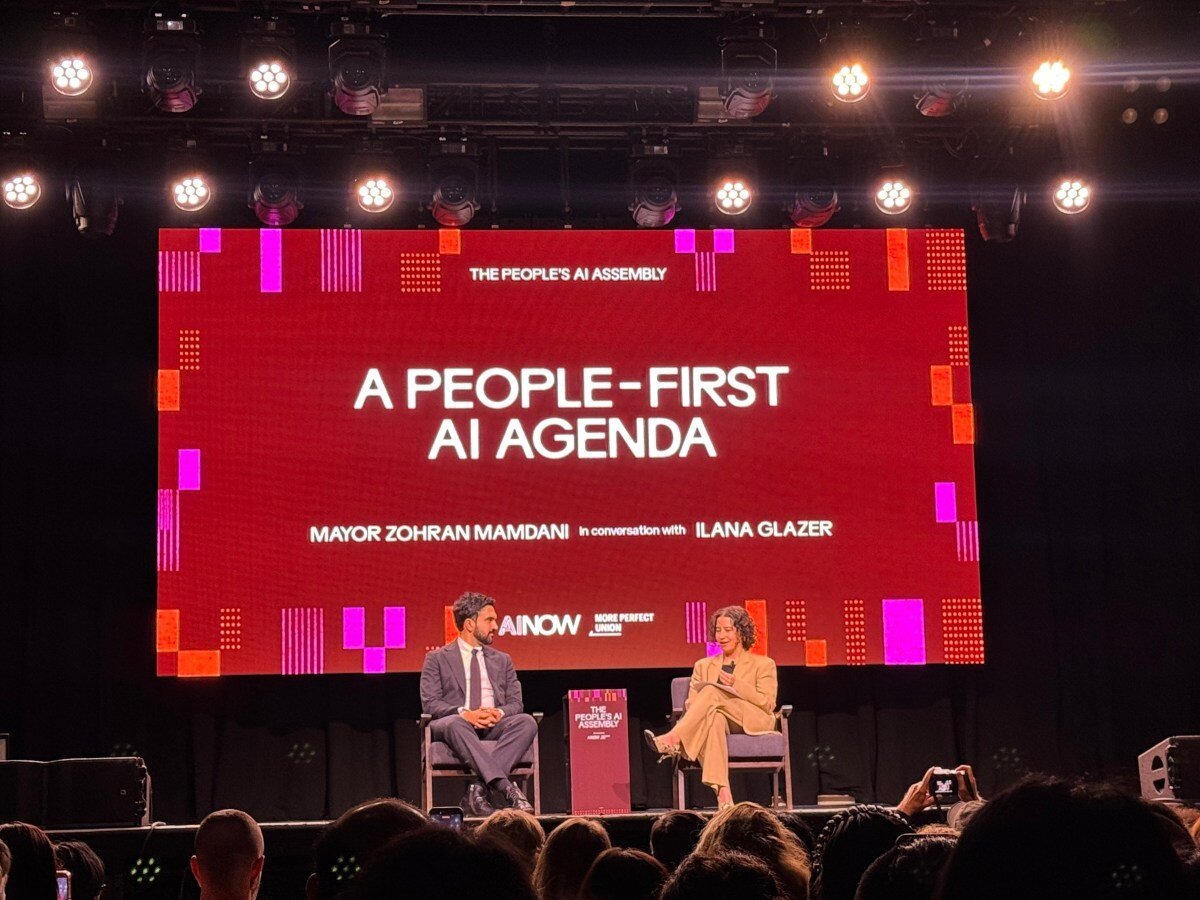
New York City Mayor Zohran Mamdani used a Manhattan forum on Monday night to argue that artificial intelligence is not a force citizens must simply accept, calling on New Yorkers to push back against a technology rollout he said is moving faster than public accountability. Speaking at The People’s AI Assembly at Webster Hall, Mamdani said the federal government has effectively stepped aside, leaving cities to confront AI’s social and economic consequences on their own.
The event, hosted by the AI Now Institute, brought together the mayor and actor-activist Ilana Glazer for a public conversation about the role of AI in schools, housing, work, and civic life. Mamdani’s message was direct: AI adoption does not have to be automatic, and elected officials should be willing to impose boundaries before the technology becomes embedded in everyday institutions without proper oversight.
His remarks come as local governments increasingly find themselves on the front line of AI regulation while Washington remains cautious about imposing binding rules. In New York, Mamdani has already moved on a pair of high-profile measures aimed at limiting harm: a ban on AI use in elementary and middle schools, and a disclosure rule requiring landlords, brokers, and real estate platforms to tell consumers when listing photos or videos have been made with AI.
Why Mamdani is taking a local-first approach to AI
Mamdani’s core argument is that people should not be made to feel powerless in the face of technology companies’ ambitions. Rather than accepting the idea that AI’s spread is unavoidable, he said public officials can set limits that protect residents, especially children and renters, from the most immediate risks.
He framed the debate as one of political choice, not technological destiny. In his view, the “pushback” matters because the current rollout of AI often proceeds as if institutions have no option but to absorb it, regardless of whether the systems are reliable, transparent, or socially beneficial.
According to Mamdani, there is an intentional pressure to make the public feel overwhelmed, as though resistance is futile and no alternative exists. He told the audience that this sense of inevitability is part of the problem, not proof that AI should be embraced.
The mayor also tied the issue to a broader critique of accountability. He said the companies building and selling AI frequently present the technology as beyond meaningful questioning, while policymakers are often told that regulation must wait until after deployment.
What happened at The People’s AI Assembly?
The People’s AI Assembly was organized by the AI Now Institute, a policy and research think tank focused on the social effects of artificial intelligence. The Manhattan gathering paired Mamdani with Glazer, who has been outspoken about technology’s influence on families and education.
Glazer, who is a parent, said she is uneasy about AI becoming a fixed part of school life. Her concern was less about the abstract promise of new tools than about the feeling that the technology is being imposed on students and teachers without meaningful consent or public debate.
Glazer said the prospect of AI in schools feels unsettling because it seems like a change that has arrived too quickly and without asking whether families want it there in the first place.
The exchange helped frame the event as more than a policy talk. It became an argument about social permission: who gets to decide whether AI belongs in classrooms, public services, and private transactions, and what standards should apply before it does.
How is New York City already regulating AI?
New York City has begun to test rules that treat AI as a consumer protection issue as much as a technological one. Mamdani’s administration has moved on education and housing, two areas where digital systems can affect children’s development and residents’ access to stable shelter.
In schools, he has ordered a ban on AI use in elementary and middle school settings. In housing, his office has pursued disclosure requirements aimed at preventing misleading digital listings that could trick prospective tenants or buyers.
The housing policy is intended to stop what the mayor has described as a form of digital deception in the rental and sales market. By requiring people involved in the listing process to reveal whether photos or videos were generated or altered using AI, the city hopes to make it harder for residents to be misled by polished but inaccurate representations of homes.
That theme—forcing disclosure before damage occurs—also runs through the school policy. Rather than wait for a deeper crisis over learning quality, child development, or classroom surveillance, the city has opted to draw a boundary now.
Key New York AI actions so far
- Ban on AI use in elementary and middle schools.
- Disclosure requirements for AI-generated property listing media.
- Public criticism of the assumption that AI must be adopted by default.
- A call for more local oversight in the absence of federal rules.
What did Mamdani say about federal oversight?
Mamdani argued that the federal government has not kept pace with the technology’s growth and has, in effect, abandoned the field. He said that leaves cities and states to confront the consequences of AI deployment without a strong national framework to guide them.
He criticized the national conversation for being dominated by geopolitical competition, especially the idea that AI must be treated as an arms race with China. In that framing, he said, concerns about ethics, human impact, and accountability are often pushed aside in favor of speed and strategic advantage.
In Mamdani’s telling, federal policy has failed to establish the kind of serious guardrails that would force companies to justify their systems, prove their safety, and accept responsibility when things go wrong.
His comments reflect a broader frustration among local leaders who want more authority to regulate technologies affecting housing, schools, and public safety. Without federal standards, cities are left to improvise, creating a patchwork of rules that can be both innovative and uneven.
Why the mayor invoked military AI failures
Mamdani used a recent U.S. military incident to illustrate the dangers of treating AI as inherently trustworthy. He cited the February strike in Iran that killed more than 150 people, including at least 123 children, and pointed to reporting that overreliance on AI-assisted targeting was one factor under review in the Pentagon’s internal investigation.
The example was intended to show that the stakes of bad AI decisions are not limited to consumer apps or office software. In high-consequence settings, errors can become catastrophic quickly, especially when people defer too much to automated systems.
By bringing up a military case, Mamdani tried to puncture the idea that AI is merely a neutral efficiency tool. He suggested that once institutions begin treating algorithmic outputs as authoritative, the result can be dangerous overconfidence.
How do companies fit into the fight over AI accountability?
Mamdani’s remarks also targeted the incentives of the companies that build AI systems. He suggested that firms often resist tighter oversight because regulatory scrutiny could threaten the valuations they hope to preserve ahead of public listings and other financing milestones.
He said the push to present AI as unquestionable resembles earlier arguments made by major social platforms in the late 2000s, when tech leaders often claimed they should be allowed to scale first and answer hard questions later. In his view, the same pattern is repeating, only with even more powerful tools.
The timing matters. Anthropic is expected to go public this year, while OpenAI has indicated it plans to pursue a public listing in 2027. As AI firms move closer to the public markets, pressure is likely to increase to show growth, defend product expansion, and minimize the appearance of regulatory risk.
That dynamic creates a tension at the heart of the current AI boom: the faster companies scale, the harder it can become for regulators to slow them down. Mamdani’s answer is to confront that momentum earlier, rather than later.
| Issue | New York City action | Why it matters |
|---|---|---|
| Schools | Ban on AI use in elementary and middle schools | Limits early exposure before parents and educators agree on classroom standards |
| Housing | Disclosure rules for AI-generated listing media | Helps prevent misleading or deceptive property marketing |
| Federal policy | Mayor says Washington has not built a meaningful framework | Leaves cities to regulate on their own |
| Company incentives | Critique of self-regulation and rapid scaling | Raises questions about safety versus valuation |
What does this fight mean for other cities?
New York’s approach may serve as a model for other cities that are frustrated with the slow pace of national action. Urban governments are increasingly encountering AI in education, rental markets, public communication, and customer service, even when residents have not been asked whether they want these systems in place.
If more cities follow New York’s lead, the result could be a more aggressive local patchwork of rules covering disclosure, school use, procurement, and consumer protection. That would not replace federal policy, but it could create meaningful pressure on companies to adapt to stricter standards.
At the same time, local rules can only go so far. Cities can mandate transparency and set boundaries in public institutions, but they cannot fully shape the design of the models or the incentives that drive the broader market. That is why Mamdani’s speech emphasized not just policy, but political organizing.
His central appeal was to resist resignation. The public, he argued, should not accept a future in which AI is introduced into every setting by default and then debated only after the consequences appear.
What comes next for New York’s AI debate?
For now, the city’s AI debate is likely to continue through the lens of enforcement and public reaction. School districts, landlords, brokers, tech companies, and parents all have different stakes in how the rules are applied. Any gaps in implementation could quickly turn into political disputes.
The bigger question is whether Mamdani’s message resonates beyond a single event. If New Yorkers embrace the idea that AI should be regulated where it affects daily life most directly, the city could become one of the country’s more influential examples of local AI governance.
That would mark a notable shift from the dominant narrative around AI, which often treats rapid deployment as both inevitable and beneficial by default. Mamdani’s speech challenged that assumption head-on, arguing that the public still has leverage if it chooses to use it.
In that sense, the Webster Hall conversation was about more than AI policy. It was about who gets to decide the future of a technology that is already reshaping education, housing, work, and public trust.
Timeline of New York City’s recent AI moves
| Date | Action | Context |
|---|---|---|
| Summer 2026 | Disclosure policy for AI-generated real estate media introduced | Aimed at preventing deceptive listings |
| September 2026 | Ban on AI use in elementary and middle schools ordered | Responds to concerns from parents and educators |
| October 19, 2026 | Mamdani speaks at The People’s AI Assembly | Calls for public pushback and stronger accountability |
For Mamdani, the lesson is clear: if lawmakers do not set the terms, the companies building AI will. And if that happens, he warned, the public may find itself living with rules it never agreed to in the first place.
Frequently asked questions
What did Zohran Mamdani say about AI?
Zohran Mamdani said New Yorkers should not accept AI as inevitable and should push back against rapid adoption without accountability. He argued that public officials must set boundaries, especially where the technology affects schools, housing, and public safety.
Why is New York City regulating AI on its own?
New York City is acting on its own because Mamdani says the federal government has failed to build a meaningful national framework. In his view, that leaves cities to protect residents from misleading, unsafe, or overly aggressive AI deployments.
What AI rules has Mamdani introduced in New York?
Mamdani has ordered a ban on AI use in elementary and middle schools and introduced disclosure requirements for real estate listings that use AI-generated photos or videos. Both policies are designed to increase transparency and reduce harm.
Why did Mamdani mention the military?
Mamdani cited a U.S. military strike in Iran to show that AI overreliance can have deadly consequences. He used the example to argue that automated systems should not be treated as infallible, especially in high-stakes decisions.