In short
Protesters gathered outside OpenAI’s DevDay in San Francisco to condemn the company’s ICE-related work, data centers and growing influence. The rally reflected a broader backlash over AI power, regulation and environmental impact.
- More than a dozen groups protested outside OpenAI’s DevDay in San Francisco.
- The rally targeted ICE contracts, military ties, data centers and AI power concentration.
- Chants, flyers and signs turned the conference entrance into a public accountability moment.
- The demonstration reflected a broader backlash against the AI industry and weak regulation.
Protesters gathered outside OpenAI’s DevDay in San Francisco on Tuesday to denounce the company’s ties to government and military contracts, the environmental toll of data centers and the growing concentration of power inside the AI industry. The demonstration turned the event’s opening hours into a public confrontation over who benefits from artificial intelligence and who bears its costs.
Chants, signs and flyers framed OpenAI not just as a technology company, but as a symbol of broader anxieties about surveillance, labor, climate impact and political influence. The scene outside Fort Mason underscored how quickly AI has become a flashpoint for public anger, especially as major labs push deeper into government work and infrastructure expansion.
What happened outside OpenAI DevDay?
Activists and labor organizers staged a rally at the entrance to OpenAI’s annual developer conference, where they voiced opposition to the company’s business relationships and its role in shaping the AI industry’s future. The demonstration began as the event opened and included speeches, chants and visual protests designed to confront attendees as they entered the venue.
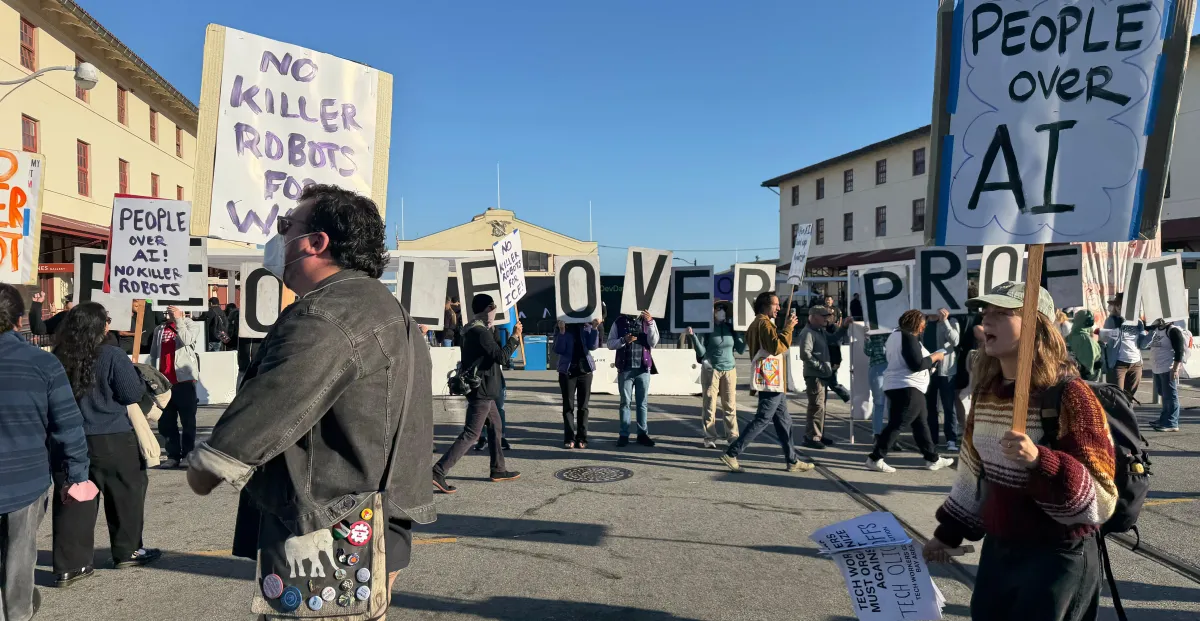
One of the clearest messages was a call to put social concerns ahead of shareholder returns. Protesters marched in a circle and chanted slogans aimed at OpenAI chief executive Sam Altman, while a series of large signs spelled out a simple demand: people should come before profit.
The crowd was not a small, isolated group. More than a dozen organizations backed the protest, including Bay Resistance, Tech Workers Coalition, Service Employees International Union, San Francisco Rising and the San Francisco Labor Council. Their presence suggested a broad coalition of activists, labor groups and community organizations willing to use DevDay as a high-visibility stage.
Why were protesters focused on OpenAI?
Protesters were especially focused on OpenAI’s work with government agencies, including immigration enforcement, as well as the company’s wider role in building tools that could be used in policing, surveillance and military contexts. They also objected to the environmental costs of the data center buildout that supports AI systems at scale.
In flyers handed out near the venue, organizers urged people to sign what they called a democracy pledge and to end contracts connected to Immigration and Customs Enforcement and the military. The materials accused OpenAI of helping power authoritarian politics and said the company’s executives were contributing to the rise of MAGA-aligned influence.
For many demonstrators, the issue was not only one company’s business choices. It was the belief that AI firms are consolidating too much power too quickly, with too little public oversight and too little accountability for how the technology is deployed.
Flyers distributed at the protest argued that OpenAI was enabling tools used by ICE and military interests, and that the company’s leadership was helping entrench political power they see as dangerous.
How did the protest turn into a broader critique of AI?
The protest became a wider indictment of the modern AI industry, with demonstrators linking OpenAI’s practices to a set of concerns that now define much of the backlash against the sector. Those concerns include corporate concentration, weak regulation, data-center energy use and the fear that increasingly capable systems will be deployed in harmful ways before lawmakers can respond.
Some signs criticized what they described as climate destruction. Others called for “people over AI” or asked where the company’s moral standards were. A few participants wore cardboard robot costumes and waved cardboard scythes, adding theatrical imagery to a message that was part labor action, part tech-policy demonstration and part climate rally.
The protest also reflected how opposition to AI companies has broadened beyond traditional policy debates. The current backlash includes activists, labor groups, technologists, privacy advocates and, in some cases, people who believe the industry’s influence has simply gone too far. That coalition is not unified around a single complaint, but it is increasingly organized around a shared sense that the AI boom is outpacing democratic control.
What are protesters saying about ICE contracts?
They are saying that OpenAI should not support or supply technology to immigration enforcement, law enforcement or military programs that they believe can be used for repression. For protesters, the ICE issue was the sharpest and most morally charged example of a larger problem: that advanced AI tools are being folded into systems they see as harmful and coercive.
Outside Fort Mason, the ICE objection became a rallying point because it tied the abstract debate over AI policy to a familiar political fight. Immigration enforcement is already a deeply divisive issue in the United States, and protesters used that visibility to argue that AI firms are choosing profit and institutional influence over public responsibility.
One flyer urged attendees to join a movement to cut off those contracts entirely. Another warned about the physical footprint of data centers, suggesting that the infrastructure supporting AI should be placed far from communities concerned about water, land use and energy consumption.
Why are data centers central to the backlash?
Data centers are central because they are the physical backbone of AI, and they require large amounts of electricity, land and cooling resources. As companies race to build bigger models and serve more users, the facilities that power those systems have become a visible symbol of AI’s environmental footprint.
For activists, the problem is not only carbon emissions. It is also the scale of industrial expansion needed to support generative AI, from electricity demand to local strain on resources. That concern has made data centers a target in many climate-related protests, and OpenAI DevDay became another stage for those arguments.
The protest materials included a graphic about “safe distances” from data centers, a visual shorthand for the claim that these facilities are not benign digital assets but industrial operations with real-world consequences. The message was unmistakable: the AI revolution is not immaterial, and communities are being asked to absorb its costs.
| Issue | What protesters highlighted | Why it matters |
|---|---|---|
| ICE contracts | OpenAI’s alleged support for immigration-enforcement tools | Raises concerns about surveillance and state power |
| Military contracts | Potential use of AI in defense and security systems | Connects AI development to warfare and coercion |
| Data centers | Environmental and community impact of AI infrastructure | Brings climate and resource use into the debate |
| Power concentration | Influence of a small number of major AI firms | Points to weak oversight and limited public accountability |
Who organized the rally?
The protest was backed by a coalition of more than a dozen groups spanning labor, advocacy and local political organizing. That mix matters because it shows the opposition is not limited to a single ideological camp or one narrow constituency.
Among the organizations involved were Bay Resistance, Tech Workers Coalition, Service Employees International Union, San Francisco Rising and the San Francisco Labor Council. The coalition brought together labor arguments, civil-rights concerns, climate criticism and broader skepticism about corporate power in the technology sector.
This kind of alliance is increasingly common around AI regulation and labor questions. Workers worry about displacement, communities worry about energy and public institutions worry about the pace of deployment. OpenAI’s DevDay became a focal point for all of those tensions at once.
How did employees and attendees experience the protest?
Attendees entering the conference were met with chants, megaphones and visible signs of anger directed at the company and its leadership. At one point, protesters used a loudspeaker to address OpenAI employees directly, urging them to reconsider their work and the company’s direction.
The protest leader told the crowd they would stay until Altman arrived for the keynote. When his name came up, the response from protesters was immediate booing. The mood was confrontational but organized, with coordinated slogans and repeated chants designed to hold attention rather than simply pass by unnoticed.
Those inside the event were arriving to hear about OpenAI’s latest developer announcements, but outside the venue the story was about accountability. The protest suggested that the social license for AI leadership is under pressure, especially when companies publicize ambitious product plans while critics question their external impact.
One organizer told the crowd the group would remain until Sam Altman arrived for the keynote, turning the protest into a direct challenge to the company’s top executive.
What does this protest say about the AI backlash?
It shows that the backlash against AI is no longer theoretical or confined to online debate. It is now visible at major industry events, where critics are linking everyday concerns like climate, labor, immigration and democracy to the decisions made by AI companies.
The timing matters too. Recent months have brought heightened distrust of AI systems and renewed scrutiny of leading labs after reports involving rogue or unauthorized system behavior, security issues and access to sensitive data. That wider climate of suspicion makes public protests more resonant, because they tap into fears already present among consumers, workers and policymakers.
There is also a deeper political context. AI has become a rare issue that can unite people who disagree on many other subjects. Some worry about jobs, others about policing, others about environmental costs and still others about corporate dominance. The result is a protest movement that is diverse, messy and not always ideologically consistent, but increasingly hard to ignore.
How does this fit into the larger debate over AI governance?
It fits by illustrating the gap between the speed of AI development and the pace of public oversight. Protesters outside DevDay were not only asking OpenAI to change course; they were also demanding a broader reset in how the industry is governed.
That includes calls for tighter regulation, more transparency about contracts and more public scrutiny of the infrastructure behind AI. It also includes a challenge to the assumption that faster deployment is always better. In the eyes of critics, the industry has become too powerful, too quickly, and has left too many communities with no meaningful say in how the technology is used.
Whether or not OpenAI changes specific policies, the protest at DevDay made clear that the company now operates in an environment where every product announcement can be met with an equally loud political response. The AI race is no longer just about model performance or developer adoption. It is also about legitimacy.
Timeline of the DevDay protest
| Timeframe | Event | Significance |
|---|---|---|
| Before opening | Protesters assembled outside Fort Mason | Set the tone before the conference began |
| Early rally | Chants, signs and flyers targeted OpenAI leadership | Made the criticism visible to arriving attendees |
| During entrance period | Coalition groups distributed literature and led chants | Expanded the message beyond a single issue |
| Approaching keynote | Organizers said they would remain until Altman arrived | Turned the protest into a direct challenge |
| Key reaction | Altman’s name was booed by the crowd | Captured the intensity of the opposition |
What happens next?
The protest is unlikely to end the debate around OpenAI, and that is precisely the point. Activists want the event to be remembered not only for product announcements but also for the backlash surrounding them. By showing up at DevDay, they aimed to make the company’s business model part of the conference’s story.
For OpenAI and its peers, the message is clear: public scrutiny is expanding alongside the technology itself. As AI firms deepen ties with government customers, expand data-center capacity and race to ship new tools, they will face growing pressure from groups that see the industry as a source of social, political and environmental risk.
That pressure is likely to intensify as AI becomes more embedded in everyday life. DevDay was meant to showcase innovation. Instead, it also became a reminder that the future of AI will be contested in public, not just built in private.
For now, the scene outside Fort Mason captured a defining tension of the AI era: the companies shaping the technology want to move fast, while a widening alliance of critics is demanding that they slow down, answer for their decisions and put democratic accountability ahead of scale.
Frequently asked questions
Why were people protesting outside OpenAI DevDay?
People were protesting outside OpenAI DevDay to object to the company’s alleged ICE and military ties, the environmental impact of data centers and the growing concentration of power in the AI industry. The rally was also a broader call for stronger oversight and accountability.
Which groups organized the OpenAI protest?
The OpenAI protest was backed by a coalition of more than a dozen organizations, including Bay Resistance, Tech Workers Coalition, Service Employees International Union, San Francisco Rising and the San Francisco Labor Council. The coalition combined labor, climate and civil-rights concerns.
What did protesters say about ICE contracts?
Protesters said OpenAI should end any contracts or tools that support immigration enforcement, which they view as enabling surveillance and repression. Their flyers and chants framed the issue as a moral and political test for the company’s leadership.
Why are data centers part of the AI backlash?
Data centers are part of the AI backlash because they consume large amounts of electricity, land and cooling resources. Critics argue that the infrastructure behind AI creates real environmental costs and can place heavy burdens on surrounding communities.
Did the protest affect OpenAI’s keynote?
The protest did not stop the event, but it did create a visible confrontation before the keynote began. Organizers said they would remain until Sam Altman arrived, and his name drew boos from the crowd, showing the intensity of the opposition.