In short
A growing data center backlash is taking shape in Florida and beyond, blending environmental, anti-development and anti-AI concerns into a bipartisan political movement. The fight could influence local zoning, state policy and upcoming elections.
- Hernando County, Florida, approved a one-year moratorium on new data center construction.
- Opposition to data centers is increasingly bipartisan, mixing conservative anti-development politics with left-leaning environmental concerns.
- Residents are worried about water use, power demand, noise, secrecy and the broader harms of generative AI.
- The issue is beginning to influence Florida politics, including messaging from Republican candidates and state leaders.
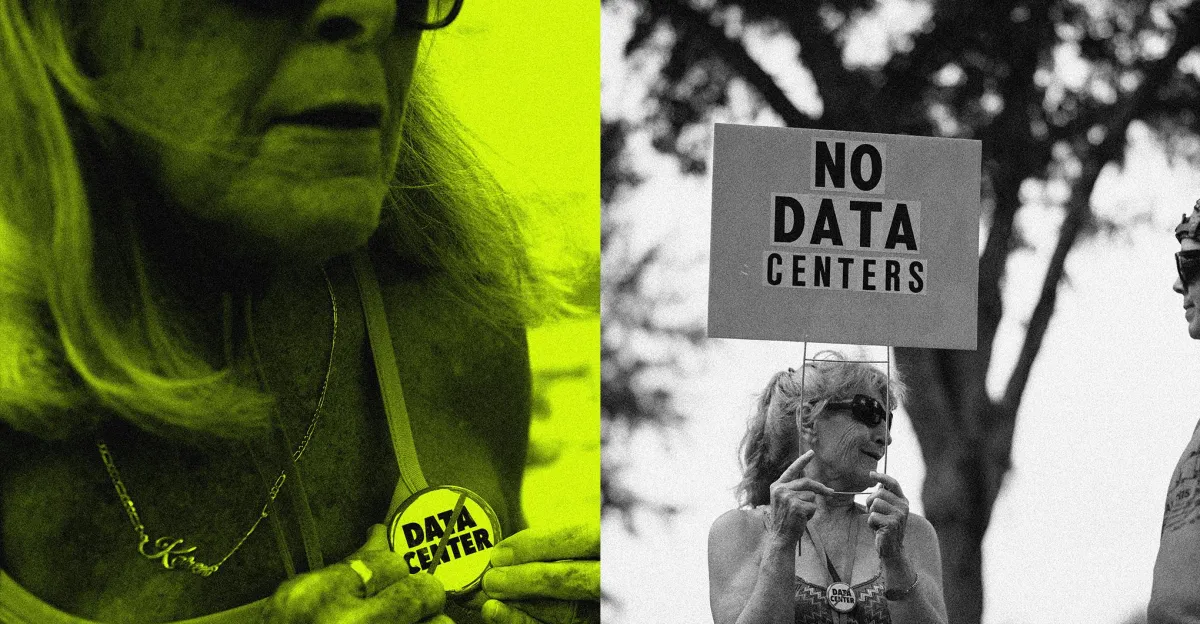
Local opposition to data centers is growing into a serious bipartisan political movement, with protests, moratoriums and election pressure now shaping how states like Florida approve AI infrastructure. In Hernando County, Florida, residents recently pushed through a one-year pause on new data center construction, underscoring how public anger over AI, utilities, water use and development is reshaping the politics of the boom.
What started as a debate over massive warehouses for cloud computing is now becoming a broader revolt against the physical infrastructure behind artificial intelligence. Across the country, residents on both the right and the left are using town halls, county commissions and protests to challenge data center projects they see as noisy, resource-hungry and emblematic of an AI economy they do not trust.
Why are people turning against data centers?
People are turning against data centers because the facilities have become the most tangible symbol of an AI boom that many voters feel is being imposed on their communities without consent. The backlash is driven by a mix of local concerns and deeper cultural distrust, ranging from water use and power demand to fears about jobs, surveillance and social disruption.
The public response has also been helped along by the simple fact that data centers are hard to ignore. They are large, loud and often tied to major industrial build-outs that require zoning changes, utility upgrades and long-term commitments from local governments. That gives residents a specific target for their frustration, even when their concerns are really about the wider direction of technology policy.
Local concerns are the first trigger
In Florida, critics focus heavily on humidity, groundwater and contamination risk. In drier states such as Arizona, opponents argue that data centers make even less sense because the facilities require heavy cooling in places already stressed by heat and water scarcity.
That pattern has repeated across the country: communities do not always agree on the exact environmental risk, but they usually agree that a data center feels too big, too intrusive or too mismatched to local conditions.
The AI boom itself is part of the backlash
Opponents are not just reacting to construction. They are reacting to what the construction represents. Many residents see the data center surge as a physical extension of generative AI systems that they associate with low-quality content, job displacement and a loss of control over daily life.
For some, the facilities are linked to chatbots that can mislead vulnerable users. For others, they are tied to corporate power, political influence and a broader sense that ordinary people are being asked to absorb the costs of an industry they did not choose.
Residents and organizers interviewed in Florida described the anger as intensely local, but also part of a wider rejection of AI infrastructure that they believe is changing their communities without clear public benefit.
How did Hernando County become a flashpoint?
Hernando County became a flashpoint when its county commission unanimously approved a one-year moratorium on data center construction after a wave of community concern and activism. The decision marked one of the clearest examples yet of local government acting on public pressure against AI-related infrastructure.
The county has become an important test case because it shows how fast the politics around data centers can shift when residents organize effectively. A project once framed as economic development can quickly become a symbol of overreach, secrecy and environmental risk.
Humans First and the conservative pushback
A key driver of the Florida protests is Humans First, a grassroots movement that initially had broader appeal but is now focused on conservative organizing against data center build-outs. The group reflects an unusual dynamic: opposition to tech development is no longer confined to progressive activists or environmental groups.
Instead, the movement brings together people who might otherwise support business-friendly policies but are alarmed by the size, scale and secrecy of these projects. In Hernando County, that anger was visible in public meetings and demonstrations that looked more like anti-establishment revolt than traditional partisan activism.
What makes data center opposition bipartisan?
Data center opposition is bipartisan because the facilities sit at the intersection of different kinds of grievances that appeal to different political identities. Conservatives may object to top-down development, property changes and rural disruption, while liberals may focus on environmental harm, surveillance and labor displacement.
At the same time, both sides increasingly share skepticism about the promises of Silicon Valley and the AI industry. That shared distrust has created a political coalition that does not map neatly onto the usual left-right divide.
Populists versus technocrats
One useful way to understand the backlash is as a populist-versus-technocrat divide. On one side are officials, developers and investors who argue that AI infrastructure is necessary and inevitable. On the other are residents who believe that communities are being forced to absorb the downsides while corporations and executives capture the upside.
This divide helps explain why anti-data center activism can emerge from very different political cultures. It is less about traditional ideology than about whether people believe technological change is happening with them or to them.
Right-coded and left-coded arguments often overlap
Some objections sound conservative: preserving rural landscapes, resisting outside developers and protecting local control. Others sound progressive: concern over water contamination, environmental degradation and the social harms associated with AI systems.
In practice, the same person may use both sets of arguments in the same meeting. A homeowner can complain about property values, utility costs and social fragmentation in one breath and then warn about environmental damage in the next.
| Issue | How opponents describe it | Why it matters politically |
|---|---|---|
| Water use | Too much strain on scarce local water supplies | Connects environmental concerns to everyday household costs |
| Power demand | Data centers consume too much electricity and require new infrastructure | Raises utility bills and questions about who pays |
| Noise and size | Large, industrial buildings change the character of a community | Turns zoning fights into identity politics |
| AI symbolism | The buildings represent chatbots, job loss and corporate control | Links a local fight to national distrust of tech |
| Political secrecy | Residents complain about nondisclosure agreements and closed-door planning | Amplifies suspicion that local leaders are hiding deals |
How do environmental and conspiracy fears feed each other?
Environmental concerns and conspiracy thinking often feed each other because data centers are large, complicated projects that are difficult for residents to fully understand and easy to treat as a catch-all for broader fears. Once a community believes it has lost control, rumors can spread quickly around whatever issue seems most plausible.
That dynamic has produced everything from claims about groundwater contamination to stranger stories about health effects and livestock problems. Some worries stem from misunderstandings or exaggerated claims; others are grounded in real issues such as water demand, utility consumption and construction impacts.
The key point is not that every concern is the same, but that data centers create a public stage on which many kinds of anxiety can be projected.
Why do rumors spread so easily?
Rumors spread easily because data centers are technically complex and politically opaque. Many residents do not know how the facilities work, what they power or who benefits from them. That makes it easier for false or distorted claims to take hold online and in community meetings.
Social media can accelerate that process, turning one anecdote into a local belief system. When people already feel excluded from planning decisions, they are more likely to accept dramatic stories that explain why a project should be stopped.
Gaby Del Valle, who has reported extensively on the issue, describes the backlash as a mix of legitimate local frustration and a broader social reaction to the rise of generative AI and large language models.
What role do jobs and economics play?
Jobs and economics play a major role, but not in the way developers often promise. Residents are increasingly skeptical that data centers deliver the long-term employment or broad economic growth that officials advertise when courting major tech projects.
Construction can bring a burst of work, and facilities require some maintenance and HVAC support, but opponents argue that those benefits are limited and temporary. By contrast, the costs of land use, power infrastructure and community disruption are immediate and lasting.
The jobs argument is losing credibility
Many communities now believe the job story is overstated. They see flashy announcements about the AI economy but compare them with the small number of permanent positions actually needed to run a finished facility.
That disconnect matters politically because it weakens one of the central arguments used to justify large-scale development. If voters no longer believe the promised benefits, they are more likely to treat the project as a transfer of public resources to private companies.
Why is Florida especially important?
Florida is especially important because the state has become a proving ground for the politics of anti-data center activism, with local land-use fights now intersecting with statewide Republican politics. The issue is no longer confined to obscure zoning hearings; it is starting to influence elections and policy debates at the top of the ticket.
That matters because Florida has both intense development pressure and a politically engaged conservative electorate. When residents who normally support the GOP begin turning against data center projects, party leaders are forced to respond.
Byron Donalds and the politics of backlash
One of the most visible examples is Byron Donalds, a Republican gubernatorial frontrunner who has received support from the AI and data center sectors. Opposition to data centers has become strong enough that some voters who describe themselves as loyal Trump supporters say they are reconsidering their ballot choices.
Donalds has adjusted his public framing, emphasizing responsible development rather than blanket expansion. That shift suggests the issue is already creating pressure on candidates who expected AI infrastructure to be an easy pro-growth talking point.
Ron DeSantis has also become part of the story. His administration has backed measures that would require data centers to cover more of their own utility costs and, in some cases, allow counties to require reclaimed water. At the same time, the state has also offered tax incentives that encourage the very kinds of projects residents fear most.
Housing costs make the anger sharper
Florida’s housing crisis has made local development fights more combustible. Residents who have already watched rents and home prices rise are less willing to accept the arrival of another large industrial project that promises limited neighborhood benefits.
For many people, data centers are not an isolated issue. They are one more example of outside money reshaping communities faster than local families can adapt.
How are local governments responding?
Local governments are responding unevenly, and that inconsistency is one reason the issue is spreading. Some counties have adopted moratoriums or stricter rules, while others continue to approve projects over residents’ objections.
In some places, city officials are more responsive than county officials, creating a split between local jurisdictions that residents then try to exploit through public pressure, elections or legal appeals.
NDA complaints are fueling distrust
One of the most persistent sources of public anger is the belief that officials and developers are operating behind nondisclosure agreements. Residents repeatedly ask whether public servants have signed NDAs related to projects, and evasive answers only deepen the suspicion.
Even when officials insist they cannot disclose details, that response often sounds to residents like confirmation that something is being hidden. In a climate already shaped by mistrust, secrecy can be as politically damaging as the project itself.
What does this mean for the future of AI politics?
The backlash against data centers suggests that AI politics is becoming more local, more material and more electorally consequential. Rather than debating AI only in terms of chatbots, regulation or copyright, voters are now confronting the concrete infrastructure that powers the technology.
That shift matters because physical infrastructure creates visible points of resistance. A community can hold a meeting, block a permit, pass a moratorium or organize a protest in front of a site. It is much harder to stop a digital service than it is to stop a building from rising in your neighborhood.
Data centers as the new front line
Data centers may become the new front line in the AI debate because they connect national technology policy to local quality-of-life concerns. The issue can now move from a school board or county commission to a statewide campaign or even a presidential race.
That makes the political stakes unusually high. If more voters conclude that AI brings environmental costs, social harms and few local rewards, then data center approval could become one of the toughest development fights in America.
Key moments in the emerging backlash
The anti-data center movement has unfolded quickly, but a few milestones stand out as signs of where the politics may be heading.
| Event | Location | Political significance |
|---|---|---|
| Local protests intensify | Hernando County, Florida | Shows conservative-led opposition can force action |
| One-year moratorium approved | Hernando County Commission | Creates a model for other counties considering limits |
| State-level candidates react | Florida gubernatorial race | Suggests data centers may affect campaign messaging |
| Local reporting accelerates | Florida and Arizona | Shows the issue is spreading beyond one state |
| Public meetings become confrontational | Multiple counties | Illustrates how land-use fights are becoming culture-war flashpoints |
What happens next?
The next phase will likely be defined by more moratoriums, more utility fights and more campaign attention. As AI infrastructure expands, local communities will keep looking for leverage, and politicians will keep trying to separate “responsible” development from the versions that trigger the strongest backlash.
That is why the data center debate may matter well beyond Florida. It is becoming one of the clearest examples of how AI is moving from the abstract world of software into the physical world of land, water, electricity and local democracy.
And because the backlash crosses party lines, it may prove harder for the tech industry to dismiss than earlier waves of criticism. Residents are not merely objecting to a product. They are challenging the infrastructure, economics and power structures that make the AI boom possible.
Bottom line
The growing revolt against data centers shows that AI policy is no longer just a debate among engineers, executives and regulators. It is becoming a neighborhood fight, a county-level test of democracy and, increasingly, a political issue that could shape elections.
As more communities confront proposals for hyperscale facilities, the question is no longer whether data centers will face pushback. The question is how much of the country will decide that the AI boom is too disruptive to welcome at all.
Frequently asked questions
Why is there a data center backlash in Florida?
There is a data center backlash in Florida because residents worry about water use, power demand, noise, secrecy and rapid development that they say brings few local benefits. Many opponents also see the facilities as the physical symbol of an AI boom they do not trust.
Is opposition to data centers only a left-wing issue?
No, opposition to data centers is not only a left-wing issue. The backlash is increasingly bipartisan, with conservatives objecting to outside development and local disruption while liberals focus on environmental damage, surveillance concerns and the social harms tied to AI systems.
What happened in Hernando County?
Hernando County commissioners unanimously approved a one-year moratorium on data center construction after rising public pressure. The move made the county one of the clearest examples of local governments responding directly to the growing anti-data center movement.
Why do data centers matter politically now?
Data centers matter politically now because they turn abstract AI debates into visible local fights over land, utilities and community control. That makes them easier to protest, easier to regulate and increasingly relevant to elections at the county and state level.
Are data centers really that unpopular with voters?
Yes, in many communities data centers are becoming deeply unpopular, especially when residents believe the projects will not create enough long-term jobs or will raise utility and environmental costs. The strongest reactions often come where people feel the planning process has been opaque or rushed.