Updated July 22, 2026 11:23 pm
In short
Neill Blomkamp’s Nightborne is a 13-minute AI zombie short built entirely from Seedance 2.0 output, and it’s drawing swift backlash as a proof-of-concept for a future feature.
- Neill Blomkamp’s Nightborne is a 13-minute sci-fi short generated with ByteDance’s Seedance 2.0.
- The film uses human actors, concept art and editing, but its visuals are overwhelmingly AI-made.
- Critics say the short exposes the limits of current text-to-video tools, especially for performance and continuity.
- Blomkamp says the project is a test and a potential stepping stone to a feature-length AI film.
- The release has reignited debate over authorship, creative labor and whether AI video is ready for cinema.
Update — July 22, 2026 11:23 pm
The updated source adds a key production detail: Nightborne was built entirely from Seedance 2.0 output, with every shot generated by the model rather than just the footage generally.
It also says the short leans on documentary-style interview cutaways to paper over Seedance’s limit of only producing a few seconds at a time, while the mixed reaction has quickly hardened into backlash from viewers who say the project makes Blomkamp look creatively diminished.
Blomkamp also described the short as a test run and said he wants to make a full feature in the same format later on.
Update — July 22, 2026 1:24 am
The updated report adds that every shot in Nightborne was generated with ByteDance’s Seedance 2.0, rather than just the short’s footage overall.
It also says the film relies on documentary-style interview cutaways to disguise the fact that the model can only produce a few seconds at a time, and that the project has already drawn immediate backlash from viewers who see it as a sign that Blomkamp’s creative voice is fading.
The source further notes that Blomkamp has compared the project to a proof of concept and reiterated his interest in making a full feature in the same style.
Neill Blomkamp has released Nightborne, a 13-minute sci-fi short made with ByteDance’s Seedance 2.0 text-to-video model, and the reaction has been sharply divided. The project matters because it is one of the most prominent examples yet of a major filmmaker using generative AI as the core production tool, raising fresh questions about creativity, labor, and whether AI video is ready for serious storytelling.
Blomkamp introduced the short on Monday through his AI startup and production outfit, Barley Studios, describing it as an early experiment in what the technology can do and hinting that he would like to build a feature film in a similar way. But the finished piece has drawn heavy criticism for its rough visual logic, inconsistent performance quality, and the broader impression that the technology is still far from replacing conventional filmmaking craft.
What is Nightborne, and why is everyone talking about it?
Nightborne is a short film by Neill Blomkamp that uses generative video as its main creative engine. It is being discussed because it is not a small proof-of-concept buried on a tech demo page; it comes from a filmmaker whose name carries real weight in modern science fiction, and it arrives at a moment when studios, creators, and AI companies are still arguing over what machine-generated video should be allowed to become.
Blomkamp is best known for directing District 9 and Gran Turismo, two films that helped shape his reputation for ambitious worldbuilding and high-concept genre work. That history gives Nightborne an outsized cultural footprint, even though the short itself is only 13 minutes long and was made as a test of a new production approach rather than as a traditional release.
The short is built from footage generated with Seedance 2.0, a text-to-video model developed by ByteDance. Human performers were involved, and Blomkamp said real concept artists contributed to the project, but the moving images themselves were created by the model rather than shot on a conventional film set.
How was Nightborne made?
Nightborne was assembled from many very short AI-generated clips, then edited into a linear story by Austyn Daines. That matters because it reveals one of the current realities of text-to-video systems: they can generate striking fragments, but they still struggle to sustain coherent action, facial consistency, or physically believable movement over longer sequences.
The project also incorporated human voices and likenesses. Blomkamp said 32 actors agreed to let their appearances be used in the film, and the production mixed dialogue and sound in a way meant to make the result feel like a finished piece of cinema rather than a patchwork of computer output.
That effort, however, is part of what makes the short such a revealing case study. The more the production tries to smooth over the seams, the more obvious the seams become. Instead of dissolving the machine inside the movie, the editing often highlights just how much the film depends on stitching together brief outputs from a system that still lacks a deep understanding of continuity.
| Key detail | Information |
|---|---|
| Project | Nightborne |
| Director | Neill Blomkamp |
| Length | 13 minutes |
| Production company | Barley Studios |
| AI model used | ByteDance Seedance 2.0 |
| Based on | Loosely inspired by Peter Watts’ Echopraxia |
| Human actors involved | 32 |
| Primary format | Text-to-video generated clips edited into a short film |
What is the story of Nightborne?
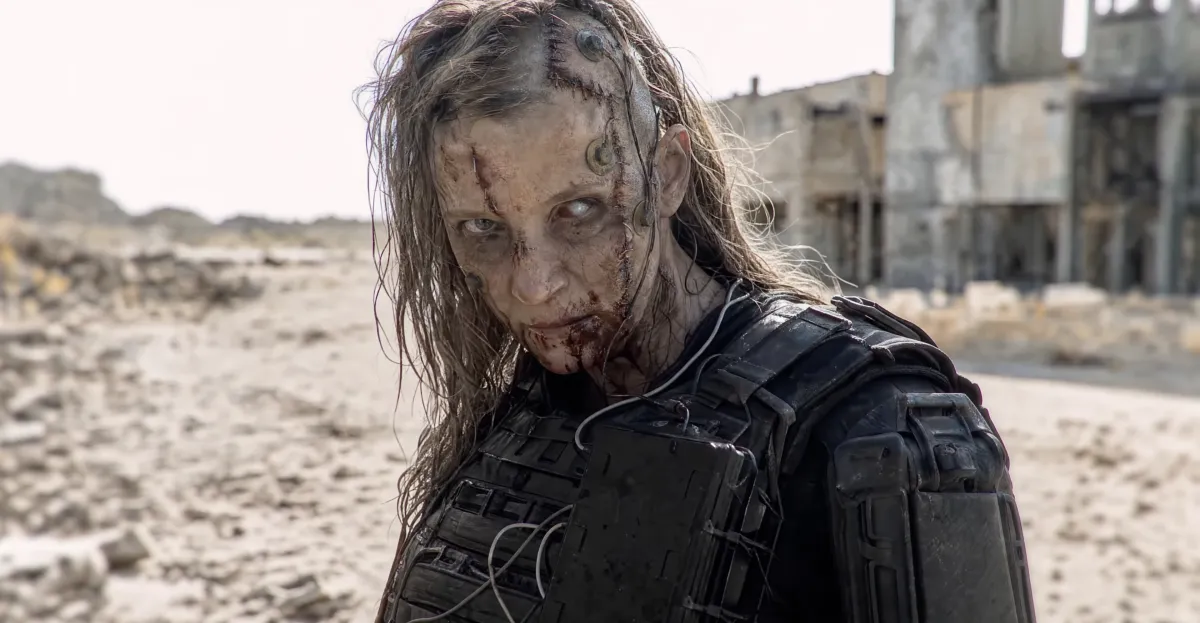
The film is set during a military conflict between the United States and Syria and centers on an American helicopter pilot whose aircraft is shot down and who suffers devastating injuries. Her body is so damaged that she becomes a candidate for a secret government program called Project Nightborne, which repurposes brain-dead soldiers into remotely controlled combat assets.
That premise gives the short an immediate dystopian edge. In the film’s world, the military has access to an apparently limitless supply of bodies, and the program quietly transforms wounded service members into weaponized undead troops. The result is part war story, part body-horror idea, and part speculative warning about institutional cruelty.
Blomkamp has tied the film loosely to Peter Watts’ 2014 novel Echopraxia, but the connection appears thematic rather than literal. The zombie element takes center stage, and the short is less concerned with adapting the book faithfully than with building a compact sci-fi scenario around the possibilities of the generator that made it.
Why are critics calling it AI slop?
Nightborne has been criticized because its technical polish does not hide the same problems that plague much of the AI video ecosystem: distorted lettering, awkward emotional cues, odd pacing, and a shallow sense of physical reality. The short may look more coherent than the cheapest viral clips circulating online, but it still displays the telltale instability of machine-generated footage.
Viewers and critics have pointed to background text that turns into nonsense, characters whose speech rhythms feel unnatural, and facial performances that seem to imitate emotion without fully capturing it. The effect is less like watching a polished film and more like watching an extended demonstration of a system that has learned surface patterns but not the underlying logic of human behavior.
According to Blomkamp, the film was intended as a “test start” for what generative AI can do, with the director saying he wants to make a feature in the same format at some point.
That ambition is one reason the reaction has been so intense. Because Blomkamp is not just an anonymous experimenter, the short reads as an argument about the future of cinema. The backlash has therefore focused not only on whether the film works as a piece of entertainment, but on whether a filmmaker of his stature should be helping normalize a production method many artists still see as creatively thin and ethically fraught.
How much human craft is in an AI-generated film?
The answer is: more than the marketing of such projects sometimes suggests, but not enough to make the technology disappear. In Nightborne, people shaped the concept art, performance references, casting, voice work, and editorial assembly. Still, the visual core of the project was created by a system that generates images from text prompts and training data.
This division of labor is at the center of the debate surrounding AI cinema. Supporters often frame these projects as collaborations between artists and tools. Critics respond that the tool is doing the work most audiences actually see, while human creators are reduced to curating, cleaning, and patching together outputs that remain fundamentally synthetic.
That tension is visible throughout Nightborne. The film tries to borrow the language of documentary realism and war drama, but the result never fully escapes the uncanny look of generated media. What should feel like a bleak military thriller instead often feels like a high-end demo reel for software that is still learning how to behave like a camera.
What the production credits reveal
The credits tell a revealing story about the current state of AI filmmaking. Human artists were involved early and often, yet the project still leaned heavily on machine output for nearly every frame. The result is not “AI replacing everyone” so much as a hybrid workflow in which human labor is used to organize and refine what the model can already produce.
That may sound efficient, but it also raises hard questions about authorship. If a film’s images are generated by software trained on enormous libraries of prior creative work, then the director’s role starts to resemble that of a curator managing the machine’s tendencies instead of a filmmaker constructing scenes from scratch.
How does Nightborne compare with other Seedance 2.0 projects?
Nightborne is not the first attention-grabbing piece made with Seedance 2.0, but it may be one of the most visible because of Blomkamp’s name. Other recent AI videos associated with the model have shown similar strengths and weaknesses: impressive motion in brief bursts, but a tendency toward visual instability when the output is expected to support a complete dramatic idea.
That pattern has become familiar across generative video. Tools can create compelling single moments, but sustained storytelling remains difficult. The more a project asks the system to handle character consistency, narrative logic, and emotional shading at the same time, the more likely the seams become visible.
Seedance 2.0 may be improving rapidly, but Nightborne suggests that the leap from flashy clips to a genuinely satisfying film remains large. A movie is not simply a sequence of plausible frames. It is also rhythm, intention, subtext, performance control, and visual continuity.
Why filmmakers keep testing these tools
Filmmakers keep testing generative video because the payoff, if the technology matures, could be enormous. The ability to produce scenes without traditional crews, locations, physical effects, or even conventional actors is a powerful incentive for studios, indie creators, and startups alike.
But the same promise is what makes the backlash so fierce. If the technology advances by absorbing creative labor and then offering a cheaper, faster substitute for it, many artists see that not as innovation but as extraction. Projects like Nightborne therefore function as both artistic experiments and industry signals.
What does the backlash say about Neill Blomkamp’s career?
The reaction suggests that audiences still expect more from Blomkamp than a novelty experiment. Because he built his reputation on inventive visual storytelling, some viewers appear to have taken Nightborne as evidence that his instincts are fading or that he has become too interested in the technology for its own sake.
That perception is heightened by comparison with his earlier work. His breakout short Alive in Joburg was memorable because it used visual effects to deepen an allegorical idea about apartheid-era prejudice. By contrast, critics say Nightborne feels like a film assembled around the software rather than around a memorable dramatic vision.
The difference matters. In the earlier work, technology served the idea. In the new short, many viewers feel the idea exists mainly to justify the technology.
Blomkamp has argued that the project is meant to showcase what is possible with generative video and that he wants to explore a feature-length version in the future.
That may be true, but the response to the short indicates that audiences are not yet willing to judge these works as neutral technical demonstrations. Once a filmmaker releases a project into the culture, it has to stand as a film, not only as a proof of concept.
Why the film feels like a comment on AI itself
Nightborne can be read as an accidental allegory about the very technology that made it. The story involves a state power using bodies without consent, stripping people of agency, and converting them into labor for a military machine. That setup mirrors one of the most common criticisms of generative AI: that it depends on the exploitation of existing human work, style, and identity in order to produce cheap imitations of originality.
The parallel is uncomfortable but difficult to ignore. In the film’s universe, the dead are turned into tools for war. In the real-world debate over AI, creative labor is often reduced to training data, performance reference, or model output. The scale is different, but the underlying logic of repurposing human life for institutional advantage is similar enough to make the comparison resonate.
That is perhaps the most interesting thing about Nightborne. Even if the short is not persuasive as cinema, it remains useful as a cultural artifact because it exposes the assumptions driving some of the most aggressive AI hype: that speed matters more than craft, that output matters more than authorship, and that if a machine can imitate emotional expression, it may be close enough to replace the process that creates it.
What this means for the future of AI film
The short answer is that the future is still unresolved. Nightborne shows that text-to-video tools can support a more coherent, polished project than the chaotic clips most users see online, but it also demonstrates that the leap from demonstration to durable storytelling is still incomplete.
For the film industry, that means the conversation is likely to shift from “Can AI make moving images?” to “What level of quality, labor substitution, and artistic control do we accept?” Those are very different questions, and Nightborne forces them into the open.
For filmmakers, the project is a reminder that technological novelty is not the same as cinematic value. A film can be expensive, handcrafted, and still fail; it can also be digitally generated and still achieve artistic purpose. But at least for now, critics argue, generative video has not demonstrated that it can consistently deliver the depth, control, or expressive richness required to make a feature worth watching.
What happens next?
For now, Nightborne stands as a high-profile experiment that has succeeded more as a conversation starter than as a work of art. Whether Blomkamp continues down this path may depend on how much attention the project generates, how quickly Seedance-like systems improve, and whether audiences become more accepting of machine-made imagery as a legitimate form of filmmaking.
What seems clear is that the debate is not going away. Each new AI film brings the same core issue into sharper relief: if the images are generated, the performances simulated, and the structure stitched together from brief outputs, then what exactly is the role of the human filmmaker? Nightborne does not answer that question, but it makes the stakes harder to ignore.
And for now, that may be the project’s most lasting impact. It is less a glimpse of a settled future than a public demonstration that the future of AI film is still being argued over in real time.
Timeline of the Nightborne rollout
| Date | Event | Why it matters |
|---|---|---|
| 2014 | Peter Watts publishes Echopraxia | The novel loosely informs the short’s premise |
| Monday, July 21, 2026 | Blomkamp unveils Nightborne online | The project enters the public conversation |
| Same day | Backlash spreads on social platforms and in coverage | Viewers debate whether the short represents progress or decline |
| Future | Blomkamp says he wants to attempt a feature in this format | The short may be a precursor to a larger AI film project |
Bottom line
Nightborne is important less because it proves generative video has arrived than because it shows how far the medium still has to go. Neill Blomkamp’s short demonstrates the growing sophistication of AI filmmaking tools, but it also exposes their persistent inability to deliver the nuance, continuity, and emotional credibility that audiences expect from cinema.
As a result, the short has become a flash point in the wider debate over artificial intelligence in entertainment. For supporters, it is an early step toward a radically new production model. For detractors, it is a polished version of the same creative slop that has made many viewers skeptical of AI-generated culture in the first place.
Either way, Nightborne has ensured that the next conversation about AI film will happen with Neill Blomkamp at the center of it.
Frequently asked questions
What is Neill Blomkamp’s Nightborne?
Nightborne is a 13-minute sci-fi short directed by Neill Blomkamp and made with ByteDance’s Seedance 2.0 text-to-video model. It is loosely inspired by Peter Watts’ novel Echopraxia and centers on a military program that turns injured soldiers into controlled zombie-like fighters.
Why is Nightborne getting backlash?
Nightborne is getting backlash because many viewers считают it looks like a polished but still awkward AI video rather than a convincing film. Critics have pointed to gibberish background text, strange line delivery and a lack of emotional depth, all of which highlight the limits of current generative video tools.
How was Nightborne made?
Nightborne was built from short AI-generated clips created with Seedance 2.0 and then edited into a narrative short. Human actors contributed likenesses, concept artists worked on the project, and the final cut was assembled by editor Austyn Daines, but the core imagery came from the model.
Is Nightborne based on a book?
Yes. Nightborne is loosely based on Peter Watts’ 2014 novel Echopraxia, although it does not appear to be a direct adaptation. The film borrows the broad sci-fi tone and some thematic ideas, then builds its own zombie military premise around them.
Will Neill Blomkamp make a feature-length AI film?
Blomkamp has said he wants to pursue a feature-length film using the same AI-driven approach. Nightborne is being presented as a test case, so the short may be the first step in a larger experiment rather than a one-off release.