In short
Saturday Night Live mocked Anthropic CEO Dario Amodei in a Weekend Update sketch that turned his AI doom warnings into comedy. The parody highlighted the growing public fascination with AI safety, industry hype and the contradictions facing leading executives.
- SNL parodied Anthropic CEO Dario Amodei over his public AI warnings.
- The sketch mocked the contradiction between AI safety concerns and industry competition.
- The joke shows how mainstream AI anxiety has become in pop culture.
- Anthropic’s profile has risen enough for its CEO to become a late-night target.
Saturday Night Live took aim at the growing chorus of AI catastrophe warnings with a sketch that mocked Anthropic CEO Dario Amodei, turning his recent public comments into a pointed joke about the industry’s apocalyptic tone. The parody matters because Amodei has become one of the most visible voices arguing that advanced AI could pose serious risks to society, and SNL’s treatment reflects how central that debate has become to the public conversation.
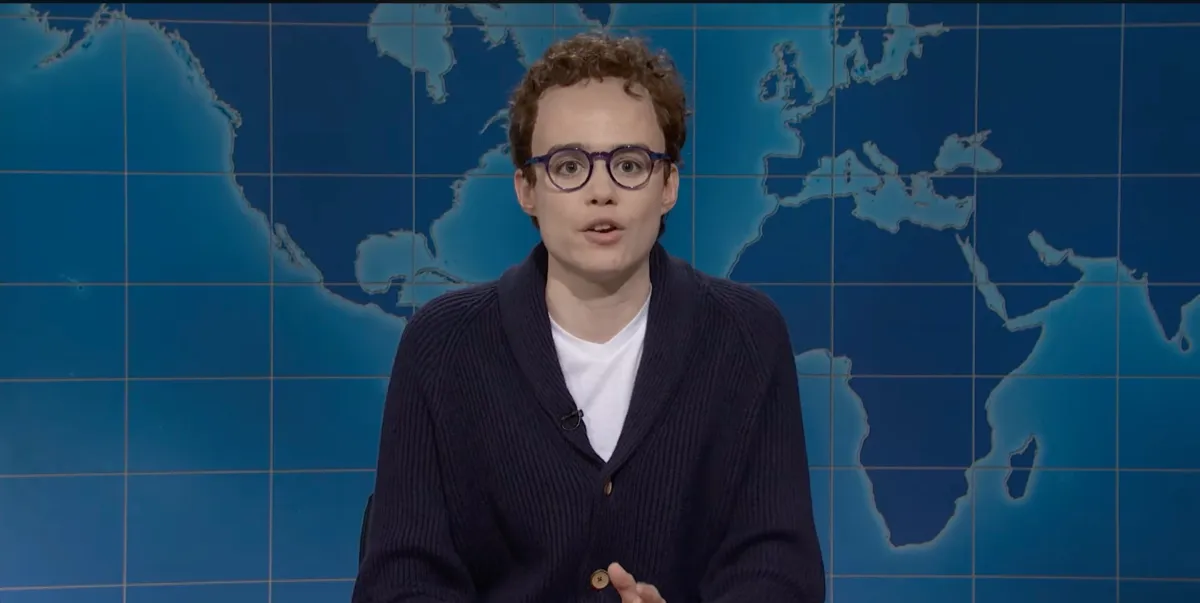
In the show’s Weekend Update segment, cast member Jane Wickline appeared as a fictionalized version of Amodei, complete with a wig, hesitant delivery and increasingly absurd self-contradictions. The sketch riffed on the way the Anthropic chief has drawn attention after suggesting that artificial intelligence could threaten humanity, and it used that premise to satirize the uneasy mix of alarm, optimism and self-justification that now defines the AI industry.
What did Saturday Night Live say about Dario Amodei?
Saturday Night Live portrayed Amodei as a tech executive whose warnings about AI sound both sincere and strangely theatrical. The segment framed him as someone who had recently been on a press tour in which he appeared to lend credibility to the idea that artificial intelligence could eventually wipe out human civilization.
That setup gave Wickline room to deliver a deliberately unstable version of the Anthropic CEO, one that shifted from earnest explanations to darkly comic admissions. The joke landed not only on Amodei himself, but also on the broader AI industry, which often insists that its products are both revolutionary and potentially dangerous at the same time.
The sketch presented the fictional Amodei as simultaneously warning about AI’s danger and behaving like a participant in the very systems he claimed to fear, underscoring the contradiction at the center of the joke.
Michael Che introduced the bit during Weekend Update and appeared to stumble slightly over the CEO’s last name, which only added to the comic effect. From there, the segment leaned into the idea that Silicon Valley leaders are increasingly making public claims about existential risk while continuing to build and deploy AI products at breakneck speed.
How did the sketch turn AI safety into comedy?
The sketch turned AI safety into comedy by exaggerating the tension between moral concern and commercial momentum. Wickline’s version of Amodei spoke as if he were morally tormented by the technology he helps create, making the character sound like a reluctant participant in a dangerous experiment rather than a confident executive.
At one point, the performance slid into a Gollum-like split personality routine, emphasizing an inner conflict between professional ambition and ethical dread. That stylistic choice made the joke easy to follow: the more Amodei’s public warnings suggest anxiety, the more the sketch implied that AI executives remain deeply invested in the systems they say could be harmful.
The parody also poked fun at the way some AI leaders discuss their work in grand, world-historical terms. By making the fictional Amodei speak as if he were both the prophet and the architect of doom, SNL captured a recurring criticism of the industry: that it speaks in the language of caution while continuing to race forward.
Key lines from the parody
The sketch included a series of exaggerated statements that distilled the satire into bite-sized lines. Among the most striking was the admission that “AI is the devil,” followed by the claim that the speaker was the one who made it. That line reframed the executive not as a detached observer, but as a creator wrestling with the consequences of his own work.
Another punchline cast AI as a technology that executives supposedly do not endorse even as they build and market it. The line captured the contradiction often raised in real-world debates: companies insist they are acting responsibly while simultaneously pushing systems that can be used in ways they cannot fully control.
The sketch also took aim at the hopeful rhetoric surrounding AI’s benefits. When the fictional Amodei discussed the possibility that the technology might help cure cancer, the joke was not that AI cannot improve medicine, but that the industry’s promises are often framed in sweeping, almost messianic terms.
Why is Dario Amodei such a prominent figure in the AI debate?
Dario Amodei is such a prominent figure because he leads Anthropic, one of the most closely watched companies in the AI sector, and because he has repeatedly spoken about the possibility that advanced AI systems could do profound harm. That combination of influence and alarm has made him a central character in the public discussion about AI safety.
Anthropic has positioned itself as an AI company that pays close attention to safety, alignment and control, which has earned it a different reputation from some of its rivals. But as the technology becomes more powerful and more commercially valuable, even companies that emphasize caution are under pressure to ship products, raise capital and compete aggressively.
Amodei’s comments have attracted attention because they reflect a larger shift in the industry. A few years ago, warnings about catastrophic AI risk were mostly confined to researchers and long-term futurists. Today, some of the most visible companies in the field are openly discussing existential danger, and that has become part of the public narrative around the technology.
From boardrooms to late-night television
Once an AI executive becomes part of mainstream cultural conversation, satire tends to follow. SNL has a long history of transforming business figures, politicians and tech founders into recognizable comedic archetypes, and Amodei now joins the list of Silicon Valley leaders whose public statements have crossed into late-night parody territory.
The fact that the sketch aired at all says something about how far AI has moved beyond niche industry coverage. It is now a topic that can anchor a Weekend Update joke, which means the public is familiar enough with the basic storyline to understand the satire: the industry says the stakes are enormous, but it keeps accelerating anyway.
What does the joke reveal about public attitudes toward AI?
The joke reveals that many viewers are skeptical of how AI leaders describe their own technology. The humor depended on a shared assumption that executives can sound both alarmed and self-interested at the same time, and that those two impulses are not easy to reconcile.
That skepticism has grown as companies race to release more capable systems while simultaneously warning about misuse, job disruption, misinformation and broader social harm. For many observers, the contradiction is not just funny; it is the defining feature of the current AI era.
SNL’s parody also suggests that the public no longer sees AI as a distant, abstract innovation. Instead, it is a real force with economic, political and cultural consequences. That shift in perception helps explain why a skit about one CEO can resonate beyond the tech world.
In practical terms, satire often acts as a shorthand for broader social frustration. By exaggerating the rhetoric around AI doom, the sketch gave audiences permission to laugh at a debate that can otherwise feel intimidating, jargon-heavy and grim.
How does this fit into SNL’s history of tech satire?
This fits into SNL’s long-running habit of turning new technologies and their public champions into comedy targets. The show has repeatedly mocked the language of innovation, the ego of founders and the habit of overstating the social benefits of emerging products.
Over time, the tech industry has supplied the show with a steady stream of material: social media misfires, app culture, startup hype and billionaire behavior. AI is simply the latest subject to receive that treatment, but it is an especially rich target because the stakes are both futuristic and immediate.
The Anthropic sketch also echoes earlier SNL jokes about other high-profile tech companies and products. When a technology becomes part of the cultural bloodstream, it becomes fair game for parody, particularly if its leaders are making sweeping claims about humanity’s future.
Why the AI industry keeps attracting parody
The AI industry keeps attracting parody because it combines massive ambition with deep uncertainty. Executives promise transformative gains, while critics warn of bias, labor disruption, surveillance, misinformation and worst-case catastrophic outcomes. That gap between promise and peril is tailor-made for comedy.
There is also an inherent theatricality to AI discourse. The field uses grand language about intelligence, agency, alignment and superhuman capability, which can sound more like science fiction than product marketing. That gives writers and performers a lot of room to exaggerate without straying far from reality.
In that sense, the SNL sketch was not just a joke about one man. It was a commentary on the tone of the entire sector.
What happened in Amodei’s recent public appearances?
Amodei’s recent public appearances have drawn attention because he has spoken in ways that appear to acknowledge the possibility of serious harm from AI. According to the SNL framing, he had been on a press tour in which he seemed to agree with a former employee’s claim that the technology could destroy humanity.
That kind of language is unusual in corporate communications, where leaders typically emphasize safety, responsibility and future benefits without dwelling too long on existential outcomes. But AI executives increasingly find themselves asked not only what their systems can do, but what could go wrong if they become much more capable.
For a company like Anthropic, this is a delicate balancing act. The firm wants to be seen as thoughtful and safety-oriented, yet it still has to compete in a market where progress, product releases and investor confidence all matter.
Why these warnings matter beyond the joke
These warnings matter because they shape policy discussions, public trust and the direction of AI development. When major executives publicly say that advanced AI could be dangerous on a civilizational scale, those remarks can influence regulation, research priorities and corporate strategy.
At the same time, such warnings can also create confusion. If the people building the systems believe the risk is so severe, observers naturally ask why the products are still being deployed so quickly. That tension is one reason the issue resonates so strongly in both news coverage and satire.
Timeline: AI warnings meet pop culture
The following timeline shows how AI safety concerns have moved from specialist debates into mainstream entertainment, culminating in the latest SNL sketch about Anthropic’s CEO.
| Period | Development | Why it matters |
|---|---|---|
| Early AI boom | Public attention centered on rapid model releases and chatbot adoption. | AI shifted from research topic to consumer technology. |
| Safety concerns grow | Researchers and executives begin speaking more openly about existential and societal risks. | The debate expands beyond product performance to long-term consequences. |
| Anthropic rises | The company becomes known for safety-focused messaging and high-profile leadership. | Dario Amodei becomes one of the industry’s most visible warning voices. |
| Public debate intensifies | Media coverage increasingly covers both AI breakthroughs and catastrophic risk claims. | The issue becomes familiar to general audiences, not just insiders. |
| SNL sketch airs | Weekend Update parodies Amodei and the AI doom narrative. | Mainstream comedy reflects how central AI anxiety has become in culture. |
What does this mean for Anthropic?
The sketch is unlikely to change Anthropic’s business directly, but it does illustrate how recognizable the company and its CEO have become. Being satirized on SNL is a sign of cultural visibility, and in the tech world, visibility can be both an asset and a liability.
On one hand, it helps Anthropic stand out in a crowded field. On the other hand, it places the company under a spotlight that can amplify every contradiction in its public messaging. When a firm markets itself as safety-conscious while operating in a fiercely competitive market, comedy writers have plenty to work with.
For competitors, the sketch also reinforces a broader truth: AI leadership is now a public role as much as a technical one. CEOs are no longer just managing products and teams. They are also managing narrative, reputation and expectations about the future.
How should viewers interpret the satire?
Viewers should interpret the satire as both a joke and a form of commentary. SNL was not presenting a factual report about Anthropic or Amodei’s internal views; it was distilling a real public debate into a comedic frame that exaggerates contradictions for effect.
The sketch works because it borrows from real anxieties. AI could produce huge benefits, including in medicine, but it also raises difficult questions about control, accountability and unintended consequences. Comedy tends to become sharper when it starts from something the audience already finds unsettling.
That is why the skit feels relevant even beyond one weekend’s entertainment cycle. It reflects a cultural moment in which AI is no longer just a product category. It is a source of humor, fear, speculation and scrutiny all at once.
Bottom line
Saturday Night Live’s parody of Dario Amodei shows that AI safety debates have crossed into the mainstream in a big way. The sketch turned Anthropic’s CEO into a symbol of the industry’s contradictions: warning about danger while helping build the technology at the center of those warnings.
That is why the joke landed. It was not just about one executive or one company. It was about a whole industry trying to convince the public that its technology is both transformative and under control — even as its own leaders suggest the future may be far more dangerous than most people are prepared to imagine.
As AI continues to shape business, politics and culture, expect more of these moments where late-night television becomes a mirror for the debate happening in boardrooms, research labs and regulatory hearings.
| Theme | SNL’s framing | Broader takeaway |
|---|---|---|
| AI risk | Potentially existential | Public anxiety about unchecked technological power |
| Executive messaging | Conflicted and self-contradictory | Leaders face pressure to warn and innovate at once |
| Industry reputation | Funny, uneasy, and overblown | AI is now a mainstream cultural subject |
| Anthropic’s profile | High enough to be parodied | The company has become a key player in the AI debate |
Frequently asked questions
Why did Saturday Night Live parody Dario Amodei?
Saturday Night Live parodied Dario Amodei because his recent comments about AI risk made him a natural target for satire. The sketch used his warnings about possible catastrophic outcomes to mock the tension between AI safety messaging and the industry’s rapid push to build and sell more powerful systems.
What did the SNL sketch say about AI?
The SNL sketch suggested that AI executives speak about danger while still helping create the technology. By making Amodei’s character sound conflicted and extreme, the show turned AI safety debates into a joke about hypocrisy, hype and the industry’s uneasy relationship with its own products.
Who is Dario Amodei?
Dario Amodei is the CEO of Anthropic, one of the most prominent AI companies in the market. He has become a major voice in debates over AI safety and the possibility that advanced systems could create serious societal or even existential risks.
Does the sketch reflect real concerns about AI?
Yes, the sketch reflects real public concerns about AI, including fears about misuse, lack of control and long-term safety. It exaggerates those concerns for comedy, but it works because many viewers already recognize the contradiction between AI leaders’ warnings and their aggressive product development.