In short
Reliance Industries is rolling out AI features across phone calls, mobile apps and connected homes as Mukesh Ambani pushes the company deeper into India’s AI race. The move pairs new consumer products with sector-specific tools and an IPO update for Jio Platforms.
- Reliance unveiled Jio Call Agent, an AI assistant embedded in phone calls for transcription, summaries and task handling.
- The company also launched AI features for MyJio and a home device called TeleFrame for proactive household alerts.
- Reliance is expanding into AI for healthcare, education, agriculture and small business with multilingual products.
- The push comes as India’s corporate giants race to build domestic AI capability and reduce dependence on foreign models.
- Jio Platforms’ board approved a draft IPO prospectus, adding financial pressure and strategic importance to the AI push.
India’s largest conglomerate is making a clear bet that artificial intelligence will not remain a separate product category for long. Instead, Reliance Industries wants AI woven into the most ordinary parts of daily life: phone calls, mobile apps, home displays, and eventually a range of services that touch everything from healthcare to farming.
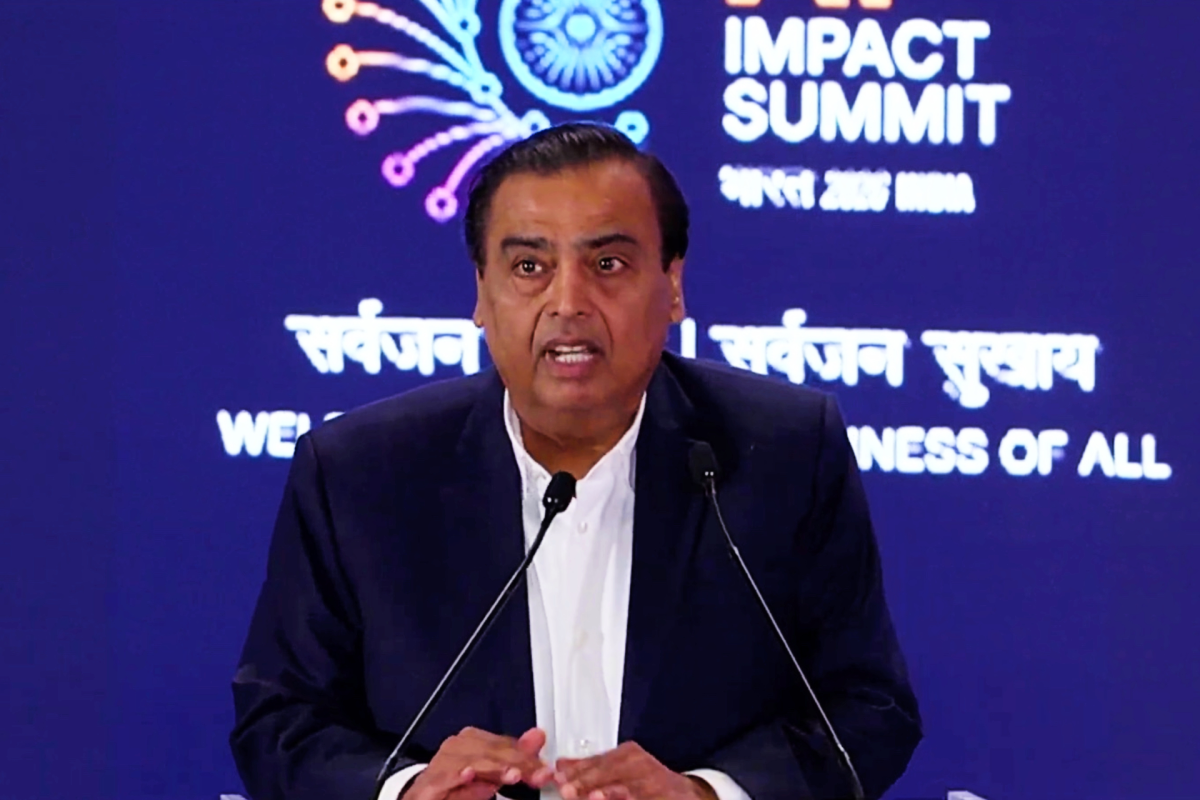
At its annual shareholder meeting on Friday, billionaire Mukesh Ambani used the stage to show how aggressively Reliance is moving to turn that vision into a business. The company introduced a phone-call assistant, a new AI-powered version of its consumer app, and a connected home display designed to surface reminders, alerts and recommendations before users ask for them.
The strategy is about more than product launches. It reflects a larger attempt by Reliance to position itself as India’s domestic answer to the global AI race at a time when the country’s biggest companies remain reliant on foreign model providers and cloud infrastructure. It also underscores the scale of the opportunity: Reliance’s telecom arm, Jio, serves more than 500 million users, giving the company a distribution platform that few rivals in India can match.
A national push to build AI at home
Ambani has repeatedly framed AI as a strategic capability India should not outsource. In remarks at the meeting, he argued that the country must move beyond being an end user of imported technology and become a builder of AI systems as well.
Ambani said India should not simply consume AI built elsewhere, but should become a creator, adopter and global leader in the field.
That message fits neatly into the company’s broader pitch: Reliance wants to be seen not just as a telecom operator or retail giant, but as a national technology platform capable of shaping how Indians work, communicate and manage household life.
The timing is important. India’s AI market is expanding fast, but most of the foundational technology still comes from the United States or China. For large Indian firms, that creates both opportunity and risk. Access to leading models can change quickly depending on policy decisions, commercial terms or platform restrictions abroad. Reliance’s answer is to build more of the stack itself.
Jio Call Agent brings AI directly into the phone network
The most eye-catching announcement was Jio Call Agent, an AI assistant that can join live calls and turn conversations into useful outputs. Reliance said the tool will be able to transcribe phone conversations, generate summaries and handle practical tasks such as booking cabs, ordering food or making reservations.
Users will be able to trigger the assistant with a voice prompt that starts with “Hey Jio,” according to the company. Reliance said it expects the service to roll out later this year to Jio’s vast user base.
What makes the product notable is not only its feature set, but where it sits. Rather than introducing another standalone app that users must download, manage and remember to open, Jio Call Agent is being embedded into the telecom network itself. That gives Reliance a potentially powerful advantage: AI support becomes part of the call experience, not an extra layer on top of it.
This approach could also help Reliance reduce dependence on the fragmented market for third-party call assistants and capture more of the user relationship inside its own ecosystem. In a market where convenience often determines adoption, network-native AI may prove more compelling than a separate chatbot interface.
Why call-based AI matters in India
India still relies heavily on phone calls for everyday tasks, especially outside the largest cities. Many users prefer calls over apps for arranging transport, confirming appointments or making reservations. If Jio Call Agent works as described, it could fit naturally into that behavior instead of trying to replace it.
That local fit could matter more than flashy features. In markets where smartphone adoption is broad but digital habits vary widely, the best AI product is not always the most advanced one. It is often the one that meets people in the channel they already use.
MyJio gets a conversational overhaul
Reliance also introduced an AI-enabled version of its MyJio application. The company said users will be able to make requests in natural language and have the app perform tasks on their behalf, including activating eSIMs and choosing roaming plans.
That may sound modest compared with the more ambitious promise of AI call handling, but it points to the same strategy: reduce friction by letting users ask for outcomes rather than navigate menus. Instead of tapping through multiple screens, a customer could simply describe what they want and let the system carry out the steps.
For a telecom company with hundreds of millions of customers, even small reductions in support friction can matter. Tasks like SIM activation, plan changes and roaming selection are repetitive, high-volume interactions. Automating them with AI could cut service costs while improving convenience for users.
It also helps Reliance deepen its control over the customer experience. If AI becomes the first layer of interaction inside MyJio, the company can potentially guide users more efficiently toward its own services and bundled products.
TeleFrame points to an AI future inside the home
Beyond mobile and calls, Reliance unveiled TeleFrame, a home display designed to act more like an ambient assistant than a passive screen. The company says it uses AI agents to proactively show useful information such as weather alerts, schedules and household reminders.
The concept echoes a wider industry race to create devices that understand context and surface information before users even ask. Amazon and Google have both spent years trying to make smart speakers, screens and home assistants feel more natural and more predictive.
TeleFrame suggests Reliance wants a stake in that same category, but adapted for the Indian market and tied to its own service ecosystem. If the product gains traction, it could become a domestic alternative in a space where most of the leading hardware and software platforms remain controlled by U.S. companies.
The challenge will be adoption. Smart home devices still face a mixed reception in many households, where price sensitivity, privacy concerns and unclear utility can slow uptake. But Reliance has an advantage there too: it can bundle services across telecom, entertainment, retail and home connectivity in ways most rivals cannot.
AI services tailored to Indian sectors
The shareholder meeting was not limited to consumer gadgets. Reliance also outlined a broader set of AI products aimed at major sectors in the Indian economy, including healthcare, education, agriculture and small businesses.
The new offerings were branded JioHealthIQ, JioLearnIQ, JioKrishiIQ and AI Vyapar. Reliance said the tools are designed to support multiple Indian languages and address local use cases.
That multilingual emphasis is significant. India’s market is not defined by a single language or a single digital habit. A successful AI platform in the country has to work across regional languages and adapt to uneven levels of digital literacy. A system built only for English-speaking urban users would leave much of the population behind.
By targeting sectors that matter to everyday life and business formation, Reliance is also trying to move beyond generic chatbot functionality. Healthcare triage, school assistance, crop guidance and merchant support are all areas where AI may produce concrete value if deployed well. They are also areas where localized data and distribution could become major advantages.
Why these verticals matter
- Healthcare: AI tools could help patients navigate appointments, records and health guidance.
- Education: Tutoring and learning support may be adapted to different languages and curricula.
- Agriculture: Farmers could receive weather, crop and market information in usable form.
- Small business: Merchants may benefit from assistance with payments, operations and customer management.
Each of those sectors is large enough to support a meaningful business on its own. Together, they point to Reliance’s ambition to build a broad AI platform rather than a single headline product.
Reliance’s AI strategy is also a network strategy
One of the clearest themes in Friday’s announcements was distribution. Reliance is not starting from scratch. It already has telecom scale, consumer apps, retail reach and deep relationships across India’s digital economy.
That matters because AI products often struggle not on technical capability, but on customer acquisition. A well-known company can place a new assistant in front of users far faster than a startup can, especially when it controls billing relationships, mobile access and app ecosystems.
Reliance is essentially using its scale as a launchpad. Jio Call Agent sits inside the network. MyJio lives inside an app already used by millions. TeleFrame can connect to the home. Sector-specific tools can be layered into business or community services. The result is a more integrated strategy than the standalone chatbot model that has defined much of the consumer AI market so far.
That approach may also help the company collect feedback faster and refine products around actual usage patterns. Still, it raises one of the biggest unresolved questions in consumer AI: who owns the data, and how is it used?
Data governance and consent remain open questions
As Reliance expands AI into calls, mobile tasks and home devices, privacy and data policy become central issues. The company said the new services will operate with user consent, but it did not answer questions about whether the information generated through those products could be used to train AI systems or shared with partners.
That omission is likely to draw scrutiny. Call transcription, task automation and connected-home recommendations all depend on collecting and interpreting highly personal information. In a country where digital adoption is growing rapidly, the rules around consent, storage and model training will shape public trust.
For consumers, the practical question is simple: if an AI assistant listens to calls or analyzes household routines, what happens to that data after the task is completed? For regulators and privacy advocates, the concern is broader. Large-scale AI deployment inside telecom and home ecosystems could concentrate sensitive information in ways that are difficult to monitor.
Reliance’s willingness to address these issues publicly will likely become as important as the products themselves. The more AI becomes embedded in daily life, the more user trust becomes a competitive advantage.
Building an Indian AI stack instead of renting one
Reliance’s latest announcements sit against a larger backdrop: many Indian startups and enterprises still depend on foreign AI models and cloud services. That dependency can create uncertainty when access terms shift or when model availability changes unexpectedly.
Recent limits on access to some of Anthropic’s newer models have highlighted that vulnerability. For companies building AI products in India, a decision made in another country can alter what is possible almost overnight.
That is one reason Indian conglomerates are now pushing to own more of the stack. It is not just about prestige or speed. It is about control, resilience and the ability to serve a massive domestic market without being exposed to every external policy shift.
Reliance appears to understand that. Its AI push is not only a product strategy; it is a supply-chain strategy for the digital age.
| Announcement | What it does | Primary users | Expected impact |
|---|---|---|---|
| Jio Call Agent | Joins calls, transcribes, summarizes and completes tasks by voice command | Jio mobile users | Turns phone calls into an AI-powered service layer |
| AI MyJio app | Handles requests in natural language, including eSIM and roaming actions | Mobile subscribers | Reduces friction in common account and plan management tasks |
| TeleFrame | Displays proactive alerts, reminders and recommendations at home | Households | Pushes Reliance into ambient AI for connected homes |
| JioHealthIQ, JioLearnIQ, JioKrishiIQ, AI Vyapar | AI tools for healthcare, education, agriculture and small business | Consumers and enterprises | Extends AI into high-value Indian sectors with local language support |
| Jio Platforms IPO plan | Board approved draft prospectus for a public offering | Investors | Creates a major capital-markets event tied to Reliance’s growth story |
Partnerships with big tech are central to the plan
Reliance is not pursuing this transformation alone. The company has been building AI partnerships with some of the biggest names in global technology, including Google, Meta and Nvidia.
Those relationships matter for several reasons. Google brings cloud and digital ecosystem expertise. Meta offers AI collaboration and consumer technology reach. Nvidia supplies critical hardware for training and running advanced models. Together, they help Reliance bridge the gap between ambition and infrastructure.
Last week, Reliance said it would work with Meta to establish an AI data center in Gujarat. That expands on Meta’s earlier investment in Jio Platforms and a joint venture launched last year to develop enterprise AI tools for India and overseas markets.
The message to the market is clear: Reliance wants to be a local owner of AI distribution and infrastructure, but it is still comfortable using global partners to accelerate execution.
A crowded field is taking shape
Reliance is not the only Indian corporate group trying to define the country’s AI future. Tata Consultancy Services, Infosys and the Adani Group have all expanded their own AI partnerships and initiatives. Their collaborators include Anthropic, Google and OpenAI.
That competition suggests India’s largest corporations now see AI as a strategic layer that will affect every major sector, from cloud infrastructure and enterprise software to consumer services and industrial operations.
For startups, that could mean more opportunities to plug into large corporate ecosystems — but also more competition from incumbents with bigger distribution channels and deeper capital reserves.
The IPO backdrop raises the stakes
Friday’s meeting also brought an important update for investors waiting for a Jio listing. Ambani said the board of Jio Platforms had approved a draft prospectus for an initial public offering that would include a fresh issue of up to 270 million shares, according to a stock exchange filing.
The proposed offering adds another layer to Reliance’s AI push. A public market debut would put even more attention on the company’s growth trajectory and its ability to develop new revenue engines beyond telecom and core consumer businesses.
That pressure matters. Reliance’s shares have fallen about 17% this year, which means investors are likely to scrutinize every initiative that can support future valuation. AI, in that context, is not just a technology story. It is part of the company’s answer to a harder question: where will the next phase of growth come from?
Jio’s market debut has long been anticipated. If and when it happens, the listing will likely be judged not only on subscriber strength, but on whether Reliance has turned Jio into a platform with durable tech ambitions.
What comes next for Reliance’s AI push
Reliance has now moved from broad AI rhetoric into more concrete product execution. But the road ahead will determine whether the company becomes a genuine AI platform leader or simply another large enterprise trying to attach AI branding to existing services.
Several factors will shape the outcome:
- Product usefulness: The tools must solve real problems better than current alternatives.
- Language support: Multilingual performance will be critical in reaching users across India.
- Privacy trust: Users will need confidence that calls and household data are handled responsibly.
- Distribution: Reliance’s telecom and app ecosystem gives it a rare rollout advantage.
- Infrastructure scale: The company will need enough computing power and partner support to sustain growth.
If those pieces come together, Reliance could play a central role in making AI feel less like a novelty and more like a utility across Indian life.
If they do not, the company risks overpromising in a market that is already crowded with AI claims and still uncertain about what consumers actually want.
The bigger picture
What Ambani unveiled this week is best understood as a blueprint for how a telecom-and-retail giant can try to become an AI-era platform company. The playbook is familiar in some ways: build distribution first, add services, partner where needed and use scale to lock in users. What is new is the ambition to put AI in the middle of calls, apps and homes rather than treat it as a separate product.
That ambition is tied to a larger national story. India wants to be more than a market for imported AI. It wants domestic champions that can build, deploy and export technology at scale. Reliance clearly sees an opening to help define that future — and to profit from it.
For now, the company has shown its hand. The next question is whether Indian consumers, businesses and regulators will accept Reliance’s invitation to let AI into nearly every corner of daily life.