Updated July 29, 2026 12:53 pm
In short
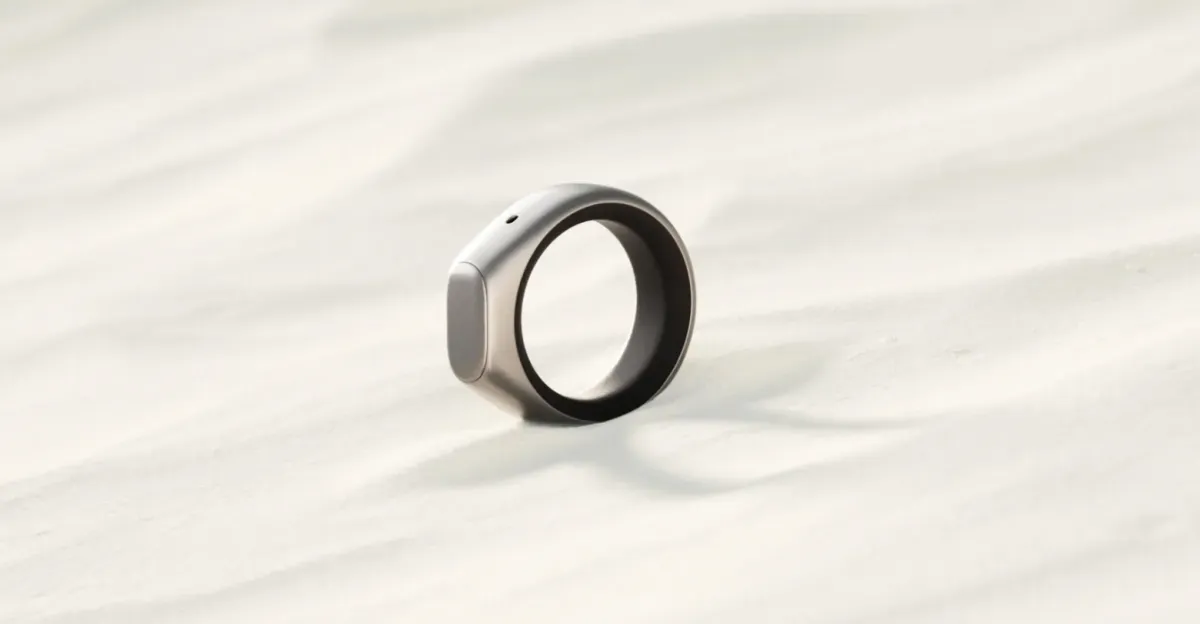
Sandbar says its Stream AI ring is set to ship later this year, and the company is positioning it as a cross-device dictation tool amid early competition from other AI rings.
- Smart rings may solve the friction of phone-based voice input by making dictation nearly instant.
- Sandbar’s Stream ring is designed for personal note capture, AI chat, and text entry across devices.
- The category is distinct from AI recorders because it focuses on the wearer’s own speech, not room capture.
- Privacy, battery life, and software integration will determine whether the category catches on.
Update — July 29, 2026 12:53 pm
Sandbar now says the Stream ring is due to ship later this year, giving the device a timeline that was not in our original report.
The updated demo also frames Stream as a broader dictation tool: the company wants it to send text to whatever apps and devices a user already relies on, not just Sandbar’s own software. In the demonstration, that included a smooth handoff between a Mac and an iPhone after a firmware update.
The Verge also points to a few other AI ring efforts already in progress, including Pebble founder Eric Migicovsky’s Index 01 and Vocci, which is aimed more at meetings.
Update — July 28, 2026 3:55 pm
Sandbar now says the Stream ring is scheduled to ship later this year, adding a concrete timeline that was not included in our original story.
The updated demo also emphasized a broader dictation goal: the ring is being positioned to work across all of a user’s devices, not just inside Sandbar’s own app.
The Verge piece also notes that other AI ring efforts are already underway, including the Index 01 from Pebble founder Eric Migicovsky and a more meeting-focused device called Vocci.
Smart rings are emerging as a more practical AI gadget than smart glasses or pins because they let people dictate, take notes, and talk to assistants with minimal friction. A new demo from Sandbar suggests the category could become one of the clearest examples yet of how voice-first AI is moving from novelty to useful everyday input.
For the past few months, I have been spending a lot of time speaking to computers. The biggest change brought on by large language models is not just better answers, but a dramatic improvement in speech-to-text tools, which are now good enough to handle quick emails, chat messages, reminders, and notes without much correction. A growing number of apps can capture speech accurately and quickly, but a recent demo of Sandbar’s Stream smart ring made the case that the best interface for talking to AI may not be a phone screen or a headset at all. It may be a ring worn on a finger.
Why smart rings are suddenly getting attention
Smart rings are getting attention because they solve one of the most annoying problems in modern computing: the cost of capturing a thought before it disappears. Phones are powerful, but they are awkward for this job. You have to pull one out, unlock it, find the right app, start a note or message, and then type. If you are walking, commuting, or just trying to stay in the flow of a conversation or task, that sequence can feel too slow to bother with.
Voice input changes that equation, but most voice tools still ask too much of the user. Speaking into earbuds in public can feel intrusive, while talking to a laptop in a café or on a train is often impractical. Smart rings offer a different model: bring your hand to your mouth, press a touch surface, and speak quietly. The gesture is small, private, and fast enough to encourage use in the moments when ideas are most likely to slip away.
That is the central promise behind the Stream ring from Sandbar, a New York startup led by CEO Mina Fahmi. The company is pitching the device not as a phone replacement, but as a subtle companion that captures voice and routes it to the tools people already use. In a market crowded with AI gadgets that record meetings or act as portable summaries, Stream is trying to narrow the focus to the user’s own voice and the user’s own intent.
How does the Stream ring work?
The Stream ring works by combining a microphone, a battery, Bluetooth connectivity, and a touch-sensitive control surface into a device worn on the finger. In practice, it is designed to do three main things: start an AI conversation, capture notes, and dictate text into another device or app.
During a demonstration at Sandbar’s New York office, Fahmi showed how quickly the ring could handle dictation. He opened Apple Notes, activated the ring by touching it with his thumb, spoke a few words, and had two accurate sentences appear almost immediately in the note. The demo suggested the ring can serve as a fast alternative to typing, especially for short bursts of thought.
Fahmi’s pitch, as demonstrated in the office, was that the ring can quietly capture spoken thoughts and move them into digital text with surprisingly little effort from the user.
One of the more interesting claims about the device is its whisper mode. Fahmi reportedly spoke so softly during the demo that the words were barely audible in the room, yet the ring still transcribed them correctly. If that reliability holds up in real-world use, it could make the product useful in public settings where people want voice input without drawing attention.
Sandbar is also testing a future in which the Stream is not trapped inside its own app. The longer-term goal is for the ring to work across multiple services and devices, sending dictation to whatever note app, text field, or assistant the user prefers. In one part of the demo, Fahmi flashed new firmware onto the device, connected it to both a Mac and an iPhone, and switched between them smoothly while dictating. The company did not spell out the technical method behind that handoff, but the result appeared seamless.
Key Stream features at a glance
| Feature | What it does | Why it matters |
|---|---|---|
| Voice dictation | Turns spoken words into text | Speeds up note-taking and messaging |
| AI chat access | Starts conversations with an assistant | Reduces reliance on the phone screen |
| Note capture | Saves ideas quickly in the companion app | Prevents thoughts from getting lost |
| Whisper mode | Recognizes very quiet speech | Improves privacy in public spaces |
| Cross-device input | Can route text to different devices | Makes the ring more useful than a single-app recorder |
What makes this different from other AI recorders?
The Stream stands apart from a wave of AI recorders because it is not trying to capture everyone around you. Many of the current products in this space are built around meetings, phone calls, and group conversations. They are often sold as tools that can record a room, summarize a discussion, and extract action items later. Companies including Plaud, Pocket, FoCase, and Mobvoi have all pushed portable recorders in this direction.
Sandbar’s ring, by contrast, is intentionally more inward-facing. It is meant to preserve the user’s own ideas, reminders, and messages rather than turn the wearer into a mobile recorder. That makes it less about surveillance or transcription at scale and more about a personal input system that happens to use AI in the background.
That distinction matters. A device that records other people can quickly raise privacy concerns, while a device that simply helps its wearer speak to their own software is easier to explain and more likely to feel socially acceptable. It is also more aligned with the way many people actually use AI today: not for grand automation, but for small, repeated tasks such as drafting a text, writing down a thought, or asking a question without opening a laptop.
Why the phone may not be the best AI interface
The phone remains central to most people’s digital lives, but it is not especially good at rapid input. It is optimized for consumption and navigation, not for capturing thoughts at speed. Even with excellent speech-to-text systems, the act of starting a recording or note still usually depends on unlocking a device and launching the right software.
That workflow is cumbersome enough to discourage use. The problem becomes more obvious in motion, when hands are occupied, or when the thought arrives in a moment that is hard to interrupt. Smart rings try to remove that barrier by keeping the capture mechanism always on hand, physically close to the mouth, and ready with a tap.
There is also a social advantage. A finger-sized microphone is less conspicuous than speaking into a headset or phone. It does not require the wearer to look like they are in a call, and it avoids the visual awkwardness of talking to an AI assistant out loud in front of others. In that sense, the ring is not just a new gadget; it is a new posture for computing.
Who else is building voice rings?
Several companies are exploring the same idea, which suggests the category is still at an early stage but drawing serious interest. Pebble founder Eric Migicovsky has built the Index 01, another ring shaped around capturing thoughts, reminders, and notes as quickly as possible. Vocci is pursuing a more meeting-oriented take on the concept.
Existing health-focused ring makers may also move in this direction over time. Companies such as Oura and Ultrahuman already have hardware worn on the finger, sensors in place, and users accustomed to wearing rings every day. If they decide to add voice or AI features, they could bring those functions to a much larger installed base than a startup could on its own.
The idea is not technically dramatic on its face. A microphone is a simple component, and Bluetooth-to-phone connectivity is well understood. The hard part is everything behind it: transcription accuracy, latency, battery life, software integration, and the user experience of making the device feel instant rather than fussy. That complexity is what turns a simple sensor into a useful product.
How the Stream fits into the broader AI gadget boom
The Stream is part of a larger push to invent hardware around generative AI. In the last couple of years, companies have tried to sell AI in many forms: glasses, pins, wearables, pendant-style devices, and pocket recorders. Most of those efforts have struggled to find a compelling reason to exist alongside a smartphone.
What makes the ring category stand out is that it does not aim to replace the phone. Instead, it attempts to reduce the amount of time users spend interacting with it. That is a much more realistic goal. Rather than asking people to switch ecosystems or abandon familiar apps, the ring seeks to make the existing ecosystem easier to use.
This may be the strongest argument for voice-native wearables. If AI is going to be useful in everyday life, it should probably work in the brief, messy moments between bigger tasks. Rings are interesting because they live exactly there: always available, rarely intrusive, and physically positioned where a quick spoken command feels natural.
What the market is still trying to learn
Even with the promise, the market still has unanswered questions. Consumers will need to decide whether they are comfortable speaking to a ring in public, whether battery life is good enough for daily use, and whether the software can avoid becoming just another walled-off companion app.
There is also the issue of trust. Users will want to know where audio goes, whether it is stored, and how much of the process happens on-device versus in the cloud. Those questions are especially important in a category that relies on recording speech and turning it into text.
Adoption will likely depend on whether the experience feels genuinely faster than pulling out a phone. If the answer is yes, the product has a clear use case. If not, it risks becoming another clever demo that never becomes habit.
What the demo suggests about the future of AI input
The most compelling part of the Stream demonstration was not the ring itself, but the idea behind it: the next big breakthrough in AI hardware may come from better input, not better output. Most current AI devices emphasize listening to the world, summarizing meetings, or producing responses. Sandbar is arguing that a device should primarily help people express themselves faster.
That is a subtle but important shift. It reframes AI from a tool that watches and explains to one that captures and converts. In everyday life, that could prove far more useful. The common user problem is not that machines fail to generate enough content; it is that humans cannot get their own thoughts into digital form quickly enough.
Speech remains the most natural shortcut. By shrinking the microphone into a ring, Sandbar is betting that people will use it more often because it is always in the right place at the right time. The company’s larger promise is simple: if you can speak a note in a second or two instead of navigating a phone, the device has already saved you time and friction.
What happens next?
The Stream is scheduled to ship later this year, but like many products in the AI hardware space, it still has to prove itself outside a controlled demo. The company will need to demonstrate that the ring is reliable, fast, and secure across real-world use cases, not just in an office setting with a polished presentation.
If it works, the product may help define a new category of personal AI input devices. If it does not, it will still have highlighted a broader truth about the state of consumer AI hardware: the winning device may be the one that makes the smallest possible demand on the user.
For now, smart rings are beginning to look like one of the more credible answers to the question of what AI hardware should be. They do not try to turn every surface into a display, every pair of glasses into a computer, or every bag clip into a sensor. They simply ask a modest question: what if the easiest way to talk to your devices was to do it from your finger?
| Company/Product | Main approach | Primary use case | Status |
|---|---|---|---|
| Sandbar Stream | AI ring with dictation and assistant access | Personal notes, voice input, text entry | Planned for later this year |
| Index 01 | Ring for quick idea capture | Reminders and notes | In development |
| Vocci | Ring focused on meetings | Meeting capture and summaries | In development |
| Plaud / Pocket / FoCase / Mobvoi | Portable AI recorders | Recording and summarizing conversations | Available or widely marketed |
Whether smart rings become the defining AI gadget or just another promising niche, they are making a strong case that the best new interface for AI may be the one people can wear without thinking about it.
Frequently asked questions
What is the Stream smart ring?
The Stream is a smart ring from Sandbar designed to capture voice, dictate text, and connect users to AI assistants. It uses a microphone, battery, Bluetooth, and touch controls to turn spoken thoughts into text with minimal effort.
Why are smart rings becoming interesting as AI gadgets?
Smart rings are becoming interesting because they can make voice input faster and less awkward than using a phone. They let people capture notes or speak to an assistant quietly and discreetly, which is especially useful while walking or in public.
How is Stream different from AI voice recorders?
Stream is different because it is built mainly for the wearer’s own speech rather than recording other people in meetings. That makes it more of a personal input tool than a room recorder or transcription device.
When will the Stream smart ring ship?
Sandbar says the Stream is scheduled to ship later this year. The company has already shown a working demo, but the product still needs to prove itself in everyday use before it can gain traction.
Could existing smart rings add AI features too?
Yes, existing smart rings could add AI features over time. Brands such as Oura and Ultrahuman already have finger-worn hardware and user bases, so they may eventually expand into voice capture or assistant controls.