In short
TechCrunch Disrupt 2026 will feature a Real World AI Stage session on how startups move from prototype to production. Founders from space communications, autonomy and AI infrastructure will discuss the challenges of scaling real products.
- Disrupt 2026 will host a session focused on scaling AI and deep-tech startups from prototype to production.
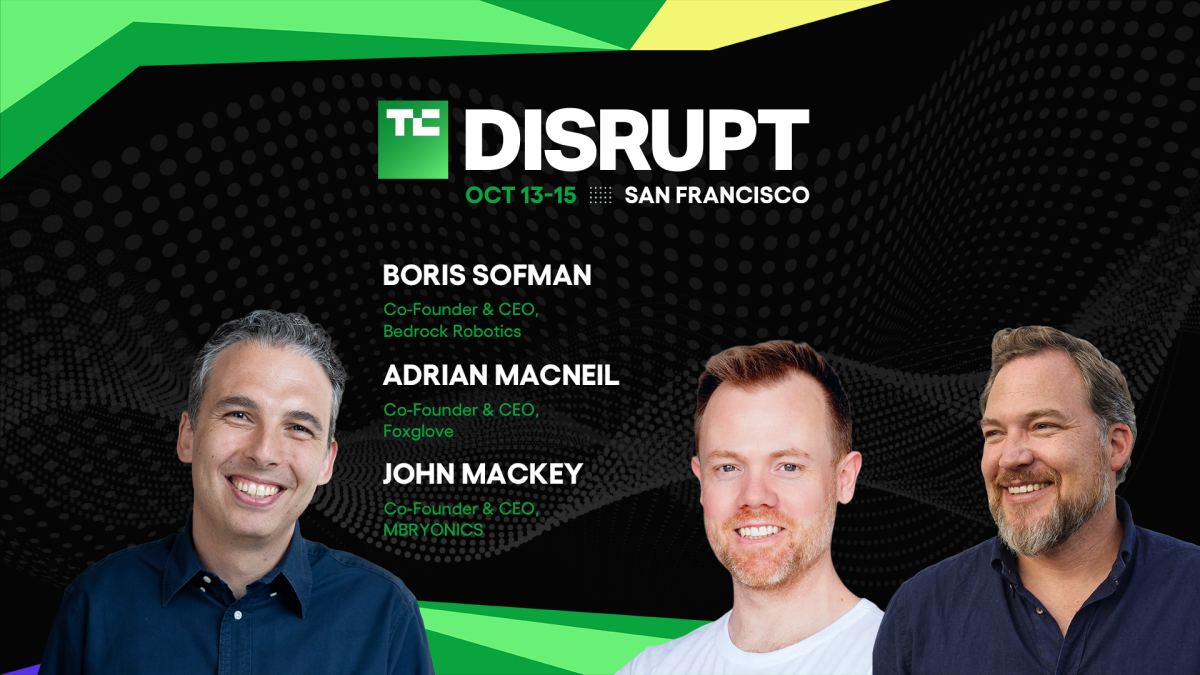
- The panel includes leaders from MBRYONICS, Bedrock Robotics and Foxglove.
- The discussion will center on manufacturing, reliability, infrastructure and deployment in real-world conditions.
- TechCrunch says the conference runs October 13-15 at Moscone West in San Francisco.
- The event reflects a broader shift in AI from impressive demos to production-grade systems.
TechCrunch Disrupt 2026 will put the spotlight on one of the hardest steps in artificial intelligence and advanced hardware: turning a flashy prototype into a product that can survive the real world. The session, From Prototype to Production: Can It Scale in Reality?, will take place at the Real World AI Stage in San Francisco on October 13-15 and is designed to show why the leap from demo to deployment matters so much.
As AI tools make it easier than ever to build impressive first versions, founders are facing a more difficult challenge: making systems reliable, manufacturable, and scalable enough for customers, investors, and operators to trust them outside a controlled lab.
Why prototype success is no longer enough
A polished prototype can win attention, raise capital, and validate an idea. But once a startup tries to ship at scale, the questions multiply quickly: Can the product be manufactured consistently? Can it run in messy, unpredictable environments? Can the surrounding software, infrastructure, and operations support real customers?
That is the central theme of TechCrunch’s Real World AI Stage discussion. Instead of focusing on what technologies can do in theory, the panel will examine what happens when a startup has to deliver dependable performance in the field, not just in a demo room.
The distinction matters because many AI and robotics companies now reach the prototype stage faster than ever. Building a proof of concept is often the easy part. Building a production system that customers can rely on is where many promising efforts slow down or fail.
What the Disrupt 2026 session will cover
From Prototype to Production: Can It Scale in Reality? will bring together founders and operators from three very different corners of technology: space communications, autonomous systems, and AI infrastructure. The point is not to offer one universal playbook. The point is to compare how scaling changes depending on the product, the market, and the technical constraints.
TechCrunch says the session will explore how teams move from promising innovation to production-ready deployment, with a special focus on the tradeoffs that emerge once a system has to work repeatedly in the real world.
How does production change the product?
Production changes the product because reliability becomes part of the product itself. A prototype can tolerate manual fixes, lab conditions, and one-off workarounds. A real product cannot.
Once a startup starts shipping, it must think about manufacturing quality, supply chains, support processes, data pipelines, monitoring systems, safety controls, and the costs of failure. In many cases, the engineering effort shifts from building the core invention to building the systems that make the invention usable at scale.
| Area | Prototype Stage | Production Stage |
|---|---|---|
| Goal | Prove the idea works | Deliver dependable value to customers |
| Environment | Controlled, limited testing | Real-world, unpredictable conditions |
| Engineering focus | Core functionality | Reliability, scale, operations, monitoring |
| Business challenge | Attract interest and validation | Manufacture, deploy, and support at scale |
| Risk profile | Technical feasibility | Safety, consistency, and customer trust |
Who is speaking at the Real World AI Stage?
The panel features three founders whose companies represent very different scaling challenges, each with lessons for startups trying to cross the same gap from demo to deployment.
John Mackey of MBRYONICS
John Mackey, co-founder and chief executive of MBRYONICS, has helped steer a specialized photonics company into the space communications market. His company has worked on optical communications systems for space, a field where production is not just about building a better gadget but about manufacturing sophisticated hardware with extreme reliability requirements.
MBRYONICS’ story highlights a common truth for deep-tech startups: when a prototype proves the concept, the next hurdle is often industrial. Teams must expand manufacturing capacity while preserving precision and performance.
According to TechCrunch’s description of the session, Mackey’s experience shows how moving from a prototype to a product can require building manufacturing capability at the same time as the technology itself.
Boris Sofman of Bedrock Robotics
Boris Sofman, co-founder of Bedrock Robotics, brings a different kind of scaling challenge to the discussion. Before launching the company, he played a major role at Waymo, where autonomous vehicles accumulated more than 100 million driverless miles. That background gives him firsthand experience with the transition from carefully managed testing to systems that must operate reliably in public, high-variance environments.
Autonomy is especially unforgiving. A vehicle, machine, or robot that works well in a test environment can still face a steep reality gap when it encounters weather, construction zones, traffic surprises, or variable human behavior. For robotics and autonomy companies, production is as much about safety engineering and operational discipline as it is about model performance.
TechCrunch says Sofman will discuss what it takes to scale autonomous systems while maintaining the consistency and reliability expected in everyday use.
Adrian Macneil of Foxglove
Adrian Macneil, co-founder of Foxglove, adds the infrastructure side of the conversation. Before Foxglove, he led engineering work at Cruise, where he helped develop the data systems that supported autonomous vehicles operating at scale.
His perspective underscores a point that many startups learn late: production success depends not only on the device, model, or vehicle, but also on the software and data infrastructure surrounding it. Logging, observability, debugging, playback, and analysis tools can be just as critical as the product itself.
TechCrunch says Macneil’s remarks will focus on the systems that allow complex technologies to move from experimentation into everyday deployment.
Why this panel matters for founders
The broader appeal of the session is that it reflects a universal startup problem. Whether a company builds satellites, robots, AI systems, or industrial tools, the journey from prototype to production almost always changes the organization.
At the prototype stage, founders often optimize for speed and proof. At production stage, they must optimize for repeatability, cost, uptime, support, and customer confidence. That transition can reshape hiring, capital needs, partnerships, timelines, and product strategy.
For founders attending Disrupt 2026, the discussion should be especially relevant because many AI-native startups are now trying to move beyond pilots and proofs of concept. Investors increasingly want evidence that a company can ship, not just demo.
What startups usually underestimate
- Manufacturing complexity, especially for hardware-heavy products
- The cost of supporting systems around the core product
- How much testing changes when a system leaves the lab
- The operational burden of monitoring and maintenance
- The time needed to earn customer trust in a live environment
How AI has changed the prototype-to-production gap
AI has compressed the time it takes to build convincing demos, but it has not eliminated the hard work of deployment. In some cases, it has made the gap more visible. A startup can now assemble an impressive model-driven product quickly, yet still face major obstacles when trying to turn that product into a dependable service or machine.
That is especially true in sectors where failure is expensive or dangerous. In robotics, autonomy, and infrastructure-heavy AI systems, teams must prove that their technology can keep working under stress, in changing conditions, and at a scale that makes the business viable.
Disrupt’s Real World AI Stage is therefore less about the novelty of AI itself and more about the operational realities that follow once a system starts handling customer expectations in the real world.
What founders can learn from space, autonomy, and infrastructure
Each speaker approaches the same problem from a different angle:
- Space communications shows how precision manufacturing and high reliability shape production.
- Autonomous systems show how deployment in open environments raises safety and consistency demands.
- AI infrastructure shows how software systems, data tooling, and observability can determine whether a product scales successfully.
Together, those perspectives illustrate that production is not a single milestone. It is a set of engineering, operational, and business transitions that startups must manage in parallel.
What is TechCrunch Disrupt 2026?
TechCrunch Disrupt 2026 is the company’s annual flagship startup conference, scheduled for October 13-15 at Moscone West in San Francisco. TechCrunch says the event will bring together more than 10,000 founders, investors, and operators across more than 250 sessions focused on emerging technologies and market shifts.
The conference has long served as a meeting point for startups seeking capital, visibility, and practical advice from experienced operators. This year’s emphasis on AI in the real world reflects how the industry has matured from fascination with demos to urgency around deployment.
For attendees, the value is not only in keynote-level discussions but in the operational lessons that come from founders who have already encountered the problems most startups are about to face.
| Event detail | Information |
|---|---|
| Event | TechCrunch Disrupt 2026 |
| Dates | October 13-15, 2026 |
| Venue | Moscone West, San Francisco |
| Expected attendance | 10,000+ founders, investors, and operators |
| Sessions | 250+ sessions |
| Featured topic | Prototype-to-production scaling in AI and deep tech |
What makes real-world AI different from a demo?
Real-world AI has to survive uncertainty. A demo often runs with hand-picked data, ideal conditions, and manual intervention behind the scenes. A deployed system has to function when users behave unpredictably, environments change, and edge cases become routine.
That is why the gap between a prototype and production can be so wide. The core algorithm might work, but the product still needs sensor reliability, control systems, error handling, uptime guarantees, and often a complete operational playbook.
For AI startups, the shift also changes customer expectations. Buyers do not care whether a model is impressive in a benchmark if it cannot deliver consistent outcomes in practice. Disrupt’s panel aims to bring that reality into focus.
Why investors care about production readiness
Investors often view production readiness as a signal that a startup has moved beyond curiosity and into commercial viability. A prototype can suggest potential, but production demonstrates discipline, execution, and a path to repeatable revenue.
That is particularly important in deep-tech sectors where capital requirements are high and timelines can stretch. Companies that understand manufacturing, infrastructure, and deployment early are often better positioned to reduce risk and accelerate adoption later.
The panel at Disrupt should appeal to investors for the same reason it appeals to founders: it surfaces the non-obvious work that determines whether a promising technology becomes a durable business.
When will the session happen?
The “From Prototype to Production: Can It Scale in Reality?” session will take place during TechCrunch Disrupt 2026 at the Real World AI Stage in San Francisco from October 13 to October 15.
TechCrunch says tickets are available now, with promotional savings advertised ahead of a price increase on September 25. The company also notes that exhibit table booking has a separate deadline, set for September 18.
Those details matter because Disrupt is as much a business event as a conference. For startups, the schedule is a reminder that the path from prototype to production is often tied to the broader tasks of fundraising, customer development, recruiting, and market positioning.
What this says about the AI startup market
The focus on production reflects a broader shift in the startup market. As the AI boom matures, investors and customers are increasingly asking harder questions about durability, scalability, and integration into existing workflows.
That means the best-positioned companies may not be the ones with the most dramatic demo, but the ones with the most credible plan for engineering, deployment, and support. In that sense, the Disrupt panel is less a niche technical discussion than a snapshot of where the market is headed.
Startups that can combine technical ambition with production discipline may have the best chance of turning early excitement into long-term advantage.
TechCrunch’s framing of the session makes the point plainly: a successful prototype is only the beginning, and the hard part starts when the product has to perform reliably in the real world.
That is the lesson the Real World AI Stage aims to unpack. For founders, operators, and investors, the upcoming discussion offers a chance to compare notes on one of the most consequential transitions in technology: moving from something that works in a demo to something customers can trust every day.
At a time when AI tools can help teams build quickly, the companies most likely to endure may be those that understand the next step is not more flash, but more rigor.
Frequently asked questions
What is the TechCrunch Disrupt 2026 prototype-to-production session about?
It is about how startups turn working demos into dependable products. The session will examine manufacturing, infrastructure, deployment and reliability challenges that emerge when AI and deep-tech systems leave the lab and enter real-world use.
Who is speaking at the Real World AI Stage panel?
The panel features John Mackey of MBRYONICS, Boris Sofman of Bedrock Robotics and Adrian Macneil of Foxglove. TechCrunch says each speaker brings a different perspective on scaling technology from prototype to production.
When and where is TechCrunch Disrupt 2026 taking place?
TechCrunch Disrupt 2026 is scheduled for October 13-15 at Moscone West in San Francisco. TechCrunch says the event will include 10,000+ attendees and more than 250 sessions.
Why is production readiness such a big issue for AI startups?
Production readiness matters because a prototype only proves an idea can work, while production proves it can work consistently for customers. AI startups must handle reliability, monitoring, support, infrastructure and unpredictable real-world conditions.