In short
Google has opened its SynthID verification website to everyone, letting users check whether images, videos or audio clips may have been generated by AI. The launch expands access to a tool that was previously limited to selected journalists and researchers, though Google and rivals acknowledge the technology is not foolproof.
- Google launched a public SynthID site for checking AI-generated images, video and audio.
- The tool was previously tested only by selected journalists, researchers and media professionals.
- SynthID is built into Google products such as Gemini and Chrome.
- Major tech rivals, including OpenAI, Microsoft and Meta, also have authenticity tools, but none are perfect.
- Google says the system already receives about 1 million verification requests each day.
Google has launched a public website that lets anyone check whether an image, video or audio clip may have been generated with AI, widening access to its SynthID verification tool beyond the journalists and researchers who tested it last year. The move matters because the flood of synthetic media has made it harder to trust what people see and hear online, and Google is now trying to make watermark detection more broadly available.
The new site can inspect a wide range of common file types and is designed to work alongside Google’s own products, including Gemini and Chrome, while also relying on the invisible watermarking system the company introduced in 2023. But the rollout also highlights a central problem in AI content detection: these tools are useful, but they are not perfect.
What Google launched and why it matters
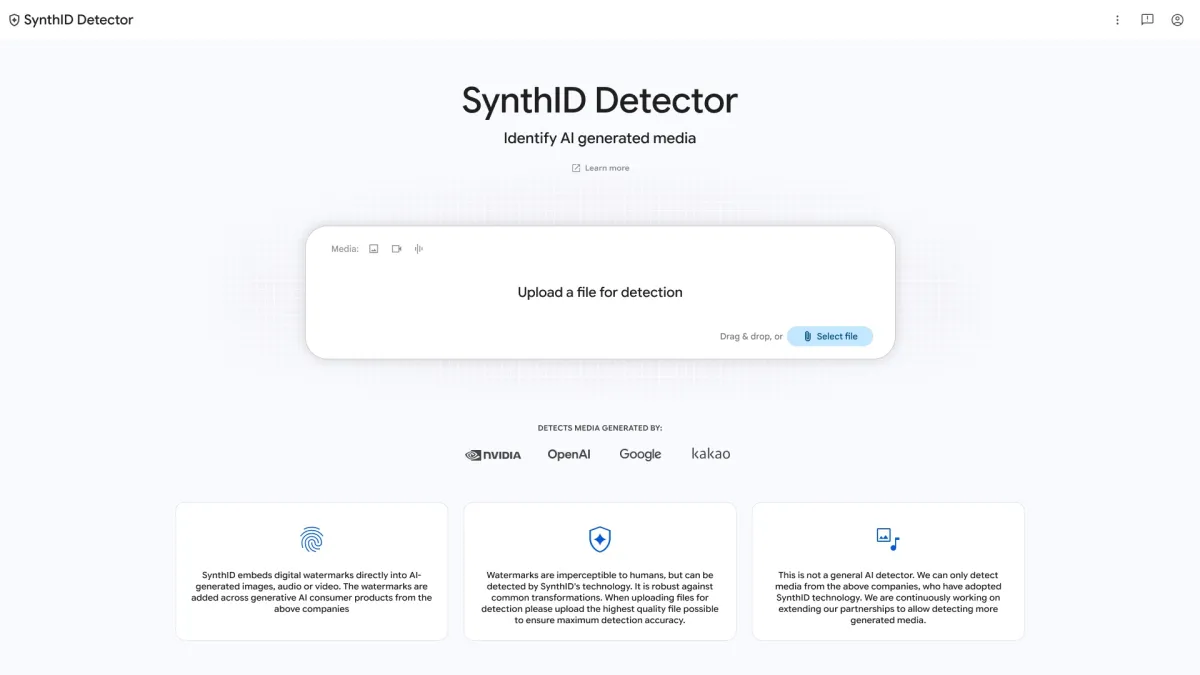
Google’s new SynthID website is a public verification portal for suspected AI-generated media. A user can upload or check a file to see whether it carries a SynthID watermark or other signals associated with Google’s AI generation systems.
That matters because synthetic content is now easy to create and difficult to judge by sight or sound alone. As image, video and audio generators improve, watermarking and verification tools are becoming one of the few practical ways for consumers, journalists and platforms to establish provenance quickly.
The website is the latest step in Google’s broader effort to build an ecosystem around content authenticity. Rather than leaving detection only to experts, the company is trying to make the process available to the general public.
How does SynthID work?
SynthID is Google’s invisible watermarking technology for AI-generated content. When one of Google’s supported models or generation tools creates media, SynthID embeds signals into the output that are intended to survive common editing and make later verification possible.
Google first introduced SynthID in 2023. Since then, the company has extended support across a growing list of its AI products. According to Google, models and tools including Nano Banana, Veo, Lyria, Gemini, Flow, ProducerAI and Vids all use SynthID to watermark media they generate.
Which file types are supported?
The public tool can inspect multiple common media formats across images, video and audio, giving it broad practical coverage for everyday uploads.
| Media type | Supported formats | Examples of use |
|---|---|---|
| Images | JPG, JPEG, PNG, BMP, WEBP, AVIF, HEIC, HEIF, TIFF, TIF, GIF | Photos, memes, AI artwork, screenshots |
| Video | MP4, MOV, WEBM | Clips, short-form social video, generated scenes |
| Audio | WAV, MP3, OGG, FLAC, AAC, M4A | Voice clips, music samples, synthetic speech |
The variety of supported formats is important because manipulated or generated content rarely arrives in a single standard file type. By covering many of the most common media standards, Google is making it more likely that users can check the file they actually have, rather than converting it first.
Who can use the new verification site?
Anyone can now use it. Google had previously offered the tool only to a limited group of journalists, media professionals and researchers as part of an early test that began around Google I/O last year. The public release marks a shift from controlled access to mass availability.
The broader rollout suggests Google believes the demand for authenticity checks is no longer confined to newsrooms and academic labs. Ordinary users increasingly encounter AI-generated content in social feeds, messaging apps and workplace tools, and many of them now need a way to test whether something is synthetic before trusting it.
Google says the service already handles about 1 million verification requests per day, indicating that interest in media authentication has grown quickly even before the public launch.
Why Google is pushing verification now
Google is moving now because the debate over AI content has shifted from novelty to trust. Generative AI tools can produce polished images, realistic voice clones and convincing video at scale, creating both creative opportunity and a new information problem.
That problem is especially acute for publishers, social platforms and consumers who have to decide whether a piece of media is authentic, manipulated or fully synthetic. A verification system cannot solve misinformation on its own, but it can reduce uncertainty when content already carries a watermark.
There is also a competitive dimension. As more companies release generative AI products, they are increasingly expected to offer a responsible-content layer alongside creation tools. Google’s public SynthID site is one way to signal that it is not only shipping generators, but also building checks for them.
How does Google compare with OpenAI, Meta and Microsoft?
Google is not alone in this race. OpenAI, Microsoft and Meta all have their own approaches to watermarking or verifying AI-generated content, and OpenAI also operates a site for checking content authenticity.
At the same time, Google’s system stands out because it is already tied into multiple parts of the company’s AI stack and browser ecosystem. SynthID verification is built into Gemini and Chrome, which means the company can surface checks where people are already encountering content.
But the broader industry reality is less tidy than the marketing suggests. These verification tools are still imperfect, and they do not always identify material made by the very systems they are meant to police. That limitation matters because it means watermarking is best understood as one signal among many, not a definitive verdict in every case.
What are the limitations?
The biggest limitation is reliability. Google’s competitors face similar issues, and none of the major watermarking systems can guarantee detection in all scenarios. Watermarks can be lost through editing, cropping, compression or re-recording, and some media may never carry a watermark in the first place.
Another challenge is interoperability. Different companies are adopting different standards, which means a file created by one platform may not be readable by another platform’s checker. That fragmentation weakens the overall ecosystem, even as each company improves its own tools.
For that reason, verification services should be treated as useful infrastructure rather than final authority. They can help identify many AI-generated files, but they cannot yet deliver universal content truth.
Why the public launch could change everyday media checking
The biggest practical shift is accessibility. Before this release, SynthID was largely something experts could test. Now it is a public-facing tool that can be used by anyone who receives a suspicious image, audio clip or video file.
That could be especially valuable in three situations:
- newsrooms verifying user-submitted material during breaking news;
- creators checking whether a file has been produced by Google’s AI tools;
- ordinary users trying to assess viral content before sharing it.
In theory, the more frequently people check media, the more normal authenticity verification becomes. Over time, that could reduce the amount of synthetic content that spreads unchecked, especially when it comes from supported Google tools.
What this means for AI-generated content in 2026
Google’s move is part of a broader industry acknowledgement that generative AI needs provenance systems, not just better outputs. As synthetic media becomes more realistic and easier to distribute, detection has become as important as generation.
That shift is visible in the way major tech companies are now talking about their products. They are no longer only competing on realism, speed or ease of use. They are also competing on trust signals, traceability and responsible deployment.
Google’s public SynthID site will not end AI deception, and it will not identify every synthetic file people encounter online. But it does make the company’s detection system far more accessible, and that alone could have real impact in a media environment where skepticism is increasingly necessary.
Timeline of SynthID’s expansion
The rollout has happened in stages, moving from internal development to limited testing and now to public access.
| Year | Milestone | Significance |
|---|---|---|
| 2023 | Google introduced SynthID | Launched invisible watermarking for AI-generated media |
| 2025 | Limited testing at Google I/O | Access given to selected journalists, media professionals and researchers |
| 2026 | Public verification site launched | Anyone can now check supported image, video and audio files |
The progression shows a clear strategy: start with creators, test with experts, then expand to the public once the system is mature enough to handle wider use. That approach mirrors how many security and authenticity tools reach mainstream adoption.
What users should keep in mind
Anyone using the new site should remember that a missing watermark does not automatically prove a file is real, and a positive result does not by itself explain the file’s entire history. The tool is a detector, not a courtroom verdict.
Still, the public release is a meaningful step. It gives more people a practical way to interrogate digital media at a time when AI output is increasingly woven into everyday communication, entertainment and misinformation.
As synthetic content continues to spread, the competition among Google, OpenAI, Microsoft and Meta is no longer just about who can make the most convincing media. It is also about who can help the public tell the difference.
Frequently asked questions
What is Google’s new SynthID website?
Google’s new SynthID website is a public verification tool that checks whether an image, video or audio file may contain Google’s AI watermark. It expands access beyond earlier private testing and is meant to help users identify media generated by supported Google models and tools.
Which file formats does SynthID support?
SynthID supports a wide range of common formats, including JPG, PNG, GIF and other image types; MP4, MOV and WEBM for video; and WAV, MP3, OGG, FLAC, AAC and M4A for audio. That broad coverage makes the tool useful for everyday media checks.
Can SynthID detect every AI-generated file?
No, SynthID cannot detect every AI-generated file. Like other watermarking systems from OpenAI, Microsoft and Meta, it can fail in some cases, especially if media is edited, compressed or created outside supported systems. It should be treated as one signal, not absolute proof.
Why did Google open SynthID to everyone?
Google opened SynthID to everyone because AI-generated media is now a mass-market issue, not just a professional concern. Public access gives ordinary users, journalists and researchers a practical way to verify suspicious files and better judge whether content was created by AI.