In short
Pinterest is testing Restyle, an AI feature that lets users upload a room photo and visualize decor changes in different styles. The company says the tool could help turn saved inspiration into purchases.
- Pinterest is beta-testing Restyle in the U.S. and Canada.
- The feature uses AI to redesign real room photos with new decor styles and object swaps.
- Pinterest says the tool is meant to strengthen the path from inspiration to shopping.
- Restyle is powered by Pinterest Intelligence, which includes Nvidia technology and open-source models.
Pinterest is beginning to test a new artificial intelligence feature called Restyle that lets users upload a photo of a room and experiment with different decor, layouts and styles inside that image. The beta rollout in the U.S. and Canada, announced on Thursday, underscores how Pinterest is using AI to turn inspiration boards into a more direct shopping and design tool.
The feature matters because it could close one of Pinterest’s biggest gaps: helping people move from saving ideas to visualizing and buying them in their own homes. Instead of just collecting pins, users will be able to see products and styles in context before deciding what to purchase.
Restyle is part of a larger push built on Pinterest Intelligence, the company’s AI foundation that combines Nvidia Blackwell GPUs, Nvidia Dynamo, open-source models and Pinterest’s own technology. Pinterest says the system is also meant to make the Pinterest Assistant better at handling visual search requests and interpreting user behavior as a signal for discovery and shopping.
What Pinterest announced
Pinterest said Restyle is launching as an early preview for users in the United States and Canada, with a wider rollout planned for next month. The company unveiled the feature at its annual Pinterest Presents event alongside new advertising products, app promotion tools and other updates aimed at brands.
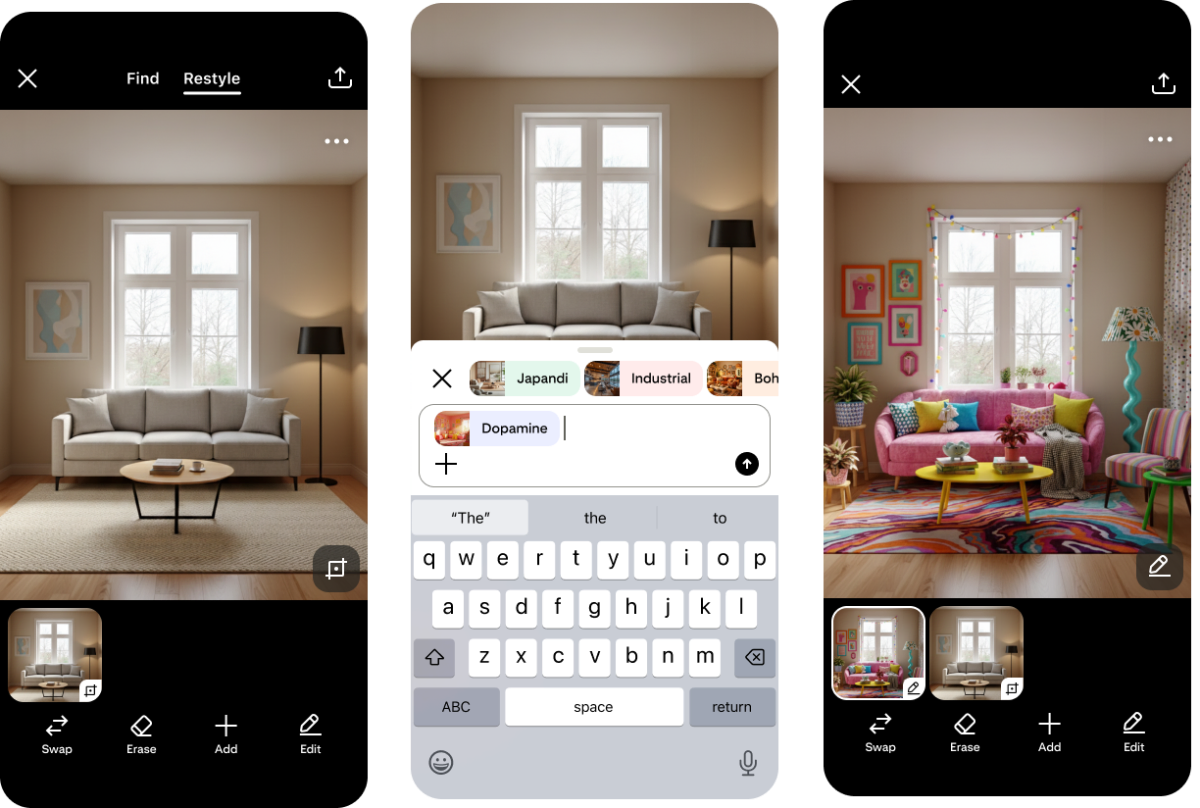
At its core, Restyle is designed for room makeovers. Users take a photo of a space and then ask the AI to alter it in specific ways. That can include adding wall art, swapping furniture, changing accessories, adjusting lighting, repainting the walls, adding plants and more.
The feature also allows more granular edits. A user can tap individual objects in a room and replace them, remove them or modify them further. Pinterest says people will also be able to prompt the system to reimagine a room in a fully different style, such as bohemian, industrial, whimsical or dopamine-inspired design.
How Restyle works
Restyle takes a user’s own room photo as the base image, then overlays AI-generated design changes on top of that real-world setting. That makes the experience more practical than generic mood boards because the user can compare options against their actual furniture, lighting and space constraints.
The idea is not just to produce a pretty image. It is to help people evaluate what a sofa, lamp, rug or framed print might look like in a real bedroom, living room or office before they spend money or commit to a renovation plan.
- Upload a photo of a room
- Ask AI to restyle the space
- Swap, erase or edit specific items
- Preview different themes and decor combinations
- Use saved Pinterest inspiration items inside the room
Why Pinterest is betting on room redesign
Room restyling has already become a familiar consumer use case for generative AI tools. Pinterest’s advantage is distribution: it already sits at the intersection of inspiration, product discovery and shopping intent.
That combination may be especially powerful in home decor, where people often collect ideas long before they buy. Pinterest is effectively trying to reduce the distance between the board and the checkout cart by showing users how saved items might look in the exact room they live in.
If the feature works well, it could also deepen engagement with content already on the platform. A user who saves a chair, table or lamp may be more likely to buy it after seeing how it fits in a real room rather than on a standalone product page.
Pinterest is framing Restyle as a way to help people do more than browse ideas — the company wants them to actually test those ideas in their own spaces and move closer to purchase decisions.
What this means for shopping
The shopping angle is important. Pinterest has long relied on visual discovery, but AI gives it a way to become more predictive and personalized. If a person is already expressing interest in a certain style, color palette or room type, Pinterest can use that intent to surface more relevant products and ads.
That could help the company strengthen one of its key business goals: converting inspiration into commerce. It also gives advertisers a more immersive environment in which to place home goods, furniture and lifestyle products.
How Pinterest Intelligence supports the launch
Restyle is powered by Pinterest Intelligence, which the company described earlier in the week as a combination of Nvidia Blackwell GPUs, Nvidia Dynamo, open-source models and Pinterest-built systems. In practical terms, that means Pinterest is tying together advanced compute infrastructure with its own product-specific AI layers.
The company says that foundation will improve Pinterest Assistant, especially when it comes to handling visual search queries. It is also supposed to help Pinterest interpret searches as signals for AI-driven discovery and shopping recommendations.
That matters because Pinterest’s core product is not a chatbot in the traditional sense. It is a visual discovery engine. The company is trying to use AI to make that engine more interactive without losing the browsable, image-first feel that defines the platform.
| Key detail | Information |
|---|---|
| Feature name | Restyle |
| Launch status | Early preview beta |
| Initial markets | United States and Canada |
| Broader rollout | Planned for next month |
| AI foundation | Pinterest Intelligence |
| Core technology | Nvidia Blackwell GPUs, Nvidia Dynamo, open-source models, Pinterest-built tech |
What kinds of edits can users make?
Users will be able to make both broad and targeted changes. Broad edits include changing the style of an entire room to something like industrial, bohemian, whimsical or dopamine decor. Targeted edits let users modify individual objects, such as a chair, side table or decorative item.
The system is also built to support product discovery from Pinterest itself. That means items found while browsing the platform can be inserted into a room image, allowing users to compare saved ideas in a more realistic setting.
How this differs from standard AI image tools
Restyle differs from a generic image generator because it starts with a real photo and keeps the user anchored to their actual space. That makes it less about fantasy renderings and more about decision-making.
For homeowners, renters, and even people just planning a seasonal refresh, the value is in context. A chair may look good on its own, but the real question is whether it works with a specific wall color, floor material or lighting setup. Pinterest is trying to answer that question inside the app.
The bigger strategy behind Pinterest’s AI push
Restyle is not an isolated experiment. It fits into Pinterest’s broader effort to make AI central to both user experience and revenue generation. By combining visual search, personalized recommendations and shopping features, the company is moving closer to being a guided commerce platform rather than a passive inspiration catalog.
That strategy also helps Pinterest compete in an environment where tech companies are racing to attach generative AI to existing consumer products. Some are doing it through chatbots, others through search or productivity tools. Pinterest’s angle is to make AI useful in a highly visual, high-intent category: the home.
The company’s timing may also be strategic. Home decor is one of the clearest categories where visual previewing can influence buying behavior. A virtual mockup can answer the question many shoppers ask before making a purchase: “Will this actually look right where I live?”
Why the home category is a natural fit
Home design decisions are both emotional and practical, which makes them a good fit for AI-assisted visualization. Users often want to express a style, but they also need to make sure the result fits their room size, color palette and budget.
Pinterest already serves users who are in inspiration mode for renovations, redecorating, seasonal updates and apartment decorating. Restyle takes that existing behavior and adds a layer of simulation that could speed up decision-making.
- Users discover products or styles on Pinterest
- They save ideas to boards
- Restyle lets them preview those ideas in a real room
- They compare options more easily
- They are more likely to purchase items they like
How important is the rollout?
The rollout is modest at first, but it is still significant. Early previews give Pinterest a chance to see how consumers interact with the tool, whether the edits feel realistic, and whether users actually move from inspiration to shopping more often.
Because the feature is launching only in the U.S. and Canada at the start, Pinterest can gather feedback before expanding to more markets. That is especially useful for a product that blends generative AI with commerce, since accuracy and trust will matter as much as novelty.
In the short term, Restyle may function as a showcase for Pinterest’s AI capabilities. In the longer term, it could become part of the company’s identity as a platform that helps people not just discover what they want, but visualize and buy it.
What else Pinterest highlighted at Pinterest Presents
The Restyle teaser was one part of a broader presentation focused on tools for both users and advertisers. Pinterest also introduced new visual search ads and app promotion features, reinforcing that the company sees AI, discovery and advertising as linked pieces of the same business.
That mix is important. Pinterest wants consumers to have a better experience finding ideas and shoppers to have a better experience acting on them, while advertisers gain new ways to reach people with strong purchase intent.
At Pinterest Presents, the company positioned its latest product updates as part of a broader effort to connect visual inspiration, AI discovery and commerce more tightly than before.
The bottom line
Pinterest’s Restyle feature is a practical AI experiment with a clear commercial purpose. By letting users redesign a room from a photo, the company is trying to make inspiration more actionable and shopping more confident.
If the beta performs well, Pinterest could emerge with one of the more useful consumer AI features in the home decor space — one that turns saved pins into visualized rooms and, potentially, into sales.
For now, the feature is still early and limited to a preview release. But it signals where Pinterest wants to go next: deeper into AI-powered visual search, more personalized discovery and a tighter connection between what users dream about and what they ultimately buy.
Frequently asked questions
What is Pinterest Restyle?
Pinterest Restyle is an AI feature that lets users upload a photo of a room and experiment with new decor, furniture, colors and styles. The goal is to help people visualize changes in their own space before buying or redesigning.
Where is Pinterest Restyle available?
Pinterest Restyle is available as an early preview in the United States and Canada. Pinterest says it plans to roll the feature out more broadly next month after the beta period.
How does Pinterest Restyle work?
Pinterest Restyle works by taking a photo of a real room and using AI to alter it based on user prompts. People can swap objects, erase items, change lighting or repaint walls, and they can also reimagine the space in different interior design styles.
Why is Pinterest adding AI room redesign tools?
Pinterest is adding AI room redesign tools to make its visual discovery platform more useful for shopping and decorating. The company wants to help users move from saving inspiration to seeing how products look in their own homes, which could increase purchase intent.