In short
OpenAI is rolling out ChatGPT Health to all eligible U.S. users and letting them connect medical records, lab results and wellness data directly inside chat. The launch is paired with bold claims about the model’s health reasoning, renewing debate over privacy, safety and trust.
- ChatGPT Health is now rolling out to all logged-in U.S. users 18 and older on web and iOS.
- Users can connect provider records, lab results, medications and wellness apps such as Apple Health and MyFitnessPal.
- OpenAI says the feature supports, but does not replace, professional medical care.
- The company says its latest models can reason better than clinician level, a claim it later softened.
- The launch comes amid fresh scrutiny over the risks of using chatbots for medical advice.
OpenAI is making ChatGPT Health available to all logged-in U.S. users on Thursday, giving more people the ability to connect medical records and wellness data to the chatbot. The rollout matters because the company is pairing a wider health product launch with a striking claim that its models can reason “better than clinician level,” even as experts continue to warn that medical AI can be misleading or unsafe.
The new version moves health-related questions into ChatGPT’s main chat interface and broadens the kinds of information users can link, including notes from appointments, lab results, medications and data from services such as Apple Health, MyFitnessPal and Weight Watchers. OpenAI says the feature is meant to support, not replace, professional care.
What OpenAI is releasing
ChatGPT Health is no longer limited to a separate health tab. OpenAI is folding the feature into the main conversation flow so users can ask questions about connected medical information without leaving the standard chat experience.
The company says the rollout begins on the web and iOS for users in the United States who are 18 or older, across free, Go, Plus and Pro tiers. The update is designed to make the product easier to use while also increasing the amount of health data the chatbot can analyze when a user opts in.
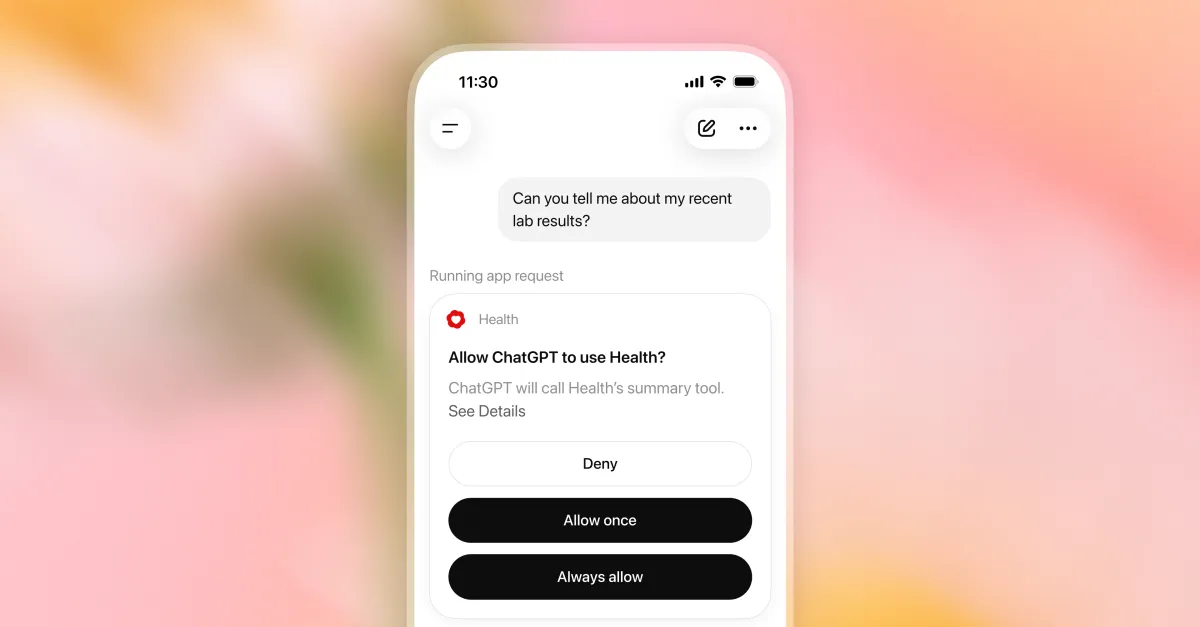
In practical terms, that means a user could connect a provider’s after-visit summary, upload lab work, and include medication lists, then ask ChatGPT to help interpret the material in ordinary language. OpenAI is careful to say the chatbot will request permission before using health data to tailor responses.
Why the launch is drawing attention
The release is notable not just for its scale, but for how aggressively OpenAI is describing the capability of its models. During a briefing, Ashley Alexander, the company’s vice president of health product, said the models are now capable of reasoning at levels that are better than clinician level.
That statement is likely to intensify scrutiny. In healthcare, claims about “clinical-grade” performance have become common in the AI industry, but they often mask how narrow a model’s testing may be or how limited its real-world reliability remains. A tool that performs well in a benchmark or research setting can still fail in a messy, high-stakes patient setting.
OpenAI’s health leadership says the company believes its latest models can reason at levels beyond clinicians, though the team also acknowledges that some evidence remains preliminary and comes from individual studies rather than a universal medical consensus.
When pressed for clarification, OpenAI health lead Karan Singhal said the company would “temper” the stronger phrasing, while pointing to research, including work from Harvard and Stanford, that he said moves in that direction. The response suggests OpenAI is aware that the headline claim may outpace what can be broadly proven today.
How does ChatGPT Health work now?
It works by letting users connect medical and wellness information that ChatGPT can reference in conversation after obtaining permission. OpenAI says the chatbot will ask before using health data to personalize its answers, and it says all conversations are encrypted at rest and in transit, with connected health information receiving additional encryption protection.
The company also says users can review and change the categories of data they share. That includes post-visit notes, care-team notes, lab results and medications, along with connected data from participating health services.
Data sources users can link
The current integration list includes a mix of provider systems and consumer wellness tools. OpenAI says users can connect data from their health providers as well as services such as Apple Health, Weight Watchers, MyFitnessPal and Function.
That combination matters because it reflects the company’s broader approach to consumer health AI: combining clinical paperwork with lifestyle tracking so the chatbot can potentially generate a fuller picture of the user’s situation.
- Health provider records
- Post-visit notes
- Care-team notes
- Lab results
- Medication information
- Apple Health data
- Weight Watchers data
- MyFitnessPal data
- Function data
What OpenAI says about safety and privacy
OpenAI is trying to reassure users that the product is designed with safeguards, but the launch still raises familiar questions about sensitive health data in a consumer AI app. The company says users remain in control of what they connect, and it reiterates that ChatGPT Health is meant to assist rather than act as a doctor.
The promise of extra encryption protection for connected health data is important, but it does not fully answer the broader concern: whether users understand the trade-offs of feeding highly personal information into a chatbot, especially one that can respond confidently even when it is wrong.
OpenAI’s message is that the tool can help organize information and explain medical documents in plain English. The lingering concern is that even helpful summaries may blur the line between explanation and advice.
OpenAI says ChatGPT Health “supports, not replaces, professional care,” underscoring that the product should be treated as a supplement rather than a medical authority.
Why medical data is especially sensitive
Health information is different from many other kinds of consumer data because mistakes can have real-world consequences. If a chatbot misreads a symptom, misunderstands a lab result or overstates reassurance, the result can be delayed treatment or false confidence.
That risk has already been highlighted by recent events. A Florida pastor sued OpenAI this week, alleging that ChatGPT gave him dangerous medical advice and contributed to his decision to delay care for a pulmonary embolism. The case is a reminder that even one flawed interaction can carry serious stakes.
How does the new rollout fit into OpenAI’s model strategy?
The health launch arrives only weeks after OpenAI introduced GPT-5.6 Sol, which it described as its strongest health model to date. ChatGPT Health will run on the company’s newest models, making the release part of a larger push to position the latest generation as particularly useful for healthcare-related tasks.
That sequencing suggests OpenAI sees health as one of the most commercially and strategically important use cases for its models. Healthcare offers a compelling mix of high value, abundant documentation and repeated user engagement, but it also brings the toughest expectations around accuracy and trust.
By tying the rollout to its latest model family, OpenAI is signaling that health is not a side experiment. It is becoming a central proof point for whether its systems can move from general-purpose assistance toward specialized, high-stakes utility.
| Launch element | Details |
|---|---|
| Product | ChatGPT Health |
| Availability | All logged-in U.S. users age 18+ on web and iOS |
| Plans included | Free, Go, Plus and Pro |
| New capability | Health questions in main chat, using connected medical data |
| Data types | Lab results, notes, medications, provider records, wellness data |
| Security claim | Encryption at rest and in transit, with extra protection for connected health info |
What are the biggest concerns?
The biggest concern is whether a consumer chatbot should be trusted with health data at all, especially when OpenAI itself is promoting the system with claims that sound close to clinical equivalence. The company’s own caveat that the tool is not a replacement for professional care suggests it understands the sensitivity of the category.
Another concern is the gap between experimental findings and everyday medical use. OpenAI’s reference to academic studies points to an important distinction: a model may outperform physicians on certain reasoning tasks or tests while still being unsafe as a general-purpose health assistant.
There is also the problem of user interpretation. Even when the chatbot is technically “supporting” care, many people may treat it as an authority if it responds with confidence. That can be especially risky if a user already feels uncertain, anxious or unwilling to seek immediate medical help.
Why the clinician-level claim matters
It matters because phrasing shapes public trust. Saying a model reasons better than clinicians is not a minor marketing flourish; it implies a level of competence that many users may read as medical endorsement.
OpenAI’s more cautious follow-up shows the company is aware the claim could be overread. Still, the tension remains: a health product intended to help people understand records is being promoted with language that sounds like a challenge to the medical profession itself.
Who can use ChatGPT Health right now?
It is available to logged-in ChatGPT users in the U.S. who are 18 or older. The rollout spans the web and iOS, and it covers users on free, Go, Plus and Pro subscriptions.
That broad access means the feature will not be limited to paying customers or to enterprise healthcare deployments. Instead, OpenAI is bringing health functionality to the same mainstream consumer audience that already uses ChatGPT for writing, coding, planning and general advice.
That choice could accelerate adoption quickly, but it also increases the odds that people will ask medical questions before understanding the product’s limits. For a category as sensitive as healthcare, scale can be both an advantage and a risk.
Why this launch could influence the wider AI health market
The move is likely to pressure other AI companies to clarify how their own medical features work, what kinds of evidence support them and where they draw the line between assistance and diagnosis. Consumer health AI has long promised convenience, but OpenAI’s decision to bring a health tool into the main ChatGPT interface gives the category new visibility.
If users begin to treat ChatGPT as a place to interpret records, ask follow-up questions after appointments and sort through wellness data, the company could help define the market’s next phase. That would make it not just a chatbot company, but a major player in how people interact with personal health information.
At the same time, the launch may also sharpen demands for clearer rules, stronger disclosures and more robust testing. The more powerful the system becomes, the harder it will be for the industry to rely on vague language like “clinical-grade” or “doctor-level” without showing exactly what those claims mean.
Timeline: How ChatGPT Health reached this point
| Date | Event | Why it matters |
|---|---|---|
| Weeks before rollout | OpenAI launched GPT-5.6 Sol | Set up the newest model family for health use |
| Wednesday | A Florida pastor filed a lawsuit against OpenAI | Highlighted allegations of harmful medical advice |
| Thursday | ChatGPT Health rolls out to all eligible U.S. users | Expands access to health data and in-chat medical questions |
What happens next?
The next test is whether users find ChatGPT Health genuinely useful without crossing into unsafe dependence. OpenAI will likely face continued questions about how the feature handles sensitive data, how it verifies outputs and what kinds of medical claims the system is allowed to make.
For now, the company is betting that consumers want a single place to organize records, interpret lab work and ask follow-up questions about their health. It is also betting that its newest models are reliable enough to support that experience at scale.
Whether those bets hold up will depend less on OpenAI’s marketing language than on what happens when real users bring real medical questions to the chatbot. In health care, the difference between useful and dangerous can be small, and that is exactly why this rollout is drawing so much attention.
The launch is a major step for OpenAI, but it is also a reminder that the more intimate the use case, the more carefully AI companies will be judged. Health is one of the most sensitive areas in technology, and OpenAI is now asking everyday users to trust its systems with exactly that kind of data.
As the feature expands, the company will need to prove that its promise of support is more than a slogan. Users may welcome easier access to their records and a simpler way to ask questions, but they will also expect accuracy, restraint and transparency from a tool that is now being positioned as useful in one of life’s most consequential domains.
Bottom line
OpenAI is widening ChatGPT Health to all eligible U.S. users and inviting them to connect medical records, lab results and wellness data inside the main chat experience. The release could make ChatGPT more useful for everyday health questions, but it also raises fresh concerns about privacy, safety and whether the company’s claims about clinician-level reasoning go too far.
Frequently asked questions
What is ChatGPT Health?
ChatGPT Health is OpenAI’s health-focused experience inside ChatGPT that lets users connect medical records and wellness data, then ask questions about that information in chat. OpenAI says the tool is intended to support professional care, not replace a doctor.
Who can use ChatGPT Health right now?
ChatGPT Health is available to logged-in ChatGPT users in the United States who are 18 or older. The rollout covers the web and iOS and includes people on free, Go, Plus and Pro plans.
What kinds of health data can users connect?
Users can connect provider records and several types of health information, including post-visit notes, care-team notes, lab results and medications. OpenAI also says it supports services such as Apple Health, MyFitnessPal, Weight Watchers and Function.
Is ChatGPT Health safe to use with medical information?
OpenAI says the product uses permission prompts and additional encryption protections for connected health data, but medical AI still carries risks. Users should treat it as a supplement for organizing and understanding information, not as a substitute for professional diagnosis or treatment.
Why are OpenAI’s health claims controversial?
OpenAI’s claim that its models reason better than clinician level is controversial because it suggests medical competence that has not been universally proven in real-world care. The company later said it would temper that wording and pointed to individual studies rather than broad consensus.