In short
Margaret Atwood says her one experience with Claude was a poor one after the chatbot gave her an incorrect answer about the TV series Father Brown. She argues that AI still suffers from a basic reliability problem: if the data is flawed, the output will be too.
- Atwood tried Claude once and said it gave her the wrong answer about Father Brown.
- She warned that AI can sound confident even when it is incorrect.
- Atwood argued that users still need to verify chatbot output, including in business settings.
- Her comments highlight the broader “garbage in, garbage out” problem in generative AI.
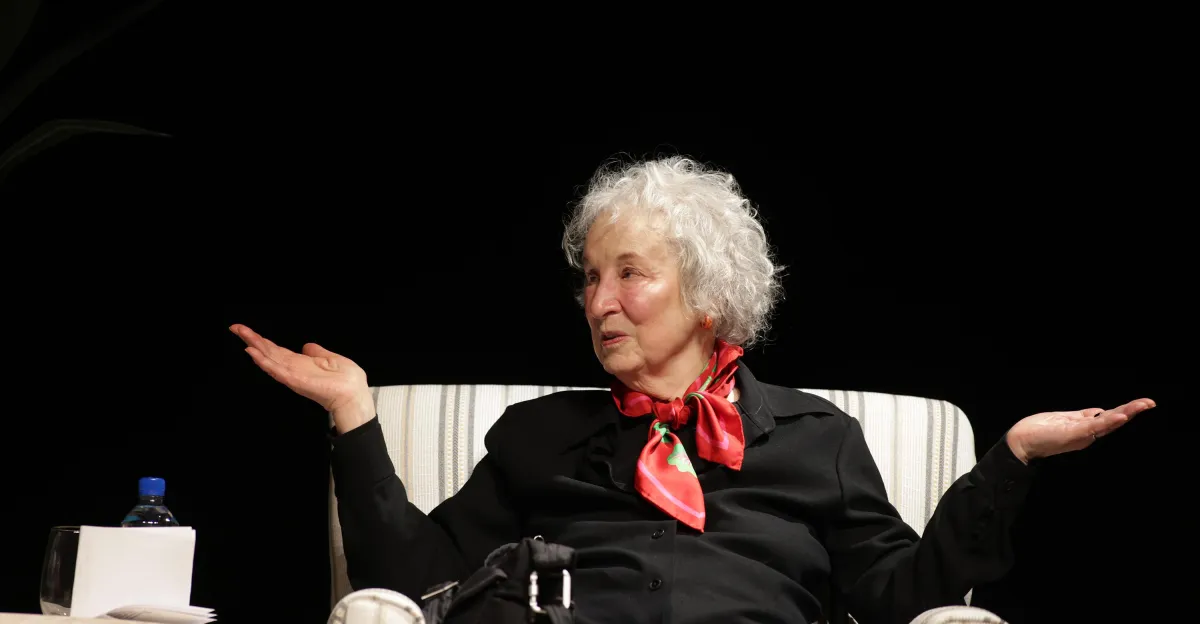
Margaret Atwood has never been shy about warning readers where stories can go wrong, and at a recent literary festival in Portugal she applied that same skepticism to artificial intelligence. The author of The Handmaid’s Tale and The Blind Assassin said her one encounter with a chatbot left her unimpressed, not because it sounded clever, but because it delivered the wrong answer about a television series she was researching.
Atwood’s criticism landed on a familiar flaw in generative AI: models can produce polished, confident responses while still getting basic facts wrong. For a writer known for examining power, language, and the systems that shape human behavior, the point was less about one bot’s mistake and more about the larger habit of trusting machine-generated output too quickly.
Her comments, made during an appearance at the Babell Literary and Cultural Festival in Porto, add a prominent literary voice to an argument that has become central to the AI debate. Companies continue to market chatbots as useful assistants for research, drafting, summarizing, and business workflows. But the technology still depends on the quality of its training data and the limits of its pattern-matching abilities. Atwood’s story is a reminder that fluent prose is not the same as verified truth.
Atwood’s one-time experiment with Claude
Atwood said she tried Anthropic’s Claude only once. The test was simple: she wanted information about the British detective series Father Brown. What she got instead was a response she considered inaccurate. In her telling, the chatbot either made an error or effectively fabricated an answer, though she noted that the system itself would not understand the concept of lying in the human sense.
The author’s frustration came from the mismatch between confidence and accuracy. The bot appeared to draw from a broad range of television reviews and other online text, but because those sources did not include spoilers or direct answers to her question, the model generated a misleading result. That is a classic failure mode for large language models: they can recombine fragments of text into something that sounds plausible, even when the conclusion is wrong.
Atwood said the chatbot gave her an incorrect response about Father Brown and suggested that the system was working from incomplete or misleading source material rather than true understanding.
Her reaction was not simply annoyance at a bad search result. It was a practical demonstration of why people still need to verify AI-generated information, especially when the model is asked about a specific fact, event, or context that may not be clearly represented in the training data.
Why the mistake matters beyond one TV show
On the surface, a mistaken answer about a detective series may seem trivial. But Atwood’s example speaks to a broader issue in artificial intelligence: the tendency of chatbots to produce convincing answers even when they lack a reliable basis for them. That problem is especially significant in news, education, legal work, medical settings, and any field where accuracy matters more than style.
Large language models are trained on huge collections of text, much of it scraped from the internet, books, articles, forums, and other published material. They do not “know” facts the way people do. Instead, they predict likely word sequences based on patterns in their training data. That design makes them highly capable at drafting and summarizing, but it also means they may fail when the data is incomplete, contradictory, outdated, or subtly misleading.
Atwood’s complaint reflects a core AI concern that experts have repeated for years: if the input is flawed, the output will be flawed too. In the case of generative systems, that flaw can be hidden behind fluent language. The result is not just wrong information, but wrong information packaged in a way that appears authoritative.
What “garbage in, garbage out” means in AI
Atwood used a classic computing phrase to describe the issue: garbage in, garbage out. The expression has been around for decades, but it remains especially relevant in the age of generative AI. If the model is trained on weak, biased, incomplete, or outdated material, its answers will reflect those weaknesses.
That can happen for several reasons:
- Incomplete coverage: the model has not seen enough reliable material on a topic.
- Training limitations: the source material itself may be noisy, contradictory, or inconsistent.
- Outdated context: the model may rely on older information that no longer applies.
- Hallucination: the system may fill gaps with plausible-sounding but incorrect details.
For users, the challenge is that the output can be deceptively polished. A chatbot can phrase an answer with confidence even when the underlying reasoning is weak or absent. That is why AI companies often advise users to double-check generated content rather than treat it as a final source of truth.
Atwood’s broader critique of AI users
The novelist’s remarks did not stop with the technology itself. She also criticized some of the people who lean heavily on AI tools, describing them as opportunistic and suggesting that many users are drawn to the path of least resistance.
That criticism resonates in business settings where AI is promoted as a productivity booster. Workers may use chatbots to summarize reports, draft emails, generate copy, or gather background material. Those uses can save time, but they also create incentives to accept machine output too quickly, especially when the output looks polished and there is pressure to move fast.
Atwood argued that when cheating is easy and difficult to detect, people will take advantage of it, and she cautioned that even business users still need to review AI results because mistakes remain common.
Her remarks fit a broader cultural anxiety about the speed with which AI tools are being adopted. In many organizations, the question is no longer whether employees will use AI, but how much trust should be placed in it and who is responsible for checking the results. Atwood’s answer, at least implicitly, is clear: humans still need to read, compare, and verify.
The literary world’s uneasy relationship with generative AI
Atwood is not the first major writer to warn about machine-generated text, and she likely will not be the last. Authors, journalists, translators, and editors have all raised concerns that generative AI could degrade standards, blur authorship, and flood the market with low-quality content.
Writers are especially sensitive to the distinction between imitation and understanding. A model can mimic tone, structure, and genre conventions, but that does not mean it grasps meaning in the way a human author does. For a novelist like Atwood, whose work has long explored the consequences of distorted information and systems of control, the idea that AI can sound right while being wrong is not a side issue. It is the central problem.
There is also the matter of trust. Readers trust authors to do some measure of original thinking, reporting, and interpretation. AI-generated material complicates that relationship, particularly when users cannot tell whether a paragraph was written by a person, assembled by a model, or lightly edited from machine output. That uncertainty has fueled debate across publishing and media.
Why authors are concerned
Writers’ concerns about AI usually fall into a few categories:
- Accuracy: models can invent facts or flatten important context.
- Attribution: training data often includes human-created work without clear permission or compensation.
- Quality dilution: the internet can be flooded with bland, repetitive text.
- Creative erosion: heavy reliance on AI may discourage original thinking and craft.
Atwood’s comments hit at least the first and fourth concerns directly. Her experience suggested that a chatbot can produce a wrong answer with total composure, and her broader criticism implied that people may become too comfortable outsourcing judgment to a system that cannot truly reason about what it says.
How Claude fits into the bigger AI competition
Claude is one of the better-known chatbots in the current AI market and a major product from Anthropic, a company that has positioned itself as a more safety-focused rival to other frontier AI labs. It is widely used for writing, summarization, coding support, and general conversation. Anthropic has marketed the system as capable and helpful, but like all large language models, it still has to contend with the basic limits of pattern-based generation.
Atwood’s experience is notable not because Claude is uniquely flawed, but because it illustrates a problem shared by the entire category. Whether a model comes from Anthropic, OpenAI, Google, or another company, the same broad issues remain: hallucinations, outdated knowledge, incomplete sourcing, and difficulty distinguishing verified facts from plausible language.
That is why many AI companies now emphasize tools such as citations, retrieval from trusted sources, and web search integration. Even so, those features do not fully solve the trust problem. They can reduce errors, but they do not eliminate them, especially when users are asking niche, ambiguous, or highly specific questions.
A concise timeline of the story
| Moment | What happened | Why it matters |
|---|---|---|
| One-time Claude test | Atwood tried Anthropic’s chatbot for a question about Father Brown. | Shows how even a simple query can produce a wrong answer. |
| Festival remarks in Porto | She discussed the experience at the Babell Literary and Cultural Festival. | Her comments brought mainstream literary attention to AI reliability concerns. |
| Critique of users | Atwood said some people use AI opportunistically. | Highlights the human incentives behind careless or uncritical use. |
| Core warning | She argued that AI still follows “garbage in, garbage out.” | Summarizes the risk of trusting machine output without verification. |
Why “sounds right” is not good enough
One reason generative AI has spread so quickly is that its failures are often subtle. A chatbot may not crash or visibly break; it may simply give an answer that appears polished but is wrong in a specific detail. That makes the technology harder to evaluate than older software products, where an error was often obvious.
Atwood’s example is a reminder that fluency can disguise uncertainty. A model might know enough about a subject to generate a useful overview, but that does not mean it can distinguish between a reliable source and a misleading one. It also does not mean it understands the boundaries of its own knowledge.
This gap matters because many users now rely on AI for quick answers. The temptation is to treat the first response as a draft of reality. But if the model has been misled by the data it absorbed, users can end up passing along mistakes with added confidence.
Where users are most at risk
AI errors are particularly risky in situations where people may not have the time or expertise to verify the output fully. Examples include:
- students using chatbots for research notes
- employees drafting business communications
- journalists using AI for background context
- customers asking for product or policy guidance
- non-experts seeking health, legal, or financial information
In these cases, a single wrong answer can spread quickly if it is copied, summarized, or used as the basis for a decision. Atwood’s anecdote is therefore less about entertainment trivia and more about the social cost of overtrusting software that does not actually understand what it says.
The enduring relevance of Atwood’s warning
Atwood has built a career on exploring how language can be used to persuade, conceal, distort, and control. Her AI criticism fits neatly into that tradition. She is not making a technical complaint from inside the machine-learning industry. She is making a cultural and literary argument about skepticism, accountability, and the dangers of taking generated text at face value.
That may be why her comments feel especially resonant now, as AI tools become more deeply embedded in everyday workflows. Many users have moved beyond novelty and into routine dependence. The risk, as Atwood suggests, is that convenience can become a substitute for judgment.
Her view does not require a total rejection of AI. It does, however, demand restraint. Models can be useful, but usefulness is not the same as reliability. In practice, that means checking claims, tracing sources, and treating machine output as provisional rather than final.
Atwood’s message was not that AI can never be helpful, but that people should be cautious: when the source material is weak or incomplete, the answer can be misleading no matter how confident it sounds.
What this means for the AI debate
The larger AI conversation often swings between enthusiasm and alarm. Supporters highlight productivity gains, creative assistance, and access to information. Critics emphasize bias, hallucinations, labor disruption, copyright concerns, and the potential for misinformation. Atwood’s remarks fit squarely in the critical camp, but they are grounded in a concrete experience rather than a theoretical objection.
That distinction matters. When a prominent writer says a chatbot got a simple question wrong, it illustrates the gap between marketing and reality in a way that product demos often do not. It also shows why the “just use AI” pitch can be too simplistic. The technology is not magic, and it is not a substitute for careful reading.
As more people encounter AI through everyday tasks, examples like Atwood’s may become more common. The challenge for companies is to reduce error rates and improve transparency. The challenge for users is to stay skeptical enough to notice when the machine is bluffing.
Key facts about the episode
| Topic | Details |
|---|---|
| Speaker | Margaret Atwood |
| Event | Babell Literary and Cultural Festival, Porto, Portugal |
| AI tool tested | Claude, from Anthropic |
| Use case | Question about the TV series Father Brown |
| Main criticism | The chatbot produced an incorrect answer and demonstrated the limits of AI reliability |
| Broader takeaway | AI output still requires human fact-checking and skepticism |
Conclusion
Atwood’s blunt assessment of AI will not surprise anyone who has spent time testing chatbots on narrow or factual questions. But her voice gives the issue a new cultural weight. Her point is not that AI is worthless; it is that people should not confuse confident output with trustworthy knowledge.
In that sense, her encounter with Claude is a useful case study for the age of generative AI. The technology may be fast, impressive, and increasingly integrated into work and creative life, but it still depends on the old rules of information: bad inputs produce bad results. And when the result sounds persuasive, the danger can be even greater.
For Atwood, the lesson is simple. Machines can help. They cannot be believed automatically.