In short
President Donald Trump has ordered the government to use “super intelligence” instead of “artificial intelligence,” and top AI executives did not publicly challenge him. The moment has become a test of loyalty, revealing both Trump’s influence and Silicon Valley’s reluctance to push back.
- Trump has pushed the federal government to replace “artificial intelligence” with “super intelligence.”
- Top AI executives did not publicly object, prompting criticism that they failed a loyalty test in front of the president.
- Experts say the new term is scientifically awkward because it usually refers to a narrower and more advanced concept than AI.
- The episode highlights a broader fight over AI regulation, public messaging, and political pressure.
President Donald Trump has tried to replace the term “artificial intelligence” with “super intelligence,” and leading technology executives did not publicly resist the move. The episode matters because it shows how quickly the biggest names in AI will bend to political pressure when the White House turns a branding whim into an executive-order-level demand.
What began as an odd remark at the United Nations became a formal White House effort this week, when Trump announced that the federal government would stop using the phrase “artificial intelligence” and instead adopt “super intelligence.” The change is more than a semantic stunt: it reveals how much leverage the president can exert over the tech industry, and how willing many of its most powerful leaders are to go along with it.
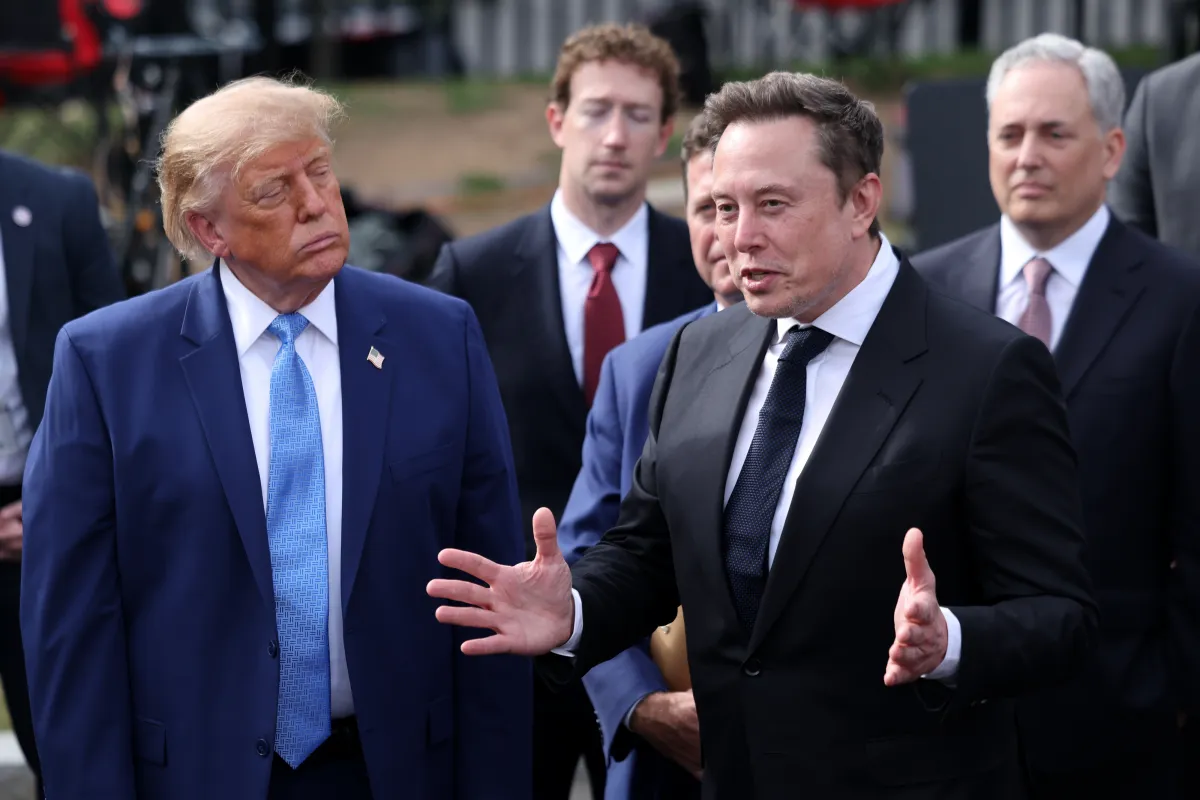
The image of executives from across the AI sector sitting silently as Trump rewrote the name of the field they have built their companies around has already become the story. For critics, the moment was a test of backbone, and the industry, by staying quiet, failed it.
What happened at the White House?
Trump used a White House lunch with top AI executives to advance his plan to abandon “artificial intelligence” in favor of “super intelligence.” The move followed a September 23 speech at the United Nations in which he signaled that he wanted to rethink the name of the field.
By the end of the lunch, the administration had turned that idea into an official directive. The president framed the term “artificial” as misleading, arguing that it implied something fake. His message was simple: the government should stop calling the technology by its long-established name.
The practical effect is unclear. The symbolic effect is immediate. Trump has once again demonstrated that he can use prestige, access, and political pressure to make even deeply powerful executives treat his preferences like policy.
Why does the name matter so much?
The name matters because it is not just jargon. “Artificial intelligence” has been the standard label for the field for nearly 70 years, since John McCarthy and other scientists used it to describe machine systems that could simulate intelligent behavior. It is embedded in research, product branding, public policy, and the identity of the companies shaping the sector.
Changing that label would not simply refresh the language of government memos. It would force companies, researchers, regulators, journalists, and investors to decide whether to comply with a presidential preference or keep using the term that has defined the field for decades.
For many in the industry, the move also cuts against common sense. “Super intelligence” usually describes systems that surpass the best human minds. “Artificial intelligence,” by contrast, is a broad umbrella that includes simple tools such as spam filters, navigation software, and the much less glamorous machine-learning systems that power everyday products.
Why “super intelligence” is scientifically awkward
The term “super intelligence” has a narrower meaning than “artificial intelligence,” which is why many researchers find Trump’s rebranding so strange. The phrase generally refers to a future system that outperforms humans across nearly every intellectual task. That is a far more specific and, in many cases, more alarming concept than the existing umbrella term.
Philosopher Nick Bostrom, whose work helped popularize the idea of superintelligence, said the phrase applies to systems that dramatically exceed the best human brains, while “AI” covers a much wider range of technologies, including basic tools and early machine systems that are not remotely superhuman.
That distinction matters because public understanding of the technology depends on precision. If the government starts using a term that implies godlike capability, it risks confusing basic tools with hypothetical frontier systems. In a field already burdened by hype, the wrong label can distort debates about safety, regulation, and risk.
How did Silicon Valley respond?
Silicon Valley’s response was notable less for what was said than for what was not. According to the reporting around the lunch, none of the major executives in the room objected publicly to the president’s demand. That silence included some of the most influential names in the sector, from founders and chief executives to leaders of the biggest model labs and hardware companies.
Among those present or represented in the conversation were leaders associated with Amazon, Anthropic, Google, Meta, Microsoft, OpenAI, xAI, and other major players. Instead of collectively resisting the terminology shift, the industry appeared to accept it with little visible pushback.
That reaction is being interpreted as an early sign of how the AI industry may behave under stronger political scrutiny: cooperate publicly, avoid confrontation, and hope the controversy burns out before it damages business interests.
Who stood to gain from staying quiet?
The obvious beneficiaries are companies that want to preserve access to the White House while negotiating on larger issues such as liability, regulation, export controls, antitrust enforcement, and government contracts. A fight over a name could easily become a fight over everything else.
Silence also helps executives avoid a spectacle in which the president can paint them as disloyal or uncooperative. In Trump’s political style, public deference is often rewarded more than principled disagreement. The price of protest can be a loss of access or a public reprimand.
But the cost of compliance is reputational. Critics now argue that executives who present themselves as stewards of a transformational technology could not muster the courage to defend the field’s most basic term.
What is really behind Trump’s rebrand?
Trump’s public explanation is that “artificial” makes the technology sound fake. He has framed the term as misleading because, in his view, it suggests the intelligence itself is not real. In his telling, the phrase is inappropriate and inaccurate.
That explanation does not withstand much scrutiny. The word “artificial” has long been used in science to distinguish machine-made systems from human cognition. It does not mean false in the sense of nonexistent or worthless. It simply marks a category boundary. Artificial light is not fake light; artificial turf is not fake grass in the sense of being imaginary. The same logic applies here.
Trump’s objections also fit a broader pattern in which he treats words as political instruments. Just as he has attacked major news organizations as “fake” when they report unfavorably on him, he now appears to be applying the same instinct to a technical term that does not flatter his preferred narrative.
How does this compare with the wider AI policy fight?
At first glance, the name dispute may sound superficial. In reality, it sits atop a much larger struggle over whether the AI industry will be regulated by public standards or largely left to voluntary commitments negotiated with the companies themselves.
That battle has already produced tensions over safety testing, watermarking, model transparency, copyright, labor displacement, national security, and the risk of misuse. A linguistic rebrand does not solve any of those issues. If anything, it may distract from them.
What worries critics most is that the same executives who failed to defend the field’s name may also be too timid to defend more meaningful safeguards when those safeguards threaten speed, market share, or political comfort.
| Event | Date | What happened | Why it matters |
|---|---|---|---|
| Dartmouth conference | 1956 | Researchers used the term “artificial intelligence” to describe machine intelligence. | Established the name that became standard across science and industry. |
| Trump UN speech | September 23, 2026 | Trump signaled discomfort with the term and hinted at replacing it. | Marked the first public warning that a rename could be coming. |
| White House lunch | This week | Trump announced the federal government would use “super intelligence.” | Converted rhetoric into official pressure on the industry. |
| Industry reaction | Immediately after | Executives did not publicly challenge the change. | Raised questions about tech leadership, independence, and political leverage. |
Why did executives not push back?
They likely did not push back because confrontation with Trump can be costly. For firms that rely on federal contracts, export permissions, regulatory clarity, and a favorable posture toward innovation, a public quarrel over terminology may have seemed unnecessary and risky.
There is also a deeper cultural reason. Many of these leaders are accustomed to operating in a system where the size of a company or the scale of a valuation translates into social influence. Trump’s behavior punctured that assumption. In the room, he was not the one seeking approval.
That reversal is part of what makes the episode so striking. The executives who help shape one of the most consequential technologies in history were placed in the position of silently validating a presidential whim, and they let the moment pass.
What would collective resistance have looked like?
Collective resistance would have been simple: the executives could have accepted the administration’s regulatory proposals while making clear that the field’s established name would remain “artificial intelligence.” If they had spoken with one voice, they might have made it politically difficult for the White House to force the issue.
Instead, the absence of a united objection allowed the president to claim that the biggest figures in the field endorsed his framing. That is how symbolic power works. Silence can be repurposed as consent.
How does the terminology affect public trust?
Terminology matters because public trust in AI is already fragile. Most people encounter the technology through products that blur the line between real and synthetic output: chatbots, image generators, voice tools, recommendation systems, and automated assistants. Clear language helps users understand what a system is, what it can do, and where its limits lie.
Calling these systems “super intelligence” risks overstating their abilities. That could make them sound more advanced than they are and make it harder for the public to judge the gap between marketing and reality. In a technology market already defined by exaggeration, the wrong government label could deepen confusion.
There is also a safety issue. The more the public imagines a magic-like intelligence, the easier it becomes for companies or officials to hide mundane problems behind grand rhetoric. Precision is a form of accountability.
What are the practical consequences for companies?
For now, the likely result is a split between official language and real-world usage. Federal communications may adopt “super intelligence,” while companies, researchers, and the press continue using “artificial intelligence” because it remains the most accurate and widely understood term.
That kind of dual-language environment is messy but common in politics. Institutions often mouth a preferred phrase without fully changing their internal practice. If that happens here, the rebrand may become a performative test of loyalty rather than a true linguistic shift.
Companies may also make small adjustments in government-facing materials while keeping product names, research papers, and public marketing untouched. The result could be a patchwork of compliance that satisfies no one.
- Government documents may adopt the new term first.
- Corporate marketing is likely to keep using AI because the label is widely recognized.
- Research publications will probably preserve the scientific term to avoid confusion.
- Public debate may become more polarized if the rebrand is seen as political theater.
Who are the key players in this standoff?
The most important player is Trump, who has translated a naming preference into an executive action. On the other side are the AI companies that dominate the sector and have enormous influence over the technology’s development, deployment, and funding.
Also central are the policy voices warning about the dangers of yielding too easily. Critics argue that the episode is not really about language. It is about whether powerful firms will defend basic truths when the political cost is low and the symbolic cost is high.
Finally, there is the public, which will ultimately live with the consequences of whatever language the government normalizes. If the administration can make a term vanish through pressure and acquiescence, it can also shape the boundaries of debate around more substantive decisions.
One critic of the industry’s silence said the episode shows how the most influential companies in the field can still behave like supplicants when a president demands a cultural gesture.
Why critics see this as more than a branding fight
Critics see the episode as a loyalty test because Trump’s style often hinges on forcing public affirmation. The point is not merely to be obeyed. The point is to be visibly obeyed. That visibility turns deference into political theater.
In that framework, the executives’ silence becomes the message. The president can claim endorsement, and the industry cannot easily deny it after the fact. That is why the episode has generated so much attention: it compresses politics, business, and prestige into a single awkward lunch.
It also underscores a familiar contradiction in the tech world. These companies often present themselves as world-changing institutions led by bold thinkers. But when faced with a demand from the Oval Office, boldness evaporated.
What happens next?
In the short term, the White House may continue using “super intelligence” in official materials and speeches. Companies, however, are unlikely to abandon the term “artificial intelligence” in their own work unless they are forced to do so or decide that the political cost of resistance outweighs the branding cost of compliance.
The most likely outcome is a tug of war over language that ends only when the political environment changes. If a future administration reverses the directive, the industry will probably revert immediately to the terminology it has used for decades.
Until then, the episode will stand as a telling snapshot of this moment in tech politics: an administration willing to police the vocabulary of a foundational industry, and an industry too cautious to defend its own name.
Bottom line
The Trump administration’s push to replace “artificial intelligence” with “super intelligence” is less about words than power. It shows how easily symbolic pressure can become policy theater, and how little public resistance the most influential companies in AI were willing to offer when the White House tested their loyalty.
For a field built on technical precision, the irony is hard to miss. The term that best describes these systems is still the one Trump wants to ban.
Frequently asked questions
What did Trump change the name of AI to?
Trump ordered the federal government to use “super intelligence” instead of “artificial intelligence.” The change was announced after he had already hinted at discomfort with the term during a speech at the United Nations.
Why is the AI rebrand controversial?
The AI rebrand is controversial because “artificial intelligence” is the long-established scientific term, while “super intelligence” usually means a far narrower and more advanced idea. Critics say the shift is politically driven, misleading, and unsupported by the industry.
Did tech executives object to Trump’s rename?
No public objection was reported from the executives in the room. Their silence has been widely criticized as a sign that the most powerful figures in AI were unwilling to challenge the president in public.
Will companies stop using the term artificial intelligence?
Probably not in any meaningful way. Most companies, researchers, and journalists are expected to keep using “artificial intelligence” because it remains the clearest and most widely understood term for the field.