Updated July 23, 2026 8:24 pm
In short
Runway is pushing its Media Router as part of a broader infrastructure play, extending an internal orchestration layer used in its creative tools while competing in a more crowded generative media market.
- Runway Media Router automatically selects media models for developers using Runway Dev.
- The company says it is the first router built specifically for generative media.
- Runway is leaning into orchestration as competition in video, image and audio models intensifies.
- Enterprises can set preferences for cost, quality and even provider origin.
- The launch helps Runway stay relevant even if its own frontier models no longer lead every ranking.
Update — July 23, 2026 8:24 pm
Runway also said the router is built on the same intelligence layer it developed for its own AI creative tools, including its agent product launched in May that turns prompts into fully edited videos and marketing campaigns.
The company’s co-founder and co-CEO, Anastasis Germanidis, said interest from customers is increasingly centered on Runway’s broader stack — not just its models — as teams build multi-scene projects and full campaigns that depend on orchestration as much as generation.
The latest pitch comes as Runway’s frontier video models have slipped from the top of some rankings, while rivals from Google, ByteDance and Alibaba have moved up, making the router a way for Runway to stay central even when it is not always the best single model provider.
Runway has launched a new AI model router that automatically chooses the best image, video or audio model for a task, signaling a push beyond being a standalone creative app and toward becoming core infrastructure for generative media. The new tool, called Runway Media Router, arrives as developers face a fast-growing and increasingly confusing market of competing media models.
Released on Thursday through Runway Dev, the company’s developer platform, the router is designed to weigh trade-offs such as quality, speed and cost, then send each request to the model that best fits a developer’s needs. Runway says it is the first router built specifically for generative media rather than text.
The move matters because the generative media market is fragmenting just as enterprises are trying to embed AI creation tools into products, marketing workflows and production pipelines. By positioning itself as the layer that decides which model to use, Runway is trying to own the orchestration problem behind AI-generated content, not just the content generation itself.
What Runway launched and why it matters
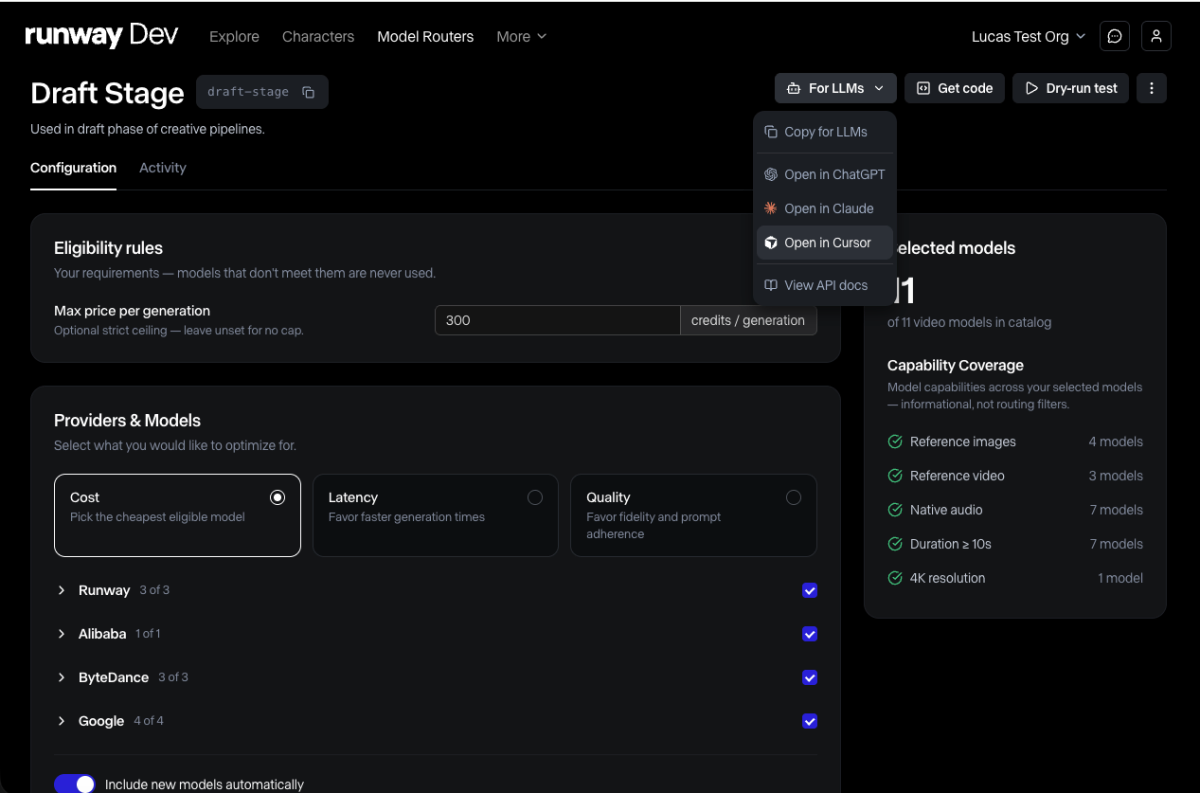
Runway Media Router is a selection engine for media models. Instead of forcing developers to commit to one image generator, one video engine or one voice model, it evaluates a request and routes it to the provider that best matches the requested balance of performance, cost and output quality.
That may sound similar to what many software teams already do with large language models, where routing tools are increasingly common. The difference, Runway argues, is that video, image and audio generation are harder to compare, more subjective to evaluate and more dependent on creative context. In practice, that makes the routing problem more complicated — and more valuable.
Anthony Maggio, Runway’s chief product officer, said the launch fits the company’s broader aim of becoming an easier one-stop integration point for developers building with generative media. In his view, the router is not a separate gimmick but part of a larger platform strategy: make it simple for customers to use many models without needing to become experts in every one of them.
“The routing really fits into that overall promise of being the easiest one-stop shop for developers to integrate with any type of generative media model,” Maggio said.
How Runway Dev is changing the company’s business
Runway Dev gives outside developers API access to a growing menu of third-party and Runway-built media models. The company says customers such as Adobe, Cloudflare, ElevenLabs, Expedia, Shutterstock and Quora are already using the platform to build generative media features inside their own products.
That is a notable shift for a company that first became known for its consumer-facing creative tools. Instead of encouraging users to come directly to Runway’s app or website, the company is increasingly selling infrastructure that sits behind other products. That move opens a wider enterprise market and helps Runway avoid competing solely on the quality of a single flagship model.
The strategy also reflects a practical market reality. Developers want access to the latest models as soon as they appear, but the pace of launches has made evaluation a moving target. A model that performs best on one task may fall behind on another, and a model that is leading today may not stay there for long.
Runway says the router helps customers avoid spending time benchmarking every new release themselves. Instead, the platform handles model selection dynamically, using Runway’s own knowledge of where each model excels.
Why model routing is becoming a big deal in generative media
Model routing matters because the cost of picking the wrong model can be high in both money and product quality. In 2026, token pricing has become a major issue for companies that built products around agentic AI and then discovered that usage costs could escalate quickly. Although generative media pricing is not identical to language model billing, the same logic applies: routing can help match expensive capabilities to the requests that actually need them.
Runway’s launch also comes shortly after it replaced unlimited plans with token-based pricing, a shift that drew criticism from some users. Against that backdrop, the company is clearly leaning into tools that help customers better manage costs and expected output quality.
For developers, routing can also reduce technical overhead. Rather than writing custom logic to determine which provider to use for a given output, teams can rely on a platform that already understands the creative differences across media types.
What developers can set inside the router
Runway says users can influence model selection based on multiple preferences, including the following:
- output quality
- generation speed
- cost efficiency
- preferred model provider
- regional or business constraints
One example Maggio pointed to is provider preference. Some companies may not want to use models developed in China, especially as geopolitical pressure on Chinese AI systems increases. Others may simply want to standardize on American providers or control procurement risk through internal policy.
More commonly, however, customers are expected to optimize around the trade-off between price and quality. In that sense, Runway is betting that generative media will follow the same path as language models, where intelligent routing has become a standard way to cut costs and keep outputs strong.
How does Runway’s router decide which model to use?
Runway says the router combines model intelligence with the company’s own creative evaluation know-how. The tool is built on the expertise Runway’s internal creative team has developed by testing how models behave across different media tasks.
That means the system is not just comparing generic performance numbers. It is also looking at creative characteristics such as whether a video model handles motion smoothly, whether an image model understands composition well or whether a voice model syncs convincingly with lip movement.
This matters because media generation is less objective than text generation. Two models may both produce usable outputs, but one may be better for cinematic motion while another may perform better for product images or brand-safe voice work. Runway says its routing layer is designed to capture those distinctions.
“Most developers are not spending the time to really understand the capabilities of each of these models and where they excel or differ based on various types of outputs across video, image, and audio,” Maggio said.
Runway says the same intelligence layer that powers its own products now underpins the router for outside developers. In effect, the company has packaged an internal advantage and turned it into a commercial product.
What is Runway trying to become?
Runway is trying to become the infrastructure layer for generative media, not just a model vendor or a creative app. That ambition is central to understanding the router launch.
The company began as one of the best-known names in AI video generation. But as the field crowded with new contenders from major tech companies and fast-moving startups, the value of being the single best model provider became less certain. Instead, the durable advantage may be controlling the layer that coordinates many models and helps customers use them effectively.
Runway co-founder and co-chief executive Anastasis Germanidis said the company has long been associated mainly with its end-user creative tools, but that the business had to build a full stack to get there. That stack now includes a developer platform, creative tools and an inference layer underneath.
Germanidis said Runway has seen growing interest from companies that want the service to operate across the entire stack, adding that orchestration is becoming increasingly important as customers build complete campaigns and multi-scene productions on top of these models.
In other words, the company is arguing that the value is no longer only in the raw pixels or generated frames. It is also in the logic that decides how those frames are made, combined and delivered.
The competitive backdrop: Runway’s frontier-model problem
Runway’s pivot to orchestration comes at a time when its own frontier-model momentum has slowed. The company’s last major video model release, Gen-4.5, arrived in December and at the time topped benchmark leaderboards, outperforming comparable systems from larger rivals, including Google. Around the same period, Runway also introduced its first world model.
Since then, the company has not released a new standalone frontier video model in months, aside from an update to its video editing system, Aleph 2.0, in May. Meanwhile, the competitive field has accelerated. According to Artificial Analysis rankings, Runway’s editing model remains near the top, but its text-to-video and image-to-video systems no longer lead the pack.
That shift is visible in current rankings, where models from Google, ByteDance and Alibaba occupy many of the top spots. The result is a more volatile market in which leadership can change quickly and no single vendor can assume it will stay ahead for long.
Rather than betting everything on one model remaining dominant, Runway is now betting on being the best system for selecting among many models. That is a smart hedge in a market where technical superiority is hard to maintain and expensive to defend.
How the market has changed since Runway’s earlier wins
Runway’s earlier success came from being among the first companies to make sophisticated AI video tools broadly usable. But the current environment is different. More competitors, deeper capital pools and rapid iteration from global rivals have turned media generation into a fast-moving commodity race.
In that setting, the company’s strongest advantage may be product design, workflow intelligence and integration depth rather than a single frontier release. The router turns that reality into a product.
It also helps Runway remain relevant when customers increasingly want complete workflows. Many companies are no longer asking for one-off generated clips. They want systems that can produce campaigns, localized variants, voiceovers, assets for different channels and revisions on demand.
Why Chinese models are part of the conversation
Geopolitics is now part of the product discussion. Maggio noted that Chinese generative media models are becoming more popular, but many businesses may be reluctant to build on them because of trust, compliance or procurement concerns.
That opens the door for policy-based routing, where companies can tell Runway to favor U.S. providers or otherwise constrain which models appear in production workflows. The issue is likely to become more important if U.S. regulators and the Trump administration continue exploring bans or sanctions tied to Chinese open AI systems.
For enterprise buyers, this is not just a technical choice. It is a governance decision. A router that can respect those choices may become more valuable as companies try to align creative experimentation with legal and geopolitical risk management.
Table: Runway Media Router at a glance
| Feature | What it does | Why it matters |
|---|---|---|
| Runway Media Router | Automatically selects an image, video or audio model for each request | Reduces the need for developers to benchmark every model manually |
| Runway Dev | Developer platform with API access to Runway and third-party models | Lets customers embed generative media inside their own products |
| Selection criteria | Quality, speed, cost and provider preference | Supports both creative and business constraints |
| Primary customer focus | Enterprises and developers building media features | Broadens Runway beyond its consumer app |
| Strategic role | Infrastructure layer for generative media | Positions Runway as an orchestration company, not just a model maker |
What this means for the generative media industry
Runway’s move is part of a broader shift in AI. As foundation models become easier to access and more interchangeable, the strategic value often moves up the stack. Companies that can abstract away complexity, coordinate multiple models and make output more predictable may capture more durable customer relationships than companies that simply publish another model.
This is especially true in media, where the end product is judged visually and emotionally rather than just numerically. A router that understands creative quality could become the equivalent of a production manager for AI content: it assigns the right tool to the right job, then adapts as the market changes.
The bigger question is whether customers will see that orchestration layer as a necessity or a convenience. If generative media continues to fragment, the answer may be necessity. If one or two providers regain clear dominance, the router may be less essential. For now, the evidence points in the other direction.
Who stands to benefit most?
Developers building high-volume creative workflows stand to benefit the most. That includes ad tech companies, media platforms, e-commerce tools, design software vendors and businesses that need to generate many types of content at scale.
It also benefits enterprises trying to keep costs under control. By routing each request to the cheapest model that still meets quality expectations, teams can preserve margins while still using top-tier creative systems when needed.
Finally, it benefits Runway itself. The company gains a reason to stay embedded even if customers switch among providers behind the scenes. In a market defined by churn, that is a valuable place to be.
What comes next for Runway?
Runway has not said when it will launch its next frontier video model, and the company did not comment on timing for Gen-5 in the source material. But the router launch shows the company is no longer waiting for a single model release to define its future.
Instead, it is building around the idea that the generative media stack will remain plural, messy and fast-changing. By owning the decision layer, Runway can keep participating in the market even when it is not the headline model leader.
That may be the most important lesson in this launch: in generative AI, the next competitive battleground may not be who can generate the best clip, image or voice line. It may be who can intelligently decide which model should do it in the first place.
As Maggio put it, Runway’s long-term focus has always been research paired with a clear view of where the market is headed. With the Media Router, the company is trying to prove that the smartest way to stay ahead may be to route around the volatility rather than fight it head-on.
For developers, that could make Runway less of a destination and more of a backbone. And for the broader AI media market, it is a sign that the race is expanding from model quality alone to the infrastructure that helps make model quality usable at scale.
Frequently asked questions
What is Runway Media Router?
Runway Media Router is an AI tool that automatically chooses the best image, video or audio model for a request. It is designed to balance quality, speed and cost, helping developers avoid manually testing every new generative media release.
Why did Runway launch an AI model router?
Runway launched an AI model router because the generative media market has become crowded and fast-changing. By offering orchestration across many models, the company can stay central to developer workflows even when a single frontier model does not dominate.
How is Runway Dev different from Runway’s consumer app?
Runway Dev is a developer platform that lets companies embed media generation directly into their own products through APIs. Unlike the consumer app, which sends users to Runway’s interface, Runway Dev is built for integration and infrastructure use cases.
Can companies choose which models the router prefers?
Yes, companies can set preferences that influence routing decisions. Runway says those preferences can include cost, quality, speed and provider choices, including business policies that may favor American models over Chinese ones.
Does this mean Runway is moving away from making its own models?
No, Runway is not abandoning model development, but it is broadening its strategy. The company is increasingly focused on being the orchestration layer for generative media, which lets it serve customers even as model leadership shifts across the market.