In short
Apple’s Vision Pro hardware chief Paul Meade is reportedly leaving for OpenAI, a move that could affect Apple’s smart glasses plans. The departure highlights the intensifying competition to build the next big AI hardware platform.
- Paul Meade, who led Apple’s Vision Pro effort, is reportedly heading to OpenAI.
- He also reportedly oversaw Apple’s upcoming AI smart glasses project.
- The move comes as Apple reorganizes hardware leadership and prepares for a possible John Ternus rise.
- OpenAI is building a hardware team around Jony Ive and Sam Altman’s device ambitions.
- The report underscores the growing competition for AI hardware talent and wearable strategy.
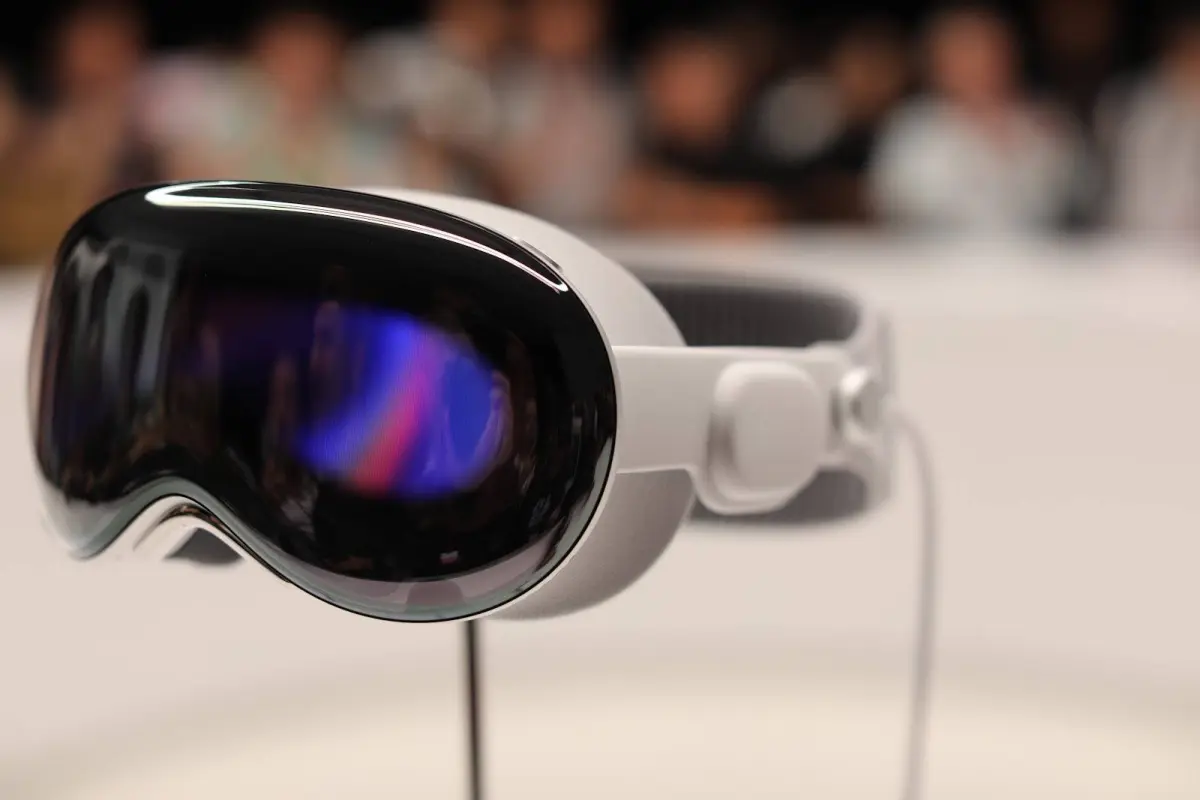
Apple’s push into next-generation wearables may be losing one of its most important hardware leaders just as the company is trying to redefine its place in the artificial intelligence era. According to a report from Bloomberg, Paul Meade, the Apple vice president overseeing the Vision Pro headset, is leaving the company to join OpenAI’s hardware efforts.
The move, if confirmed, would mark another high-profile talent shift from Apple to an AI rival at a moment when both companies are trying to shape the future of consumer devices. It also underscores how quickly the center of gravity in tech has moved from premium mixed-reality headsets toward AI-first products, including smart glasses and ambient computing devices designed around conversational models rather than traditional screens.
Meade is said to have played a broader role inside Apple than his title alone suggests. In addition to leading Vision Pro, he reportedly oversaw work on the AI-powered smart glasses that Apple is expected to introduce next year. That makes his departure particularly notable because those glasses are widely viewed as one of Apple’s most important upcoming product categories and a likely response to Meta’s growing lead in the wearable AI market.
Why Meade’s departure matters
Apple has invested years and substantial engineering resources into spatial computing, culminating in Vision Pro, a device that was positioned as a leap beyond the smartphone but failed to become a mainstream hit. The headset won praise for its display quality and interface ideas, but its high price, limited use cases and bulky design kept it from reaching mass adoption.
That has left Apple looking for a more practical entry point into wearables with broader appeal. Smart glasses, if executed well, could offer a much more accessible way to bring AI and visual computing to consumers. Compared with a head-mounted mixed-reality computer, lightweight glasses are easier to imagine as an everyday accessory.
For that reason, a senior executive who helped shape Apple’s strategy in this area leaving for OpenAI raises questions about continuity, timing and competitive pressure. It also suggests that the competition for device talent is intensifying as companies race to define what comes after the smartphone.
A key figure in Apple’s wearable ambitions
Meade’s role placed him near the center of two of Apple’s most closely watched hardware bets: Vision Pro and the company’s future smart glasses. In practical terms, that meant he was involved in both the more expensive, technically ambitious end of Apple’s wearable strategy and the more consumer-friendly path the company appears to be pursuing next.
Apple has not publicly laid out a full road map for its glasses plans, but industry reporting has consistently suggested that the company views the category as an important long-term opportunity. A departure at this stage could slow momentum or, at minimum, force Apple to redistribute responsibility across teams already under pressure to deliver new hardware products with AI features.
OpenAI’s hardware push is gaining steam
OpenAI has increasingly signaled that it intends to become more than a software company. The ChatGPT maker is working on hardware with former Apple design chief Jony Ive, and CEO Sam Altman has described that effort in unusually expansive terms, suggesting the device will aim for a calmer, less intrusive experience than the modern smartphone.
The partnership with Ive has already turned OpenAI into a serious contender in the future consumer device conversation. The addition of an Apple executive with direct experience leading a marquee wearable project could further strengthen that effort, especially if the company is trying to build a team that combines product design, hardware engineering and AI integration.
Bloomberg’s Mark Gurman framed the move as part of a broader internal reshuffle at Apple tied to the anticipated rise of hardware chief John Ternus.
According to that reporting, Ternus’ expected promotion to Apple CEO is contributing to a restructuring of hardware engineering. Some vice presidents reportedly felt the reorganization left them with less authority than before, creating internal unease and giving rivals an opening to recruit experienced leaders.
Apple’s succession politics and the hardware shake-up
Leadership transitions at Apple have historically triggered subtle but meaningful shifts in power across the company. A move from one generation of executives to another can affect product priorities, reporting lines and the influence of individual teams. In this case, the reported departure of a hardware vice president appears to be linked not just to a better opportunity elsewhere, but to the changing structure of Apple’s leadership.
The mention of John Ternus is significant because he has long been seen as one of the most likely candidates to eventually lead Apple. If he is indeed preparing for a bigger role, the reshaping of hardware responsibilities would be a natural consequence. But reorganizations also create winners and losers, and some executives may interpret new reporting arrangements as a loss of status or strategic influence.
That kind of internal dissatisfaction can be enough to prompt departures, particularly in a market where AI companies are aggressively hiring senior product and engineering talent with experience shipping consumer devices.
The broader battle over AI hardware
The reported move comes as the industry’s most important companies are all trying to answer the same question: what form should AI take outside the browser and the phone app?
Apple appears to believe the answer could be smart glasses, a category that blends wearability with everyday usefulness. Meta has already pushed hard in that direction with its own glasses and has been building consumer familiarity with camera-enabled, voice-driven wearables. OpenAI, meanwhile, seems to be betting that the next dominant interface will come from a device designed around AI from the start, rather than retrofitted with it later.
That strategic difference matters. Apple’s approach tends to be incremental, hardware-led and tightly integrated into its ecosystem. OpenAI’s approach is likely to be more experimental, pairing frontier model capabilities with new device concepts that do not look like conventional consumer electronics.
Meade’s move therefore fits a larger pattern: the most experienced hardware leaders are becoming increasingly valuable to AI companies that want to move beyond chatbots and into physical products.
Vision Pro’s commercial reality
Vision Pro was introduced with enormous fanfare, but it has not become the breakout success Apple may have hoped for when it launched the device. At its premium price point, the headset remained a niche product, appealing mostly to developers, enthusiasts and early adopters rather than the mainstream consumer base that drives Apple’s largest hardware businesses.
That matters because Apple’s wearables strategy depends on finding a product that can scale far beyond the audience willing to pay thousands of dollars for a mixed-reality headset. Smart glasses could be that product, but only if they manage to combine design, battery life, utility and AI capabilities in a way that feels seamless.
The question is whether Apple can maintain enough momentum in that category if key leaders are departing before the product has even arrived.
How Apple’s smart glasses fit into the company’s AI reset
Apple’s broader AI strategy has faced more scrutiny than those of some of its peers. The company has carefully guarded product details and typically unveils major features only when they are polished enough for mass-market release. That discipline has often served Apple well, but the fast-moving AI landscape has made it harder to appear ahead of competitors when new capabilities are arriving at a rapid pace.
Smart glasses may give Apple a way to reassert its strengths. The company has deep expertise in miniaturization, industrial design, custom silicon and consumer software integration. If it can combine those advantages with modern AI assistants and always-available visual input, it could create a product that feels distinctly Apple while still tapping into a market that is likely to grow quickly.
But the work is difficult. Glasses must remain light and stylish while housing cameras, microphones, processors, batteries and wireless components. They also need a software experience that makes sense in everyday life. That combination is exactly the kind of challenge that benefits from experienced leadership.
OpenAI’s design ambitions are no longer theoretical
OpenAI’s hardware plans are still emerging, but they are now impossible to dismiss as a side project. The company’s collaboration with Jony Ive signaled that it wanted more than a reference design or a limited accessory. It wants to shape the physical form of AI interaction itself.
Altman has described the envisioned device as something more serene and less disruptive than a smartphone. That framing reflects a broader industry belief that current mobile devices are poorly suited to the age of ambient AI. People may want answers, assistance and context without endlessly opening apps or staring at screens.
From that perspective, OpenAI’s hardware ambitions and Apple’s smart glasses plans are part of the same competitive frontier. One company is trying to adapt its wearable roadmap to the AI moment; the other is trying to invent a new AI-native consumer device. Talent moves between those two efforts are likely to continue.
What this means for the talent war in tech
High-level departures like this are often about more than one executive leaving one company for another. They can reveal where the industry believes the next major growth cycle will happen. Right now, the biggest pull is clearly toward companies that can turn AI into something physical, personal and always present.
That has consequences for how tech giants recruit and retain leaders. Hardware veterans with experience at Apple, especially those who have shipped ambitious products, are in short supply and high demand. AI firms want their product instincts, manufacturing knowledge and ability to work through difficult device trade-offs.
For Apple, the challenge is not simply replacing one executive. It is protecting the institutional knowledge that lives inside teams building products years before they launch. If multiple senior figures begin to reassess their roles during a leadership transition, the company could find itself under pressure to accelerate decisions or risk losing strategic ground.
Timeline: Apple, Vision Pro and the emerging AI device race
| Period | Event | Why it matters |
|---|---|---|
| Vision Pro launch era | Apple introduces its premium mixed-reality headset | Shows Apple’s ambition in spatial computing, but the product remains niche |
| Following months | Apple continues work on AI-powered smart glasses | Represents a more accessible wearable strategy and a possible answer to Meta |
| Recent reporting | OpenAI deepens hardware efforts with Jony Ive | Signals a push toward AI-native consumer devices |
| June 2026 | Paul Meade is reported to be leaving Apple for OpenAI | Highlights the competition for senior hardware talent |
| Near future | John Ternus is expected to take on a larger leadership role at Apple | Could reshape hardware reporting lines and product priorities |
Key questions going forward
Several important questions now hang over both companies.
- Can Apple keep its smart glasses project on track without the executive who helped lead it?
- Will OpenAI’s hardware team become a major destination for talent from consumer-device giants?
- Can AI-native devices move from concept to mass-market product faster than previous wearable categories?
- Will Meta’s early momentum in smart glasses force Apple and OpenAI to move more quickly?
For now, neither Apple nor OpenAI has publicly commented on the reported move, and TechCrunch said it had reached out to both companies for response. Until either company confirms the departure, the details remain a report rather than an official announcement. Still, the significance is hard to miss: one of Apple’s senior wearable hardware leaders may be on his way to the very company trying to redefine what the next generation of personal computing looks like.
The bigger picture
The reported exit of Paul Meade is part of a larger story about where consumer technology is headed. For more than a decade, the smartphone has been the center of the digital experience. Today, the most ambitious players in tech are searching for an alternative form factor that can make AI feel natural instead of bolted on.
That search is now unfolding across smart glasses, headsets and standalone AI devices. Apple has the manufacturing scale, design discipline and distribution power to compete. OpenAI has the momentum, brand attention and model leadership to attract partners and talent. Meta has first-mover advantage in wearables. The market is still open, but it is getting crowded quickly.
If Meade’s move is confirmed, it will be more than a personnel change. It will be another sign that the battle for the next major computing platform is no longer just about software intelligence. It is about who can put that intelligence into a device people will actually want to wear every day.