In short
Jesscia Hische says she designed Meta’s new Muse logo by hand and took the freelance job to support her Oakland businesses. After she discussed the work publicly, she faced intense backlash from designers angry about Meta and AI.
- Hische says she designed Meta’s Muse logo without using generative AI.
- The freelance job became controversial after she mentioned it publicly in her newsletter.
- Critics on Threads framed the assignment as an ethical failure because of Meta’s role in AI.
- Hische says the work helped support two Oakland businesses with thin margins.
- The episode highlights how AI politics are reshaping even traditional design work.
Bay Area lettering artist Jesscia Hische says she took Meta’s logo assignment for its new AI assistant, Muse, because her small businesses needed the money and the work was done by hand, not by generative AI. The decision drew a wave of criticism online, underscoring how deeply anti-AI sentiment and distrust of Meta now shape reactions to even routine design jobs.
Hische, who runs two brick-and-mortar shops in Oakland, says the project was a short freelance sprint that helped stabilize finances at a precarious moment for her studio businesses. But once she publicly mentioned the assignment in her newsletter, the response on Threads quickly turned personal, with other designers accusing her of compromising her values by working with the company.
The episode has become a useful snapshot of the culture clash surrounding artificial intelligence: even artists who reject generative AI can now face backlash for serving companies that build AI products. It also raises a broader question for creative workers trying to survive in a shifting economy — when does taking a client job become an ethical statement, and who gets to decide?
What happened when Meta hired an independent designer for Muse?
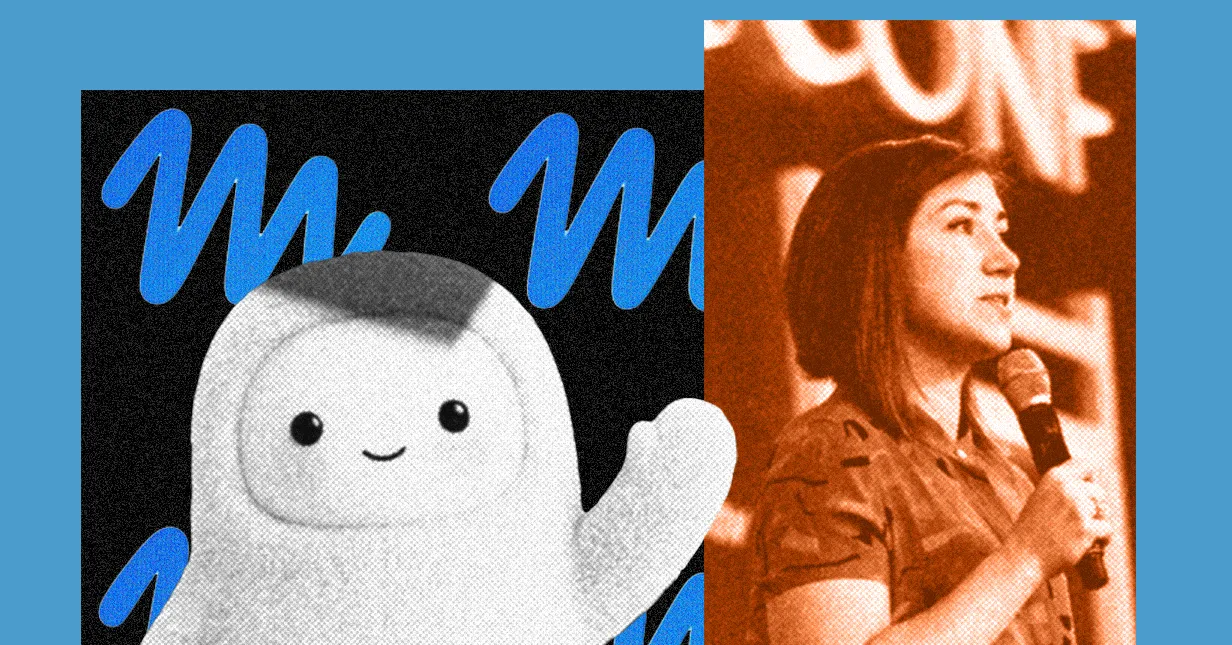
Meta brought in Hische to refine the visual identity for Muse, the company’s new AI assistant and agent product. She says the assignment focused on the “M” icon and accompanying logotype, both of which had already been drafted internally and needed professional typographic polishing.
Rather than generating assets with software, Hische says she produced the mark the traditional way, using her own design skills and making dozens of iterations. The work, she said, was intended to make Muse feel approachable and imaginative, not rigid or overly engineered.
Her account places the project in a very specific niche: the intersection of branding, letterform design, and product strategy. Meta wanted a mark that would visually sit in the same family as its existing infinity-loop brand language, while still signaling a separate AI offering.
How the logo was developed
Hische said the initial version of the “M” used a single-width vector stroke, which gave it a flat, uniform appearance. She explained that part of the design challenge was to introduce the subtle irregularities that make typography feel alive — small changes in thickness and spacing that create visual rhythm and warmth.
According to her, Meta’s internal team had already explored the concept and knew it needed a more refined finish. The company’s ask, she said, was not simply for a prettier letter, but for a symbol that felt creative, inviting and less mechanical.
She completed the icon in roughly two days, producing 32 variations, and spent another two weeks on the wordmark. That kind of timeline is typical for a fast-moving product launch, especially when a company wants to preserve momentum while still improving the final presentation.
Hische said the goal was to make the brand feel “inspiring and creative” and to avoid the impression of something stiff or cold.
Why did the backlash spread so quickly?
The criticism escalated because the project touched two especially polarizing subjects at once: Meta and artificial intelligence. For many designers and creatives, those are not separate concerns but overlapping symbols of disruption, labor anxiety and distrust in how technology companies use creative work.
Hische says she expected some pushback from fellow artists, but not the scale or intensity that followed. Once her newsletter post started circulating, replies and quote-posts piled up across Threads, where users accused her of selling out and questioned her ethics for working with the company.
In the online pile-on, the conversation moved beyond the logo itself. Some commenters implied that taking Meta’s money was morally comparable to siding with the very forces threatening creative labor. Others publicly speculated about her wealth and circulated photos of her home, turning a design commission into a broader morality play.
What critics argued
The central criticism was straightforward: working for Meta on anything connected to AI was seen by many as legitimizing a company they believe is helping destabilize artistic labor. For some, the objection was not whether Hische used generative AI — she says she did not — but whether any collaboration with Meta represented a betrayal of the creative community.
That reaction reflects a growing cultural hard line. In some artistic circles, AI is no longer just a tool with ethical concerns; it is a symbol of extraction, industrial scale and devaluation of human craft. As a result, associating with an AI product can trigger hostility even when the work itself is fully human-made.
Hische said some commenters framed the job as an ethical failure rather than a normal freelance assignment, while others treated her financial disclosures as proof she was wealthy and out of touch.
How much did Meta pay for the logo work?
Hische says she charged about $12,500 for the two-day design sprint, describing it as strong compensation for a short project at a large company, but not the kind of windfall that would transform her finances. She presented the fee as a practical business decision rather than a fortune.
That context matters because Hische says her freelance pipeline had slowed significantly, while her physical businesses were operating on thin margins. In her telling, the Meta work was less about prestige than about keeping payroll covered and reducing pressure around cash flow.
She says she was balancing income from client projects against operating costs at two Oakland businesses: one focused on stationery and art goods, and another centered on creative workshops and kids’ activities. Both required ongoing investment, inventory and staffing.
Hische’s financial picture, by her account
Hische told Wired that the prior year left her with only a small profit from the two shops combined. She said she had also put substantial money into Studioworks, a platform for creatives, and Drawling, her Oakland art shop for kids.
She stressed that she was responsible not only for herself but for employees and family members who work with her. Her concern, she said, was meeting payroll and maintaining basic business stability, not taking a morally questionable payday.
That reality is central to understanding why so many freelancers accept work from controversial clients. For many independent creatives, the choice is rarely between a perfect and an imperfect project; it is often between a paycheck and none at all.
| Milestone | Details | Why it mattered |
|---|---|---|
| Meta commissions Muse branding | Hische is brought in to refine the assistant’s icon and logotype | Shows Meta still hiring humans for key design work |
| Two-day icon sprint | 32 variations of the “M” are explored | Highlights the speed and intensity of product branding work |
| Public newsletter post | Hische mentions the project and its context | Triggers backlash across Threads |
| Online escalation | Critics accuse her of selling out and question her finances | Illustrates how quickly design work became a moral issue |
| Aftermath | Hische says she spends days in tears and feels misunderstood | Shows the personal cost of viral creative controversy |
Who is Jesscia Hische, and why does her work matter?
Hische is an established lettering artist and designer known for identity work and refined logo refreshes. She says she specializes in the kind of subtle visual updates that make a brand feel newly polished without making it unrecognizable.
Her description of the process is telling. She compares good logo work to a spa weekend rather than major cosmetic surgery: the result should feel fresher and more confident, but still unmistakably itself. That philosophy is common in identity design, where restraint often matters as much as invention.
Her portfolio includes redesigns for brands such as Squier by Fender, Jeni’s Ice Cream and Southern Living. In the design world, that kind of client list gives her credibility as someone who understands how to modernize an identity while respecting its history.
The controversy also speaks to the vulnerability of independent creatives who have spent years building reputations in communities that now expect ideological purity. Hische’s public profile gave the backlash more reach, but the dynamics she faced are increasingly familiar to freelancers across disciplines.
What did the Meta team want from the Muse logo?
Meta wanted the new mark to feel like part of its brand family, while still standing apart as a dedicated AI assistant identity. Hische says the company’s internal designers and engineers had already developed a direction, and her job was to make the result more elegant and typographically sound.
The emphasis on warmth and playfulness suggests a broader challenge that many AI companies now face: how to market products built on complex, often controversial infrastructure as friendly consumer experiences. Branding is one of the main tools companies use to soften that tension.
Meta chief AI officer Alexandr Wang has since commented publicly on the logo, saying he was glad it did not resemble a vulgar shape. Hische says those concerns may well have existed internally, but her brief focused more on making the symbol feel visually connected to Meta’s existing infinity-inspired universe.
Why the logo debate became symbolic
Logo criticism may sound trivial, but in this case it became a proxy war over the future of AI branding. A company’s icon is often the first thing people see, and in a contested category like AI assistants, design choices can carry outsized ideological weight.
To supporters, the fact that Meta paid an independent artist rather than leaning on generative tools should have been a positive sign. To critics, the assignment still linked a respected designer to a company they distrust, and that was enough to provoke anger.
That tension helps explain why the public discussion veered far from the actual design choices. Once AI and Meta were in the same sentence, the conversation was no longer just about typography.
How did Hische respond to the criticism?
Hische says she initially tried to engage critics directly and defuse the anger with explanation rather than argument. She believes that when misunderstandings arise online, a calm, conversational response can often help reduce escalation.
In this case, however, her effort to clarify the situation appears to have backfired. A remark about avoiding credit card debt during the holiday season was stripped of context and recast by opponents as evidence of wealth and privilege.
From her perspective, the reaction was not just harsh but distortive. She says the internet turned a working freelancer into a caricature of a rich, indifferent collaborator with power, when she sees herself as a small business owner trying to keep employees paid.
Hische said the experience made her feel deeply misunderstood and left her emotionally overwhelmed for days after the backlash intensified.
Why she chose to speak publicly at all
She says she shared the project because she generally likes discussing her work and assumed her newsletter audience would understand the context. She also believed it was worth acknowledging that she has a long-standing connection to Meta through her husband’s past employment there.
That decision may have been the turning point. In a more cautious media environment, many freelancers would likely have taken the assignment quietly. Hische chose openness, and the internet punished the transparency more than the work itself.
Her experience suggests that public honesty is no longer a neutral act for creators working near controversial industries. The choice to disclose can be interpreted as bravado, defensiveness or even provocation.
What does this say about AI and commercial art?
The episode reveals a complicated split within the creative community. Some artists see any relationship with AI companies as a compromise, while others distinguish sharply between using AI to replace creative labor and using humans to do traditional design work for AI products.
Hische falls into the latter camp, at least in this case. She argues that a large company hiring an independent designer is preferable to relying on generative systems that can automate away human originality, especially in branding and identity work.
At the same time, she is not a blanket AI cheerleader. She says she has long had reservations about generative uses of AI and does not use those tools to create art. She draws a line between administrative or technical assistance and creative substitution.
Where she draws the line
According to Hische, AI can be useful for non-artistic tasks such as administration, coding support and web-building. She says the problem begins when a model starts replacing people in work that depends on judgment, craft and creativity.
That distinction is increasingly common among working professionals who are not anti-technology but are worried about labor displacement. It also mirrors a broader debate in the creative economy: whether AI is best understood as infrastructure, collaborator, competitor or threat.
Hische also noted that she may benefit from the ongoing Anthropic settlement process because of alleged scraping of her books, another sign that creators are beginning to expect legal and financial consequences from the AI industry, not just cultural ones.
Timeline of the Muse logo backlash
The sequence below shows how quickly a routine freelance assignment turned into a broader debate about ethics, labor and AI culture.
| Date/Stage | Event | Impact |
|---|---|---|
| Initial commission | Meta hires Hische to refine the Muse logo and wordmark | Independent human design work is used for an AI product |
| Design sprint | Hische completes icon iterations over two days and the logotype in about two weeks | The project is finalized quickly ahead of launch |
| Newsletter reveal | Hische mentions the job publicly and explains her reasoning | The post spreads to Threads and begins drawing criticism |
| Backlash peaks | Designers and other users accuse her of unethical behavior | The discussion turns personal and emotionally charged |
| Aftermath | Hische reflects on the reaction and reaffirms her stance on AI | The story becomes a broader commentary on creator anxiety |
Why this story matters beyond one logo
On its surface, this is a story about a lettering artist and a corporate identity update. In practice, it exposes a much larger fault line running through the creative industries: whether there is still room for pragmatic freelance work in a culture that increasingly demands ideological alignment.
The reaction to Hische also shows how fast AI debate has moved from technical discussion to social identity. A person can reject generative tools, work by hand and still be accused of aiding the wrong side simply because the client is associated with AI.
That logic is dangerous for freelancers, who often depend on a mix of clients to survive. When the market is fragile, many independent workers cannot afford to turn every controversial brief into a referendum on their character.
It is also significant that Meta chose a human designer. Companies frequently claim that AI will augment creativity, not erase it, yet public trust remains low. Hiring a respected artist for a high-profile AI brand may have been intended to signal sophistication, but it also created a lightning rod for criticism.
What comes next for designers working in the AI era?
Designers will likely face even more pressure to explain who they work for, what tools they use and what values they are willing to compromise on. The Muse backlash suggests that in some online communities, those distinctions will not be enough to avoid suspicion.
For Hische, the immediate lesson appears to be that transparency can be costly. For the broader industry, the lesson is that AI is now so politically charged that even conventional brand work can trigger a moral reaction.
That may make the future more difficult for independent artists, not easier. The same technologies that threaten creative jobs are also reshaping the social norms around who gets to take which job in the first place.
In that sense, the Muse logo story is not just about a company and a designer. It is about the changing price of survival in the creative economy, and the growing difficulty of separating work from ideology.
For now, Hische’s experience stands as a cautionary tale: in the age of AI, even a hand-drawn logo can become a cultural flashpoint.
Frequently asked questions
Did Jesscia Hische use AI to design Meta’s Muse logo?
No. Hische says she created the logo through traditional design work and did not use generative AI in the process. Her role was to refine an internal concept into a more polished, typographically nuanced brand mark for Meta’s Muse assistant.
How much did Meta pay for the Muse logo project?
Hische says she was paid about $12,500 for the job. She describes it as strong compensation for a short, two-day sprint, but not enough to transform her finances or make the backlash worth it from a business perspective.
Why were designers angry about the Meta commission?
Many designers were upset because Meta is closely tied to the AI debate, and some viewed any work for the company as ethically compromised. The backlash was less about whether Hische used AI and more about whether collaborating with Meta signaled support for a controversial industry player.
What is Muse?
Muse is Meta’s new AI assistant and agent product. The branding assignment focused on giving the assistant a distinct icon and logotype that still felt connected to Meta’s existing visual identity.
Does Hische oppose AI altogether?
No. Hische says she is opposed to using AI for generative art and for replacing creative labor, but she sees value in AI for admin tasks, coding help and other non-artistic uses. She says her position softened after seeing some of the technology’s non-creative applications.
Frequently asked questions
Why did Jesscia Hische take Meta’s Muse logo job?
She took the job because her freelance work had slowed and her Oakland businesses needed income to cover payroll and operating costs. Hische said the fee helped reduce financial stress and support employees, making the assignment a practical business decision.
What exactly did Hische design for Meta?
She designed the visual identity for Muse, Meta’s AI assistant, including a refined version of the M icon and the logotype. Hische says Meta had already developed an internal direction and brought her in to polish the typography and brand feel.
Why did the design community criticize her?
Many critics saw Meta as a symbol of the harms associated with AI and tech power, so they viewed any collaboration with the company as ethically suspect. The backlash focused less on the design work itself and more on the symbolism of accepting the commission.
Did Meta use AI to create the Muse logo?
No, according to Hische, the work was done traditionally by a human designer. She says she used no generative AI in the process, and she argues that hiring an independent artist is preferable to having AI generate branding.
How much was Hische paid for the project?
She says she charged about $12,500 for the two-day sprint. Hische described it as a solid fee for a fast freelance job, but not life-changing money.