In short
Microsoft is expanding a biomimicry strategy for data centers, using native landscaping and ecosystem restoration to reduce community backlash. Critics say the projects help locally but cannot offset the wider water, power and emissions costs of AI infrastructure.
- Microsoft is using biomimicry to make data centers blend more naturally into local environments.
- San Antonio residents and officials are concerned about tree loss, noise, water use and electricity demand.
- The company says it is funding habitat restoration and site-specific ecological projects in multiple regions.
- Advocates argue the measures are useful but too small compared with the environmental footprint of AI growth.
- Texas regulators and local leaders are moving to scrutinize or slow new data center development.
Microsoft is redesigning parts of its data center strategy with nature-based landscaping and ecosystem restoration as pressure rises over noise, trees cut down, water use and energy demand from AI infrastructure. The company says its new “biomimicry” approach is meant to make facilities less disruptive and more welcome in the communities that host them.
The shift matters because Microsoft is expanding rapidly at the same time that residents and officials in places such as San Antonio are pushing back against the scale of hyperscale data centers and the pollution linked to their power needs.
What looked like ordinary office buildings two decades ago has become something far larger and harder to ignore. Across the United States, data centers now rise as sprawling industrial campuses that can cover millions of square feet, draw huge amounts of electricity and water, and transform nearby neighborhoods with construction traffic, bright exterior lighting and round-the-clock mechanical noise.
Microsoft is not backing away from that expansion. Instead, it is trying to soften the footprint with tree plantings, pollinator habitat, creek restoration and other designs borrowed from the natural world. Supporters say that could reduce damage and improve relations with residents. Critics argue the approach does little to offset the broader environmental cost of building the infrastructure behind artificial intelligence.
Why Microsoft is leaning into biomimicry
Microsoft’s new approach is built around a simple idea: if data centers are going to keep spreading, they should look and behave less like industrial intrusions and more like neighbors.
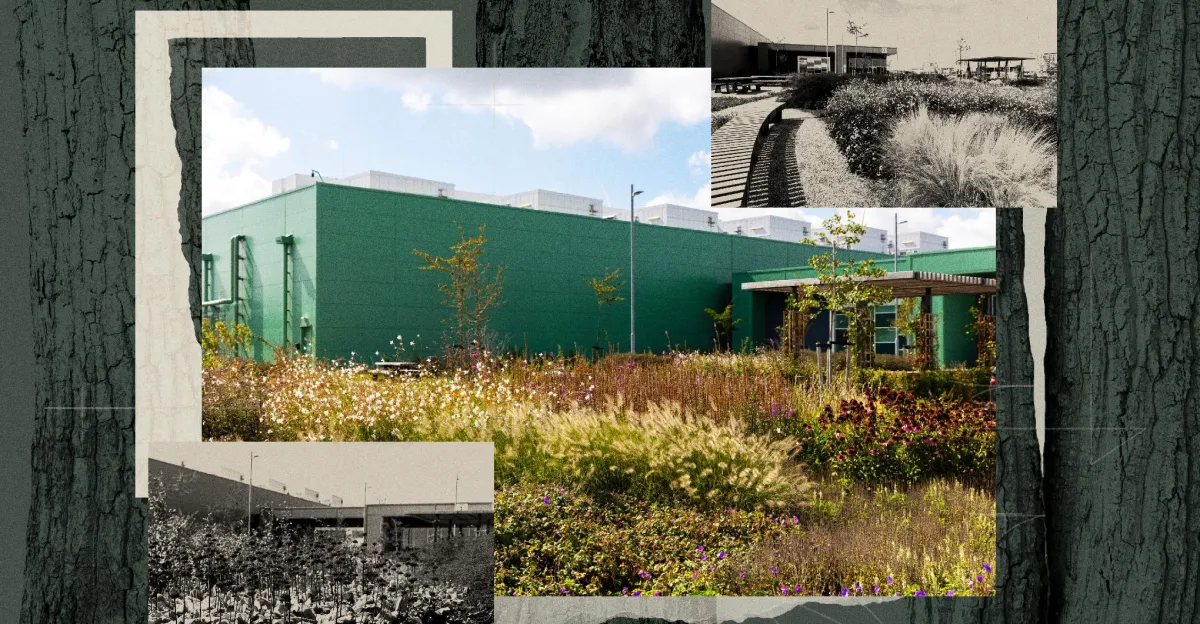
The company uses biomimicry as an umbrella term for nature-inspired design. In practice, that means planting native species, restoring habitat on or near its sites, adding buffers that can dampen noise, and tailoring projects to local ecosystems rather than applying one standard blueprint everywhere.
Microsoft says the goal is not only to improve the appearance of its facilities, but to create “resilient ecosystems” that help biodiversity and preserve some of the green space lost to construction. The company also says the work is intended to reduce some of the friction that has developed between data center operators and surrounding communities.
How Microsoft describes the strategy
Microsoft says its projects are meant to blend data centers into local landscapes and repair some of the environmental damage associated with development. The company has framed the effort as a way to become a better neighbor while continuing to build out the infrastructure required for AI.
Microsoft says it wants nature-inspired solutions that fit each location, restore what may have been lost and enhance the ecosystems already there.
Kaitlin Chuzi, who leads global land strategy at Microsoft, said the company is customizing each site’s approach rather than using a single template. In her telling, the objective is to build with the habitat in mind and to improve the land over time, not simply occupy it.
What is happening in San Antonio?
San Antonio has become a revealing example of the tensions surrounding data center growth. Councilmember Ric Galvan says his district, which covers roughly 55 square miles, already has more than a dozen data centers and could end up with around 20 if projects under consideration move forward.
The facilities are concentrated along two main roads, he says, which means their burdens are also concentrated. Nearby residents have dealt with heavy construction traffic, trees removed during site preparation, persistent light at night and the hum of generators and cooling systems once the buildings are operating.
Galvan remembers a time when much of the land felt open and green. The newer projects, he says, have changed that relationship with the environment almost overnight.
Galvan says the feeling of being close to nature can disappear quickly once a large data center is built.
Microsoft has been active in the greater San Antonio area for nearly a decade and is investing heavily in additional sites. One project in particular triggered strong local backlash when the company cleared more than 2,600 trees across 33 acres in 2022. Residents also objected to Microsoft’s requests for zoning changes and tax incentives, turning the project into a symbol of how big tech development can reshape a region without much public consensus.
Microsoft says it is trying to address those concerns. In San Antonio, the company says it is investing in more than 400 acres of woodland and pollinator prairie restoration and aims to leave the land more productive than it found it.
How does Microsoft say the projects work?
Microsoft says the biomimicry program is not cosmetic landscaping alone. The company argues that the projects are intended to change how sites interact with stormwater, habitat and neighboring communities.
Some efforts involve restoring degraded ecosystems. Others focus on reducing practical annoyances associated with data centers, including visual clutter and noise. In some locations, Microsoft says it is considering layered vegetation around facilities to create a softer edge between industrial buildings and nearby homes or businesses.
Examples from Wisconsin and the Netherlands
Microsoft says it began biomimicry work at a data center in the Netherlands in 2022 and is now planning nature-based projects at more than 20 sites in the United States and Germany. The company also says the same approach will apply to all new U.S. projects and to an increasing number of projects elsewhere in the world.
One of the most cited examples is in Mount Pleasant, Wisconsin, where Microsoft is redeveloping the former Foxconn LCD factory property for data centers. There, the company funded a $4.2 million project in 2023 to restore a creek that runs through the site and worked with the Root-Pike Watershed Initiative Network on the restoration.
Dave Giordano, the nonprofit group’s executive director, said Microsoft also took a step that stood out locally by adding forebays to stormwater ponds, helping trap sediment before it can spread further. He said such measures are not common in the region and suggested Microsoft has been more thoughtful than some other operators.
Giordano said Microsoft’s approach is unusual enough that not all data center companies should be lumped together.
What are residents and advocates saying?
Local officials and environmental advocates generally welcome restoration work and habitat projects, but many say those measures do not fully address the broader footprint of the AI buildout.
Galvan says community members want real responses to long-running complaints about water, pollution and the destruction of natural landscapes. He acknowledges Microsoft has been more accessible than some competitors, including by assigning a local representative to hear concerns, but he still wants stronger action from the industry as a whole.
Adrian Shelley, Texas director at the consumer advocacy group Public Citizen, said nature-based projects are better than doing nothing, but argued they can look like a small cosmetic fix compared with the scale of the damage created by the facilities themselves.
Shelley said he supports ecosystem-sensitive projects, but sees them as largely inadequate if the surrounding development is still driving pollution and resource strain.
His biggest objection is the way data centers are affecting the state’s energy system. He pointed to new gas plants being built to serve the growing electricity needs of AI campuses and said those projects lock in emissions that cannot be solved by planting trees around a server farm.
In June, Microsoft signed a 20-year agreement with Chevron for power tied to a new AI data center campus in West Texas. Chevron has said the project will rank among the largest co-located natural gas and data center developments in the country, a scale that has only sharpened criticism from climate and consumer groups.
Shelley argues that no amount of landscape design can make a gas plant an appealing neighbor.
Why water and electricity are central to the fight
Data centers are controversial not only because they occupy land, but because they use huge amounts of electricity and require cooling systems that can consume significant volumes of water. Their impact is also indirect: the power plants supplying them often need water too, especially fossil fuel and nuclear facilities with their own cooling requirements.
That combination has alarmed communities in Texas, where drought and rising demand already make water a politically sensitive issue. According to the Houston Advanced Research Center, data centers in the state used about 25 billion gallons of water last year. That was roughly 0.4 percent of all water use, but researchers expect the share to rise as more projects are built.
The future total is still uncertain because many proposed projects may never be completed, and because cooling technologies vary. Even so, the same researchers estimate that data centers could account for between 0.5 percent and 2.7 percent of annual water consumption in Texas by 2030.
Erin Kinney, a senior research scientist at HARC, says renewable power can reduce some of the associated water burden because it generally requires less water than thermal generation. She is more optimistic than some critics about Microsoft’s biomimicry projects, especially because the company is trying to adapt them site by site rather than using a one-size-fits-all model.
Still, she says the test will be whether Microsoft can measure the benefits clearly and share them with the public in a way that matches community expectations.
What happened to Microsoft’s wider climate goals?
Microsoft has long said it wants to be water positive by 2030 and carbon negative by the end of the decade. Those goals helped position the company as a climate leader among major tech firms.
But AI growth is now making those promises harder to keep. Microsoft’s latest sustainability report showed its carbon emissions rose 25 percent in 2025, underscoring the scale of the challenge.
The company has also reportedly been reconsidering one of its most ambitious electricity strategies: the pledge to match 100 percent of its power use with renewables on an hourly basis. That idea was designed to push cleaner energy onto the grid at the same time electricity is consumed, but it appears increasingly difficult to maintain as AI data center demand surges.
The tension has become visible inside the company as well. Holly Alpine, who previously led ecosystem restoration and climate resilience work across dozens of communities near Microsoft data centers, left the company in 2024 after struggling with what she saw as contradictions between its sustainability messaging and its business decisions.
Alpine said she was excited by the biomimicry work because it could help local ecosystems, but she believes those gains are outweighed by Microsoft’s broader support for fossil fuel activity through cloud services and AI tools.
She coauthored a paper in Nature in August that examined whether AI’s efficiency gains could offset emissions in energy systems. Her conclusion was that, overall, AI is likely to drive more warming pollution than it prevents, especially if it helps fossil fuel production become more efficient.
How state and local governments are reacting
As the backlash grows, elected officials are beginning to push for guardrails. Galvan proposed a moratorium in August on new data center development in San Antonio, arguing the city needs time to assess what the wave of projects means for land, water and public infrastructure.
At the state level, Texas Gov. Greg Abbott later imposed a broader pause on data center projects seeking access to the power grid while audits are completed on their electricity and water use. The move reflects how quickly the issue has risen from a local zoning dispute to a statewide policy concern.
Those interventions do not mean the industry is slowing down, but they do signal a harder political environment for developers. More communities are asking whether the benefits of AI infrastructure justify the strain on public resources, especially when the facilities can reshape neighborhoods long before they generate visible local value.
Key concerns raised by residents and advocates
- Loss of tree canopy and green space during construction
- Noise from servers, generators and cooling equipment
- Nighttime lighting and visual disruption
- Pressure on water supplies and treatment systems
- Higher electricity demand and more fossil fuel generation
- Uncertainty over long-term cleanup and site restoration
Can biomimicry solve the data center problem?
Biomimicry can help, but it cannot solve the entire problem by itself.
That is the central debate now surrounding Microsoft’s strategy. Supporters say restoring habitat, planting native species and designing facilities around local ecosystems is preferable to the older model of building large industrial campuses and hoping communities adapt. They argue those changes can make a site less noisy, less visually harsh and more environmentally responsible.
Critics counter that the most important harms come from the scale of AI infrastructure itself: the land cleared, the power consumed, the water required and the emissions tied to the energy system feeding it. From that perspective, a meadow around the perimeter of a data center may be helpful, but it does not erase the larger footprint.
The truth may sit somewhere between those views. Microsoft is clearly trying to distinguish itself from rivals that do less outreach or invest less in site-level restoration. Its work in Wisconsin and San Antonio shows the company is willing to spend real money on creek restoration, habitat repair and community engagement.
But the company is also helping build the infrastructure that underpins a rapidly expanding AI economy. That means every local environmental fix sits beside a much larger global contradiction: the same technology company trying to restore ecosystems is also driving higher electricity demand and, in some cases, new fossil fuel investments.
What comes next for Microsoft and its neighbors?
The next stage will likely be defined less by branding than by accountability. Communities are likely to keep asking for clearer answers about noise, water use, emissions and traffic, along with evidence that restoration projects are working as promised.
Microsoft says it is still learning what it takes to be a good neighbor. That admission may be the most revealing part of the story. The company appears to understand that public acceptance will not come from technical language alone; it will depend on whether local residents see real improvements on the ground.
For now, the company is betting that gardens, prairie restoration, creek repair and vegetation buffers can help data centers fit more naturally into the places where they are built. Whether that will be enough is another question entirely.
As AI demand keeps rising, the gap between Microsoft’s environmental aspirations and the physical realities of data center expansion may only become more visible. In cities like San Antonio, where green space, water and heat are already urgent issues, that gap is likely to remain a political flashpoint.
| Issue | Microsoft’s approach | Community concern |
|---|---|---|
| Land use | Native plantings, habitat restoration, visual screening | Tree loss, campus sprawl, reduced green space |
| Noise | Vegetation buffers to soften sound | 24/7 mechanical hum and generator noise |
| Water | Site-specific restoration and efficiency measures | Cooling demand and stress on local supplies |
| Energy | Carbon-free electricity investments and decarbonization claims | New gas infrastructure and higher emissions |
| Community relations | Local representatives and engagement plans | Fear that development is still outpacing oversight |
For Microsoft, the challenge is no longer whether it can make a data center look greener. It is whether the company can prove that greener design changes the lived experience of the people who have to live next to the machines powering AI.
Frequently asked questions
What is Microsoft’s data center biomimicry strategy?
Microsoft’s data center biomimicry strategy is a set of nature-inspired design and restoration projects meant to make facilities less disruptive. The company is adding native plants, habitat restoration, creek work and visual or noise buffers around sites.
Why are communities pushing back against data centers?
Communities are pushing back because data centers can bring tree removal, heavy construction, noise, bright lighting, water demand and higher electricity use. Many residents also worry that the facilities will accelerate fossil fuel development and strain local infrastructure.
Is Microsoft really restoring land near its data centers?
Yes, Microsoft says it is funding restoration projects at multiple sites, including woodland and prairie work in San Antonio and creek restoration in Wisconsin. Critics say those efforts help locally, but do not cancel the wider environmental cost of AI growth.
How much water do Texas data centers use?
Texas data centers used about 25 billion gallons of water last year, according to HARC. That was around 0.4% of total water use, but researchers expect the share could rise to as much as 2.7% by 2030.
Will biomimicry solve the AI data center problem?
No, biomimicry can reduce some local impacts, but it cannot solve the broader issues tied to massive energy demand, emissions, and water use. Environmental advocates say those systemic costs remain even if a site is landscaped and restored.