In short
ScrollEd is building an AI-powered learning app that turns textbooks and PDFs into a TikTok-like feed. The startup will launch its consumer product at TechCrunch Disrupt and is aiming at students, schools, and corporate training customers.
- ScrollEd turns text files and textbooks into a vertical, short-form learning feed.
- The app uses AI to generate video, audio, text, and quizzes from source material.
- Founders Utsav Gupta and Rebecca Neff are both students, and they bootstrapped the startup this year.
- The company plans a freemium model with consumer, Pro, and institutional products.
- ScrollEd will debut at TechCrunch Disrupt in San Francisco on October 13-15, 2026.
ScrollEd, a Palo Alto startup founded by two students, is trying to turn static textbooks and PDFs into a TikTok-style learning feed, and it will debut the product to investors and attendees at TechCrunch Disrupt in San Francisco on October 13-15, 2026. The idea matters because it reflects a bigger fight over attention: instead of asking students to abandon scrolling, ScrollEd wants to make scrolling itself a path to deeper learning.
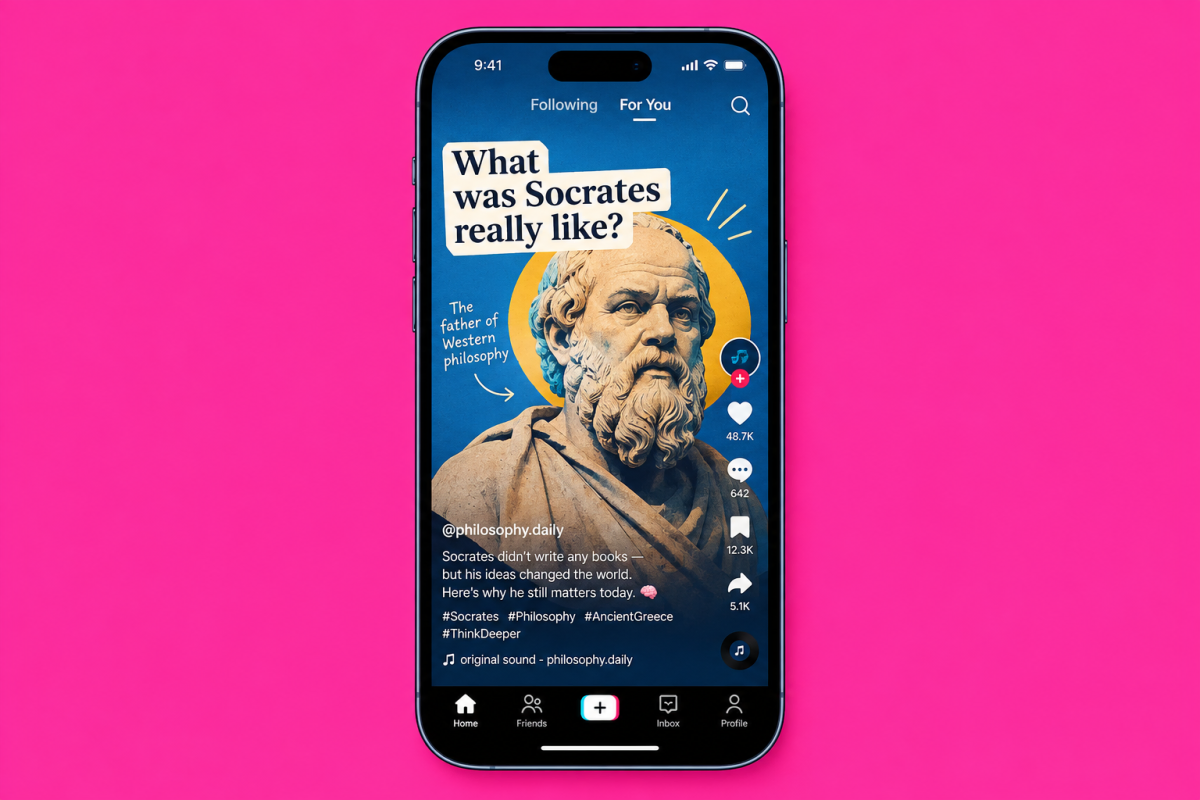
The company’s app converts uploaded text into a vertical feed that can surface AI-generated video, audio, text summaries, and quizzes. Users can swipe up to move to the next topic or swipe sideways to dig deeper into a subject, with an assessment waiting at the end of the lesson.
ScrollEd is one of the more unusual startups in this year’s Battlefield lineup because it is not building a new model, a productivity tool, or a workplace agent. It is trying to repackage learning so it feels native to the internet habits of younger users who have grown up on short-form video.
What ScrollEd is trying to change
ScrollEd’s central argument is straightforward: many students do not want to begin with a dense textbook page, but they may be willing to start with a feed. From there, the startup hopes curiosity can carry them into more serious material.
Co-founder Utsav Gupta says the team’s goal is not to trap people in endless engagement loops. Instead, he says the platform is designed so that going deeper feels as easy as moving on to the next clip, rather than like a separate, burdensome task.
Gupta said the company is trying to meet younger users where they already spend their time, while being intentional about not maximizing attention for its own sake.
The pitch taps into a familiar complaint among educators and parents: short-form video has trained many people to expect information in compact bursts. Rather than framing that shift as purely a loss, ScrollEd is betting it can be turned into an advantage for learning.
How does the app work?
ScrollEd lets users upload text files, including textbooks and PDFs, then transforms the material into an interactive feed. The content can appear in several formats depending on the lesson and the user’s path through it.
According to the company, a topic might be presented as AI-generated video or audio, as a text-based explanation, or as a quiz that checks comprehension. The experience is meant to feel closer to social video than to a course portal.
Swipe up, swipe sideways
The interface is built around familiar gestures. Swiping up advances to another topic, while swiping sideways opens a deeper layer of the same lesson. That design choice is central to the startup’s thesis: if the next step is effortless, users may be more likely to continue learning.
At the end of a segment, ScrollEd places a quiz in front of the learner. That final check is important because it shows the company is not only interested in exposure to content, but in actual retention and comprehension.
Why use AI-generated media?
AI is doing the conversion work behind the scenes. The company says it uses artificial intelligence to turn long-form source material into multiple formats that are easier to consume in short bursts.
That approach reflects a broader trend in education technology: software is increasingly being used to repackage the same information in more adaptable ways, especially for users who have different learning preferences or shorter attention windows.
Who built ScrollEd?
ScrollEd was started this year by Utsav Gupta and Rebecca Neff, who are also married. Both founders are still students, which gives the company a lived-in understanding of the problem it is trying to solve.
Gupta studies AI and human purpose at Stanford University, while Neff studies computer science at the University of Pennsylvania. The pair said the idea grew out of their own experience with doomscrolling before bed and the sense that they were often consuming content that left them less satisfied, not more informed.
Gupta has said the startup’s ambition is to build “a social network that’s better for you,” positioning the product as an alternative to attention-maximizing platforms.
That framing is important because it places ScrollEd in the growing category of products that want to keep the interface familiar while changing the incentives underneath it. The app is not trying to eliminate the feed; it is trying to redirect it toward learning.
Why this launch matters now
ScrollEd is launching at a moment when educators, parents, employers, and platform designers are all grappling with the effects of short-form content on focus and comprehension. The company’s answer is not to fight the feed, but to redesign it around depth.
That makes the startup interesting for three reasons. First, it speaks to how Gen Z and younger users already consume media. Second, it applies generative AI to a practical learning workflow rather than a novelty demo. Third, it turns a social-media pattern into a potential distribution channel for education.
Gupta said the startup has heard from younger users who increasingly prefer vertical, short-form experiences, especially among 18-year-olds. The company sees that behavior as a design constraint, but also as an opening.
If ScrollEd can make study material feel as effortless as watching the next clip, it could offer a new model for educational engagement. If it cannot, it risks becoming another app that promises to solve distraction by borrowing the mechanics of distraction.
What is ScrollEd’s business model?
ScrollEd plans to use a freemium structure that mixes consumer access with paid products for institutions. That approach gives the company a path to both broad adoption and revenue from schools, training organizations, and other enterprise customers.
The free version will serve as the consumer-facing feed. ScrollEd Pro will be a paid subscription, while institutions will be able to license the platform annually for educational delivery and reporting tools.
For schools and companies, the value proposition is not just the feed itself. ScrollEd says institutional customers would receive reporting on engagement, lesson progress, and related data.
That reporting layer could become one of the startup’s most important differentiators if it can show whether learners are actually moving through material and retaining it. Educational software lives or dies on proof, not just presentation.
How does ScrollEd compare to traditional edtech?
ScrollEd is not replacing learning management systems, textbooks, or teachers. Instead, it is trying to insert itself into the front end of learning, where motivation and first impressions often determine whether students continue.
Traditional edtech platforms often emphasize structure: modules, assignments, dashboards, and deadlines. ScrollEd emphasizes discovery and motion. That makes it less like a conventional classroom tool and more like a content platform with educational intent.
The difference matters because educational engagement is often lost before the lesson even begins. If the first interaction feels heavy, many learners disengage. ScrollEd is betting that a lighter first interaction can improve the odds that a learner will stay with the material.
| Aspect | ScrollEd approach | Why it matters |
|---|---|---|
| Input | Text files, PDFs, textbooks | Lets users start with material they already have |
| Format | Vertical feed with AI-generated media | Makes learning feel familiar to short-form video users |
| Navigation | Swipe up or sideways | Encourages both breadth and depth |
| Assessment | Quiz at the end of a lesson | Adds a retention check, not just passive viewing |
| Revenue | Freemium, Pro subscription, institutional licenses | Supports consumer growth and enterprise sales |
What makes the startup’s timing notable?
ScrollEd is launching during a period when AI tools are increasingly being tested in classrooms, corporate learning, and content transformation. That broader shift has created both enthusiasm and skepticism.
On the one hand, AI can lower the friction of converting long-form material into summaries, videos, and interactive experiences. On the other, educators worry about accuracy, shallow comprehension, and the temptation to over-automate learning.
ScrollEd says it is already working on the infrastructure it will need to support source checking and lesson-library development. That matters because an education product based on AI-generated content needs strong quality controls if it wants to earn trust.
The company also says it plans to build tools that could one day help educators assess individual students and adapt lessons to their needs. That suggests the product may evolve from a content converter into a more personalized learning system.
Why founders are fascinated by “better” social media
The startup’s messaging fits a growing category of companies that want to preserve the addictive convenience of modern apps while stripping away some of their worst incentives. The idea is simple: if users are not going to leave the scroll behind, perhaps the scroll should be redesigned.
That ambition is especially relevant in education, where the competition is not only other software but also YouTube, TikTok, Instagram, games, and whatever else is demanding a student’s attention.
ScrollEd’s thesis is that a lesson does not have to look like a lesson to be effective. If the delivery is better matched to user behavior, the company believes students may be more willing to engage with depth.
That is a meaningful bet, but it is also a hard one. Attention is easy to capture and difficult to convert into understanding. The challenge for ScrollEd will be proving that its format produces durable learning, not just a more polished distraction.
What to watch next
For the near term, ScrollEd says it will focus on three priorities: launching its consumer product, expanding its lesson library, and tightening its source-verification workflow. It will also continue developing pilots for institutions.
The startup will present its consumer offering at TechCrunch Disrupt, which could give it an early test with investors, educators, and potential users. In a crowded startup market, visibility matters almost as much as product quality.
There is also a broader question behind the company’s pitch: can a social feed be made genuinely educational without losing the simplicity that makes feeds compelling in the first place? ScrollEd is trying to answer yes.
If it works, the app could point toward a new category of learning software built around scrollable discovery rather than static coursework. If it fails, it will still offer a revealing experiment in how far AI and interface design can go in reshaping how people learn.
Key facts about ScrollEd
- Founded this year by Stanford student Utsav Gupta and University of Pennsylvania student Rebecca Neff.
- Based in Palo Alto and debuting at TechCrunch Disrupt in San Francisco on October 13-15, 2026.
- Turns textbooks, PDFs, and text files into a TikTok-like learning feed.
- Uses AI to generate video, audio, text, and quizzes from source material.
- Plans a freemium model with consumer, pro, and institutional offerings.
Bottom line
ScrollEd is trying to turn a complaint about modern attention spans into a product strategy. Its bet is that if students insist on scrolling, then the right design can make scrolling useful, structured, and educational.
That is a bold proposition, and one that will now face the realities of product adoption, learning outcomes, and trust. But it is also a timely one, because the fight over how young people consume information is no longer theoretical. It is shaping the next generation of education tools right now.
Timeline
| Date | Milestone | Why it matters |
|---|---|---|
| This year | ScrollEd is bootstrapped by the founders | Shows the startup began with a lean, founder-led build |
| September 20, 2026 | Public coverage ahead of Disrupt | Signals the company is entering a higher-visibility phase |
| October 13-15, 2026 | TechCrunch Disrupt in San Francisco | Consumer launch and investor exposure |
| Coming months | Lesson library, source-checking, institutional pilots | Core product and trust-building work |
Frequently asked questions
What is ScrollEd?
ScrollEd is a Palo Alto startup building an AI-powered app that turns textbooks, PDFs, and other text files into a TikTok-style learning feed. The platform presents lessons in short, swipeable formats with video, audio, text, and quizzes designed to make studying feel more like scrolling.
How does ScrollEd work?
ScrollEd works by letting users upload text-based materials and then converting them into a vertical feed. Users can swipe up for the next topic, swipe sideways to go deeper into a subject, and finish with a quiz that checks understanding.
Who founded ScrollEd?
ScrollEd was founded by Utsav Gupta and Rebecca Neff, who are also a married couple and current students. Gupta studies AI and human purpose at Stanford, while Neff studies computer science at the University of Pennsylvania.
How will ScrollEd make money?
ScrollEd plans to use a freemium model. It will offer a free consumer feed, a paid ScrollEd Pro subscription, and annual licenses for institutions that want to deliver learning material through the platform and track engagement and progress.
Why is ScrollEd launching at TechCrunch Disrupt?
ScrollEd is launching at TechCrunch Disrupt to reach investors, potential customers, and early users at a major startup showcase. The event gives the company a public stage for its consumer debut and its pitch that scrolling can be redesigned for learning.