Updated September 16, 2026 1:23 am
In short
Philadelphia’s anti-data-center push is growing, with more than 100 people at a launch rally and activists now widening their concerns to surveillance as similar moratorium fights spread to other cities.
- Philadelphia residents are urging city leaders to pause any data center plans before a formal proposal is filed.
- Opponents say the projects could worsen pollution, strain electricity and water supplies, and deliver limited local jobs.
- The campaign is rooted in Grays Ferry’s history of living beside the former Philadelphia Energy Solutions refinery.
- Similar moratoriums and permit pauses are spreading in cities and states across the U.S.
- AI infrastructure demand is rising fast enough to worry environmental and public health advocates.
Update — September 16, 2026 1:23 am
Philadelphia opponents say their campaign is now drawing broader traction, with more than 100 people showing up for a launch rally Monday at City Hall.
The new source also adds that state and local resistance is spreading beyond Philadelphia: New York Gov. Kathy Hochul has temporarily blocked new large-project permits, and moratoriums on data centers have already been approved in cities including Denver, Indianapolis, Asheville, Charlotte and Reno.
At the Philadelphia rally, activists also raised a new concern beyond pollution and power use: surveillance, with residents worried data centers could give companies access to information they should not have.
Philadelphia activists are pushing for a moratorium on new data centers as communities across the U.S. resist the AI infrastructure boom, arguing that the facilities can bring higher power demand, water use, noise and pollution without delivering enough local benefits. The fight is especially sharp in Grays Ferry, where residents say memories of refinery-era harm make them wary of another industrial project in the neighborhood.
At the center of the local campaign is Shawmar Pitts, a longtime Grays Ferry resident and now managing co-director of Philly Thrive, who says the neighborhood’s experience living beside the former Philadelphia Energy Solutions refinery has shaped how people view any new large-scale industrial development. The city has not yet received a formal proposal for a data center, but officials have identified two possible sites, including one in Grays Ferry.
The Philadelphia debate reflects a growing national backlash to the rapid buildout of AI data centers, which companies say are needed to power the next generation of digital services. Critics counter that the facilities can strain power grids, increase fossil fuel use, and worsen air quality in communities already carrying environmental burdens.
Why Philadelphia residents are pushing back
Philadelphia’s opposition is rooted in lived experience. For many residents, the issue is not abstract policy but the memory of what it felt like to live near one of the country’s largest refineries, which once processed hundreds of thousands of barrels of crude oil a day before closing after a 2019 explosion.
Pitts said his own understanding changed after he encountered Philly Thrive volunteers tabling in his neighborhood in 2018. Information about health effects tied to refinery pollution, he said, matched what he saw around him: family members, neighbors and friends dealing with chronic illness. That realization pulled him into environmental activism and later into leadership at the organization.
According to Pitts, the health effects listed by activists lined up with illnesses he had seen across his own block, convincing him that pollution had long shaped daily life in Grays Ferry.
Now, the same neighborhood is being discussed as a possible location for a data center. To local opponents, that raises a familiar question: whether a new industrial project will bring jobs and tax revenue, or whether it will instead repeat a pattern of pollution and disruption for nearby residents.
What do opponents say a data center could bring?
Opponents say the risks range from air quality and energy use to privacy concerns. Their argument is that even if a data center is less visibly dirty than a refinery, it can still rely on large amounts of electricity, diesel backup systems and water for cooling, while offering relatively few permanent jobs once construction ends.
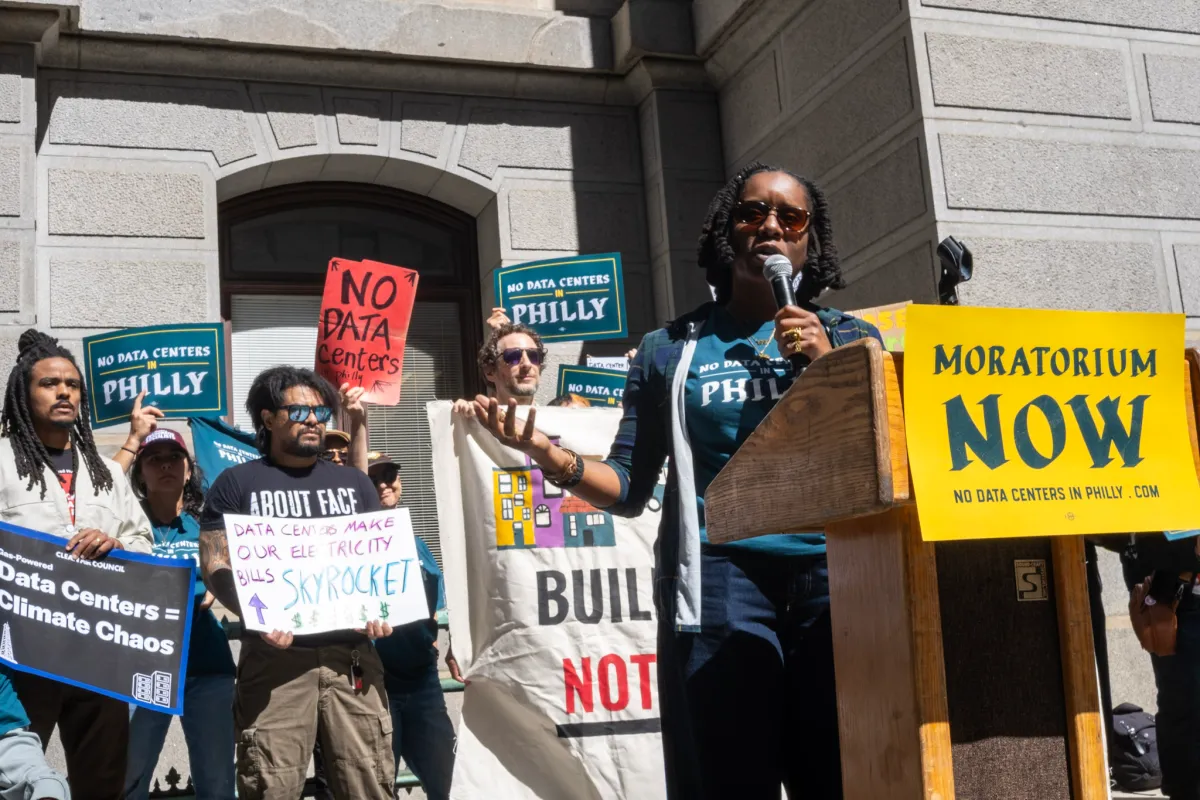
At a rally outside Philadelphia City Hall, Philly Thrive board president Sonya Sanders said residents do not want a facility that adds to pollution and noise while failing to meaningfully improve employment prospects. Her comments echoed a broader skepticism in communities that have lived for decades with the effects of industrial development.
Sanders told supporters that residents do not want more pollution or more noise, and she questioned whether data centers would create the kind of job growth city leaders often promise.
Sanders also tied the issue to personal loss. She said her husband, who also lived in Grays Ferry, died of a rare bone cancer in 2020 and that she believes refinery emissions played a role in his illness. Her remarks underline why environmental justice groups see the data center fight as part of a much older struggle over who absorbs the costs of industrial growth.
How the AI data center boom is changing local politics
The answer is that AI is turning a once technical infrastructure issue into a public fight about land use, utilities and environmental risk. As demand for computing power rises, local governments are being asked to approve very large facilities that may need substantial electricity, backup generation and water resources.
That has led to protests, hearings and, in some places, temporary bans while officials study the impact. In Philadelphia, the campaign is still early, but the rally at City Hall showed how quickly residents can organize when they believe a project could change the character and health of their community.
Philadelphia is not alone. Across the U.S., residents have objected to proposed data centers near their homes, especially in places where utility capacity is limited or where residents feel they have already carried a heavy industrial burden. The common complaint is that the promised gains are often vague, while the costs land on nearby neighborhoods in a more immediate way.
Why this backlash is spreading
The backlash is spreading because data centers sit at the intersection of multiple public concerns. They can increase local electricity demand, require backup generators, intensify water use and raise questions about how much revenue the host city will actually receive relative to the scale of the project.
There is also a trust problem. Communities that have experienced industrial pollution before are less likely to take corporate assurances at face value, especially when those assurances are paired with broad promises about innovation and economic development.
- Higher electricity demand can affect grid planning and utility costs.
- Diesel backup systems can create local air pollution.
- Cooling needs can add pressure on water supplies.
- Construction jobs often outnumber permanent operational jobs.
- Residents near the site bear the most direct environmental impact.
What are the environmental concerns around AI data centers?
The main concern is that the buildout of AI infrastructure could intensify energy and emissions at a moment when cities and utilities are already facing strain. BloombergNEF has projected that by 2035, U.S. data centers could consume more natural gas than Germany and Japan combined, a forecast that underscores how large the sector could become if current growth continues.
That projection also matters because it has risen sharply. BloombergNEF’s latest estimate is nearly double the firm’s projection from nine months earlier, signaling that demand expectations are moving fast as AI investment accelerates.
Natural gas is cleaner than coal or oil when burned, but it still produces carbon dioxide and other pollutants. Additional data center demand, according to the reporting, could translate into roughly 1 million metric tons of extra greenhouse gas pollution per day, equivalent to about 12% of current U.S. greenhouse gas emissions. For communities already dealing with asthma, cancer clusters and heat stress, that is a major concern.
Environmental health researchers have also linked fossil fuel air pollution to serious mortality risks worldwide. Harvard researchers found in 2021 that such pollution was responsible for one in five deaths globally, a reminder that the health debate around industrial expansion is not limited to local inconvenience.
| Issue | What it means | Why residents care |
|---|---|---|
| Electricity demand | Large AI facilities require substantial continuous power | Can strain grids and raise concerns about utility costs |
| Backup diesel engines | Generators may be used when the grid is stressed | Can emit local air pollution during hot weather or outages |
| Water use | Cooling systems may require significant water resources | Can intensify competition for municipal supplies |
| Job creation | Construction work is temporary; operations can be more limited | Residents question whether promised employment is substantial |
| Community risk | Facilities are often placed near existing infrastructure | Environmental justice communities fear repeated harm |
How are city and state officials responding?
Officials in several places are responding with caution, and in some cases with temporary limits on new approvals. In New York, Governor Kathy Hochul signed an executive order that blocks the state from granting permits for large projects while the policy is in place.
Hochul said development should not come with higher utility bills, reduced water supplies or noise pollution, and she argued that data centers should be built only in communities that actually want them.
That same logic is behind moratoriums adopted in cities including Denver, Indianapolis, Asheville, Charlotte and Reno. These pauses are often framed as fact-finding measures, giving officials time to assess possible effects on the grid, local infrastructure, water use and quality of life before allowing projects to move ahead.
For city leaders, the challenge is balancing the potential for investment against the risk of public backlash. For residents, the question is whether the decision-making process gives enough weight to the neighborhoods most affected.
Who is Shawmar Pitts, and why does his story matter?
He is a community organizer whose biography mirrors the broader argument against industrial siting in overburdened neighborhoods. Pitts grew up in Grays Ferry next to a refinery that became a defining feature of the area’s landscape, economy and health concerns. Today, he is helping lead the campaign against bringing another major industrial project to the same community.
His role matters because environmental justice campaigns are often driven by local residents who can connect policy debates to specific memories of illness, displacement and environmental neglect. Pitts represents a generation of neighborhood leaders who see data centers not just as a technology issue, but as part of a longer history of who gets protected and who gets exposed.
At Monday’s rally, more than 100 people gathered for the launch of the “No Data Centers in Philly” campaign, chanting in hopes that city council members inside City Hall would hear them. The size of the turnout suggested that the issue has already moved beyond one activist group and into a broader civic confrontation.
Timeline of the Philadelphia fight
The conflict is still unfolding, but several milestones help explain how it reached this point.
| Date | Event | Significance |
|---|---|---|
| 2018 | Pitts encounters Philly Thrive tabling in Grays Ferry | His involvement in environmental justice begins |
| 2019 | Philadelphia Energy Solutions refinery closes after explosion | Leaves behind a powerful memory of industrial risk |
| 2020 | Sanders’ husband dies of rare bone cancer | Deepens local fears about pollution and health |
| 2026 | City identifies two possible data center sites | Triggers organized opposition and calls for a moratorium |
| Monday rally | No Data Centers in Philly campaign launches at City Hall | Public resistance becomes more visible and coordinated |
What happens next in Philadelphia?
The immediate next step is political pressure. Campaign organizers are trying to persuade city officials to adopt a pause on data center development before any formal proposal advances. If they succeed, Philadelphia would join other cities that have opted to study the issue first rather than approve projects immediately.
That approach could delay development, but it would not settle the broader debate. Cities still have to decide how to weigh economic promises against environmental justice concerns, especially when proposed sites overlap with historically polluted neighborhoods.
If Philadelphia eventually receives a formal proposal, the city will likely face a contentious review of everything from zoning and utilities to emergency generation and public health. For now, the most important issue is whether local leaders treat community skepticism as a warning sign or as a hurdle to be overcome by marketing.
For residents like Pitts and Sanders, the answer is already clear: after years of living with the consequences of heavy industry, they do not want to be asked to trust another project that could shape their health, their homes and their future.
National stakes beyond one neighborhood
Philadelphia’s fight is part of a larger reckoning over how the AI economy gets built. The technology industry is racing to expand computing capacity, but the physical systems behind that growth are being placed on land, water and electrical networks that belong to real communities with real limits.
That is why the data center debate has moved from corporate planning rooms into city halls, statehouses and neighborhood meetings. The infrastructure may serve a global industry, but the consequences are intensely local.
In places with a history of refinery pollution, steel production, freight traffic or other forms of industrial exposure, residents are especially likely to view new AI facilities through a justice lens. They are asking not only whether data centers are efficient or profitable, but also who will breathe the air, hear the generators and pay the utility bill.
As the AI boom continues, those questions are likely to spread well beyond Philadelphia.
Frequently asked questions
Why are Philadelphia residents opposing data centers?
Philadelphia residents are opposing data centers because they fear the projects could increase pollution, noise, water use and electricity demand while delivering relatively few permanent jobs. In neighborhoods like Grays Ferry, that concern is amplified by memories of past industrial harm.
Has Philadelphia approved a data center yet?
No, Philadelphia has not formally approved a data center. City officials have identified two potential sites, but activists are already pressing for a moratorium before any proposal moves further through the planning process.
What is the environmental concern with AI data centers?
The environmental concern is that AI data centers can require large amounts of power, backup diesel generation and cooling water. Critics say that scale can raise greenhouse gas emissions, worsen local air quality and add pressure to already strained utilities and infrastructure.
Are other cities restricting data centers?
Yes, several cities and states are moving cautiously. New York has temporarily blocked permits for large projects, and moratoriums have also been approved in places including Denver, Indianapolis, Asheville, Charlotte and Reno while officials study the impacts.
Who is Shawmar Pitts?
Shawmar Pitts is a longtime Grays Ferry resident and the managing co-director of Philly Thrive. He became active in environmental justice after learning more about the health effects of living near the former refinery and now helps lead opposition to data centers in Philadelphia.