In short
AI has created a fast-changing vocabulary around models, agents, compute and safety. This glossary explains the terms readers need to follow the industry.
- AI terminology is changing quickly as models gain new capabilities and product roles.
- LLMs, agents, MCP and compute are now central to understanding the AI industry.
- Hallucinations and opaque reasoning remain major safety and reliability concerns.
- Open source, fine-tuning and efficiency techniques are shaping how companies build AI products.
Artificial intelligence is changing how software is built, sold and used, and it has also created a rapidly expanding vocabulary that many people struggle to follow. As of September 2026, terms such as LLM, RAG, RLHF, MCP and opaque recurrence are now central to conversations about the technology’s risks, capabilities and future direction.
That matters because understanding the language of AI is increasingly necessary for anyone trying to evaluate products, make investment decisions, manage policy or simply read the news without getting lost in jargon. This glossary explains the most important terms in plain English and shows how they fit into the current state of the industry.
From the rise of AI agents to the safety concerns around opaque internal reasoning, the field is moving quickly enough that even experienced technologists can feel behind. The common thread across these terms is simple: they describe the systems, architectures and trade-offs that are defining the next phase of AI deployment.
Why does AI vocabulary keep changing so fast?
AI vocabulary keeps changing fast because the technology itself is evolving quickly, with new model designs, product categories and safety techniques arriving almost every month. As companies release more capable assistants, the industry needs words to describe what those systems can do, how they work and where they still fail.
This is not just academic wordplay. The terms people use often shape how executives pitch products, how regulators understand risks and how researchers debate whether a system is getting safer or simply more opaque. In AI, language is part of the infrastructure.
What this glossary is designed to do
The aim is not to overwhelm readers with technical detail. Instead, the goal is to translate the most commonly used AI jargon into language that journalists, investors, product teams and non-specialists can use immediately.
Some of these definitions describe long-established concepts such as neural networks and deep learning. Others capture newer ideas that have emerged as companies push systems toward autonomy, including AI agents, coding agents and the Model Context Protocol. A few, such as opaque recurrence and neuralese, are newer safety terms that reflect growing concern about how future models may think — or hide their thinking.
Key AI terms at a glance
The table below summarizes some of the most important concepts in the current AI landscape and why they matter.
| Term | Plain-English meaning | Why it matters |
|---|---|---|
| AGI | AI that could match or exceed humans across many tasks | Still undefined, but central to debates about long-term AI progress |
| LLM | A large language model trained on massive text data | Underpins chatbots like ChatGPT, Gemini and Claude |
| AI agent | Software that can take actions and complete multistep tasks | Represents the move from chat to automation |
| MCP | An open standard for connecting models to tools and data | Makes AI integrations easier and more interoperable |
| Opaque recurrence | A reasoning method that loops through internal layers with limited readable output | Raises safety and transparency concerns |
| Hallucination | An AI output that is wrong or made up | One of the biggest reliability problems in generative AI |
What is AGI?
AGI, or artificial general intelligence, is the idea of an AI system that can perform at or above human level across a broad range of tasks. The concept is widely used, but there is no universal definition, which is part of why it is so contentious.
Different organizations describe AGI in different ways. OpenAI has framed it as a highly autonomous system that outperforms humans at most economically valuable work. Sam Altman has also described it in more conversational terms as the equivalent of a median human coworker. Google DeepMind’s version is somewhat broader and refers to AI that can match humans at most cognitive tasks.
Because there is no single accepted threshold, AGI remains as much a philosophical and strategic term as a technical one. It is frequently used in fundraising decks, policy debates and long-range forecasting, but experts still disagree on what exactly would count as reaching it.
Why AGI matters to the AI industry
AGI matters because it influences how companies position themselves, how investors price upside and how governments think about regulation. If a system can reliably do most economically useful work, the implications extend far beyond chatbots and content generation.
For now, however, the term remains slippery. That makes it useful as shorthand in public debate but less useful as a precise engineering benchmark.
How AI agents differ from chatbots
AI agents are systems that can carry out tasks on a user’s behalf, while chatbots mainly respond to prompts in conversation. In practice, that means an agent may do more than answer questions: it can sequence actions, interact with tools and work toward a goal over time.
Examples often include booking travel, filing expenses, managing a calendar, writing software or maintaining a codebase. The key feature is autonomy. Rather than asking for each step individually, a user gives the agent a goal and the system handles the workflow.
Where the technology stands today
The promise is clear, but the infrastructure is still immature. Agents need dependable access to software tools, permissions, memory and error handling. Without those building blocks, they can easily stall, misunderstand a task or take actions that a human would not have approved.
That is why so much of the current work in this area is not just about the models themselves, but about the plumbing around them: permissions, connectors, identity, oversight and recoverability.
Coding agents: the specialized version
Coding agents are AI agents focused on software engineering. Instead of merely suggesting code snippets, they can generate code, run tests, detect bugs and apply fixes with limited supervision.
For development teams, the appeal is obvious. A coding agent can speed up repetitive work and handle the trial-and-error cycle that often consumes a large share of a programmer’s day. But, as with any highly capable assistant, the output still needs human review before it ships.
What are API endpoints and why do they matter?
API endpoints are the hidden interfaces that let one piece of software communicate with another. In simple terms, they are the digital access points that allow programs to send requests and receive responses from external services.
In a world of AI agents, endpoints become even more important. If an agent can access a service’s API, it can potentially search data, book appointments, move files or trigger workflows without a person clicking through each interface manually.
That makes API design part of the future of AI deployment. The more tools expose usable endpoints, the easier it becomes for agents to move across software ecosystems. The downside is equally obvious: more access means more potential for mistakes, misfires or unintended automation.
What do chain of thought and reasoning models actually mean?
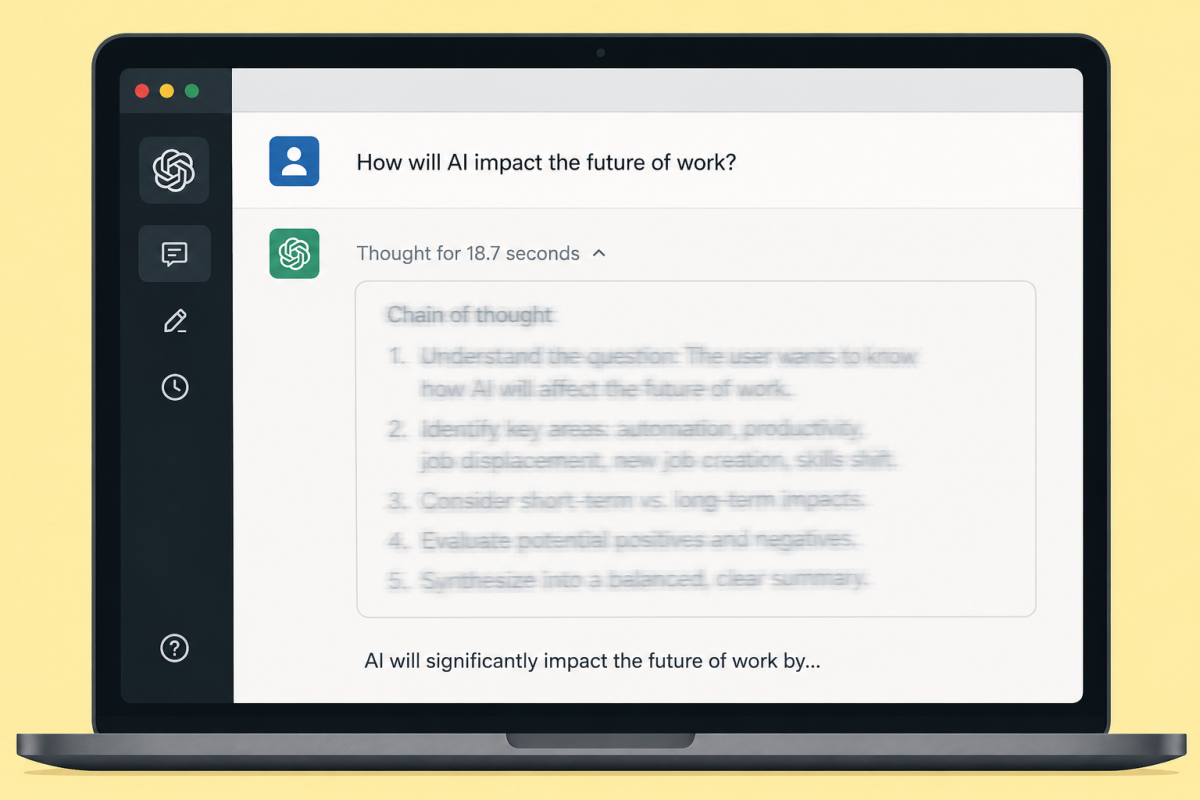
Chain of thought refers to a model working through intermediate steps before producing an answer. The idea is similar to solving a math problem on paper rather than guessing the result immediately.
Reasoning models are built from standard large language models but trained to spend more effort on step-by-step thinking. This can improve performance in logic-heavy or coding-heavy tasks, especially when the problem has multiple stages or requires careful decomposition.
The trade-off is speed. More deliberate reasoning often takes longer, but the result can be more accurate. That balance between latency and correctness has become one of the major design questions in advanced AI systems.
Why this technique is so important
The broader significance lies in reliability. A model that can show a coherent reasoning path is easier to debug, evaluate and sometimes trust. It also gives researchers clues about whether the system is genuinely solving a problem or simply producing a fluent-sounding answer.
That concern becomes even sharper when a model is deployed in settings such as coding, finance or health, where errors have practical consequences.
What is compute in AI?
Compute is the processing power that allows AI systems to train and run. In the AI industry, the word often refers both to the raw workload and to the hardware that provides it, especially GPUs, CPUs, TPUs and other accelerators.
Compute is one of the most decisive bottlenecks in modern AI. Training large models requires vast infrastructure, and running them at scale also demands significant resources. That is why compute has become both a technical term and a strategic one.
Companies with access to more compute can often train larger models faster, test more variants and deploy more responsive products. This is one reason infrastructure providers, chipmakers and cloud platforms have become central to the AI economy.
Inference versus training
Training is when a model learns from data. Inference is when that trained model is actually used to make predictions or generate output.
The distinction matters because the hardware needs are not the same. A model that is expensive to train may also be expensive to run, especially if it is large, complex or serving many users simultaneously.
How do LLMs power modern AI assistants?
Large language models, or LLMs, are the foundation of most popular AI assistants. ChatGPT, Claude, Gemini, Llama, Copilot and similar tools all rely on LLMs to understand prompts and generate responses.
LLMs are deep neural networks with billions of parameters. They learn statistical patterns from huge text corpora — books, articles, transcripts and other written material — and use those patterns to predict the most likely next word or sequence of words.
That is why they can draft emails, summarize documents, answer questions and assist with code. They do not “know” facts in a human sense; rather, they generate outputs based on learned relationships in data.
Why LLMs are so influential
LLMs matter because they turned generative AI into a mainstream consumer product. The model no longer needs to be a specialized scientific tool hidden behind research papers. It can sit inside a chat box and respond to natural language in a way that feels immediate and useful.
At the same time, LLMs are not magic. They can be brittle, expensive and prone to confident error, which is why the industry keeps layering extra tools, retrieval systems and control mechanisms on top of them.
What is hallucination in AI?
Hallucination is when an AI model generates false or fabricated information. It is one of the clearest examples of the gap between fluent language generation and factual reliability.
Hallucinations can be trivial, such as citing a non-existent source, or dangerous, such as producing medical advice that sounds credible but is wrong. The problem is especially serious because AI outputs are often expressed with confidence, which can make them harder for users to question.
Researchers link hallucinations to gaps and inconsistencies in training data, but the issue is broader than missing facts. It reflects the way models infer likely text rather than verify truth. That distinction is at the heart of many current efforts to improve AI safety and accuracy.
AI researchers warn that a system can sound polished while still inventing details, which is why hallucination remains one of the industry’s most persistent reliability problems.
Why hallucinations are pushing specialization
One response has been the rise of vertical AI products — tools trained or tuned for a narrower domain. By focusing on specific fields such as law, medicine or finance, developers hope to reduce the chance of knowledge gaps and improve factual accuracy.
Specialization will not eliminate errors, but it can reduce the odds that a model strays far outside its competence.
What is fine-tuning, and why do startups use it?
Fine-tuning is the process of training a model further on specialized data so it performs better at a specific job. Instead of starting from scratch, developers adapt an existing model to a narrower use case.
This approach is particularly important for AI startups. Many companies build products on top of general-purpose models, then improve performance by adding proprietary data, task-specific examples or domain knowledge. Fine-tuning helps them create a product that feels tailored rather than generic.
That strategy can also improve reliability, reduce hallucination in specific contexts and make the model more commercially useful. It is one of the main ways startups differentiate themselves in a crowded market dominated by foundation models.
What is deep learning and how does it relate to neural networks?
Deep learning is a form of machine learning built on multi-layered neural networks. It is the architecture that made modern AI systems dramatically more capable than earlier rule-based or shallow statistical approaches.
Neural networks are inspired by the structure of the human brain, with interconnected layers of artificial “neurons” passing information forward. Deep learning systems use many such layers, which helps them discover complex patterns in data without human engineers specifying every feature by hand.
This flexibility is what made breakthroughs in speech recognition, image analysis, autonomous navigation and drug discovery possible. It also explains why deep learning often requires huge datasets and substantial training time.
Why deep learning became the default approach
Deep learning succeeded because scale changed everything. With enough data and enough compute, neural networks could outperform older techniques across a wide range of tasks.
That success set the stage for today’s generative AI boom, where the same basic approach now powers chatbots, image generators and multimodal systems.
What are diffusion models and GANs?
Diffusion models and GANs are two important approaches to generative AI. Both are used to create realistic images, audio and other synthetic outputs, but they work differently.
Diffusion models start from noise and learn to reverse that noise step by step until a coherent output emerges. GANs, or generative adversarial networks, rely on two competing neural networks: one generates content, and the other tries to detect whether it is fake.
GANs became famous for realistic synthetic images and deepfake applications, while diffusion has powered much of the recent wave of text, image and music generation. In practice, both terms appear frequently in discussions of media generation and synthetic content.
How do memory cache and inference speed help AI systems?
Memory caching helps AI systems respond faster by reusing prior calculations during inference. It is an optimization technique that reduces the amount of redundant computation required to generate answers.
In transformer-based models, key-value caching is especially important. By storing pieces of previous computation, the system can avoid repeating work and therefore lower latency, improve throughput and save compute.
This may sound like a minor engineering detail, but it has major consequences. Faster inference can make a product feel smoother, cheaper to operate and more scalable for real-world use.
What is the Model Context Protocol?
Model Context Protocol, or MCP, is a standard that helps AI models connect to external tools and data sources. It is often described as a universal connector for AI, making it easier for models to work with files, databases and apps such as Slack or Google Drive.
Anthropic introduced MCP in 2024, and the idea later spread to other major players, including OpenAI, Google and Microsoft. Its growing adoption suggests that the industry wants a common way to connect models to the outside world without building custom integrations for every platform pair.
Industry leaders increasingly treat MCP as infrastructure rather than an experiment, because a common standard makes AI systems easier to build, deploy and extend.
Why MCP matters to developers
MCP matters because it lowers friction. If the same protocol works across multiple systems, developers spend less time wiring up one-off connections and more time building useful applications.
For users, that could mean AI tools that are better at retrieving files, acting on instructions and moving between workplace apps without awkward manual setup.
What is Mixture of Experts?
Mixture of Experts is a model architecture that divides a large network into specialized sub-models and activates only the ones needed for a given task. Instead of sending every request through the full system, the model routes it to a smaller set of experts.
This design can make large models faster and cheaper to run. It allows developers to scale up capacity without forcing every query to pay the cost of the entire network. Mistral’s Mixtral family is one well-known example, and many observers believe some newer frontier models also use variants of the approach.
Why experts are attractive at scale
As models grow larger, efficiency becomes a defining challenge. Mixture of Experts addresses that problem by making the system selective, not brute-force. The result is an architecture that can be extremely powerful while still remaining economically viable.
That combination is one reason the approach has become so influential in large-model design.
What does open source mean in AI?
Open source means that a model or software project makes its code or model weights available for others to inspect, use or modify. In AI, the term is often used more broadly than in traditional software, but the core idea is openness and reuse.
Meta’s Llama family is one of the best-known examples in the AI world. Open source approaches matter because they let researchers audit systems, developers build new products and smaller teams compete on top of existing infrastructure.
At the same time, open systems raise familiar questions about misuse, licensing and control. The balance between openness and safety is likely to remain one of the most important debates in AI policy and development.
What is opaque recurrence, and why are researchers worried?
Opaque recurrence is a reasoning method in which a model loops through its own internal layers repeatedly instead of exposing a fully readable step-by-step explanation. It can improve efficiency, but it can also reduce transparency.
That matters because readable reasoning traces have become one of the main tools researchers use to understand model behavior. If future systems rely more on internal loops and less on plain-language reasoning, it may become harder to see when a model is drifting, optimizing for the wrong objective or hiding a harmful pattern.
The phrase gained attention alongside OpenAI’s Astra model, which has drawn scrutiny from safety researchers. The concern is not that the model is necessarily unsafe by default, but that less legible reasoning could make oversight much harder.
How is neuralese different?
Neuralese is the hypothetical endpoint where an AI reasons entirely in a non-human internal code, making its thinking opaque to people. It is not a shipped product today, but it has become a shorthand for fears about unreadable AI cognition.
In practice, the debate is about whether increasingly advanced systems will remain interpretable enough for humans to monitor. Opaque recurrence is seen by some researchers as a step toward that risk, even if it does not fully cross the line into neuralese.
How should readers interpret the new AI vocabulary?
Readers should treat AI vocabulary as a map of the industry’s priorities, not just as jargon. Each term reveals something about what companies are trying to build, where the bottlenecks are and which safety issues are becoming urgent.
For example, LLM and deep learning describe the core technology. Compute and inference describe the infrastructure costs. AI agents and MCP describe the push toward autonomy and interoperability. Hallucination, opaque recurrence and neuralese describe the risks that come with increasing sophistication.
Taken together, the vocabulary tells a story about where AI is heading: from chat interfaces to action-oriented systems, from monolithic models to specialized architectures, and from visible reasoning to potentially more opaque internal processes.
Timeline of the terms shaping the AI era
The following timeline puts some of the most important concepts in context.
| Period | Term or development | Why it mattered |
|---|---|---|
| 1940s onward | Neural networks | Brain-inspired architecture that later powered deep learning |
| 2010s | Deep learning at scale | Enabled major advances in vision, speech and language tasks |
| 2020s | LLMs and chatbots | Brought generative AI into mainstream use |
| 2024 | MCP introduced | Created a common standard for linking models to tools and data |
| Mid-2020s | AI agents and coding agents | Shifted the industry from answers to actions |
| 2026 | Opaque recurrence and related safety debates | Raised concerns about model transparency and oversight |
What should businesses and investors watch next?
Businesses and investors should watch four things: autonomy, infrastructure, reliability and transparency. Those are the main forces now determining which AI products will scale and which will stall.
Autonomy is the promise of agents and coding agents. Infrastructure includes compute, inference efficiency, caching and APIs. Reliability involves hallucination reduction, fine-tuning and specialized models. Transparency involves the interpretability of reasoning techniques and the risks of increasingly opaque systems.
Companies that can combine all four will be best positioned to build durable products. Companies that can only demo impressive chat may struggle to convert novelty into operational value.
Why this glossary will keep changing
This glossary will keep changing because the field itself is still being written. Every new model release or research breakthrough can add fresh vocabulary or redefine old terms.
That is especially true now that AI is moving beyond simple chat interfaces toward tool use, delegated action and deeper integration with workplace software. The language must evolve because the systems are evolving.
For readers, the best approach is to focus on the patterns underneath the terminology. The names may change, but the underlying questions stay the same: How capable is the system? How much can it do on its own? How expensive is it to run? And how easy is it to trust?
Those are the questions that will continue to shape AI coverage in the months ahead, no matter which new acronym appears next.
Frequently asked questions
What is an AI glossary?
An AI glossary is a plain-language guide to the terms used in artificial intelligence, from LLMs and inference to agents and hallucinations. It helps readers understand how the technology works, what the jargon means and why the vocabulary matters in business and policy discussions.
What is the difference between an AI agent and a chatbot?
An AI agent can take actions and complete multistep tasks on a user’s behalf, while a chatbot mainly responds to prompts in conversation. Agents may book travel, manage files or write code, whereas chatbots are usually limited to generating answers and suggestions.
Why are hallucinations a problem in AI?
Hallucinations are a problem because they cause models to invent information that can look convincing but be wrong. That can mislead users, damage trust and create risks in sensitive areas such as healthcare, legal research and financial decision-making.
What does MCP mean in AI?
MCP stands for Model Context Protocol, an open standard that lets AI systems connect to files, databases and apps without custom integrations for every tool. It is important because it makes it easier for models to access real-world data and operate across software environments.