Updated September 3, 2026 4:54 pm
In short
Jio has opened JioPC to all internet users in India, but analysts say its real challenge will be convincing buyers to pay for cloud access instead of choosing offline PCs or refurbished machines.
- JioPC is now open to any internet user in India, not just Jio broadband customers.
- The service streams a cloud desktop to older PCs and is marketed as AI-ready.
- Plans start at ₹1,000 for two months, with annual tiers priced at ₹4,000 and ₹5,000.
- IDC says India’s PC replacement cycles are lengthening, creating room for cloud-based alternatives.
- Analysts say JioPC could form a low-cost parallel market, but connectivity remains a major hurdle.
Update — September 3, 2026 4:54 pm
JioPC’s expansion now carries a new warning from analysts: the company may have a harder time selling cloud PCs in India than a normal hardware upgrade because users would be giving up offline access for a recurring fee.
IDC’s Bharath Shenoy said that dependence on a stable internet connection could be especially important in smaller cities and towns, where connectivity can be uneven. He also flagged refurbished PCs as another low-cost option for buyers who want inexpensive hardware without staying tied to the cloud.
CyberMedia Research’s Prabhu Ram said the bigger test is whether people come to view cloud computing as a daily utility instead of a temporary workaround. He added that JioPC may end up forming a separate budget tier rather than replacing conventional PCs.
Update — September 2, 2026 7:54 pm
JioPC was first launched in July 2025, before Wednesday’s broader rollout to all internet users in India.
The updated source also says Jio is facing a tougher sell than a normal PC upgrade: it will have to persuade buyers that a recurring subscription is worth giving up offline use, especially in smaller cities and towns where connectivity can be uneven.
IDC’s Bharath Shenoy also pointed to refurbished PCs as another low-end alternative, while CyberMedia Research’s Prabhu Ram said the real question is whether cloud computing becomes a daily utility rather than a stopgap.
Reliance Jio has opened its JioPC cloud-computing service to any internet user in India, betting that households, students and small businesses will pay for virtual computing power instead of replacing aging laptops and desktops. The move matters because it could give older machines access to AI-capable performance without a costly hardware upgrade.
Announced on Wednesday, the expanded service is no longer limited to Jio broadband customers. Anyone with an internet connection can now subscribe and stream a virtual desktop from Jio’s cloud to an existing computer, with packages that scale up to eight virtual CPUs, 16GB of RAM and 1TB of storage.
The latest push turns what began as a bundled offering in 2025 into a standalone product aimed at a much wider market. It also deepens a larger debate now shaping India’s PC industry: should consumers buy a new AI-enabled computer, or simply rent the compute they need from the cloud?
What JioPC is offering and why it matters
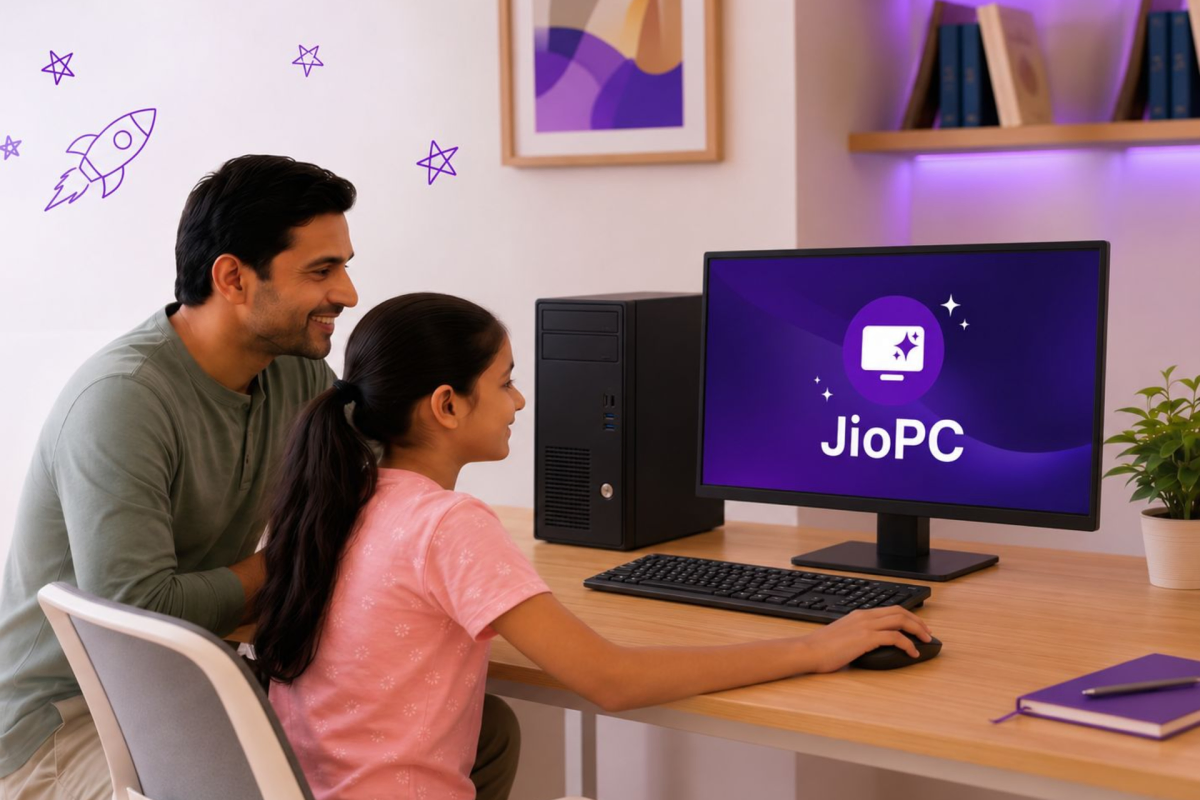
JioPC is designed to transform an ordinary computer into a cloud-powered workstation. Instead of running heavy applications locally, the service streams a desktop environment from Jio’s servers, allowing the device in front of the user to act as a terminal for most tasks.
That model is increasingly relevant as India’s installed PC base ages. IDC estimated that the country had more than 65 million PCs in use in 2025, including about 34 million consumer machines and 31 million commercial systems. The research firm expects that number to rise to nearly 69 million by the end of 2026.
Reliance Jio, part of India’s most valuable company, is effectively arguing that many of those machines do not need to be thrown away to keep up with the software era. With more processing and storage shifted into data centers, a laptop that would otherwise be considered dated can still run modern applications, including workloads associated with AI use cases.
How does JioPC work?
JioPC works by streaming a virtual desktop from Jio’s cloud to a user’s existing computer. The local device needs only enough capability to display the interface and maintain a stable internet connection; the heavier computation happens remotely.
The company has not published detailed technical specifications for the infrastructure behind the service, but it has disclosed the main subscription tiers. Those plans include configurations with up to eight virtual CPUs, 16GB of memory and 1TB of storage, giving Jio enough room to market the product as suitable for more demanding software than a basic browser-only cloud terminal.
Jio says the service can make even computers that are around eight years old suitable for AI-era workloads, without users installing new hardware or replacing the entire device.
Why is Jio expanding beyond its own broadband users?
Jio is widening access because the company appears to see a larger opportunity in selling computing capacity as a service. Until now, JioPC had largely been tied to the company’s own broadband ecosystem. Opening it to any internet user gives Jio a chance to reach millions of potential customers who may never switch telecom providers but might still pay for cloud computing.
“Jio is broadening its value proposition by opening JioPC to non-Jio users, while also challenging the traditional hardware upgrade cycle,” said Prabhu Ram, vice president of the industry research group at CyberMedia Research.
Ram said the service may not displace conventional PCs, but it could establish a parallel tier of low-cost computing for students, households and other users who cannot justify buying a new AI-capable device. In that framing, Jio is not trying to end PC ownership. It is trying to monetize access to computing power itself.
That is a significant strategic shift in a market where hardware sales have historically defined the PC business. If the company can persuade users to subscribe for performance rather than purchase for permanence, it could reshape the economics of entry-level computing in India.
What is Jio selling: hardware or computing power?
Jio is selling computing power, not a box on a desk. The product’s logic is closer to utility billing than to a one-time electronics purchase, with recurring fees tied to performance, storage and access.
That model echoes the broader cloud industry, but Jio is applying it to personal computing in a country where budget-conscious buyers often stretch devices for years. The company’s pitch is that an old machine can be made more useful simply by connecting it to Jio’s cloud.
- Core idea: turn a local computer into a cloud desktop.
- Primary benefit: avoid buying a new PC to access more capable software.
- Main trade-off: users must stay connected to the internet.
- Target audience: value-driven consumers, students and small businesses.
How much does JioPC cost?
The service is priced to look cheaper than replacing a laptop, though users must keep paying for access over time. Jio’s entry offer begins at ₹1,000, or about $11, for two months.
For longer commitments, the company is offering annual plans at ₹4,000, or roughly $42, for 8GB of RAM and 500GB of storage, and ₹5,000, or about $53, for 16GB of RAM and 1TB of storage. The higher-end package is aimed at users who want more headroom for productivity apps, content creation or AI-oriented tools.
For families or students comparing the price with a brand-new laptop, the subscription could look attractive. But the economics change if the machine is expected to be used for years without interruption. Over time, recurring fees can add up to a meaningful expense, especially if multiple users in a household need access.
| JioPC plan | Price | RAM | Storage | Term |
|---|---|---|---|---|
| Entry offer | ₹1,000 / about $11 | Not specified in source | Not specified in source | 2 months |
| Annual plan | ₹4,000 / about $42 | 8GB | 500GB | 12 months |
| Annual plan | ₹5,000 / about $53 | 16GB | 1TB | 12 months |
What does the PC market in India look like right now?
India’s PC market is large, but the pace of replacement is slowing. IDC estimates that the country had more than 65 million PCs in use in 2025 and expects the figure to approach 69 million by the end of 2026.
That pool is split between roughly 34 million consumer PCs and 31 million commercial machines. But the more important story may be how long people are keeping them. Replacement cycles are stretching as buyers delay upgrades, partly because devices are more expensive and partly because many everyday tasks no longer require a new machine every few years.
According to Bharath Shenoy, IDC’s senior market analyst, consumers and small businesses in India now typically replace PCs every five to six years, compared with four to five years in 2022. Enterprises, meanwhile, are holding onto their systems for around four years, up from three years earlier.
That shift creates a favorable backdrop for cloud-based PC services. If buyers are already delaying replacement, a subscription that extends the useful life of existing devices may feel like a practical compromise.
Who stands to benefit most?
Users most likely to benefit are those with functioning but aging computers and limited appetite for a full replacement. That includes students, gig workers, small offices, and households in which the current machine is adequate for basic tasks but struggles with heavier modern software.
It may also appeal in smaller cities and towns, where the market for affordable computing still has room to grow. In those places, a relatively low monthly or annual payment could be easier to manage than the upfront cost of a new laptop.
Still, the target audience is not everyone. Users who need their computers to work offline, or who value complete control over local storage and software, are less likely to see cloud PCs as a full substitute.
Why experts think JioPC could create a new tier of computing
Industry watchers say the service could alter how consumers think about PCs, even if it does not replace the classic ownership model.
Prabhu Ram said the product may create “a parallel, price-sensitive tier” for people who would not otherwise buy an AI-ready computer.
That view matters because the AI PC market is still evolving. Many of the newest Windows laptops and notebooks are marketed around dedicated on-device AI chips, which are meant to accelerate generative AI tasks locally. JioPC, by contrast, appears to be making a different promise: access to sufficient cloud-side performance without making AI accelerators part of the local machine.
In other words, Jio is challenging the assumption that “AI-ready” must mean “new hardware.” For consumers focused on affordability, that distinction could prove persuasive.
What about refurbished PCs?
Refurbished machines remain a major competing option at the low end. They allow buyers to own a physical computer outright at a reduced price, without being dependent on an ongoing internet connection or a subscription fee.
That is a serious counterargument to Jio’s pitch. Refurbished PCs offer one-time ownership and offline capability, both of which are valued in markets where connectivity can be inconsistent. They may also be easier to understand for buyers who are already comfortable with traditional hardware purchases.
Jio’s challenge is therefore not simply to offer a cheaper option. It must make cloud computing feel reliable, convenient and familiar enough to compete with the simplicity of a used laptop.
Why internet dependence could decide the outcome
The success of JioPC may hinge on whether internet access is good enough, cheap enough and stable enough for everyday use. Because the service depends on a live connection to Jio’s cloud, any disruption can affect performance in ways a normal PC would not.
That makes connectivity a central issue, especially outside major urban centers. In places where broadband quality is uneven or outages are common, a cloud desktop may feel less like an upgrade and more like a compromise.
By contrast, a conventional PC can continue to run many tasks even if the network goes down. That independence is one reason many Indian consumers still prefer buying hardware rather than renting access to it.
Shenoy noted that Jio will have to persuade users that a recurring subscription is worth sacrificing some of the benefits of owning a traditional PC, including the ability to keep working when the internet is unavailable.
How does this fit into the broader AI PC race?
JioPC lands in the middle of an industry-wide push to define the next generation of personal computing. Hardware makers and software vendors are racing to market “AI PCs” as the category that will replace older machines, often using specialized chips to run generative AI functions locally.
Jio’s approach is different. Rather than embedding more AI capability in the device itself, it pushes the intelligence and processing power into the cloud. That difference may sound technical, but it is commercially important: one model requires a new machine, while the other tries to make existing machines more valuable.
This is also why Jio’s pitch is notable beyond India. Cloud-first computing has long been discussed as a way to lower the cost of access, but it has often struggled to become a mainstream desktop substitute. If Jio can make the model feel affordable and dependable at scale in India, the company could provide a template for similar markets elsewhere.
What the company has not said yet
Jio has not shared much about the underlying architecture powering JioPC, and that absence leaves some important questions unanswered. The company has disclosed the top-line specifications of the service, but not the precise hardware mix, latency performance or any dedicated AI acceleration within the cloud stack.
That matters because consumers evaluating an “AI-ready” PC may expect more than remote processing power. They may want clarity on responsiveness, offline resilience, data handling and how well demanding applications perform under real-world conditions.
Without those details, the product’s appeal may rest less on technical bragging rights and more on whether users find it easy enough to trust for daily work.
What Jio’s expansion signals for India’s digital market
The expansion of JioPC underscores a broader shift in India’s digital economy. A company best known for telecom and broadband is trying to extend its footprint into personal computing, effectively turning infrastructure into a consumer product.
If the strategy works, Jio could create another recurring revenue stream from the same customers who already rely on its network services. It would also reinforce a long-running pattern in Indian tech: the use of low-cost, mass-market pricing to expand digital access.
But the gamble is not trivial. Jio must balance low prices with enough quality to keep users subscribed, while also convincing them that cloud desktops are not merely a stopgap. The service must feel like a practical alternative, not just a workaround for people who cannot afford newer laptops.
That will be the real test over the coming months. If JioPC becomes a regular tool for students, families and small businesses, it could mark a meaningful step toward cloud-based consumer computing in India. If it remains a niche option, it will still have revealed something important: that the next wave of AI-era computing may be shaped as much by affordability and access as by hardware innovation.
Timeline of JioPC’s rollout
| Date | Milestone | Why it matters |
|---|---|---|
| July 2025 | JioPC launched for Jio broadband users | Introduced the cloud PC concept inside Jio’s own ecosystem |
| 2025 | India’s PC base exceeds 65 million units | Shows the scale of the existing device market Jio can target |
| Wednesday, Sept. 2, 2026 | Jio opens JioPC to any internet user in India | Transforms the service into a standalone subscription product |
| End of 2026 | IDC expects nearly 69 million PCs in use | Indicates the market will keep growing even as devices age |
Bottom line
JioPC’s expansion is a bet that India is ready to pay for computing power as a service. By opening the product to anyone with internet access, Reliance Jio is trying to convert aging PCs into usable, AI-capable machines without new hardware purchases — and in doing so, it is challenging how the next generation of personal computing will be bought, sold and used.
Frequently asked questions
What is JioPC?
JioPC is a cloud-based PC service from Reliance Jio that streams a virtual desktop from Jio’s servers to an existing computer. It is designed to let older machines handle more demanding software without requiring a new laptop or hardware upgrade.
Who can use JioPC now?
Any internet user in India can use JioPC now, as long as they have a stable connection. Jio has expanded the service beyond its original audience of its own broadband subscribers and is selling it as a standalone subscription.
How much does JioPC cost?
JioPC starts at ₹1,000 for two months. The company also offers annual plans at ₹4,000 for 8GB RAM and 500GB storage, and ₹5,000 for 16GB RAM and 1TB storage.
Can JioPC replace a regular PC?
JioPC is unlikely to replace a conventional PC for everyone because it depends on internet access and does not offer full offline independence. It may work best as a lower-cost alternative for users who value affordability over ownership.
Why is JioPC being called AI-ready?
JioPC is being marketed as AI-ready because it provides the cloud-side computing power needed for modern applications, even on aging devices. The service does not appear to rely on local AI chips in the computer itself, which sets it apart from many new AI PCs.