In short
At TechBBQ in Copenhagen, Europe’s AI community focused on sovereignty, privacy and control rather than just new products. The Anthropic model disruption, plus warnings from speakers like Meredith Whittaker and Emad Mostaque, made dependence on foreign AI labs a major concern.
- Europe’s AI debate at TechBBQ centered on who controls models, data and infrastructure.
- Anthropic model access disruptions sharpened concerns about European dependence on foreign AI providers.
- Privacy advocates warned that AI assistants can become powerful data collection systems.
- Speakers linked AI agents to broader questions about labor, ownership and democracy.
- Networking events showed the startup ecosystem still values human relationships amid AI hype.
Europe’s biggest AI conversations at TechBBQ in Copenhagen centered on a single question: who actually controls the technology, and how much of it should Europe own itself? The issue mattered more this year after Anthropic’s models became unavailable to users outside Europe, sharpening concerns about dependence on U.S. and Chinese AI infrastructure.
Across panels, side events and late-night networking, founders, investors and operators kept returning to the same theme: sovereignty. The conference’s “Emerging from Agency” banner was intended to signal ambition, but in practice it became a forum for a deeper anxiety about control over models, data, compute and the business rules that govern AI adoption.
That debate played out in a city wide open to startup deal-making and social events, but also in conversations about privacy, labor, economic power and Europe’s ability to build its own AI stack rather than rent access to it. In Copenhagen, AI was not discussed only as a product category. It was treated as a geopolitical dependency.
Why TechBBQ became a sovereignty conference in disguise
TechBBQ has long been one of the Nordics’ most important startup gatherings, but this year it reflected a broader shift in Europe’s AI mood. The focus was not simply on which AI applications might win users or raise capital. Instead, many attendees wanted to know whether Europe can remain an active owner in the AI economy rather than becoming a downstream customer of foreign labs.
The trigger for that worry was concrete. Earlier in the year, Anthropic’s Mythos and Fable models were no longer available to users outside Europe, a disruption that forced many founders and teams to think harder about platform risk. Even companies that had not been directly affected saw the episode as evidence that access to frontier AI can change quickly and for reasons far beyond product quality.
For some entrepreneurs, that lesson was immediate and operational. For others, it was philosophical. But the basic conclusion was hard to miss: if a startup’s core workflow depends on models controlled elsewhere, then product stability, pricing, data governance and even market access may all be vulnerable to outside decisions.
What the Anthropic disruption changed
The Anthropic episode made sovereignty feel less abstract because it disrupted real work. One startup executive said it caused meaningful problems for his software team, illustrating how quickly an external AI dependency can become an internal business issue.
Another founder took a more relaxed view, arguing that Europe is not yet facing an emergency. In that view, the continent may be reliant on powerful U.S. and Chinese platforms, but everyday AI use still functions well enough that the strategic risk remains easy to ignore. That split in perspective captured the wider mood in Copenhagen: concern is growing, but urgency is uneven.
| Issue | What happened at TechBBQ | Why it matters |
|---|---|---|
| Model access | Attendees repeatedly referenced Anthropic’s temporary unavailability outside Europe. | It highlighted how quickly control over AI tools can shift away from European users. |
| AI sovereignty | Founders and investors discussed ownership of models, infrastructure and data. | Europe wants to reduce dependence on foreign AI providers. |
| Privacy | Speakers questioned whether AI assistants can coexist with strong data protections. | AI adoption may conflict with Europe’s privacy expectations and regulation. |
| Agentic AI | Panels debated the rise of AI agents and an “agentic workforce.” | That shift could alter labor markets, business power and public trust. |
How are European founders thinking about AI sovereignty?
European founders are increasingly treating AI sovereignty as a business question, not just a policy slogan. They are asking who owns the models, where the compute sits, who controls the data, and what happens if access to a critical system disappears overnight.
That concern is especially strong in a market that has historically depended on imported technology platforms. In AI, the dependency is more visible because model access is often mediated through APIs, subscription products and cloud services controlled by companies headquartered outside Europe.
The result is a new strategic conversation. Rather than debating whether Europe should simply adopt the best tools available, more people are asking whether Europe can build enough of its own infrastructure to avoid becoming permanently subordinate in the AI value chain.
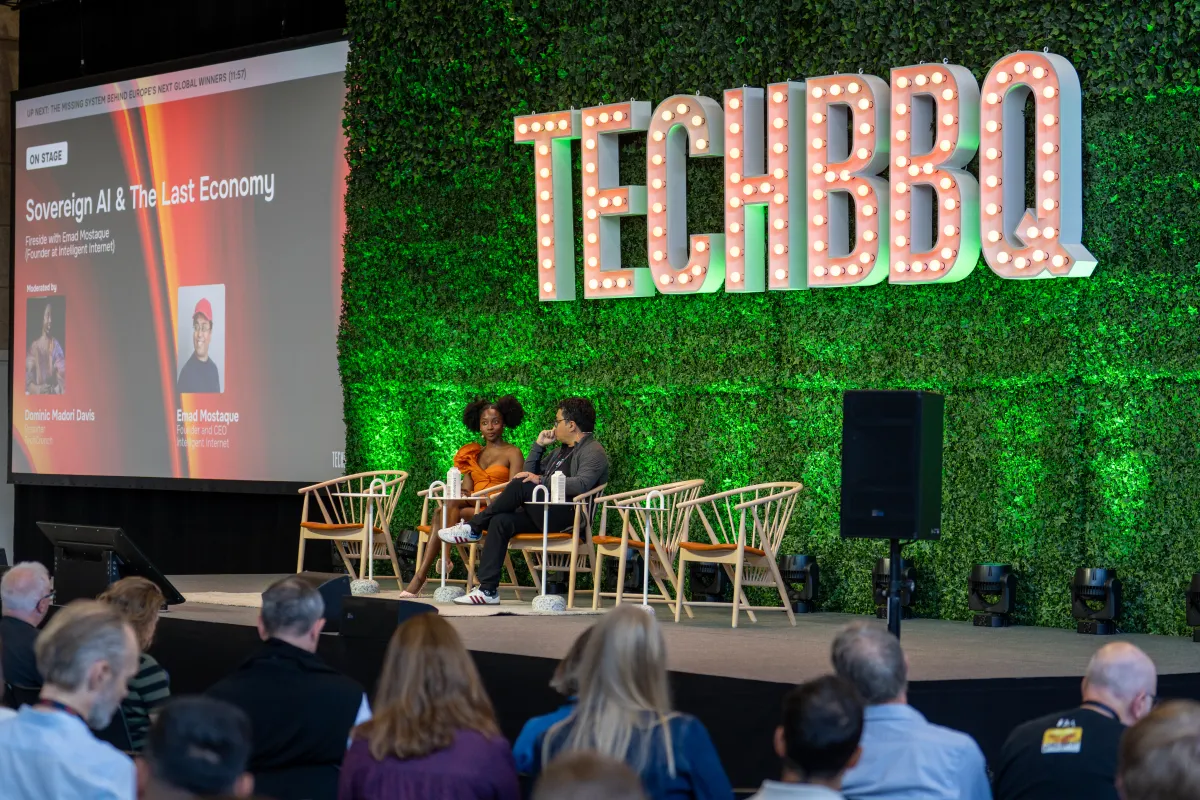
“Sovereignty is the ability to resist power being exerted over you,” Emad Mostaque said during one of the conference panels, framing the issue as a question of leverage rather than ideology.
Mostaque, co-founder of Stability AI and Intelligent Internet, argued that control of AI systems is increasingly concentrated in the hands of a small number of labs. He suggested that this concentration could shape not just business outcomes but national power, going so far as to say that the entity controlling AI may effectively control the country that depends on it.
That claim may sound extreme, but it resonated because it reflected a broader fear: if software increasingly mediates work, communication, commerce and decision-making, then dependence on a handful of providers becomes a structural vulnerability.
Why investors are paying attention
Investors were not merely listening for product-market fit. They were also watching for where Europe can build defensible layers in the AI stack, from infrastructure to specialized applications. That includes backing companies that can keep more of the value and control within Europe.
This is especially relevant in a region where capital access remains a persistent concern. Several sessions at TechBBQ touched on how to channel more growth capital into Europe, an issue that intersects with AI because the most strategic opportunities often require heavy upfront investment in talent, data and compute.
In other words, the sovereignty debate is also a financing debate. If Europe wants more control over AI, it needs not only policy ambition but enough capital to support alternatives to U.S.- and China-led platforms.
What did privacy advocates say about AI agents?
Privacy advocates used TechBBQ to challenge the assumption that AI agents are a neutral productivity upgrade. In their view, the push to integrate assistants into operating systems and consumer devices raises significant questions about surveillance, consent and data extraction.
One of the sharpest critiques came from Meredith Whittaker, president of Signal, who appeared on a panel focused on whether privacy and AI can coexist. She warned against the growing push to embed AI assistants and agents into the core layers of operating systems, including consumer messaging environments.
Whittaker argued that the industry is building a powerful data-gathering machine and that marketing language around AI can obscure the broader consequences of collecting so much information.
Her position landed strongly in a European setting, where data protection has long been a defining cultural and regulatory principle. The question for many attendees was not whether AI can be useful, but whether the cost of convenience is creeping too high.
Whittaker also noted that privacy remains a real commercial demand, particularly in markets where sovereignty concerns are growing. In that sense, privacy is not merely a defensive constraint. It may also be a market differentiator for companies that can build AI products without overreaching into user data.
Can privacy and AI coexist?
Yes, but only if companies build AI products with clear limits on data collection, retention and integration. That was the underlying message from the privacy-focused discussions in Copenhagen, where speakers suggested that the current direction of travel is too often toward greater extraction rather than better user control.
The tension is straightforward: the most powerful AI products often benefit from more data, while strong privacy norms demand less. Reconciling those two realities will require deliberate product design, not just policy statements.
- Minimize what data is collected in the first place.
- Separate useful features from broad surveillance-style integration.
- Give users meaningful control over retention and access.
- Avoid making assistants the default gateway to every digital interaction.
How do AI agents affect work, ownership and democracy?
AI agents raise bigger questions than job automation alone. At TechBBQ, speakers and attendees repeatedly connected the rise of agentic systems to broader concerns about ownership, participation and democratic control.
Mostaque described an “agentic workforce” as part of a much wider transformation, implying that software is moving from being a tool people use to a system that increasingly performs work on their behalf. That shift may improve productivity, but it also concentrates decision-making in the systems themselves and the organizations that control them.
Mia Negru, advocacy and engagement director for the nonprofit Life With Artificials, pushed the idea further in a message following the panel discussion. She suggested that if intelligent agents handle more cognitive labor and robots take on more physical labor, society may need to rethink how ownership works, how people participate in the economy and how democratic systems adapt.
Negru said the long-term question may not be limited to technological disruption, but to whether society is prepared to redefine work, economic participation and even inclusion itself.
That is a striking argument because it moves the conversation beyond efficiency. If AI systems absorb a growing share of labor, then the distribution of power, income and voice becomes just as important as the technology’s capabilities.
What does “agency” mean in this context?
Agency, in the context of TechBBQ’s theme, refers to human control over technological systems and the freedom to choose what to automate, what to delegate and what to keep under human judgment. The irony, several attendees noted, is that “agents” are often marketed as empowering tools even as they can reduce the user’s direct role.
That is why the conference theme felt more politically loaded than celebratory. “Emerging from Agency” could be read as optimism about startup momentum, but many participants interpreted it as a reminder that Europe must decide how much agency it is willing to hand over.
Who made the event feel less abstract?
Europe’s sovereignty debate could have remained theoretical, but TechBBQ’s program anchored it in practical conversations. Panels on women’s health, Nordic-African collaboration and European growth capital kept the event focused on real industries and real financing decisions, not just abstract concerns about the future.
The most memorable sessions, according to attendees, were often those that brought the implications of AI back to human relationships and lived experience. Privacy, trust, health innovation and the concentration of power were not side topics; they were the mechanisms through which AI’s impact would actually be felt.
That broader context matters because the sovereignty debate in Europe is not isolated to AI researchers or policy specialists. It touches startups trying to ship products, investors deciding where to place capital and regulators trying to preserve user protections without stifling innovation.
What happened offstage at TechBBQ?
Outside the panels, TechBBQ looked like the kind of conference that still runs on personal chemistry as much as pitch decks. Rooftop barbecues, cocktail gatherings, island dinners and late-night drinks created the social fabric that often determines which partnerships actually form.
Several major companies and startup brands helped host networking events, including Lovable, Nvidia, OpenAI, AWS Startups and HSBC. Those gatherings underscored the dual reality of Europe’s AI scene: even as people worry about control and dependence, they still need the infrastructure and relationships of the very companies they are debating.
In Copenhagen, the contrast was visible. On one side were conversations about model dependence, privacy and sovereignty. On the other, there were rooftop conversations about the Danish startup scene, women’s brain health innovation and the practical work of building relationships across borders.
De Brever said the most memorable part of a room full of machine talk was still something old-fashioned: in-person human connection, shared ideas and the kind of trust that technology cannot fully reproduce.
Why the social side still matters
The after-hours events are not just a perk. They are where European startup ecosystems often create the cross-border trust needed to close deals, share knowledge and recruit talent. In a region where markets are fragmented by language, regulation and geography, informal relationships can be as valuable as formal policy.
That is one reason TechBBQ remains influential. It is not just a conference about technology; it is a meeting point for a region trying to decide how much of the AI future it can influence on its own terms.
Europe’s AI dilemma, in one sentence
Europe wants the upside of AI without surrendering control of the models, the data or the infrastructure that make the technology possible.
That simple idea is now shaping more of the continent’s startup discourse. If the current AI boom has a defining European question, it is not merely what to build, but what to own, what to trust and what to refuse.
TechBBQ showed that this conversation is no longer niche. It is moving from policy panels into founder strategy, investor diligence and public debate. And as AI agents become more capable, the central question may only get sharper: who is really in the driver’s seat?
Key moments from TechBBQ in Copenhagen
Here is a concise timeline of the conference’s main discussion points:
| Moment | Discussion | Implication |
|---|---|---|
| Early 2026 | Anthropic’s Mythos and Fable models became unavailable outside Europe. | Raised alarm about external control of essential AI tools. |
| TechBBQ opening days | Panels and hallway conversations focused on agency and sovereignty. | Confirmed AI control as a mainstream concern in Europe. |
| Privacy panel | Meredith Whittaker criticized deep AI integration into operating systems. | Highlighted data collection risks and consumer privacy concerns. |
| Agentic workforce panel | Emad Mostaque and others debated AI power concentration. | Linked model ownership to economic and political leverage. |
| Conference wrap-up | Attendees emphasized human connection alongside technical ambition. | Suggested Europe’s AI future will depend on trust as much as tooling. |
What comes next for Europe’s AI conversation?
Europe’s AI debate is likely to become more pointed as model providers, cloud platforms and agentic tools become more embedded in daily work. The Copenhagen discussions suggest that the continent is moving from fascination to strategic caution.
That does not mean Europe will reject American AI companies or try to wall itself off from global innovation. But it does suggest that users, founders and investors are becoming more selective about what they adopt, how deeply they integrate it and which parts of the stack they want to control themselves.
For now, TechBBQ offered a clear snapshot of where the conversation stands: the excitement around AI is still real, but it is increasingly paired with skepticism about dependency, privacy and power. Europe’s startup community seems ready to build, but it also wants a stronger say in who sets the rules.
And that may be the most important signal from Copenhagen. In Europe, the AI story is no longer only about capability. It is about sovereignty, and about whether the region can keep enough agency to shape the future rather than simply rent it.
Frequently asked questions
Why did AI sovereignty dominate TechBBQ in Copenhagen?
AI sovereignty dominated TechBBQ because attendees were worried about Europe’s dependence on U.S. and Chinese AI providers. A recent disruption involving Anthropic’s models made the issue feel immediate, pushing founders and investors to ask who controls the tools, infrastructure and data behind AI.
What happened with Anthropic’s models in Europe?
Anthropic’s Mythos and Fable models became unavailable to users outside Europe earlier in the year, according to the conference reporting. That access change unsettled some startups and reinforced concerns that critical AI services can be altered or withdrawn by outside providers with little warning.
What did Meredith Whittaker say about AI and privacy?
Meredith Whittaker warned that integrating AI assistants and agents deeply into operating systems could create a large-scale data collection system. She argued that privacy remains a major market need, especially in Europe, where sovereignty and data protection concerns are already strong.
How did Emad Mostaque frame AI sovereignty?
Emad Mostaque defined sovereignty as the ability to resist power being exerted over you. He said control of AI is becoming concentrated in a few labs and suggested that whoever controls AI could wield enormous influence over countries and economies that depend on it.
What does AI agency mean in the TechBBQ context?
In this context, agency means human control over how much power is delegated to AI systems. The conference theme reflected a concern that AI agents may increase convenience while reducing user control, making it important to decide what should remain under human judgment.