Updated August 23, 2026 7:53 pm
In short
Inherent says its Faraday agent replicated scientific papers better than larger OpenAI and Anthropic systems while using a much smaller Qwen model, and the company is positioning that result as a step toward an AI research teammate with better scientific judgment.
- Inherent says Faraday beat larger frontier models at replicating published research.
- The agent runs on Qwen 3.6, a 27B-parameter model, not a giant frontier system.
- The startup is betting on reinforcement learning to teach scientific judgment and “taste.”
- Inherent has raised $50 million, has about 12 staff and plans to grow quickly.
- The company sees research replication as a stepping stone toward AI discovery tools.
Update — August 23, 2026 7:53 pm
TechCrunch’s update adds that Inherent also had Faraday use OpenAI’s GPT-5.5 Codex for coding, rather than building its own toolchain, as part of its broader bet on combining existing software with its own scientific-reasoning layer.
The story also includes a new comment from co-founder Edward Hughes: he says the startup’s goal is not just a one-off replication win, but an AI agent with “taste” that can choose worthwhile experiments and work more like a strong research teammate.
TechCrunch additionally says Hughes has publicly backed ending U.K. “garden leave” rules, which he says can slow hiring, and notes that Inherent’s King’s Cross office is part of London’s growing AI hub.
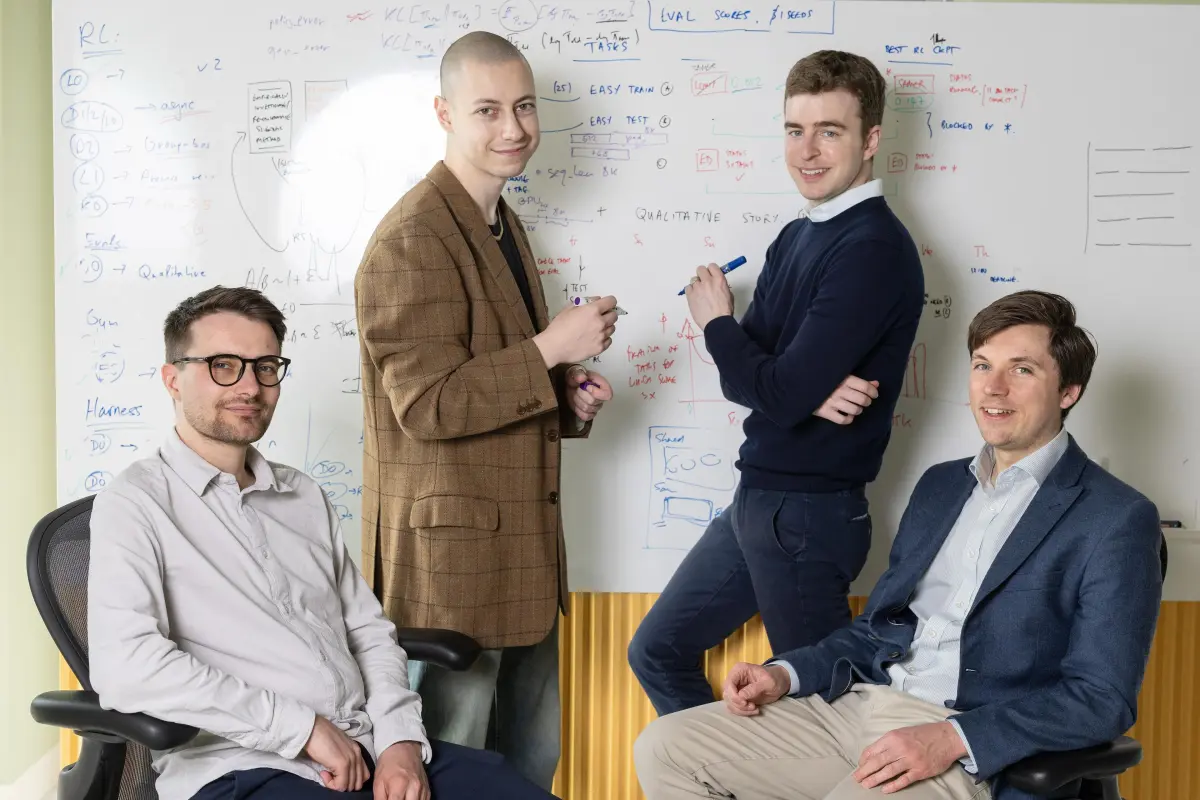
Inherent, a London AI startup founded by former Google DeepMind researchers, says its new agent Faraday has outperformed much larger systems from OpenAI and Anthropic at reproducing the results of scientific papers. The company says the feat matters because it is a step toward its longer-term goal of building an AI “scientist” that can help generate new knowledge, not just summarize existing research.
The claim comes only weeks after Inherent exited stealth with a $50 million seed round, placing the company in the middle of a fast-moving race to build AI systems that can do more than answer questions or write code. What makes the announcement stand out is not only the reported result, but the method: Inherent says Faraday reached it while running on a relatively small model, Qwen 3.6, with 27 billion parameters.
That puts the startup’s approach in sharp contrast with the broader trend in frontier AI, where bigger systems, bigger budgets and bigger model sizes usually dominate the conversation. Inherent is arguing that the future may belong to agents trained for judgment, experimental design and scientific judgment — traits the company describes as “taste.”
What Inherent says Faraday achieved
Inherent says Faraday independently reproduced findings from published scientific papers without being given the answer in advance. In practical terms, that means the agent had to read a paper, infer the underlying experiment, run tests and verify whether the conclusions held up.
The company’s benchmark is deliberately narrow, but the task is important. Reproducing published research is a core skill in science, and failure to replicate results is a persistent issue in many fields. If an AI system can reliably do that work, supporters argue, it could become a useful assistant for scientists and eventually contribute to discovery itself.
Co-founder and chief scientist Edward Hughes said the goal was not simply to score a win against larger models. Instead, the company wanted to see whether it could build a system that arrived at the answer the right way.
Hughes said the most interesting part was not that Faraday beat better-known frontier systems, but how the company designed and trained it.
He also framed replication as a natural entry point for AI in science. Many graduate researchers, he noted, begin by recreating the results of established studies before moving on to original work.
How did a smaller model beat larger frontier systems?
Inherent says the answer lies in training strategy rather than sheer scale. Faraday runs on Qwen 3.6, a model with 27 billion parameters, which is small by frontier standards. By comparison, the company says it tested against Anthropic’s Claude Opus 4.8 and OpenAI’s GPT-5.5, both of which are significantly larger systems.
Instead of optimizing for raw size, Inherent says it uses reinforcement learning to teach the agent how to make better scientific decisions. Reinforcement learning rewards behavior that leads to strong outcomes, which can be more flexible than hard-coding rules for every step of a task.
The company’s aim is not just accuracy. It wants the model to show something closer to human scientific instinct: deciding which experiments are worth running, what evidence matters and how to structure the search for an answer.
That is the core of what Inherent calls “research taste.” In the company’s view, taste means an AI can prioritize promising hypotheses, avoid dead ends and make choices that look like those of a strong human collaborator.
Why “taste” matters in scientific AI
Because scientific work is not only about finding answers; it is about choosing the right questions to ask. Inherent says a useful research agent must be able to evaluate uncertainty, weigh evidence and decide when an experiment is worth the cost.
That is a harder challenge than simply writing code or generating text. It requires planning under uncertainty, a sense of experimental design and a willingness to update based on results. Inherent believes reinforcement learning is a better fit for that problem than standard instruction-following training alone.
In other words, Faraday is being built less like a chatbot and more like a junior researcher who can suggest next steps and learn from what happens in the lab.
Why Inherent is not trying to build everything itself
Inherent’s strategy is selective, not maximalist. Rather than trying to create a full stack of in-house scientific software, the startup says Faraday relies on OpenAI’s GPT-5.5 Codex for coding tasks, mirroring how human scientists often use existing tools instead of reinventing them.
That decision matters because it shows how the company is thinking about product design. Inherent is not trying to own every component of the workflow. It is focusing on where it believes it can add the most value: scientific reasoning, task selection and experimental judgment.
The startup also wants its agents to avoid the overly agreeable behavior that has become a common complaint about AI assistants. Hughes said he wants the model to act like a thoughtful teammate who comes back with an unexpected line of inquiry rather than simply echoing a user’s assumptions.
Hughes described the ideal collaborator as someone who says they got curious, ran experiments and wants feedback on the results.
That description reflects a broader shift in AI product thinking. The next generation of agents is increasingly being judged not just on speed or fluency, but on whether they can challenge users in useful ways.
How big is Inherent and what happens next?
Inherent is still small, but it is growing quickly. The company says it has about a dozen employees, all working in person from an office in King’s Cross, one of London’s most active AI districts.
Hughes said the startup plans to expand to roughly 20 to 25 employees by the end of the year. That hiring push could make it a destination for DeepMind researchers and engineers looking for a new home, especially as several senior AI labs continue to compete aggressively for talent.
The company’s ambitions go beyond replication. It is also working on world models, which are systems designed to build internal representations of how the world works and how outcomes unfold over time. Those models are often viewed as a key ingredient for more capable reasoning systems and robotics, as well as AI that can plan in complex environments.
For now, Faraday’s research-replication result offers a proof point. It does not prove the company has solved scientific discovery, but it does suggest its method can produce measurable gains in a task closely tied to the kind of reasoning science requires.
Why London matters in the race for AI scientists
London has become one of the most important AI hubs in the world, and Inherent is explicitly leaning into that identity. The city’s concentration of talent, universities and startups has accelerated over the past several years, helped in no small part by the presence of Google DeepMind.
Hughes said he believes London is the right place for the company to build. That view is shared by many founders who see the city as a strong base for research-heavy AI work, even if the United States still dominates funding, compute access and large-scale commercialization.
At the same time, Hughes added his voice to a long-running debate in the U.K. startup scene: whether “garden leave” should be reduced or eliminated. The practice can prevent departing employees from joining a rival or starting a new company for months after leaving a job.
Supporters say garden leave helps protect intellectual property and gives companies time to manage transitions. Critics argue it slows innovation and makes it harder for startups to hire talent quickly, especially when compared with the U.S., where such restrictions are usually less burdensome.
Hughes said his views on the issue are personal, not a formal company position, but he noted that the restriction affected him directly.
What is garden leave and why do founders object to it?
Garden leave is a contractual restriction that keeps employees on payroll while preventing them from working for a competitor or launching a rival company during a notice period. Founders often object because it can delay hiring, limit mobility and make it harder to move quickly in competitive markets such as AI.
Inherent’s attention to the issue reflects a broader concern among British AI leaders: talented researchers can be trapped by rules that slow down the movement of expertise. That matters in a field where small timing advantages can determine whether a startup can recruit critical talent.
How does Faraday fit into the wider AI race?
Faraday sits at the intersection of several major trends in AI: smaller but more efficient models, agentic systems that can take actions, reinforcement learning for decision-making and growing interest in specialized tools for science. Together, those trends point to a market that is maturing beyond generic chat interfaces.
Until recently, many AI companies competed mainly on model size and benchmark performance. But as the field evolves, more startups are seeking advantage through training methods, workflow integration and domain-specific behavior. Inherent’s pitch is that science requires a different kind of intelligence than broad-language fluency alone.
The company is also trying to define a narrower, more credible path to AGI-like claims. Rather than promising general superintelligence today, it is building toward a specific capability: an AI collaborator that can help scientists make better decisions, run better experiments and eventually contribute to new discoveries.
That is a more modest story on paper, but potentially a more practical one. Scientific research is full of bottlenecks where a capable agent could save time, reduce trial and error and improve the quality of work done by human researchers.
What the replication claim does — and does not — mean
The claim should be read as an early benchmark result, not a final verdict on scientific AI. Reproducing published papers is a meaningful test, but it is only one step toward actual discovery. A system that can verify prior work is not automatically capable of creating new theories or designing experiments that transform a field.
Still, the result matters because it addresses a specific weakness in many AI systems: they can sound convincing without demonstrating reliable reasoning. If Faraday really can outperform much larger models on replication while using a smaller backbone, that suggests there may be room for more efficient approaches to scientific intelligence.
It also suggests that the future of research agents may not depend on the largest model available, but on the quality of training, reward structure and task design. That would be good news for startups that cannot afford the biggest frontier infrastructure, and for researchers who care more about capability than scale for its own sake.
Key facts about Inherent and Faraday
| Item | Details |
|---|---|
| Company | Inherent, a London AI lab founded by former Google DeepMind researchers |
| Latest product | Faraday, an AI agent built for scientific research tasks |
| Claimed benchmark | Outperformed larger models in independently reproducing published research findings |
| Models referenced | Anthropic’s Claude Opus 4.8, OpenAI’s GPT-5.5, and Qwen 3.6 |
| Model size | Faraday runs on Qwen 3.6 with 27 billion parameters |
| Funding | $50 million seed round |
| Current team | About 12 employees |
| Planned headcount | About 20 to 25 employees by year-end |
| Office | King’s Cross, London |
Timeline: How Inherent emerged
| Time | Milestone |
|---|---|
| Before launch | Founded by former Google DeepMind researchers, including Edward Hughes |
| Weeks ago | Exited stealth with a $50 million seed round |
| Now | Releases Faraday and says it beat larger frontier models at paper replication |
| By year-end | Plans to grow to roughly 20 to 25 employees |
What investors and rivals will watch next
Investors will likely focus on whether Inherent can turn one benchmark claim into a repeatable product story. In AI, a convincing demo can quickly attract attention, but durable value usually depends on proving that the approach works across multiple tasks, not just one carefully chosen test.
Rivals will also be watching whether the company’s reinforcement-learning approach scales. If it can reliably train agents to show better research judgment without resorting to larger models, that would be a notable technical edge. If not, Faraday may remain an interesting but limited experiment.
For now, though, Inherent has done what many startups struggle to do after a big funding announcement: it has put a concrete technical claim on the table. In a crowded AI market filled with broad promises, that alone is enough to get attention.
Bottom line
Inherent is trying to redefine what a useful AI agent looks like in science. Rather than chasing the biggest model or the flashiest general-purpose assistant, the London startup is betting that carefully trained systems with better judgment can beat larger rivals on real research work.
If Faraday’s result holds up, it could strengthen the case for smaller, more specialized agents in scientific discovery. More importantly, it suggests the race to build AI for research may be shifting from scale alone to something harder to quantify: how well a model thinks like a scientist.
Frequently asked questions
What did Inherent claim about its AI agent Faraday?
Inherent said Faraday outperformed larger models from OpenAI and Anthropic at independently reproducing the findings of published scientific papers. The company says the result shows its approach can produce strong research behavior even with a much smaller model backbone.
How large is the model behind Faraday?
Faraday runs on Qwen 3.6 with 27 billion parameters. Inherent says that is much smaller than the frontier systems it compared against, which is part of why the result is notable for investors and AI researchers.
Why does Inherent focus on reinforcement learning?
Inherent says reinforcement learning is better suited to teaching an AI system scientific judgment, because it rewards good outcomes rather than relying only on explicit rules. The startup believes this approach can help agents develop research “taste” and generalize to more scientific tasks.
Is Faraday an AI scientist already?
No. Faraday is not a full AI scientist yet, but Inherent says it is a step toward that goal. The company wants to build agents that can help choose experiments, evaluate evidence and eventually contribute to new scientific discoveries.
Where is Inherent based and how big is the team?
Inherent is based in London, with its team working in person from King’s Cross. The company says it has about 12 employees now and plans to grow to roughly 20 to 25 people by the end of the year.