In short
Saber Interactive says it did not replace writers with AI on Rideshare Stimulator, but the former lead writer says ChatGPT took over part of the work. The dispute is now centered on AI disclosure, authorship and labor concerns in game development.
- Saber says no writers were replaced by AI on Rideshare Stimulator.
- Former lead writer Stella Sacco says ChatGPT took over her work mid-development.
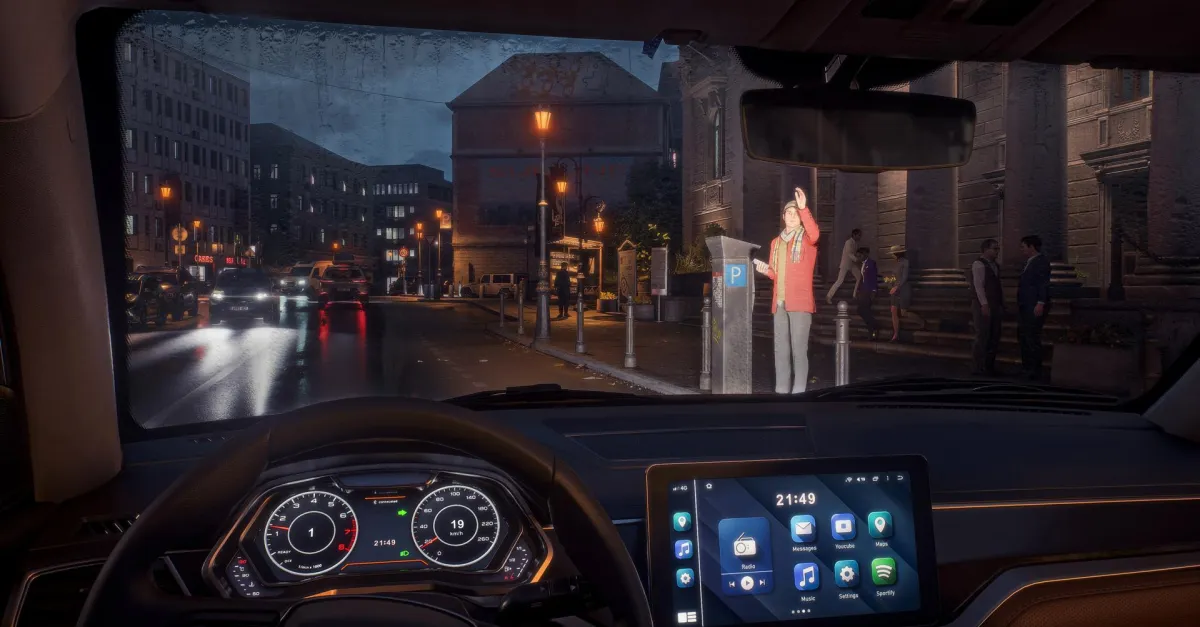
- The game’s free-ride mode appears to use AI for endless passenger interactions.
- The dispute raises broader questions about AI disclosure and labor in games.
Saber Interactive is denying claims that it replaced a writer on Rideshare Stimulator with ChatGPT, but the game’s former lead writer says AI still took over part of the work. The dispute matters because it highlights the growing tension between game studios eager to use generative AI and creatives who fear the technology is being used to sideline human labor without clear disclosure.
The controversy centers on a new driving-simulation game announced last month and developed by Unigine with Saber involved in the project. A former lead writer, Stella Sacco, says she was removed from the role after the studio shifted direction toward AI-generated material. Saber chief executive Matthew Karch, however, says the company has not replaced writers with AI and says the project includes only a limited experimental mode that depends on AI because it is built around endless passenger interactions.
At the heart of the disagreement is not only who wrote specific lines of dialogue, but also how much generative AI was used, whether that use was disclosed, and whether the studio’s public explanation matches what actually happened during development.
What happened with Rideshare Stimulator?
The immediate conflict began after Sacco publicly said she had been the game’s lead writer and that Saber swapped her out for ChatGPT midway through development. She also said the voices of the passengers featured in the game were generated by AI. In her telling, the studio either changed direction after she left or failed to properly disclose the AI use on Steam.
Saber’s response came through Karch, who told The Verge that neither Saber nor Unigine had replaced writers with AI. He said the game’s story was written by people, with one exception: an experimental free-ride mode that uses AI by design because the number of potential passengers is effectively unlimited.
That free-ride setup appears to be the main area where the company admits AI is involved. But Sacco argues that this distinction is too narrow if AI also produced text that was once supposed to be written by humans.
Who is saying what in the dispute?
Saber says it did not replace writers, and that AI is being used as a gameplay tool rather than a human substitute.
The former writer says the studio did replace her with ChatGPT and used AI voices for rider dialogue.
What makes the issue sensitive is that both accounts can sound partially compatible at first glance while leading to very different conclusions about labor, disclosure and authorship.
According to Karch’s statement, the company sees AI as a way to improve gameplay and NPC behavior, and it says the project’s free-ride mode requires AI because of the scale of possible interactions.
Sacco, by contrast, says it is not meaningful to claim the story was fully written by people while also acknowledging that computers generated some of the text and passenger lines.
The disagreement is not just semantic. It cuts to a larger industry question: if a studio writes part of a game with humans and part with generative AI, how should that be described to players, workers and platform holders?
Why this dispute matters for gaming and AI
This fight lands at a moment when the video game industry is under pressure from rising costs, layoffs and aggressive experimentation with AI tools. Studios increasingly say generative systems can speed up production, help fill out large worlds and make non-player characters more responsive. Writers, performers and designers often see the same tools as a threat to jobs, credit and creative control.
Rideshare Stimulator is especially relevant because the project’s premise depends on constant dialogue with passengers. That makes it a natural test case for AI-generated text and audio, but also a flashing warning light for labor concerns. If the game truly relies on AI for open-ended conversations, then studios may be tempted to treat human writing as a template rather than the final product.
The issue is also tied to trust. Players increasingly want to know when a game uses AI-generated content, especially if that content may shape a major part of the experience. Meanwhile, writers and other creators want clear boundaries around when AI is permitted and when it is replacing work that would otherwise have been done by people.
How did the project describe its AI use?
The game’s public description and its trailer suggest that AI-generated writing and voice are part of the experience, at least in some segments. But its Steam listing does not currently appear to include a clear generative AI disclosure, which is part of what raised questions after Sacco’s post.
That gap between the teaser material and the store page matters because platform disclosures are often where players learn whether AI was used in production. If a game includes synthetic text, voice or visual assets, the absence of a straightforward label can fuel accusations that a studio is downplaying the role of automation.
For this project, the uncertainty is sharpened by the fact that the game is still relatively new in public view and the studio has not released a detailed breakdown of what was human-written, what was machine-generated and at what stage those choices were made.
What does Saber say the AI is doing?
Saber says AI is being used as an experimental feature rather than a wholesale replacement for creative staff. Karch said the company believes in AI tools that improve gameplay and NPC behavior, and he said Saber has been using such tools in some form since it was founded in 2001.
He also emphasized that Saber continues hiring and that its workforce of more than 3,000 employees is not being replaced by AI. That claim is intended to address fears that generative systems are already being used as a labor-cutting strategy across the company.
Still, saying workers are not being replaced companywide does not necessarily answer the narrower question of whether a specific writer’s work was cut back or supplemented by AI on a specific game.
What did the former writer say after Saber’s response?
Sacco pushed back hard on Karch’s framing. In a message to The Verge, she said she objected to being called dishonest and argued that the studio cannot fairly claim the story was written by humans while also admitting that computers wrote some of the in-game text.
She said that if the game includes rides she wrote and also rides generated by AI, then AI was used in a way that displaced her work. In her view, that is exactly what happened when Saber told her in December 2023 that it would move in that direction.
Her objection points to a key labor issue in the generative AI era: companies may view AI as one component of a hybrid workflow, while individual workers may experience the same decision as a loss of assignments, credit and control.
How does the game fit the broader AI debate in entertainment?
Rideshare Stimulator is part of a larger argument across entertainment about when AI should be used, how transparently it should be disclosed and whether audiences want it at all. Game studios, film companies and publishers have all begun experimenting with generative tools for text, voices, art and support systems.
That experimentation has produced a familiar pattern. Companies often talk about efficiency, scalability and innovation. Creators often respond that these same tools are being introduced in ways that weaken employment protections and allow firms to capture the value of human creative work without paying for all of it.
The dispute at Saber is therefore more than a single-company controversy. It reflects the unstable middle ground the industry is currently occupying, where AI can be framed as both a productivity tool and a substitute for specific forms of creative labor.
Key tensions raised by the case
- Disclosure: players may not know how much AI is in a game unless studios say so clearly.
- Authorship: a project can be described as human-written even if AI generates some lines or scenes.
- Labor: workers may see AI as displacing assignments even when companies deny wholesale replacement.
- Product design: open-ended simulation games are especially likely to use generative systems.
Table: What is known about the Rideshare Stimulator dispute
| Issue | Saber’s position | Sacco’s position |
|---|---|---|
| Writer replacement | Company says no writers were replaced by AI | Former lead writer says she was replaced by ChatGPT |
| Story authorship | CEO says the story was written by real people | Writer says AI also wrote text, so the human-only claim is incomplete |
| Passenger dialogue | AI is used in an experimental free-ride mode | AI voices were used for passenger lines during development |
| Disclosure | Company has not provided a full public breakdown in the quoted statement | Writer says the Steam listing does not clearly disclose AI use |
| Industry meaning | AI is a gameplay enhancement tool | AI is a labor substitute if it takes over written work |
Why the Steam disclosure question matters
Steam and other storefronts have become a primary source of truth for players who want to know what they are buying. If a project relies on AI-generated text or audio, many users expect that to be stated plainly so they can make informed choices.
That expectation is especially strong when a game’s premise makes synthetic dialogue central to gameplay. In a title about operating a rideshare business, the passenger conversations are not incidental extras. They are part of the core loop, which makes any AI contribution more consequential than if it were confined to a minor side feature.
When disclosures are missing or vague, companies risk two kinds of backlash: criticism from players who feel misled and criticism from workers who feel their contribution has been minimized or rewritten after the fact.
What Saber’s defense reveals about AI in game development
Karch’s statement offers a glimpse into how some studios want to define AI’s role. Under that view, AI is acceptable if it helps build dynamic systems, populate endless content or improve behavior in non-player characters. In other words, the technology is treated as an engine for scale, not as a substitute for authorship.
That distinction may be important to executives, but it may not satisfy writers or players who see a direct line between using AI to generate dialogue and reducing the need for human script work. In practical terms, if a machine is producing the lines that a writer would otherwise have created, the labor question becomes unavoidable.
The company’s insistence that it is not replacing employees also reflects a broader PR challenge for tech-adjacent entertainment businesses. Many want the benefits of AI adoption without appearing to endorse job losses. That makes messaging around “enhancement” versus “replacement” especially fraught.
How should readers understand the conflict?
The safest reading is that both sides are describing different parts of the same development process. Saber appears to be acknowledging some AI use, particularly in an experimental mode tied to the game’s structure, while denying that it wholesale fired writers in favor of automation. Sacco, meanwhile, says the AI use was substantive enough to count as replacement.
That distinction matters because legal, ethical and creative standards around AI in games are still evolving. A studio can believe it is using AI responsibly while a worker can believe the studio has crossed a line. Without a detailed breakdown of workflow, credits and disclosure practices, outsiders are left to judge from partial information.
For now, the controversy around Rideshare Stimulator stands as another sign that generative AI is not simply a tool choice inside game development. It is becoming a labor issue, a consumer transparency issue and a cultural issue all at once.
Timeline of the dispute
| Date | Event |
|---|---|
| December 2023 | Sacco says Saber told her it would move in the direction of using AI. |
| Last month | Rideshare Stimulator is announced publicly. |
| After announcement | Sacco says she had been the lead writer and was replaced by ChatGPT. |
| August 12, 2026 | Saber’s CEO publicly denies that writers were replaced by AI. |
As the game moves forward, the key unanswered question is not whether AI appeared in the project at all. It is how deeply it shaped the writing, whether that use was clearly disclosed and whether the studio’s explanation will hold up as more details emerge.
For now, the public record shows a company insisting it preserved human authorship, a writer insisting she was pushed aside by automation, and a game whose most important feature may now be the controversy around how it was made.
Sacco said the company is trying to present two different versions of the same story: one that emphasizes human writing and another that acknowledges machine-generated text. In her view, both cannot be true in the way Saber wants them to be.
Frequently asked questions
Did Saber replace Rideshare Stimulator’s writer with ChatGPT?
Saber says it did not replace any writers with AI, but the former lead writer says she was replaced mid-development. The dispute remains unresolved publicly because the studio and writer are describing the same project very differently.
What AI use is Saber admitting on the game?
Saber says the game includes an experimental free-ride mode that uses AI because the number of passengers is effectively infinite. The company frames that use as a gameplay feature rather than a replacement for human writing.
Why is the Steam disclosure important?
The Steam disclosure is important because players often rely on storefront labels to know whether a game uses generative AI. If that information is missing or unclear, it can create mistrust about authorship and transparency.
Is this conflict only about one game?
No, this is bigger than one game. The argument reflects a wider industry debate about whether AI is a productivity tool, a creative partner or a substitute for human labor in game development.
What did the former writer say after Saber responded?
The former writer said Saber was trying to have it both ways by claiming the story was human-written while also admitting that computers generated some of the text. She argued that if AI wrote part of the content, her work was still displaced.