Updated August 12, 2026 1:54 pm
In short
Spotify will soon badge AI personas, exclude them from recommendations by default, and now plans to let listeners flag suspected synthetic profiles while keeping its labels focused on artist identity rather than AI use in the music.
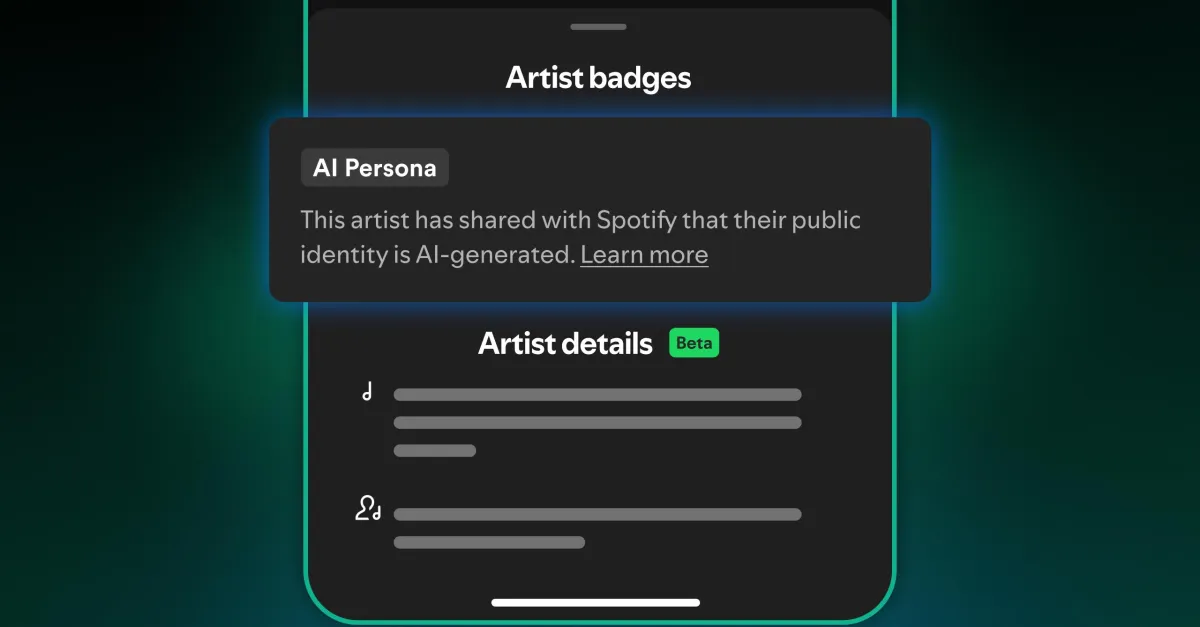
- Spotify will badge profiles that do not represent real people as AI Personas.
- Music from those profiles will be excluded from editorial and personal recommendations by default.
- Artists can self-disclose AI persona status now, but Spotify will also use review and detection tools.
- The company will notify affected artists and allow appeals.
- Spotify’s move comes as AI-generated music continues to surge across streaming platforms.
Update — August 12, 2026 1:54 pm
Spotify’s latest update adds one more safeguard: the company now says it will let listeners report artist profiles they believe may be AI-generated, giving users a way to flag suspicious accounts.
The service also clarified that its new labels are aimed only at an artist’s identity, not whether AI was used in the music itself, and reiterated that it already offers a separate “Verified by Spotify” badge to show a profile belongs to a real person.
Update — August 11, 2026 4:54 pm
Spotify says artists will be able to self-identify as an AI persona starting today, rather than waiting for the mid-September rollout.
The company also plans to add a listener tool that will let users flag profiles they suspect are AI-generated, expanding beyond its existing mix of staff review and automated checks.
Spotify reiterated that its new labels are about the artist’s identity, not whether AI was used in making the music, and said it already offers a separate “Verified by Spotify” badge to indicate a real person.
Spotify will begin marking AI-generated artist profiles with an “AI Persona” badge and will stop surfacing music from those accounts in its editorial picks and personalized recommendations by default. The rollout, which starts in mid-September, is meant to reduce confusion for listeners and push back against the growing wave of synthetic music on streaming platforms.
The company says the change is aimed at profiles that do not represent a real person, and it will use a mix of artist disclosures, human review and AI detection tools to decide when an account should be labeled. It is one of the clearest steps yet by a major streaming service to separate human artists from synthetic identities as AI music becomes increasingly common online.
What Spotify is changing and when
Spotify says the new policy will start appearing across the app in mid-September. From that point, profiles identified as AI personas will carry a visible badge, and their tracks will be excluded from editorial recommendations and algorithmic suggestions unless the system is updated in the future.
The company is also allowing artists to self-disclose that they are an AI persona beginning immediately. But Spotify is not relying only on self-reporting, which it says would be too easy to game. Instead, it will combine user submissions, review by staff and automated tools to determine whether a profile appears to be synthetic.
| Change | What it means | Timing |
|---|---|---|
| AI Persona badge | Profiles that are not real people will be labeled in the app | Rollout begins mid-September |
| Self-disclosure | Artists can identify themselves as AI personas | Available now |
| Human + AI review | Spotify checks identity signals beyond self-reporting | Ongoing |
| Recommendation filtering | AI persona music removed from editorial and personal recommendations by default | Mid-September rollout |
| Appeals process | Artists can challenge a label applied to their profile | After notification |
Why is Spotify acting now?
Spotify is responding to a broader flood of AI-generated music that has been spreading across streaming platforms and complicating how listeners understand who is behind a song. The company says users have told it they do not want to click on a profile that looks like a human artist only to discover later that the persona is synthetic.
That frustration has become more urgent as AI tools make it easy to generate convincing names, portraits and entire catalogues of music. For Spotify, which depends on trust in its curation systems, the issue is not just a technical problem. It is also a branding problem and a discovery problem, especially when a fake-looking artist profile can end up occupying the same recommendation slots as a touring musician or independent singer.
Spotify said listeners have been clear that they do not want to be misled by artist pages that appear human but are actually AI-generated, and it added that its ranking systems are intended to emphasize authentic human artists while limiting spam-like or low-effort uploads.
The label shift also lands at a time when other music services are grappling with the same problem. Deezer, a rival streaming platform, recently said that AI-generated tracks now account for half of the songs uploaded to its service each day, a startling figure that underscores how quickly synthetic content is scaling.
How Spotify will decide what counts as an AI persona
Spotify’s new system focuses on identity rather than composition. In other words, the platform is not primarily trying to determine whether artificial intelligence helped produce a song. Instead, it is trying to figure out whether the artist profile itself represents a real human being.
That distinction matters. A musician might use AI tools in the production process, from mastering assistance to vocal cleanup, without being a synthetic performer. Spotify says the new badges are meant to address the persona behind the account, not every possible use of AI in music creation.
What signals will Spotify use?
Spotify says it will examine whether an artist’s name, photo or other profile elements appear to be photorealistic AI-generated identities. The company has not published a full technical breakdown of the detection process, but it says the decision will not be made automatically from a single signal.
- Artist self-disclosure
- Human moderation review
- AI-assisted detection tools
- Profile identity signals such as image and name patterns
- Audience thresholds that prioritize high-reach profiles first
The platform says it will focus first on artists that meet “defined audience thresholds,” meaning the most widely listened-to profiles will get reviewed before smaller ones. That approach suggests Spotify wants to address the most visible synthetic acts quickly, especially those most likely to confuse large numbers of users.
What happens if Spotify gets it wrong?
Spotify says artists will be notified if a “Likely AI Persona” badge is added to their profile and will have the chance to appeal. That safeguard is important because the company is making a judgment call based on profile signals, not a perfect scientific test.
It also plans to introduce a listener-facing reporting tool so users can flag suspected AI-generated identities. That could help Spotify catch accounts that slip through the system, although it could also open the door to false reports from fans or rivals. The company has not said exactly how quickly it will process those complaints.
Why the distinction between identity and music matters
Spotify’s approach draws a line between who an artist is and how a track is made. That is a crucial distinction in a moment when AI is already part of many legitimate music workflows, even when the public cannot see it.
In practice, the policy means a real musician who uses AI for production may still appear normally on Spotify, while an entirely synthetic persona with no human performer behind it could be labeled and de-emphasized. That choice is likely to matter for creators, record labels and listeners because it preserves a place for AI-assisted production while drawing a harder line around identity deception.
It also signals that Spotify is not yet ready to classify songs themselves as AI-made with the same confidence. The platform currently does not have a system comparable to Deezer’s effort to identify AI-generated tracks at the file level. Instead, Spotify is choosing a simpler and more visible intervention: label the persona, not the waveform.
How does this compare with other platforms?
Spotify is not alone in trying to manage AI music, but its strategy is narrower than some competitors’ approaches and more focused on the listener experience.
Deezer has taken a more aggressive stance on detection, saying it can identify AI-generated tracks and quantify their share of uploads. Spotify, by contrast, is emphasizing disclosure and curation. The company is telling users what kind of artist they are hearing and keeping questionable profiles out of recommendation channels rather than trying to police every AI-assisted song.
That difference reflects two separate industry challenges. One is the authenticity of the creator. The other is the authenticity of the audio itself. Spotify’s latest policy tackles the first problem immediately while leaving the second mostly unresolved for now.
| Platform | Current AI approach | Main focus |
|---|---|---|
| Spotify | Labels AI personas and limits recommendations | Artist identity |
| Deezer | Detects AI-generated tracks and tracks upload volume | Audio content |
| Other services | Varying disclosure and moderation policies | Mixed |
What this means for listeners
For users, the biggest change will be visibility. If Spotify determines that an artist profile is synthetic, a badge will appear on the page so listeners can see the distinction before playing a track or following the account.
More importantly, that music will no longer be pushed into the main discovery machinery by default. Songs from AI personas will not appear in editorial recommendations, and they will be excluded from personal recommendation feeds unless Spotify changes the setting later. For casual listeners, that should reduce the odds of being steered toward a fake-looking act without warning.
For heavy users of Spotify’s algorithmic features, the policy may subtly change what shows up in mixes, suggestions and curated surfaces. The company is effectively saying it wants recommendations to feel more trustworthy, even if that means being more selective about what kinds of profiles receive exposure.
What this means for artists and the music industry
For legitimate artists, Spotify’s move may be welcome. Human musicians have long argued that streaming algorithms can amplify low-effort or mass-produced content at their expense, especially when platform rules are slow to adapt to new forms of spam.
At the same time, the policy could create uncertainty for creators experimenting with AI tools, especially those building virtual acts or character-based projects. The line between performance art, digital persona and deceptive imitation is not always easy to draw, and Spotify’s appeals process will likely be tested as more creators launch AI-branded identities.
The music industry is also looking for broader standards. Record labels, publishers and streaming platforms have all been under pressure to clarify what counts as human-made, AI-assisted and fully synthetic content. Spotify’s decision will not settle those debates, but it does show that the largest platforms are moving from abstract concerns to product rules that shape what listeners actually see.
How the rollout could evolve
Spotify’s policy appears designed to be flexible, which suggests the company may refine it as it gathers feedback. The current version addresses identity badges, notifications, appeals and reporting, but not the full complexity of AI-assisted music production.
That leaves several open questions. How will Spotify define a “real person” in cases involving virtual bands, animated characters or collaborative AI projects? How will it distinguish between a stylized artist image and a photorealistic synthetic face? And how much evidence will be required before the platform applies the “Likely AI Persona” label?
Those questions matter because the next phase of AI music will almost certainly be more sophisticated than today’s synthetic one-offs. As models improve, artists may build entire identities that are partially human, partly automated and difficult to classify. Spotify’s new policy is an early attempt to create a boundary before those distinctions become impossible to see.
Timeline of Spotify’s AI persona policy
The rollout is happening in stages, with disclosure coming first and labels following later in September.
| Date | Milestone | Impact |
|---|---|---|
| Today | Artists can disclose AI persona status | Voluntary transparency starts immediately |
| Before mid-September | Spotify continues reviewing high-audience profiles | Initial labeling targets the most visible accounts |
| Mid-September | AI Persona badges begin appearing across the app | Listeners see profile labels and reduced recommendations |
| After rollout | Appeals and listener reporting expand | Artists and users can challenge or flag labels |
The bigger industry backdrop
Spotify’s announcement is part of a larger battle over what streaming platforms should do as AI-generated material becomes cheap, abundant and increasingly convincing. The growth of synthetic music raises concerns about fraud, catalog spam, recommendation manipulation and the erosion of trust in digital discovery.
There is also an economic issue. If recommendation systems reward fake personas or mass-produced tracks, they can dilute audience attention and reduce earnings for working musicians. That is one reason the streaming industry is under pressure to prove that its algorithms can still promote quality and authenticity rather than simply scale.
Spotify’s solution is not comprehensive, but it is strategically important. By attaching a visible label and cutting AI personas out of default recommendation pathways, the company is trying to make transparency part of the user experience. It is also acknowledging that the age of synthetic performers is no longer a future problem. It is already here.
What to watch next
The most important developments to watch are whether other major platforms follow Spotify’s lead, how aggressively the company enforces its labels and how many artists challenge the AI persona designation through appeals.
It will also be worth watching whether Spotify expands the policy beyond identity and into audio detection. If AI-generated music keeps flooding the market, the company may eventually need to decide whether it can or should label songs themselves, not just the faces attached to them.
For now, Spotify is drawing an early line in a fast-moving debate. The platform is telling users that if an artist page does not belong to a real person, it will say so — and it will not help that persona rise through the recommendation system.
That may not end AI music’s spread, but it could change how discoverable synthetic acts become on one of the world’s biggest streaming services.
Frequently asked questions
What is Spotify’s AI Persona label?
Spotify’s AI Persona label is a badge the company will place on artist profiles that appear to represent a synthetic identity rather than a real person. The label is designed to make AI-generated performers easier for listeners to identify across the app.
When will Spotify start applying the AI Persona badge?
Spotify will begin rolling out the AI Persona badge in mid-September. Artists can start disclosing that they are AI personas right away, but the visible label and recommendation changes will arrive later in the rollout.
Will Spotify remove AI music completely?
No, Spotify is not removing AI music completely. The company is focusing on the identity of the artist profile, not on banning every track that uses AI somewhere in the production process.
How will Spotify decide if a profile is an AI persona?
Spotify will use a mix of artist self-disclosure, human review and AI detection tools. It says it will look for signs that a profile name, photo or other elements appear to represent a photorealistic AI-generated identity.
Can artists appeal if Spotify labels them as AI personas?
Yes, Spotify says affected artists will be notified and will have a chance to appeal if the company applies a Likely AI Persona badge to their profile. Spotify also plans to let listeners flag suspicious profiles in the future.