Updated July 31, 2026 5:24 pm
In short
Google DeepMind’s Gemini Robotics 2 now adds whole-body control, stronger dexterity and long-horizon reasoning, plus multi-robot coordination, improved safety features and faster on-device adaptation to new robot bodies.
- Gemini Robotics 2 expands control from upper-body motion to whole-body humanoid movement.
- The model improves dexterity for five-fingered hands, supporting finer manipulation tasks.
- Gemini Robotics ER 2 adds better long-duration reasoning and task start/end awareness.
- Google says the new robotics system can detect nearby people and stop more safely.
- An on-device version can adapt faster to new robot bodies without internet access.
Update — July 31, 2026 5:24 pm
Google DeepMind also says Gemini Robotics 2 can now coordinate more than one robot at a time, including machines with different body types working on the same task.
The company says Gemini Robotics ER 2 is its safest robotics model yet, with stronger human-detection, safety-tool triggering and the ability to stop a robot if someone gets too close.
Google also says its on-device robotics model has been improved so it can adapt faster to new robot designs, including systems with very different shapes, sensors and ranges of motion, even without an internet connection.
Update — July 30, 2026 8:54 pm
Google DeepMind also says the updated system can coordinate multiple robots of different types on the same job, rather than only improving a single humanoid’s movement and grasping.
The company further says Gemini Robotics ER 2 is its safest robotics model yet, with better human-detection, safety-call triggering and the ability to bring a robot to a stop if someone gets too close.
Separately, Google says its on-device robotics model has been improved so it can adapt faster to robots with very different shapes, sensors and ranges of motion, even without an internet connection.
Google DeepMind has unveiled Gemini Robotics 2, an upgraded AI model that can coordinate a humanoid robot’s entire body, from its feet to its fingertips. The update matters because it moves robots beyond limited upper-body actions and into more realistic, full-body tasks such as walking, crouching, reaching, grasping and handling objects in dynamic environments.
The new system also improves robotic dexterity, adds stronger long-duration task planning and brings safer human-aware behavior, as Google intensifies its push to make robots more capable in homes, warehouses and other real-world settings.
What Gemini Robotics 2 changes
Gemini Robotics 2 is Google DeepMind’s latest robotics foundation model, and the headline improvement is whole-body control. The company says the earlier version was mainly oriented around upper-body movement, while the new release expands that control to the full humanoid form.
That means the model can help a robot coordinate its legs, torso, arms and hands as one system rather than as isolated parts. In practical terms, Google says the robot can walk, crouch, stretch, bend and manipulate items in ways that better resemble how humans carry out everyday physical tasks.
Google DeepMind is framing the update as a step toward robots that can do more than simple pick-and-place demonstrations. The company wants machines that can manage household chores, warehouse work and other activities where movement, balance, object handling and timing all matter at once.
Why whole-body control matters
Whole-body control is important because real-world work rarely happens from a fixed position. A robot that can only move its arms has limited usefulness when it needs to bend down, stabilize itself, step around an obstacle or reach into a tight space.
By bringing the legs and torso into the decision-making loop, Gemini Robotics 2 is designed to support more natural movement and better coordination. That capability is especially relevant for humanoid robots, which are being positioned as general-purpose machines meant to operate in spaces built for people.
Google DeepMind said the robots still have work to do on movement speed, which signals that this is not a fully mature deployment-ready system. Even so, the company describes the release as a meaningful milestone for the kinds of skills required in more demanding physical environments.
How does Gemini Robotics 2 work with robot hands?
Gemini Robotics 2 also improves dexterity by better controlling complex, five-fingered hands. That upgrade expands the range of delicate tasks a robot can attempt, including sealing a plastic bag, tying a trash bag and unscrewing a lightbulb.
These actions may sound simple, but they are difficult for robots because they require precise finger coordination, force control and an understanding of how objects respond to being squeezed, twisted or pulled.
In Google’s demonstrations, dexterity is as important as locomotion. A robot that can move around a room but cannot reliably use its hands will still struggle with many jobs that people consider basic.
Examples from Google’s demos
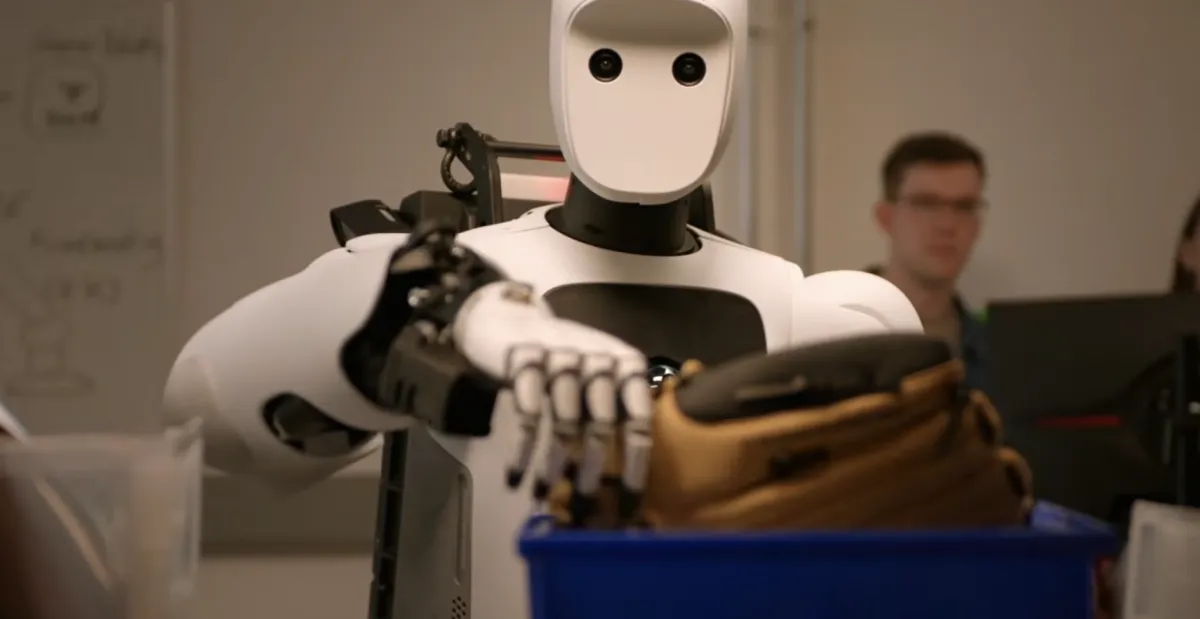
In one video, Apptronik’s Apollo 2 humanoid robot bends over to pick up a watering can. In another, the same robot locates and removes a specific object from a shelf. Those clips suggest Google is focusing on multi-step, visually guided interaction rather than narrow pre-scripted motions.
Another demonstration shows Apollo 2 directing Google’s dual-arm robot to place tools in a bin during a garage-cleaning scenario. That kind of cooperative example points to a future in which different robots, each with distinct strengths, may work together on a single job.
| Gemini Robotics version | Main capability | Key improvement | Example tasks |
|---|---|---|---|
| Gemini Robotics | Upper-body robot control | Focused on arms and manipulation | Basic object handling |
| Gemini Robotics 2 | Whole-body humanoid control | Adds feet-to-fingertips coordination | Walking, crouching, reaching, grasping |
| Gemini Robotics ER 2 | Embodied reasoning and task planning | Better long-run task execution and timing | Multi-step actions, collaboration, safety checks |
| Gemini Robotics On-Device | Local robot inference | Faster adaptation to new robot bodies | Robots with different shapes and sensors |
What is Gemini Robotics ER 2?
Gemini Robotics ER 2 is Google DeepMind’s updated embodied reasoning model, and it is responsible for helping robots interpret their surroundings, follow instructions and complete tasks that unfold over time. In other words, this layer is about reasoning and sequencing, not just movement.
The company says the new version is better at handling extended activities and can recognize when a task starts and when it ends. That matters because many real-world jobs are not one-off motions but chains of actions that require context, memory and judgment.
For a robot, knowing that a request is finished can be just as important as knowing how to begin it. A machine that keeps working after the job is done, or stops too early, is not ready for practical use.
Why task timing is a major robotics challenge
Robots often excel in demonstrations that are tightly controlled, but they struggle when the environment changes or when they must judge the boundaries of a human request. A kitchen, garage or workshop contains interruptions, moving people and unpredictable objects.
Google DeepMind’s emphasis on task start and end recognition suggests it is trying to reduce those failures. By improving temporal awareness, the model can better manage sequences such as clean-up, tool sorting or object retrieval without waiting for every step to be manually scripted.
Google DeepMind says the updated system is built to better handle long-running tasks, understand when a job has begun and detect when it has been completed.
How safe is the new robotics model?
Google DeepMind says Gemini Robotics ER 2 is its safest robotics model so far. The company says it can more reliably detect when humans are nearby, trigger safety checks and stop the robot if someone gets too close.
That emphasis reflects a central challenge in robotics: once machines are large, mobile and physically capable, they must be able to recognize and react to people quickly. A robot operating around humans needs more than intelligence; it needs restraint.
Safety is especially important for humanoid systems because they are meant to move through the same spaces as people. If these machines are ever used in homes, hospitals or factories, they will need to pause, reroute or halt immediately when a person enters their path.
Why safety now sits at the center of robotics
Robots are no longer just isolated industrial arms behind fences. The latest generation is being built to share environments with people, which raises the risk of collisions, misinterpretations and unexpected motions.
Google’s mention of human detection and “safe stop” behavior indicates that its robotics stack is being shaped with deployment conditions in mind, not only research demos. The company is signaling that capability without safety will not be enough for wide adoption.
What role does on-device AI play?
Google DeepMind is also improving Gemini Robotics On-Device, a version of the model that runs directly on the robot without an internet connection. That matters because local inference can reduce delay, improve reliability and make the robot functional even in places with poor or no connectivity.
The company says the on-device model can adapt more quickly to new robot bodies, including systems with very different forms, sensors and movement ranges. That flexibility is crucial if robotics hardware is going to diversify across industries and manufacturers.
In the field, robots will not all look alike. Some will have wheels, some will walk, some will use two arms, and some will be built for narrow specialized tasks. A model that can adapt to different embodiments more quickly could help lower the barrier to deployment.
Who is Apptronik and why does Apollo 2 matter?
Apptronik is one of the robotics partners appearing in Google DeepMind’s demos, and its Apollo 2 humanoid serves as a showcase for the new model’s capabilities. The robot is part of a growing wave of humanoids being tested for work that requires human-like reach, balance and manipulation.
By highlighting Apollo 2, Google is not just showing off software. It is also pointing to the hardware side of the humanoid race, where robot makers and AI developers are increasingly working together to bridge the gap between laboratory research and deployable machines.
The demonstrations suggest a future in which the AI model and the robot body are co-designed, with software guiding the body and the body shaping what the software needs to learn.
Why this update matters for the robotics race
Gemini Robotics 2 comes at a moment when major tech companies are investing more heavily in embodied AI, humanoids and autonomous physical systems. The promise is not just better robots, but robots that can generalize across tasks rather than needing a separate program for each one.
Google DeepMind’s approach is built on the same strategic idea that has driven progress in language models: scale up the foundation model, feed it richer data and let it learn patterns that transfer across situations. In robotics, though, the stakes are higher because the output is physical action, not text.
If the model can reliably coordinate motion, reasoning and safety, it could become a core layer for next-generation machines in homes, factories, warehouses and service environments.
How Gemini Robotics 2 compares with earlier robotics systems
Compared with older robot software, Gemini Robotics 2 is trying to solve more of the whole problem at once. Traditional systems often separate perception, motion planning, grasping and safety into different modules. That approach can work, but it is harder to scale and often less flexible when conditions change.
Google’s newer model combines broader control and reasoning, which may allow robots to improvise more effectively when a task does not follow a perfectly scripted pattern. The company is betting that general-purpose AI can make robots more adaptable than narrowly programmed machines.
| Capability area | What it enables | Why it matters |
|---|---|---|
| Whole-body motion | Walking, crouching, bending, reaching | Supports tasks in real environments |
| Hand dexterity | Fine manipulation of tools and objects | Expands household and work uses |
| Embodied reasoning | Multi-step planning and instruction following | Helps robots finish longer jobs |
| Human-aware safety | Detecting people and stopping safely | Reduces risks around humans |
| On-device execution | Local operation without internet access | Improves reliability and adaptability |
What this means for real-world use
For now, Gemini Robotics 2 is still a technology demonstration rather than a consumer product. But the direction is clear: Google DeepMind wants to build robot intelligence that can move from lab tests into practical settings where unpredictability is the norm.
That could eventually matter in warehouses, where humanoids might move goods, sort items or fetch tools; in homes, where they might assist with cleaning or small chores; and in industrial spaces, where they might support repetitive work that requires both mobility and hand skill.
The path from demo to deployment is long. Robots need better balance, faster motions, more reliable grasping, lower costs and stronger safeguards before they can be trusted at scale. Even so, each software advance narrows the gap between prototype and product.
How far away are practical humanoid robots?
Practical humanoid robots are still not mainstream, but the pace of progress suggests they are moving from science-fiction territory toward early commercial testing. Google DeepMind’s latest update highlights where the bottlenecks remain: speed, coordination, dexterity and safety.
The company’s message is not that the problem is solved. Instead, it is that the problem is becoming more tractable as foundation models start to handle more of the complexity that used to require hand-built engineering for every scenario.
If those gains continue, the next major leap may not be a robot that simply stands and moves, but one that can perceive a room, understand a request, plan a sequence of actions and carry them out without constant human intervention.
What comes next for Google DeepMind robotics?
What comes next is likely a continued push to improve robustness in the physical world. Google has now shown whole-body control, improved manipulation, extended task handling, stronger safety logic and local execution. The remaining challenge is turning those ingredients into consistent, useful performance outside curated demonstrations.
The company’s broader robotics strategy appears to be moving toward systems that can share the same human spaces, adapt to different robot bodies and support longer, more useful tasks. If that happens, Gemini Robotics could become a major building block in the next wave of embodied AI.
For the robotics sector, the release is a reminder that the race is no longer just about making a robot move. It is about making the robot understand the environment, coordinate every part of its body and behave safely enough to be trusted near people.
Timeline of Google DeepMind’s robotics progress
Below is a simple timeline showing how the new release fits into the company’s broader robotics push.
| Stage | Focus | Significance |
|---|---|---|
| Earlier Gemini Robotics | Upper-body control | First step toward robot manipulation |
| Gemini Robotics ER | Embodied reasoning | Added instruction following and task planning |
| Gemini Robotics On-Device | Local robot inference | Enabled operation without cloud dependence |
| Gemini Robotics 2 | Whole-body humanoid control | Expanded the model from arms to full-body motion |
| Gemini Robotics ER 2 | Safer, longer task execution | Improved real-world readiness and human awareness |
Google DeepMind’s latest update is a clear signal that the company sees robotics as the next frontier for foundation models. The question now is not whether robots can be made smarter in the abstract, but whether that intelligence can be translated into reliable, safe and useful physical work.
Frequently asked questions
What is Gemini Robotics 2?
Gemini Robotics 2 is Google DeepMind’s updated robotics AI model for humanoid robots. It adds whole-body control, allowing the system to coordinate movement from feet to fingertips, rather than focusing mainly on upper-body actions and basic manipulation.
Why is whole-body control important for robots?
Whole-body control is important because real-world tasks often require more than arm movement. A robot may need to walk, crouch, balance, reach and grasp at the same time, especially in homes, warehouses or other environments built for people.
What can Gemini Robotics 2 do with robot hands?
Gemini Robotics 2 can better control complex, five-fingered hands, which helps robots perform delicate tasks. Google says that includes actions such as sealing a Ziploc bag, tying a trash bag and unscrewing a lightbulb.
How does Gemini Robotics ER 2 improve the system?
Gemini Robotics ER 2 improves embodied reasoning, helping robots understand instructions, process their surroundings and complete multi-step tasks over longer periods. Google says it also better recognizes when tasks begin and end, which is important for practical use.
Is Gemini Robotics 2 safe to use around people?
Google DeepMind says Gemini Robotics ER 2 is its safest robotics model so far because it can better detect nearby humans, trigger safety checks and stop the robot if someone approaches too closely. That said, it remains a research and development system, not a finished consumer product.