Updated July 23, 2026 8:54 am
In short
Synthesia has launched AI roleplay coaching for enterprise training and says it plans to broaden access beyond large companies in the coming months as it adds early scaled customers.
- Synthesia launched Roleplay Sessions, an interactive coaching product for enterprise training.
- The tool lets employees practice sales, leadership, and customer conversations with an AI avatar.
- The company says the real value of AI training is proving behavior change, not just generating content.
- Roleplay is the first part of a broader Sessions platform that may expand into interviews and screening.
- Synthesia plans to widen access beyond large enterprises if inference costs keep falling.
Update — July 23, 2026 8:54 am
Synthesia says Roleplay Sessions will stay enterprise-only for now, but it expects to open it up to smaller businesses, prosumers and potentially schools in the next few months as inference costs fall.
The company also described the product’s early traction more specifically, saying it already has scaled commercial rollouts at one of Europe’s top three companies by market cap, one of the top five Fortune 100 firms and one of the world’s largest recruitment companies.
Update — July 22, 2026 11:25 am
Synthesia says Roleplay Sessions is starting as an enterprise product, but it plans to make it available more broadly in the coming months to smaller businesses, individual users, and possibly schools as compute costs drop.
The company also says its early customer list includes scaled deployments at one of Europe’s top three companies by market value, one of the top five Fortune 100 firms, and one of the world’s largest recruitment companies.
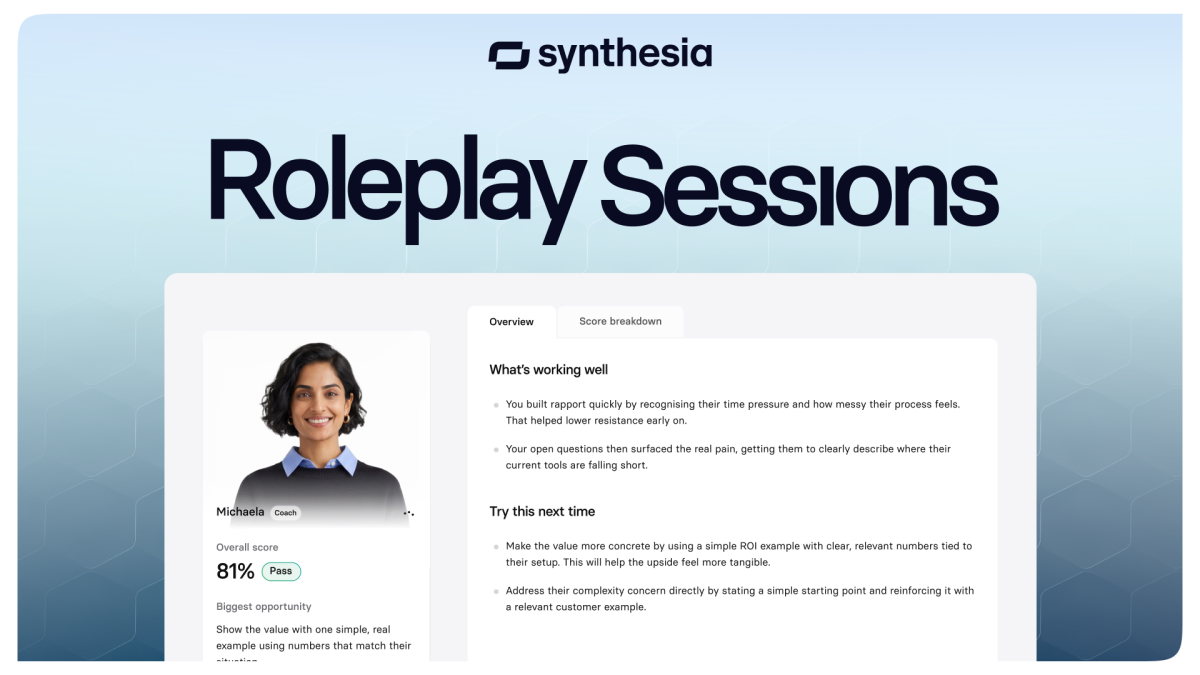
Synthesia is expanding beyond AI-generated training videos with a new product designed to test whether employees can actually apply what they learn. The British startup on Wednesday introduced Roleplay Sessions, an interactive coaching tool that lets workers rehearse difficult workplace conversations with an AI avatar and receive performance feedback, a move that could help enterprise customers measure the business value of AI training more clearly.
The launch marks a strategic shift for the company, which built its reputation on helping businesses produce polished training videos quickly and at lower cost. With Roleplay Sessions, Synthesia is moving into live practice, scoring, and analytics — a broader bet that the next wave of enterprise AI will be judged less by how convincing content looks and more by whether it changes employee behavior.
TechCrunch reported that Roleplay is the first product in a larger Sessions platform that Synthesia intends to expand into additional formats, including job interviews and candidate screening. The company says the product is aimed at organizations that want more than passive instruction and are increasingly asking whether their AI spend leads to measurable improvements on the job.
What is Synthesia’s Roleplay Sessions?
Roleplay Sessions is an AI-based training environment where employees can practice real-world workplace scenarios with a responsive avatar that speaks back, challenges their responses, and then evaluates their performance against a rubric. Instead of watching a video or reading a slide deck, users are placed into an interactive conversation and asked to respond in the moment.
According to Synthesia, the product is designed for situations where practice matters as much as information. Common examples include sales pitches, leadership conversations, performance reviews, and handling customer complaints. In each case, the user is expected to rehearse not just facts, but tone, judgment, and delivery.
The startup says the feedback loop is the core differentiator. The AI does not merely simulate a conversation; it also grades the participant and generates data that managers can use to understand strengths and weaknesses across a team.
How does the product work?
The system combines Synthesia’s proprietary avatar and voice technology with OpenAI’s underlying reasoning capabilities. That setup allows the avatar to behave like a realistic conversation partner while Synthesia layers on its own scoring structure, training framework, and analytics tools.
Users can build training flows themselves or work with Synthesia consultants to create custom programs using internal company documents and context. That makes the product flexible enough for both standardized corporate training and bespoke leadership or sales programs.
In practice, a company could ask employees to rehearse a product demo, a difficult employee conversation, or a complaint resolution scenario. The tool then evaluates how they handled the exchange and aggregates results for broader analysis.
Why is Synthesia moving from video to coaching?
Synthesia is making the shift because enterprise buyers are under more pressure to show that AI systems generate tangible returns, not just impressive demos. The company’s own research readout suggests that traditional training content often informs people without changing what they do afterward. Synthesia argues that active practice, not passive consumption, is what creates durable learning.
That logic mirrors a long-standing principle in workplace education: employees often need repetition, feedback, and correction before a skill becomes routine. By turning training into an interactive exercise, Synthesia is trying to attach its platform to a more measurable outcome than video views or completion rates.
Chief executive and co-founder Victor Riparbelli said the company believes people generally learn better by practicing than by merely reading or watching. He also argued that video beats text-based formats, but still falls short of hands-on rehearsal for many kinds of skills.
Riparbelli said video is more effective than documents or text-heavy training, but that real learning usually comes from practicing a task rather than just consuming information.
That framing matters because it broadens the company’s appeal. Synthesia is no longer positioning itself only as a way to make training content cheaper and faster to produce. It is now pitching itself as a platform that can help organizations improve performance and prove that improvement with data.
How does Roleplay Sessions change Synthesia’s business model?
Roleplay Sessions pushes Synthesia up the stack from content creation into performance management. That distinction could be important in a market where many AI tools can generate a video, but far fewer can show whether the training changed a worker’s behavior or improved a team’s results.
The company’s avatar and voice systems remain proprietary, but the higher-value layer may now be the analytics built on top. By combining training rubrics, performance scoring, and organization-wide reporting, Synthesia is offering a product that can help managers compare outcomes across teams and roles.
Riparbelli said executives are showing strong interest in understanding talent at a granular level, especially in sales organizations. If a company’s entire sales team practices with the tool, managers can use the resulting data to identify patterns in performance and training gaps.
That makes Synthesia’s offering more defensible than a basic video generator. The avatar may still be the visible front end, but the company is increasingly selling a system that creates, measures, and organizes training data.
| Area | Synthesia’s earlier model | Roleplay Sessions model |
|---|---|---|
| Main function | Create AI training videos | Run interactive training conversations |
| User experience | Passive viewing | Active practice with feedback |
| Core value | Speed and lower production cost | Behavior change and measurement |
| Buyer benefit | Content creation efficiency | Performance insights and analytics |
| Likely use cases | Employee education videos | Sales, leadership, interviews, screening |
Who is using it already?
Synthesia says the product is already being used by several early customers with large-scale deployments. A company spokesperson said those users include one of Europe’s three most valuable companies, one of the top five Fortune 100 firms, and one of the world’s largest recruitment companies.
The startup did not identify the customers by name, but the size and profile of the adopters suggest that large enterprises are testing the platform for high-stakes internal training and talent management use cases.
That early traction is significant because it implies the product is not merely experimental. Instead, it appears to be moving into environments where enterprise buyers are willing to invest in tools that can potentially standardize coaching and capture performance data across large workforces.
Which use cases look strongest?
The most common scenarios so far are sales training and leadership development. Those categories make sense because they depend heavily on human judgment, conversation, and response quality — all areas where passive learning often falls short.
Soft skills training is especially well suited to roleplay because the challenge is not memorizing a script. It is learning how to listen, adapt, and respond under pressure. That is exactly the type of behavior AI-guided practice can simulate.
- Practicing a product pitch before a customer meeting
- Rehearsing a performance review with an employee
- Handling a complaint from a dissatisfied customer
- Preparing managers for difficult feedback conversations
- Training recruiters on interview and screening scenarios
What is the bigger market signal?
Synthesia’s new product reflects a broader shift in enterprise AI buying behavior. Early enthusiasm for generative AI was often driven by novelty and presentation value: Could the software produce something fast, polished, and convincing? Increasingly, companies want a different answer: Did it improve outcomes?
That change is especially important in training, where the cost of content production has historically been a barrier. AI lowered that barrier by making videos cheaper and faster to produce. But once the content is easy to generate, the competitive question becomes whether the training actually works.
Synthesia is effectively arguing that the next phase of enterprise AI will reward tools that show proof, not just promise. In that view, the real moat is not the ability to generate a video avatar. It is the ability to collect signals about behavior, track progress, and demonstrate business value.
That approach also aligns with current corporate skepticism about AI budgets. Many companies have deployed generative tools experimentally, but leaders are now more focused on outcomes such as productivity, employee performance, and consistency across teams.
How does this fit into the company’s long-term strategy?
Roleplay Sessions gives Synthesia a pathway into a wider product family that could extend beyond traditional training. The company has said Sessions will grow to include other interactive formats, such as interviews and candidate assessment, which would move it deeper into recruiting and talent operations.
If Synthesia succeeds, it could evolve from a content creation vendor into a broader enterprise learning and assessment platform. That would make the business less dependent on video production demand and more tied to workflow, people analytics, and organizational development.
There is also a commercial advantage in that expansion. Training videos can be copied conceptually by competitors, but a system that embeds itself in a company’s learning processes and performance reviews is harder to replace.
Riparbelli said the company sees strong interest from managers who want a clearer view of talent across the organization and want to measure how teams perform in a more structured way.
The new platform may also open the door to smaller customers. For now, Roleplay is being sold as an enterprise product, but Synthesia expects to widen access to small businesses, prosumers, and possibly schools over the next few months as inference costs continue to decline.
What happens next for Roleplay Sessions?
Synthesia’s near-term goal is to expand the product beyond enterprise accounts and add more interactive training formats. The company appears to believe the economics of AI will keep improving enough to make live coaching cheaper and more widely usable over time.
If that happens, the market for AI training could shift from one-way content delivery to ongoing skill development. Instead of producing a library of videos and leaving employees to absorb them on their own, companies could run repeated practice sessions and compare results over time.
That would be a meaningful evolution for corporate learning software. It would also place Synthesia in a category closer to assessment and workforce intelligence than simple media generation.
For now, the product is still early, and its long-term success will depend on whether large enterprises trust AI scoring enough to incorporate it into training decisions. But the company’s direction is clear: it wants to be measured not by how realistic its avatars look, but by whether its platform helps people get better at their jobs.
Timeline of Synthesia’s enterprise AI shift
| Period | Milestone | Significance |
|---|---|---|
| Previous years | Built a business around AI training videos | Focused on content generation and cost savings |
| Wednesday launch | Introduced Roleplay Sessions | Added interactive coaching and performance scoring |
| Next phase | Expansion into interviews and candidate screening | Moves into talent assessment and hiring workflows |
| Future rollout | Possible access for small businesses and schools | Could broaden market beyond large enterprises |
For Synthesia, the bet is straightforward: if AI can simulate the conversation and evaluate the response, then training stops being a video problem and becomes a behavior problem. That may be where the next real enterprise AI market is heading.
Frequently asked questions
What is Synthesia’s new AI training platform feature?
Synthesia’s new AI training platform feature is Roleplay Sessions, an interactive coaching product that lets employees practice workplace conversations with an AI avatar. The system talks back, challenges responses, and scores performance using a rubric.
Why is Synthesia moving beyond AI training videos?
Synthesia is moving beyond AI training videos because enterprises increasingly want proof that training changes behavior. The company believes active practice and feedback are more effective than passive viewing, and that measurable outcomes are now the real buying priority.
What kinds of training does Roleplay Sessions support?
Roleplay Sessions supports high-stakes conversations such as sales pitches, leadership talks, performance reviews, customer complaints, and other soft-skills scenarios. Synthesia says sales and leadership training are currently the most popular use cases.
Who can use Synthesia’s Roleplay product today?
Synthesia is selling Roleplay Sessions as an enterprise product for now, with several large customers already using it. The company says it may expand the offering to small businesses, prosumers, and educational institutions in the coming months.
How is Synthesia’s product different from other AI trainers?
Synthesia’s product is different because it combines its proprietary avatar and voice technology with scoring, analytics, and training rubrics. That shifts the value from content creation alone to performance measurement and workforce insight.