Updated July 17, 2026 2:56 pm
In short
AMI Labs is still pre-product and betting on world models for robotics and other physical tasks, while its CEO rejects AGI and superintelligence labels and leans into South Korea as a partner-rich base for real-world training.
- AMI Labs says it will not describe its work as AGI or superintelligence.
- The startup is building world models aimed at robotics and other physical systems.
- LeBrun argues current AI is weak in real-world, safety-critical environments.
- South Korea is a key target because of its industrial base and fast AI adoption.
- AMI Labs raised $1.03 billion in March but has not yet launched a product.
Update — July 17, 2026 2:56 pm
LeBrun also said AMI does not use the terms “AGI” or “superintelligence” internally, calling both labels too vague to be useful. He said the industry has simply moved from one buzzword to another without defining any real technical milestone.
He added that AMI still has no product or launch date to share. Instead, the company says it will reveal more only when it is ready.
The updated interview also sharpened AMI’s Asia focus: LeBrun said the company wants partners that can help it train on real-world environments, and he singled out South Korea’s mix of robotics, chips and manufacturing as well as its fast adoption culture as key reasons for building there from day one.
Update — July 16, 2026 5:56 pm
LeBrun was in Seoul for the International Conference on Machine Learning while scouting industrial partners, global companies and researchers, and he said AMI’s push into Asia is being driven in part by Korea’s advanced robotics, semiconductor and manufacturing base.
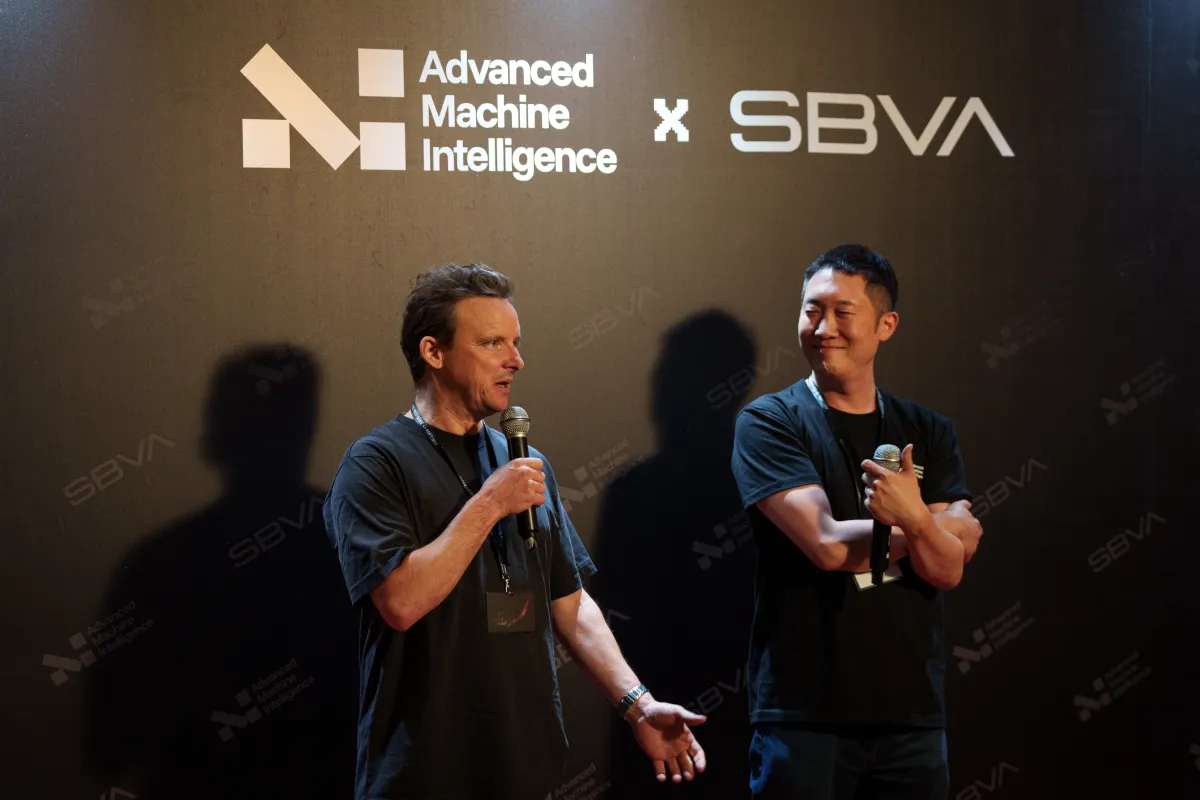
He also pointed to South Korea’s AI spending plans as a reason for the company’s interest, saying the country combines a deep hardware ecosystem with a fast appetite for adopting new tools. One of AMI’s Asian backers, SBVA CEO JP Lee, said he has been urging LeBrun and the team to come to Korea from the start.
LeBrun added that AMI still has no product or launch timeline, saying only that the company will reveal it when it is ready.
AMI Labs CEO Alexandre LeBrun is refusing to join the AI industry’s latest branding arms race, saying the startup he leads will not describe its technology as “AGI” or “superintelligence.” The company is instead focusing on world models for robots, factories and other physical systems, a strategy LeBrun argues is more practical for the real world and more useful than vague labels.
The comments, made during a TechCrunch interview in Seoul last week, come as AMI Labs prepares to build partnerships in Asia while staying pre-product after a massive $1.03 billion funding round earlier this year. The startup’s wager is that the next major AI breakthrough will not come from language alone, but from systems that understand physics, context and action in the physical world.
Why AMI Labs is avoiding “AGI” and “superintelligence”
AMI Labs is avoiding those terms because, according to LeBrun, they are imprecise, overused and increasingly disconnected from what AI companies are actually building. He said the firm has never used “AGI” internally and has little interest in replacing it with “superintelligence,” which he views as equally vague.
LeBrun’s skepticism reflects a broader shift in AI messaging. As some companies move away from the once-dominant AGI label, others have begun to use superintelligence as a more dramatic shorthand for systems they believe will surpass human capability. AMI’s chief executive says that simply changes the marketing language without solving the underlying problem: the terms still do not define concrete technical milestones.
LeBrun said the industry has repeatedly swapped one grand label for another, arguing that “superintelligence” is not clearly defined and is therefore not a very useful word for describing real progress.
That position is notable because AMI Labs sits close to the center of the AI debate. The company was co-founded by Yann LeCun, the Turing Award-winning computer scientist and one of the field’s most influential voices, after his departure from Meta. Even so, AMI is taking a markedly grounded public stance: less prophecy, more engineering.
What is a world model, and how is it different from an LLM?
A world model is an AI system designed to understand how the physical world changes over time, rather than just how language flows from one word to the next. LeBrun summarized the distinction simply: an LLM predicts the next token, while a world model predicts the next state of the world.
That distinction matters in practice. If a glass is nudged off a table, a world model should be able to infer what happens next — it tips, falls and spills. In LeBrun’s view, that kind of physical intuition is what current generative systems still lack.
He was careful not to frame the two approaches as rivals. Instead, he described them as complementary. LLMs remain the best tools for language-heavy tasks, he said, while world models are intended to provide context, physical grounding and environmental awareness.
That framing echoes a larger debate in AI research about whether language models alone can get to human-like intelligence or whether systems need a richer internal representation of the world. AMI is betting on the latter for applications that go beyond chat and into action.
How world models could change robotics
World models could matter most in robotics because robots operate in spaces where the laws of physics, safety and context all matter at once. LeBrun argued that today’s robots often execute fixed routines and remain effectively static, which makes them reliable only in tightly controlled environments.
In a factory setting, repetitive motion is enough for many tasks. But once a robot moves into a home, a street or a public venue, the requirements change dramatically. It must understand people, objects, distance, movement and risk in real time.
That is where LeBrun says current systems fall short. He called robots unsafe today because they do not yet have a robust way to understand context or prevent harmful actions when conditions change unexpectedly.
His example was vivid: a robot performing for a crowd may appear impressive, but without proper awareness it could misread the scene and cause injury. To LeBrun, that is not a fringe concern. It is the core reason why physical AI still has a long way to go before it can be deployed widely.
Why context matters more than motion
Context is the difference between a machine repeating a move and a machine recognizing when not to perform that move. LeBrun’s argument is that the next generation of robotics needs situational judgment, not just mechanical precision.
That is also why he thinks the hardware progress of the past few months, while impressive, is only part of the story. Robots may have better motors, sensors and bodies, but LeBrun said they still lack a “brain” capable of interpreting the environment in a safe and flexible way.
- Current robots excel at repetition in structured settings.
- Open environments introduce safety, perception and planning challenges.
- World models aim to add environmental understanding.
- AMI Labs sees this as essential for practical robotics deployment.
Why healthcare is part of the same argument
Healthcare is another sector where LeBrun believes real-world experience matters more than text-based reasoning alone. He previously founded Nabla, an AI health startup, and used that background to draw a comparison between AI systems and doctors.
In his view, an LLM is like a physician who has studied books but never completed a residency. That kind of knowledge can be useful, but it is incomplete. Medicine depends on practice, observation and judgment developed in actual clinical settings.
LeBrun suggested that LLMs may cover only a small slice of healthcare use cases, with the rest relying on grounding in the real world. That is one reason AMI’s interest extends beyond robotics and into any application that involves physical interaction, uncertainty and consequence.
The core message is consistent: language is powerful, but it does not fully substitute for embodied experience.
What is AMI Labs trying to build now?
AMI Labs is trying to develop world models that can be trained on real environments, not just simulations or abstract datasets. LeBrun said that doing so requires access to the physical world and close collaboration with companies that already operate in it.
That makes the startup’s current phase especially important. Because AMI is still pre-product, it is not yet selling software or hardware to the market. Instead, it is seeking industrial partners and research relationships that can supply data, environments and use cases for training.
LeBrun said the startup needs access to real-world settings and that partnerships make that easier. The company’s target customers and collaborators include robotics firms, electronics makers and manufacturers — industries where AI can be tested against physical constraints rather than benchmark scores.
This is a longer-term bet than the consumer-facing AI products dominating much of the market today. It is also a harder one, because progress in the physical world is slower, messier and more expensive than release cycles for chatbots or productivity tools.
Why Korea and Asia matter to AMI Labs
Korea matters to AMI Labs because it combines deep industrial capacity with fast adoption of new technology. LeBrun was in Seoul last week for the International Conference on Machine Learning, where he was also looking for local partners across robotics, semiconductors and manufacturing.
He said he is drawn to the country for two reasons. First, Korea already has the advanced industrial base needed to make physical AI relevant. Second, it has a track record of moving quickly when new technology arrives. In LeBrun’s telling, that combination is rare.
He pointed to Korea’s historical role as a rapid adopter of the internet as evidence that the market can embrace major technological change early. He also said the government’s support for AI and related infrastructure adds momentum to that trend.
SBVA chief executive JP Lee, one of AMI’s Asian backers, said he had been urging LeBrun and the team to spend more time in Korea, where he sees strong reasons for the company to build early partnerships.
Lee said Korea has already made serious investments in sovereign language models and should now continue funding physical AI as well. He pointed to the country’s June plan to mobilize roughly $880 billion for chips, AI data centers and physical AI as a sign that the strategy is broadening rather than narrowing.
His view is that language AI and physical AI are not mutually exclusive. One may power general-purpose digital tasks, while the other helps machines interact safely with the real world.
What does Korea offer beyond hardware?
Korea offers more than factories and chip fabrication. LeBrun and Lee both emphasized the country’s dense network of developers, early adopters and technology companies that can help new tools spread quickly.
That matters because adoption is not just about supply chains. It is also about whether software teams, industrial operators and consumers are willing to test and integrate new systems. In Korea, AMI sees a market where those groups often move faster than in many larger economies.
Lee also noted that the country’s digital ecosystem has already produced major local players like Naver and Kakao, which suggests an environment capable of supporting homegrown innovation as well as imported technology.
How much money has AMI raised?
AMI Labs raised $1.03 billion in March at a $3.5 billion pre-money valuation, one of the largest early-stage funding rounds in recent memory. The size of the raise highlights how much investor interest continues to cluster around AI infrastructure, foundation models and next-generation research bets.
But unlike many heavily funded AI startups, AMI still has no product to show. That makes the company unusual even by current standards. The capital gives it time, but it does not yet provide proof that the world model approach will translate into commercial deployment.
LeBrun declined to commit to a product launch timeline, saying only that the company would reveal its work when ready. In effect, AMI is asking the market to wait while it tries to solve a problem that most AI products have largely sidestepped: how to make machines understand the world, not just talk about it.
| Key item | Details |
|---|---|
| Company | AMI Labs |
| CEO | Alexandre LeBrun |
| Co-founder | Yann LeCun |
| Funding raised | $1.03 billion |
| Pre-money valuation | $3.5 billion |
| Current status | Pre-product |
| Primary focus | World models for robotics and physical AI |
| Location of recent outreach | Seoul, South Korea |
Timeline: How AMI Labs’ story has unfolded
AMI Labs’ public story is still short, but it already spans a few major milestones. The following timeline captures the company’s recent trajectory and where it stands now.
- After leaving Meta: Yann LeCun co-founds AMI Labs to pursue world-model research.
- March 2026: The startup raises $1.03 billion at a $3.5 billion pre-money valuation.
- July 2026: LeBrun travels to Seoul to court partners in robotics, manufacturing and semiconductors.
- Now: AMI remains pre-product while it builds toward physical AI applications.
What this says about the AI race
AMI Labs’ stance reveals a quiet divide in the AI industry. On one side are companies chasing scale, language fluency and ever-larger model capabilities. On the other are researchers and startups trying to determine how AI will move beyond screens and into the physical world.
LeBrun’s refusal to use the terms “AGI” and “superintelligence” is more than a branding choice. It signals a preference for measurable progress over speculative claims, and for industrial usefulness over abstract competition. For a company that has not yet launched a product, that restraint may be a way of managing expectations. It may also be a signal to partners that AMI wants to be judged by what it can build, not by what it can promise.
The broader implication is that the AI market may be entering a second phase. The first wave was about language, search and content generation. The next may be about systems that can handle uncertainty, safety and physical action in the environments where people actually live and work.
If that shift happens, the winners may not be the companies making the loudest claims about intelligence. They may be the ones quietly solving the problem of context.
What comes next for AMI Labs?
For now, the answer is simple: partnerships, research and patience. AMI is building behind the scenes and appears in no rush to announce a product before it believes the technology is ready.
That patience may frustrate observers who expect public demos or release dates, especially after a funding round of this size. But it is also consistent with LeBrun’s broader message. In physical AI, he argues, the real world is the test, and that test cannot be rushed by hype alone.
Whether Korea becomes a launchpad for AMI’s next phase remains to be seen. What is already clear is that LeBrun wants the company to be judged not by the labels it avoids, but by the systems it eventually manages to bring into the world.
Bottom line: AMI Labs is betting that the future of advanced AI lies not in calling something AGI, but in building practical world models that can help robots, factories and other physical systems understand their surroundings safely.
Key facts at a glance
| Topic | Summary |
|---|---|
| Core claim | AMI Labs rejects AGI and superintelligence labels |
| Technical focus | World models for physical environments |
| Main use cases | Robotics, manufacturing, electronics, healthcare |
| Investor support | Backed by major funding and Asian investors |
| Strategic region | South Korea and broader Asia |
Frequently asked questions
What is AMI Labs building?
AMI Labs is building world models, which are AI systems designed to understand how the physical world changes over time. The company says that approach is better suited than language-only systems for robotics, manufacturing and other real-world applications.
Why won’t AMI Labs call its AI AGI or superintelligence?
AMI Labs avoids those terms because CEO Alexandre LeBrun считает them vague and poorly defined. He says the labels do not meaningfully describe technical progress and tend to shift as the industry searches for the next catchy phrase.
How much funding has AMI Labs raised?
AMI Labs raised $1.03 billion in March at a $3.5 billion pre-money valuation. The large round gives the pre-product company time to develop its technology, but it has not yet announced a commercial launch.
Why is South Korea important to AMI Labs?
South Korea is important because it combines advanced robotics, semiconductor and manufacturing industries with a strong record of fast technology adoption. LeBrun says that makes it a strong place to find partners and test physical AI in real settings.
How are world models different from large language models?
World models are different because they predict the next state of the physical world, while large language models predict the next token in a sequence. AMI Labs says the two are complementary, with LLMs handling language and world models adding context and physical understanding.