In short
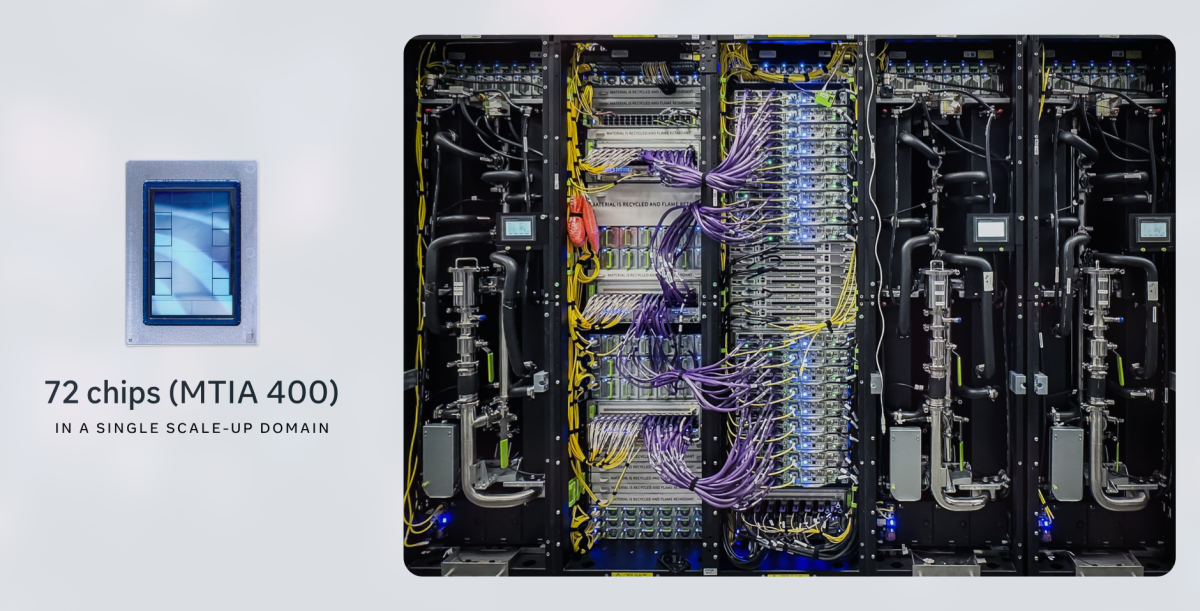
Meta plans to start production of its latest custom AI chips in September as it tries to lower GPU costs and expand AI infrastructure. The move is part of a broader industry push toward in-house silicon.
- Meta is expected to begin production of its latest MTIA AI chips in September.
- The chips are meant to reduce reliance on expensive Nvidia and AMD GPUs.
- Broadcom is helping design the chips, while TSMC will manufacture them.
- Meta is still spending heavily on AI infrastructure, with capex projected at up to $145 billion.
- The move reflects a wider trend among big AI companies to build custom silicon.
Meta is preparing to begin production of its latest in-house AI chips in September, a move designed to reduce its dependence on expensive Nvidia and AMD GPUs as the company races to secure more computing power for artificial intelligence. The production timeline, reported from an internal memo, underscores how urgently Meta is trying to control costs during a severe industry-wide shortage of advanced chip components.
The new chips are part of Meta’s Meta Training and Inference Accelerator, or MTIA, program, which the company says is built around a modular design that can be updated more quickly as AI workloads evolve. One of the chips has already cleared testing in roughly six weeks, according to the memo, an unusually fast turnaround that suggests Meta is pushing to move from design to deployment at high speed.
The timing matters because Meta is spending heavily across data centers, power infrastructure, and chip supply contracts to support its artificial intelligence ambitions. Even as it develops custom silicon, the company still expects to buy large volumes of chips from outside suppliers. But the shift toward more specialized hardware signals a broader industry trend: the biggest AI companies are no longer content to rely entirely on general-purpose GPUs.
Why Meta is building more of its own AI hardware
Meta’s main reason for building custom chips is cost control. Advanced GPUs remain the backbone of modern AI development, but they are also among the most expensive and hardest-to-source components in the market. By designing chips tailored to its own workloads, Meta hopes to reduce the amount it spends on external processors while improving efficiency for specific tasks.
That strategy has become more important as the company’s AI ambitions have expanded. Meta uses large-scale computing not only to train models, but also to run ranking systems, recommendation engines, and inference workloads across its apps. Those services touch billions of users, making even small efficiency gains potentially valuable at enormous scale.
Meta has been producing its own AI chips since 2023, but the latest version appears to reflect a more mature and more aggressive approach. Rather than building one fixed design for years at a time, the company is using a modular architecture that can incorporate newer chiplets and hardware ideas faster.
Meta said earlier this year that each new generation of its MTIA chips will build on the last by using modular chiplets, pulling in the latest insights from AI workloads, and moving on a shorter development cycle.
That cadence matters in a field where the most useful hardware can become outdated quickly. AI model sizes, inference patterns, and memory needs are changing rapidly, and chip designers are trying to keep up by shortening product cycles and making systems easier to reconfigure.
How Meta’s new chip production plan works
Meta’s new chips are being developed with Broadcom, but manufacturing will be handled by Taiwan Semiconductor Manufacturing Co., the world’s largest contract chipmaker. The company is also sourcing key components from several major suppliers, including Samsung for memory, SanDisk for storage, and Sumitomo Electric for fiber optic equipment, according to Reuters’ report.
That supply chain is a reminder that “in-house” AI chips are rarely truly made in house. Instead, the major cloud and platform companies often act as system architects, coordinating a broad network of specialized partners across design, fabrication, memory, networking, and storage.
The internal memo reported by Reuters indicated that at least one chip passed testing in about six weeks, a sign that Meta’s design and validation process is moving rapidly. If the production schedule holds, the company will be able to begin manufacturing the newest MTIA chips in September, with the expectation that they can be deployed across various AI workloads over time.
Meta has said some of the chips announced in March are already in use or will be deployed this year or next, which suggests the company is trying to build a multi-generation pipeline rather than betting on a single hardware family. That approach gives Meta more flexibility if its AI priorities shift or if certain workloads prove better suited to a different kind of accelerator.
What the MTIA chips are designed to do
The MTIA chips are intended for several distinct jobs inside Meta’s AI stack:
- training ranking and recommendation systems
- running broader AI workloads
- performing inference for Meta’s consumer applications
- supporting internal efficiency in large-scale model deployment
Inference, in particular, has become a major focus across the AI industry. While training grabs headlines because it requires enormous compute bursts, inference can generate equally large long-term bills when products are used by millions or billions of people every day. That makes custom inference silicon strategically important for companies that operate at Meta’s scale.
How much is Meta spending on AI infrastructure?
Meta is spending tens of billions of dollars to build the computing base it needs for AI, and its capital budget reflects that urgency. In April, the company said it expected capital expenditures of between $125 billion and $145 billion for the year, with a large share of that money flowing into AI infrastructure.
The company has also been negotiating data center and power deals around the world as it races to expand its capacity. Reuters reported that Meta plans to deploy 7 gigawatts of compute this year and double that figure next year, a scale that illustrates just how central infrastructure has become to the company’s AI strategy.
That spending is not limited to hardware purchases. It includes real estate, power agreements, networking gear, and the broader build-out needed to keep AI systems supplied with energy and cooling. In practice, the competition for AI dominance has become a competition for electricity, land, chips, and fabrication slots as much as it is about software or models.
| Key item | Details |
|---|---|
| Production start | September, according to an internal memo reported by Reuters |
| Chip program | Meta Training and Inference Accelerator (MTIA) |
| Manufacturing partner | TSMC |
| Design partner | Broadcom |
| Other suppliers | Samsung, SanDisk, Sumitomo Electric |
| 2026 capital spending | $125 billion to $145 billion |
| Compute deployment target | 7 gigawatts this year, doubling next year |
Why the chip shortage is shaping Meta’s strategy
The global shortage of advanced AI components is pushing companies to rethink how they source computing power. Even firms with enormous cash reserves can find themselves constrained by fabrication capacity, packaging bottlenecks, memory availability, and power infrastructure limits. Meta’s move to accelerate chip production is partly a response to those pressures.
Custom silicon does not eliminate dependence on the semiconductor supply chain, but it can change the economics of AI deployment. A custom chip tuned to a company’s own workloads may not outperform the best GPU on every task, but it can often offer better efficiency for a narrower use case. That matters when a company is running recommendation systems and inference at enormous scale.
Meta is also trying to diversify its hardware bets. While it wants MTIA chips to absorb some of the load, the company still expects to spend heavily with Nvidia and AMD. In other words, custom chips are a complement to external purchases, not a full replacement.
What Meta has already lined up
Meta’s broader hardware strategy now includes several major supplier relationships:
- a prior agreement with ARM to secure compute for recommendation systems
- a multibillion-dollar arrangement with AMD for Instinct GPUs
- a multibillion-dollar deal with Amazon to use the cloud company’s custom CPUs for AI-related workloads
Those relationships show that Meta is building resilience across multiple chip families and providers. By spreading its bets, the company can reduce exposure to shortages, delays, or pricing pressure from any single supplier.
How Meta compares with other AI giants
Meta is not alone in trying to gain more control over the hardware that powers AI. The biggest technology companies increasingly see custom chips as a way to lower costs, improve performance for specific workloads, and reduce dependence on a market dominated by Nvidia.
OpenAI recently unveiled an inference processor it is building with Broadcom. Anthropic is reportedly exploring a chip effort with Samsung. Amazon and Google already design and deploy their own chips for training and inference, and a growing cluster of startups is trying to serve the same fast-expanding market.
This shift is a sign that AI infrastructure has entered a more industrial phase. Early competition centered on who could build the strongest models. The next phase may be defined just as much by who can own the most efficient compute stack at the lowest possible cost.
Why Nvidia still matters
Even with custom chips on the rise, Nvidia remains central to the AI ecosystem. Its GPUs are still the default choice for many training and inference workloads, and Meta is not suggesting otherwise. The company’s strategy is to reduce its reliance on Nvidia where possible, not to abandon it.
That reflects the reality of the market. The demand for AI compute is growing so quickly that even companies building their own silicon still need large amounts of third-party hardware. Custom chips are an optimization layer, not a complete escape hatch.
What this means for Meta’s AI future
Meta’s latest chip push reveals a company trying to build a long-term foundation for AI rather than relying on the existing GPU supply chain alone. The September production target suggests the company is moving from planning into execution on a faster cycle than many competitors, even as the hardware landscape continues to shift.
If the chips work as intended, Meta could improve efficiency across its recommendation engines, model training pipelines, and inference systems. That would not only help contain costs but could also give the company more freedom to scale new AI products without being entirely beholden to external chip prices or availability.
At a broader level, the move highlights how AI competition is becoming a battle over infrastructure. The companies that can secure power, fabrication capacity, memory, and networking equipment may be the ones best positioned to deploy the next generation of AI services.
For Meta, the stakes are especially high. The company is spending heavily, expanding compute capacity aggressively, and trying to support a growing portfolio of AI models and product features. Custom chips are now a central part of that plan, and September may mark the point when the strategy moves from design theory into large-scale production.
Timeline of Meta’s AI chip effort
| Period | Development |
|---|---|
| 2023 | Meta begins producing its own AI chips |
| March 2026 | Meta publicly details four new MTIA chips |
| April 2026 | Meta says capex will reach $125 billion to $145 billion |
| July 2026 | Reuters reports production is set to begin in September |
| 2026 onward | Some MTIA chips are expected to be deployed this year or next |
As AI spending continues to rise, Meta’s chip strategy offers a glimpse of where the industry is heading: toward vertically integrated systems designed not just to build models, but to sustain them at massive scale.
Frequently asked questions
When will Meta’s new AI chips go into production?
Meta’s newest AI chips are expected to begin production in September, according to a Reuters report based on an internal memo. The chips are part of the company’s MTIA program and are meant to help support training, inference, and recommendation workloads.
Why is Meta building its own AI chips?
Meta is building custom chips to lower its dependence on costly GPUs from Nvidia and AMD, improve efficiency for its own workloads, and gain more control over supply during a severe component shortage. The chips are designed to better match Meta’s ranking, recommendation, and inference needs.
Who is manufacturing Meta’s AI chips?
Meta is working with Broadcom on the design, while Taiwan Semiconductor Manufacturing Co. will handle fabrication. Meta is also sourcing memory from Samsung, storage from SanDisk, and fiber optic equipment from Sumitomo Electric.
Will Meta stop buying Nvidia chips if its own chips succeed?
No, Meta still expects to spend heavily on external chips. Its custom MTIA processors are intended to reduce costs and diversify supply, but they are not a full replacement for Nvidia or AMD hardware.
How much is Meta spending on AI infrastructure?
Meta said in April that it expects capital expenditures of between $125 billion and $145 billion this year. Reuters also reported that the company plans to deploy 7 gigawatts of compute this year and double that next year.