In short
SpaceX’s huge stock-market debut has sparked concern among Americans who say their retirement savings are becoming too dependent on tech giants and AI-fueled market optimism. Many see the trend as both a financial risk and a sign of growing inequality.
- SpaceX’s IPO intensified fears that 401(k)s and index funds are becoming too exposed to tech giants.
- Many readers said they feel forced into market risk rather than freely choosing it.
- Some respondents welcomed the company’s innovation but still worried about wealth concentration.
- The debate reflects wider unease about AI hype, valuation risk and retirement security.
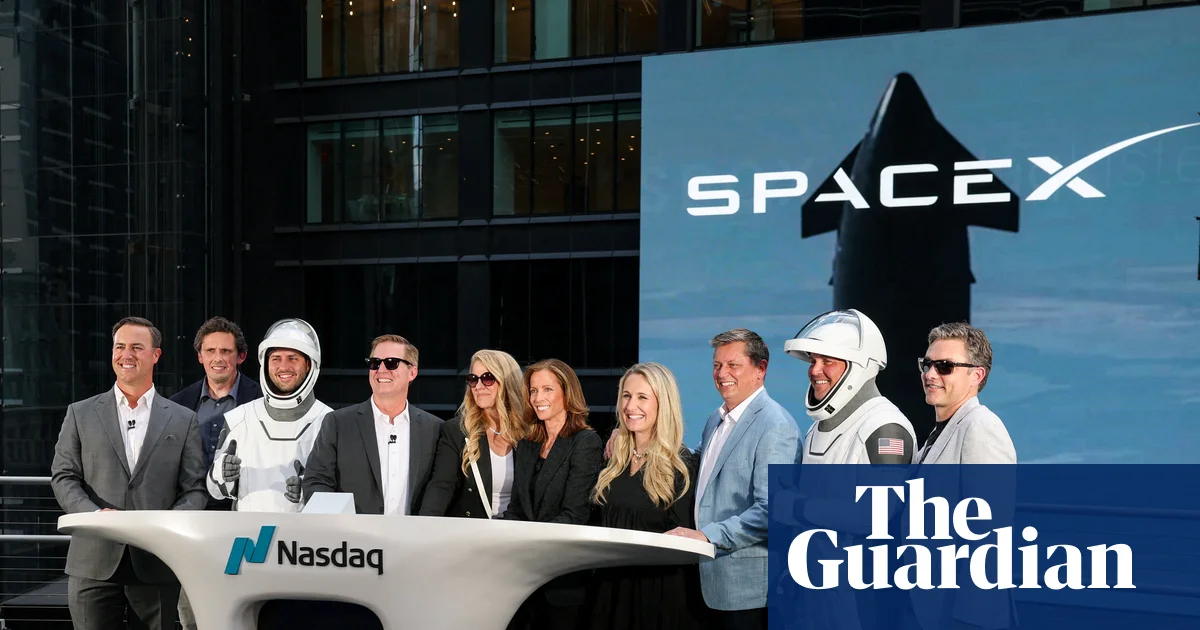
SpaceX’s blockbuster stock-market debut has done more than mint Elon Musk as the world’s first trillionaire. It has also reignited a deeply American anxiety: whether ordinary workers’ retirement money is being pulled into a market shaped by a handful of ultra-powerful technology firms, soaring valuations and a boom that many say feels increasingly detached from reality.
In responses gathered by The Guardian from more than 150 readers across the United States, the dominant mood was not celebration. Instead, many described the SpaceX listing as a warning sign that the country’s retirement system — especially 401(k) plans and index-fund investing — is becoming more exposed to the fortunes of a narrow group of companies and executives. For critics, the issue is not just financial risk. It is also about power, fairness and whether workers have any meaningful choice in how their long-term savings are invested.
The concerns come at a moment when US markets are leaning more heavily toward artificial intelligence and the companies building the chips, software and infrastructure that support it. Because many retirement savers are funneled into broad index funds, people who never intended to buy shares in SpaceX or similar firms may nonetheless end up with indirect exposure as those companies enter major benchmarks and retirement portfolios.
That prospect has prompted a wave of frustration, with some Americans saying they feel forced into what one respondent called a “casino” that they never agreed to enter.
Why SpaceX’s public listing matters beyond Silicon Valley
The SpaceX IPO is important not only because of the company’s size, but because of what it represents: a deepening overlap between private technology empires and public retirement systems. When a company with enormous brand recognition and investor demand enters the stock market at a huge valuation, it can quickly become part of the machinery that powers index funds, pension portfolios and 401(k) accounts.
That matters because many workers in the US do not actively manage their retirement savings. Instead, their money is automatically placed into funds that track the S&P 500 or other major benchmarks. These funds are widely marketed as low-cost, diversified and practical. But as the market becomes more concentrated in a small group of giant firms, even passive investing can become a form of forced exposure to the same companies critics worry about most.
SpaceX’s market entry also coincides with a larger shift toward AI-driven investment enthusiasm. Investors have poured money into companies associated with generative AI, data centers, semiconductors and automation. Supporters see the trend as the start of a new industrial cycle. Skeptics see a bubble that could leave retirement savers carrying the downside if expectations do not match reality.
Retirement money, passive investing and the fear of no escape
One of the most repeated themes in the reader responses was the sense that there is no clean way out. Many Americans have retirement money locked into employer-sponsored plans, and those accounts are often invested in index funds that mirror the broader stock market. For people who do not have access to large inherited fortunes or sophisticated financial advice, that system can feel unavoidable.
A 62-year-old engineer in Alameda, California, argued that the structure of modern investing leaves ordinary people with little real choice.
He said he felt the country had been pushed into a giant speculative arena, and that his own retirement savings are tied to the S&P 500 largely because avoiding the market can mean falling behind everyone else.
His point highlights a broader tension in the US retirement model: savers are told to build wealth through the market, yet the market increasingly rewards a small number of companies whose growth can dominate index returns. That leaves workers with exposure to firms they may distrust or actively oppose.
A 33-year-old engineer in Michigan made a similar argument, saying the valuation attached to SpaceX felt wildly disconnected from the company’s actual fundamentals. He expressed anger that his retirement funds are linked so closely to technology firms that, in his view, are not sufficiently accountable to the public or to shareholders.
For many readers, that lack of accountability is part of the problem. The concern is not simply that tech companies are large. It is that they can shape labor markets, consumer behavior, public discourse and investment outcomes while remaining insulated from the consequences faced by ordinary workers.
A moral as well as financial backlash
Several respondents said their unease goes beyond portfolio performance. They see the SpaceX listing as another example of extreme wealth accumulation in a system where the gains are privatized while the risks are socialized through retirement accounts, pensions and broader market dependence.
A professor in eastern Washington, who said he is within a decade of retirement, described anxiety about both his own financial security and the growing influence of tech founders. He said he felt alarmed by corporate consolidation and by leaders he sees as lacking accountability or ethical grounding.
Another respondent, a 54-year-old climate activist and mother in Portsmouth, New Hampshire, said she views the situation as a symptom of a broader moral failure in the economy. In her view, the system allows a small number of people to become vastly richer while many workers struggle to afford basics such as food and healthcare. She argued that this kind of imbalance could eventually provoke wider social unrest if more people decide the system no longer works for them.
The sentiment was echoed by a writer in Washington, DC, who said she has chosen not to invest in the stock market at all because she sees it as a game designed to benefit wealthy insiders. She criticized the idea that Americans’ life savings should be routed through retirement accounts that, in her view, are too exposed to speculation and to grand ambitions such as planetary colonization.
That respondent argued that the same resources used to fund Mars ambitions could instead be applied to urgent problems on Earth, including environmental repair. Her comments reflect a broader skepticism among some Americans who believe the technology elite are investing in spectacle while daily hardships remain unresolved.
The SpaceX effect and the concentration of market power
SpaceX is not just another public company in a crowded market. Its scale, profile and association with Musk give it an outsized symbolic role in the current debate over who benefits from modern capitalism. When a company reaches a valuation in the trillions, its market weight can become large enough to influence index performance, retirement outcomes and broader investor sentiment.
That concentration worries people who already believe Wall Street has drifted too far from the interests of average workers. The fear is that the retirement system, which was designed to help people build long-term security, is increasingly tied to firms whose value depends on speculative optimism, massive capital spending and the personal brand of a few influential executives.
One retired businessman in Denver said he has taken the unusual step of divesting from index funds altogether. In his view, widespread withdrawal from these products would send a signal that markets cannot keep expanding upward while ordinary savers are expected to absorb the risk without meaningful control.
Another respondent, an architect in Connecticut, said he is responding by trying to diversify more aggressively. He described SpaceX’s listing as too large for one company — or one person — to dominate in such a way and said he is increasingly uneasy about tying his financial future to a narrow set of high-growth firms.
Support for innovation, but not blind faith in valuations
Not everyone who spoke to The Guardian was uniformly hostile to SpaceX or the wider AI and space sectors. Some respondents acknowledged that the company has achieved real technical milestones and that its success reflects genuine innovation. But even those people often paired admiration with concern about the distribution of power and wealth.
A Brooklyn-based political scientist said he has mixed feelings about the IPO. He credited SpaceX with changing the space industry and said similar breakthroughs can be seen in artificial intelligence. At the same time, he warned that the rapid accumulation of wealth and influence in the hands of a few firms and founders is troubling.
He said the technological achievements are hard to dismiss, but that the growing concentration of control among a small number of companies and billionaires leaves him deeply uneasy.
That split opinion may be the most revealing part of the response. Many Americans are not rejecting innovation itself. They are questioning whether the current financial model allows the public to share in the upside without being trapped in the downside.
How 401(k) plans can magnify the problem
To understand why SpaceX’s listing has caused such anxiety, it helps to look at how retirement investing works in the US.
For decades, employer-sponsored retirement plans have shifted risk away from companies and onto workers. Instead of guaranteed pensions, many employees now rely on 401(k) plans, where investment performance determines retirement security. Because millions of savers choose low-cost index funds, those funds have become central to the system.
That model has benefits. Passive funds reduce fees and offer broad market exposure. But they also make investors passengers rather than drivers. As a result, when the market becomes more concentrated in technology giants, those companies can take on an outsized role in the retirement future of millions of people.
In practice, that means retirement savings can become a vote of confidence in business models, leadership styles and technological directions that savers may not support. It also means that if market sentiment turns, workers may face losses from developments far beyond their control.
Why concentration matters
Market concentration can amplify both gains and losses. When a small number of companies drive a large share of index returns, retirement savers become more dependent on their continued success. If those companies run into regulatory trouble, competitive pressures or a correction in sentiment, the impact can spread through portfolios that appear diversified on paper.
That is part of the unease around the AI boom. Even if the technology proves transformative, the path from promise to profit may be uneven. The more retirement money tracks those expectations, the more workers are exposed to the same cycle of euphoria and correction that has characterized past investment manias.
A snapshot of the concerns
The reader responses collected by The Guardian reflect a broad set of worries. Some are practical. Others are ethical. Many are both. The table below summarizes the main themes.
| Theme | What readers said | Why it matters |
|---|---|---|
| Retirement exposure | 401(k)s and index funds leave little room to avoid tech giants | Millions may own SpaceX indirectly without choosing to |
| Valuation concerns | Some readers called the company’s price tag disconnected from reality | A stretched valuation can increase the risk of future losses |
| Wealth concentration | Several respondents objected to so much power accruing to one founder and a small group of firms | Market influence can shape both wealth distribution and public policy |
| Moral objections | Some said the system rewards rich executives while workers struggle | Retirement investing becomes a proxy for broader inequality |
| Diversification response | A few readers said they are moving money away from index funds or reducing exposure | Investors are seeking ways to limit dependence on tech-heavy portfolios |
What the debate says about the state of US capitalism
The reactions to SpaceX’s listing are also a referendum on the structure of American capitalism itself. For many workers, retirement investing has become inseparable from the stock market. Yet the stock market is increasingly dominated by firms that are privately influential, politically powerful and sometimes culturally polarizing.
This creates a contradiction. Workers are told to trust the market as the best path to retirement security, but the market often rewards the very forces they fear are destabilizing the economy. Tech companies can bring innovation, productivity and new industries. They can also concentrate wealth, widen social divides and magnify financial volatility.
That contradiction helps explain why even people who have benefited from the market are now asking whether the system is fair. The problem is not just whether SpaceX can grow. It is whether the structure of retirement savings gives ordinary Americans any meaningful say in how much of their future depends on the ambitions of a few dominant firms.
What comes next for investors and savers
The coming months will likely determine whether SpaceX’s market debut becomes a durable success story or another flashpoint in the argument over tech valuation and retirement security. If the company performs strongly, it could reinforce the idea that the AI and space sectors deserve ever-larger capital flows. If it stumbles, it may intensify criticism of frothy valuations and the risks of concentrating retirement money in a narrow set of growth stocks.
For savers, the episode is already prompting some practical responses.
- Some are reviewing how much of their retirement money sits in index funds heavily exposed to large technology companies.
- Others are increasing diversification across sectors, geographies and asset classes.
- A smaller number are opting out of market investing altogether, despite the long-term risks of doing so.
- Many are simply feeling trapped between the need to invest and the fear of what their investments now support.
That tension may prove more durable than any single IPO. Even if SpaceX’s valuation changes over time, the deeper question remains: should retirement security depend so heavily on a market increasingly shaped by a small group of founders, platforms and AI-driven firms?
The bigger picture: technology, retirement and trust
At its core, the backlash is about trust. Americans are being asked to trust markets, institutions and companies that have grown enormous while often becoming more opaque. They are being asked to trust that the gains from innovation will be broad enough to justify the risks. And they are being asked to trust that their retirement funds can withstand the same volatility that makes tech stocks so attractive in the first place.
For many readers, that trust is wearing thin. Their message is not that innovation should stop, or that every space mission and AI project is a bad idea. It is that a system in which ordinary people are compelled to underwrite the fortunes of a few giant companies deserves much closer scrutiny.
The SpaceX IPO may have created a new level of wealth for Musk and a milestone for the company. But it has also become a mirror for American anxieties about inequality, dependence and the future of retirement itself.
And for a growing number of workers, that future looks less like prudent investing and more like a gamble they never agreed to make.
Timeline of the SpaceX retirement debate
| Date/Period | Event | Significance |
|---|---|---|
| Before the IPO | SpaceX builds its reputation as a dominant private space company | Investor anticipation grows around a public listing |
| IPO week | SpaceX debuts on the stock market at a valuation of $1.77tn | Musk becomes the world’s first trillionaire |
| Immediately after listing | Readers across the US voice concerns about retirement exposure | Public debate shifts to pensions, index funds and inequality |
| Ongoing | AI investment continues to reshape US markets | Retirement portfolios become more tied to tech concentration |
The next question is whether those concerns remain a niche backlash or become part of a much larger political and financial conversation about how Americans save for old age — and who gets to profit from that savings.