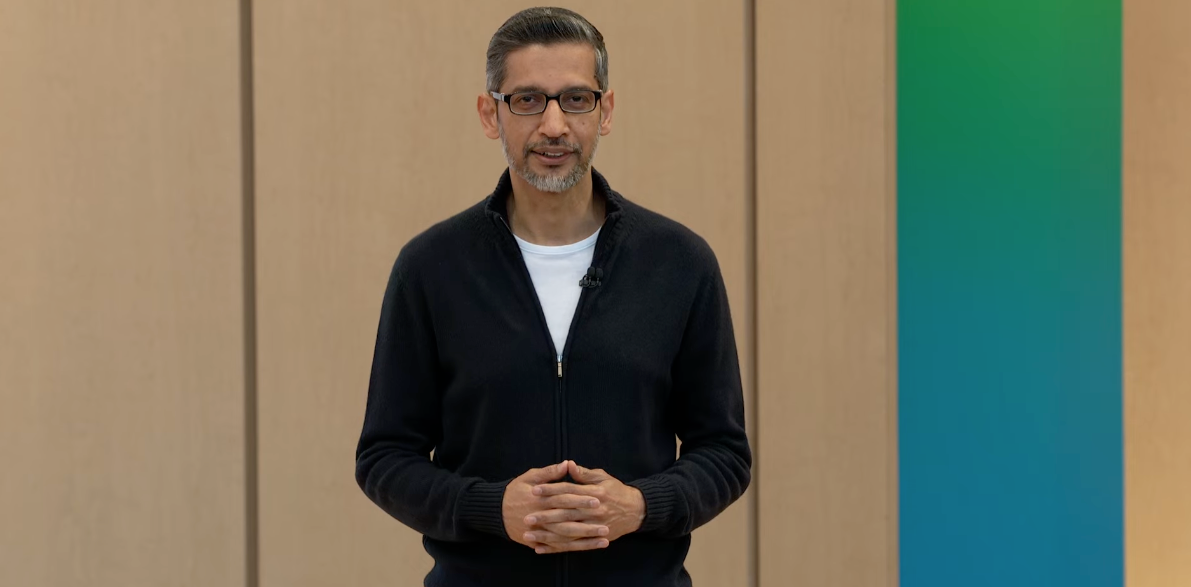
Google CEO Sundar Pichai returned to Stanford University over the weekend expecting a ceremonial homecoming. Instead, the commencement stage became a flashpoint for anger over the company’s work with the Israeli government and U.S. immigration authorities, as hundreds of graduates reportedly stood up and walked out while others booed during his appearance.
The protest at Stanford was not a spontaneous outburst so much as the latest sign that Silicon Valley’s most powerful companies are now being judged by students not only for their products, but also for the political consequences of the contracts they sign. Pichai, who earned his graduate degree in materials science and engineering at Stanford, faced a crowd that was visibly split between those there to hear a celebrated alumnus and those determined to challenge the legitimacy of giving him a warm stage.
At the center of the backlash is Google’s participation in Project Nimbus, a large cloud and artificial intelligence contract with the Israeli government that has become one of the most contested business deals in the tech industry. The agreement, which is shared with Amazon, has drawn criticism from employees, activists, researchers, and some civil society groups who argue that the technology could support military operations in Gaza and other forms of state surveillance. Separately, Google’s relationship with U.S. Immigration and Customs Enforcement has also angered activists who see the company as enabling enforcement systems they oppose.
The scene at Stanford reflected a broader pattern across campuses and boardrooms: young people are increasingly willing to confront tech leaders directly when they believe those companies are implicated in harm. In this case, the message was aimed at Google’s leadership by name, with the protest turning a graduation ceremony into a public referendum on corporate responsibility, war, surveillance, and the social role of artificial intelligence.
What happened at Stanford
According to accounts of the ceremony, roughly 200 students from the graduating class walked out while Pichai was speaking. Others remained in place but voiced their disapproval through loud booing. The protestors held signs and banners with blunt slogans connecting Google’s technology to the war in Gaza and to immigration enforcement in the United States.
Among the messages reported at the event were phrases such as “ICE SPIES WITH GOOGLE AI,” “GENOCIDE RUNS ON GOOGLE,” and “FREE FREE PALESTINE.” Video posted online showed students waving Palestinian flags and chanting in support of Palestinians. The demonstrators also issued a statement explaining that they were leaving the ceremony because they did not want to celebrate companies they believe are helping sustain violence.
The protesters said they were walking out because they refused to elevate corporations they view as fueling harm, framing the action as a deliberate use of their own power to withhold approval.
Campus activist organizations helped organize the demonstration, including Stanford Students for Justice in Palestine, No Tech for Apartheid, and Tech for Liberation. Their involvement highlights how student movements around technology have matured into organized, cross-campus networks that can mobilize quickly around contracts, employment practices, and the military use of digital systems.
Why Project Nimbus is at the center of the dispute
Project Nimbus has become shorthand for a much larger argument about whether cloud and AI providers can claim neutrality when their tools are used by governments in conflict zones. The contract, valued at about $1.2 billion, was awarded to Google and Amazon to provide cloud infrastructure and artificial intelligence services to the Israeli government and military. Critics say that those services, even if framed as standard enterprise tools, can help support surveillance, data processing, logistics, and battlefield decision-making.
Google has faced sustained criticism over the deal from outside the company and from workers within it. The pressure has not been limited to one side of the political spectrum; it has also become a test case for how far employees, customers, and students are willing to go in challenging the business choices of the largest technology firms.
The dispute intensified in 2024, when Google fired 28 employees after protests tied to Nimbus. Even after those dismissals, dissent did not disappear. The issue has remained a live internal conflict, and external critics continue to press the company over what they see as a widening gap between the rhetoric of responsible AI and the realities of lucrative government contracts.
How the contract became a symbol
For activists, Nimbus is not just a procurement agreement. It represents the convergence of cloud computing, AI, state power, and a war that has generated global outrage. The concern is that the infrastructure sold by private companies can be folded into systems of control or military operations in ways that public-facing product descriptions do not fully disclose.
That concern has been echoed by some digital rights advocates. The Electronic Frontier Foundation recently criticized Google and other firms, arguing that they are effectively turning away from the consequences of how their services are used by the Israeli government.
Google has not publicly resolved the underlying controversy, and the persistence of the protests suggests that for critics, the problem is structural rather than reputational. They are not simply asking for better public relations. They want the company to abandon the work altogether.
ICE, surveillance, and the expanding target list
The Stanford protest was also aimed at Google’s relationship with U.S. Immigration and Customs Enforcement, a second issue that has become part of the broader critique of the company’s public-sector work. Though the source of the anger may differ from the Gaza protests, the logic is similar: students and activists are challenging the use of AI and cloud systems in institutions they believe are inflicting harm.
That tension reflects the changing politics of artificial intelligence. A few years ago, campus debates about Google and other tech giants focused heavily on free speech, content moderation, or monopoly power. Today, the discussion increasingly centers on whether AI and cloud platforms are becoming infrastructure for policing, deportation, and military operations.
For many protesters, those concerns are inseparable. The same technical systems that can sort data, automate decision-making, and accelerate workflows can also be repurposed for surveillance and coercion. As a result, company leadership is no longer being judged solely on innovation or shareholder value, but on the downstream uses of the systems they build and sell.
Tech leaders defend AI while students question its costs
Pichai’s Stanford appearance also landed in a moment when technology executives are trying to sell AI as an economic necessity and a social good. University commencements have become a common stage for those arguments, with speakers urging graduates to embrace a future shaped by increasingly capable models and automated tools.
But the reception has often been mixed. Across the country, AI-heavy graduation speeches have triggered skepticism, discomfort, and occasional protests. What made the Stanford episode stand out was that the criticism was not limited to abstract fears about automation. Instead, the students focused on the specific business choices of the company behind the speaker.
That distinction matters. AI as a concept may still attract awe and anxiety in equal measure, but students are showing that they are willing to translate those broad worries into concrete demands about contracts, labor practices, and institutional accountability.
Employment anxiety adds to the backlash
There is also a generational dimension to the tension. Many younger people see AI not as a distant promise but as a force that may reduce their employment prospects, reshape knowledge work, and concentrate power in the hands of a few firms. Those fears are being layered on top of ethical objections about surveillance and war, making the public mood toward big tech even more complicated.
At Stanford, that unease appeared to extend beyond politics. The protest message suggested that the students were rejecting a version of corporate success that treats innovation and harm as separate categories. In their view, a company can no longer ask for applause simply because it sits at the center of the AI boom.
Silicon Valley reaction: sharp criticism from business elites
The protest quickly drew backlash from prominent figures in the tech and venture capital world. Vinod Khosla, the billionaire co-founder of Sun Microsystems and one of Silicon Valley’s most influential investors, criticized the students publicly on X, describing their actions in harsh terms and arguing that they were missing the broader benefits of AI.
Khosla said the protest was misguided and self-centered, and he argued that the students were ignoring the potential of AI to help billions of people around the world.
His response captures an important fault line in the AI debate. To many executives and investors, artificial intelligence is a transformational technology with huge potential upside in medicine, productivity, education, and scientific research. To critics, the enthusiasm often serves as a blanket justification for ignoring the political and social harms that accompany the same systems.
That divide is becoming harder to paper over. When a graduation ceremony turns into a confrontation, it signals that the argument over AI is no longer confined to conferences, board meetings, or policy panels. It is now shaping the public image of the people who lead the sector.
Amazon, Microsoft, and the broader cloud conflict
Google is not alone in facing pressure over government contracts. Amazon also shares support for Project Nimbus, and has drawn criticism alongside Google for its role in the agreement. The contract’s existence has therefore become a shared liability for two of the biggest cloud providers in the world, each of which has spent years promoting its technology as secure, scalable, and enterprise-ready.
Microsoft has also come under scrutiny for its relationship with the Israeli military. In that case, the company restricted use of some of its technology by the Israeli government after an investigation found that its cloud services were being used in ways that enabled mass surveillance of Palestinians. That move did not end the broader criticism, but it showed how tech companies sometimes respond only after scrutiny reaches a certain level.
The parallel cases suggest that the problem is not limited to one company or one region. Instead, the cloud industry is increasingly being forced to answer a difficult question: what responsibility do vendors have when their products are incorporated into government systems with severe human rights implications?
| Issue | Details | Why it matters |
|---|---|---|
| Project Nimbus | Approx. $1.2 billion cloud and AI contract shared by Google and Amazon with the Israeli government | Critics say it could support military operations and state surveillance |
| ICE relationship | Google’s work with U.S. Immigration and Customs Enforcement | Activists argue AI tools should not aid deportation or monitoring systems |
| Stanford protest | About 200 students reportedly walked out during Pichai’s speech | Shows student opposition to corporate involvement in conflict and surveillance |
| Employee backlash | Google fired 28 workers in 2024 after Nimbus-related protests | Demonstrates sustained internal dissent over the company’s government contracts |
A new generation of protest culture around tech
The Stanford walkout is part of a wider shift in how students and younger workers are engaging with tech companies. Protests are increasingly focused on the supply chain of digital power: who builds the tools, who pays for them, and who gets harmed when they are deployed.
This is a more targeted form of activism than the broad anti-corporate protests of earlier eras. It is also better informed by the mechanics of cloud services, AI models, and enterprise contracts, which makes it harder for companies to dismiss as purely symbolic. The demonstrators at Stanford were not protesting an abstract idea of “big tech.” They were protesting named contracts, named institutions, and named consequences.
That approach may help explain why the issue resonates beyond campus. Once a contract like Nimbus becomes a public symbol, it can travel into employee activism, academic debate, investor scrutiny, and media coverage all at once. The result is a reputational problem that no amount of keynote-stage optimism about AI can easily erase.
What this means for Google
For Google, the protest underscores a dilemma at the heart of its AI strategy. The company wants to position itself as a leader in advanced computing while also maintaining relationships with governments, universities, and enterprise clients. Yet every high-profile contract now carries the possibility of public backlash, especially when it can be linked to war, surveillance, or immigration enforcement.
The Stanford episode is not likely to alter Google’s business on its own. But it adds to a growing record of resistance that may influence how the company is perceived by the next generation of engineers, researchers, and founders. For a firm that recruits heavily from elite universities, that reputational risk should not be ignored.
It also illustrates a broader truth about AI in 2026: the technology is no longer being discussed only in terms of capability. It is being judged through the institutions that fund it, the governments that use it, and the people who are asked to live with its consequences.
The larger context: AI, politics, and legitimacy
As AI becomes more deeply embedded in public infrastructure and corporate strategy, the legitimacy of the companies building it will matter as much as the quality of their models. Graduations, campus talks, and recruiting events may seem like unlikely venues for that argument, but they are becoming crucial stages for it.
Stanford’s commencement ceremony offered a vivid example. A CEO who once represented academic success and Silicon Valley ascent instead encountered a generation unwilling to separate technological prestige from political accountability. Students do not appear satisfied with claims that AI benefits humanity in the abstract if the same companies are also helping governments wage war or expand surveillance.
That is the challenge facing Google and its peers: in the AI era, innovation is not enough to command admiration. The public is increasingly asking what the technology is for, who it serves, and who pays the price.
Timeline of the controversy
The Stanford protest is the latest chapter in a dispute that has been building for years. The following timeline highlights the major milestones referenced in the public debate:
| Date | Event | Significance |
|---|---|---|
| 2021 | Project Nimbus contract announced | Google and Amazon agree to provide cloud and AI services to the Israeli government |
| 2024 | Google fires 28 employees after protests | Shows the dispute has spread into the company’s workforce |
| 2025-2026 | Continued criticism from digital rights groups and employee activists | Public pressure remains steady despite company silence |
| June 2026 | Stanford commencement protest against Sundar Pichai | Students walk out and boo during the Google CEO’s speech |
The controversy shows no sign of fading. If anything, the Stanford protest suggests that the next phase of AI accountability will likely come not only from regulators and labor organizers, but also from campuses where future technologists are deciding what kind of industry they want to join.
For Pichai, the walkout was a reminder that even a homecoming speech can become a confrontation when the company in question sits at the center of some of the world’s most volatile debates. For Google, it was a warning that the political cost of its government work may continue to rise as AI becomes more powerful, more visible, and more inseparable from the decisions of states.