In what may be remembered as a pivotal moment in the evolution of quantum technology, Google has unveiled a groundbreaking quantum algorithm that not only dwarfs the computational power of the world’s top supercomputers—but does so in a manner that is scientifically verifiable. Dubbed Quantum Echoes, this achievement represents a transition from theoretical promise to tangible performance.
With this breakthrough, quantum computing takes a decisive step beyond mere novelty and into the domain of practical impact, laying the foundation for applications across artificial intelligence, medicine, chemistry, cryptography, and beyond.
Quantum Echoes and the Willow Chip: A Synchronized Leap
At the heart of this advance lies a coordinated synergy between Google’s newly engineered “Willow” quantum chip and its proprietary Quantum Echoes algorithm.
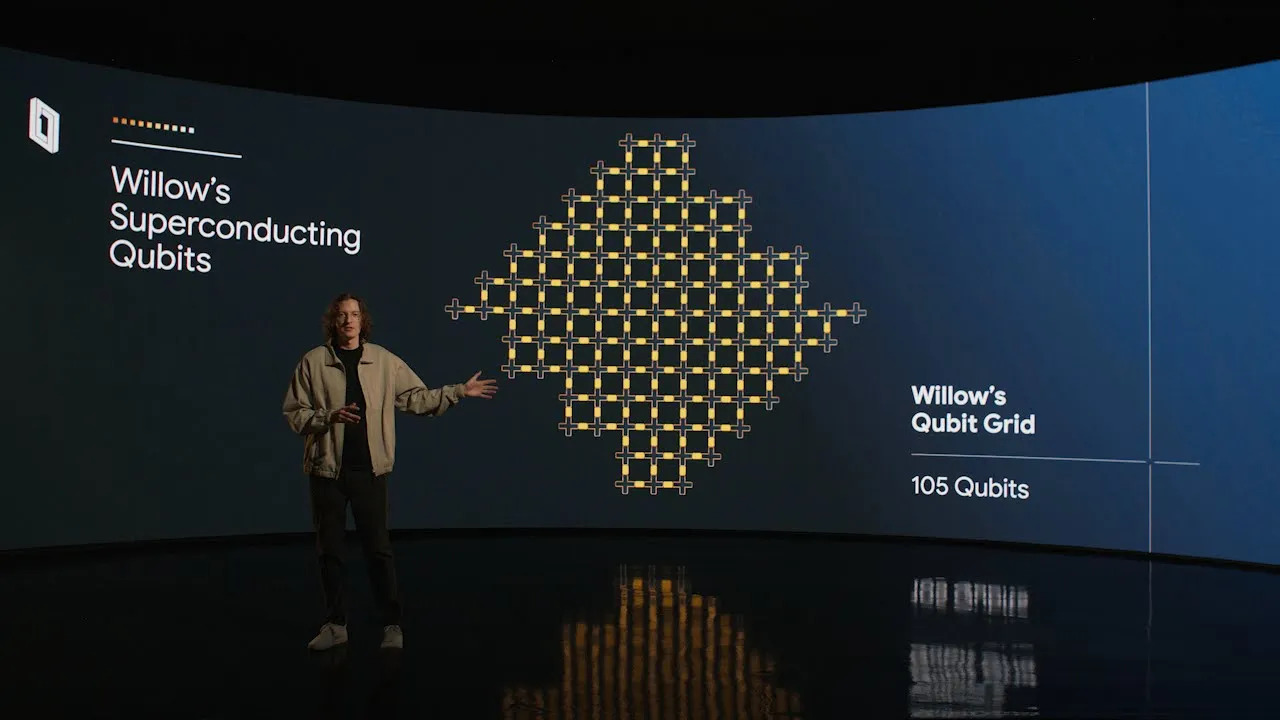
The Willow chip, boasting 105 superconducting qubits, is a leap forward in both scale and stability. Google’s Quantum AI team emphasized that this architecture significantly suppresses error rates, enabling more reliable execution of quantum circuits. But hardware alone doesn’t create advantage—Quantum Echoes completes the picture.
The algorithm focuses on a classically formidable task: modelling an out-of-time-order correlator (OTOC), a quantum property linked to chaos and information scrambling within quantum systems. This operation is notoriously hard to simulate on classical hardware but essential for understanding molecular interactions and materials at the quantum level.
According to Google’s internal benchmarks, this combined hardware–software stack achieved a 13,000× speed-up over top-tier supercomputers. More importantly, the results were verifiable, setting this milestone apart from previous “quantum supremacy” claims that lacked reproducibility.
Read the official Google blog post
Why This Breakthrough Matters
Google’s announcement marks a profound shift in how quantum computing is perceived—not just within research labs but across industries.
1. From Supremacy to Utility
The notion of “quantum supremacy”—where a quantum computer performs a task infeasible for classical machines—has been largely theoretical or symbolic until now. In 2019, Google first claimed such supremacy, but that experiment lacked practical utility.
With Quantum Echoes, Google transitions from symbolic benchmarks to scientifically and industrially relevant computation. Modelling OTOCs is not an academic stunt—it has direct relevance in fields such as drug design, quantum chemistry, and material synthesis.
2. Verifiability Solves a Long-Standing Problem
One of the biggest criticisms levied at past quantum breakthroughs was the difficulty of verifying results. Classical simulations can’t keep up—so how do we know if a quantum computer is doing it right?
Google addresses this by using statistical methods and hybrid verification frameworks that compare small sections of the result against known outputs and use quantum error metrics to extrapolate correctness. This methodology sets a new gold standard for claiming performance.
3. Quantum Speed That Matters
While previous experiments may have been “faster,” they tackled toy problems with limited relevance. Google’s 13,000× performance gain isn’t just raw speed—it’s meaningful speed on a scientifically significant problem.
The Technology Behind the Breakthrough
Willow Chip Highlights
- 105 physical qubits
- Advanced superconducting architecture
- Near-exponential error suppression using noise-resilient qubit encoding
- Operates in the NISQ regime but approaches error correction thresholds
Quantum Echoes Algorithm
- Executes OTOC simulations using a time-reversal quantum circuit
- Demonstrates complex quantum interference patterns not feasible to track classically
- Designed specifically to exploit the coherence time and connectivity of Willow
Together, the chip and algorithm showcase the next stage in quantum development: algorithm–hardware co-design, where quantum processors are customized to execute specific, high-value tasks.
Broader Implications Across Industries
The implications of this breakthrough cascade into multiple sectors:
1. Healthcare & Drug Discovery
Quantum simulation allows researchers to explore molecular structures and protein folding pathways that are too complex for classical supercomputers. Faster simulations can accelerate drug discovery, reduce R&D costs, and increase success rates in preclinical trials.
2. Materials Science & Chemistry
Understanding quantum interactions at the atomic level enables development of superconductors, solar materials, and chemical catalysts. The Quantum Echoes model can simulate properties like magnetism and energy transfer with unprecedented fidelity.
3. Artificial Intelligence
While not a direct application, quantum-enhanced AI could benefit from synthetic datasets generated by quantum simulations. These datasets can supplement training for deep learning models where real-world data is limited or expensive to gather.
4. Cybersecurity & Encryption
Although Google’s work is not a direct threat to encryption today, it inches closer to a reality where quantum decryption of RSA and ECC algorithms becomes plausible. Quantum-safe cryptography is becoming urgent for both private and public digital infrastructure.
What Comes Next: Scaling and Integration
Google’s achievement is monumental, but it is also just one step toward a fully operational quantum future.
Next milestones include:
- Scaling logical qubits with full quantum error correction
- Integrating quantum processors with classical HPC systems
- Developing quantum programming frameworks for broader developer access
- Creating standard verification tools for third-party reproducibility
- Expanding hardware robustness for long-duration quantum tasks
Google has previously shared its roadmap toward a 1 million logical qubit machine, and this new result brings that future into clearer focus. See Google’s roadmap
Critical Perspective: Caution Amid Hype
Despite its triumph, Google’s advance is not a magic bullet. This speed-up applies to a specific task; general-purpose quantum computing is still years away. Other challenges remain:
- Scalability: Operating beyond 100 qubits with low error rates is still difficult.
- Generalization: Each new algorithm may require bespoke tuning to specific hardware.
- Usability: Quantum programming is still far from accessible to everyday developers.
- Costs: Quantum systems are expensive to maintain and build. Mass adoption will require miniaturization and affordability.
Experts warn that overhyping these advances can lead to disillusionment, as seen in past tech bubbles. It is essential to communicate both the power and the limitations of current quantum systems.
Conclusion: From Theory to Threshold
Google’s Quantum Echoes isn’t just another research experiment—it’s a signal that the age of practical quantum computation has begun to flicker to life. With a validated 13,000× performance edge and a path to scalable hardware, this advance pushes quantum computing closer to mainstream relevance.
The coming years will be a litmus test: Can others reproduce this? Can it scale? And can it move from labs into production lines, hospitals, financial systems, and energy grids?
Whatever the outcome, the message is clear: quantum computing is no longer an abstract dream. It’s becoming an engineered reality.