In short
Early screenings of David Fincher’s Netflix sequel sparked online claims that generative AI may have been used, though Netflix has not confirmed anything and some viewers think the issue could be bad CGI. The controversy matters because it highlights rising audience distrust around AI-assisted filmmaking.
- Early screenings of the Netflix sequel triggered accusations of generative AI use.
- Critics described the visuals as uncanny and inconsistent, but some viewers blamed bad CGI instead.
- Netflix has not confirmed or denied whether AI was used in the film.
- The backlash is amplified by David Fincher’s reputation for precision and Netflix’s previous AI investments.
David Fincher’s Netflix film The Further Mis-Adventures of Cliff Booth is facing online suspicion over possible generative AI use after early screenings last week, just days before its Nov. 25 premiere. The backlash matters because it touches a sensitive fault line in modern filmmaking: whether audiences can trust what they are seeing when a prestige director and a major streamer are involved.
What sparked the AI speculation?
According to The Verge, reactions from early viewers quickly spilled online and centered on the look of the movie rather than its story. Critics described parts of the film as uncanny, inconsistent and low-quality, with some claiming the images appeared altered in a way that suggested generative AI.
The strongest criticism came from YouTuber and director Patrick Tomasso, who said he left the screening feeling “completely gutted.” He also said the film showed “some of the most blatant and egregious AI use” he has seen from a major studio. Tomasso further claimed that AI-generated footage appears in the trailers.
Other viewers, however, pushed back on the interpretation. Some argued that what looked like AI artifacts may instead be the result of poor CGI or other conventional visual-effects work. As of The Verge’s report, Netflix had not confirmed or denied whether the film uses generative AI.
Why it matters
The debate is about more than one movie. It reflects growing unease over how AI tools are being folded into film production, especially when the results are visible to audiences and difficult to explain away. If viewers believe a polished studio release has crossed an invisible line, even a rumor can become a trust problem.
That is especially true here because the project comes from David Fincher, a director known for precision and control, and from Netflix, which has already been active in AI-assisted production workflows. The question is not simply whether AI was used, but whether audiences are prepared to accept AI in a movie from a filmmaker and platform associated with high-end craft.
For Netflix, the discussion also lands in the shadow of a major acquisition. Earlier in 2026, the company bought Ben Affleck’s startup InterPositive for around $600 million. According to the fact pattern reported by The Verge, InterPositive builds AI that modifies footage-based assets rather than generating text-to-image content, and Netflix said the technology was intended to tweak lighting and remove unwanted background elements.
How the rumors spread
The speculation appears to have been fueled by the contrast between expectations and what some viewers saw on screen. Fincher’s work typically arrives with a reputation for polished visual control, so even small irregularities drew attention. In this case, the reaction was amplified by social media and by the fact that people were already primed to scrutinize AI in entertainment.
That scrutiny has grown sharper across the industry because generative AI can be used in different ways: to create visual effects, to clean up footage, to change lighting, or to generate entirely new imagery. When a shot looks off, viewers may not be able to tell whether they are seeing a shortcut, a production mistake, or a deliberate AI-assisted effect.
How sure are we that the film used generative AI? The short answer is: we are not sure. The Verge says Netflix has not addressed the claims, and some of the criticism is still speculative. That leaves the public with reactions and visual impressions, but no confirmation from the studio or director.
Background: Fincher, Netflix and AI in production
Fincher has already signaled he is not reflexively hostile to the technology. In a recent Los Angeles Times interview, he defended AI as a creative tool and framed anti-AI criticism as resistance to iteration in art. He said, “I’m not a Luddite, so I don’t fear the unknown.”
He added another line that gets to the heart of the debate: “Should we not use it?”
Those comments matter because they place him on the side of experimentation rather than caution. They do not prove that AI was used in The Further Mis-Adventures of Cliff Booth, but they do show that the director sees the technology as potentially legitimate inside the filmmaking process.
Netflix, too, is not new to this terrain. The company has previously incorporated AI into movies and series, and its purchase of InterPositive suggests a broader interest in tools that can modify existing footage. In the industry context described by The Verge, that kind of technology is usually associated with production polish: adjusting lighting, removing background distractions and refining shots rather than making them from scratch.
That distinction matters, because public debate often collapses very different practices into one catch-all accusation. A viewer may see an odd face, a strange texture or a soft-edged background and assume a generator created the whole frame. In practice, the issue may be a mix of editing, compositing, visual-effects cleanup and AI-assisted finishing.
What is the film about?
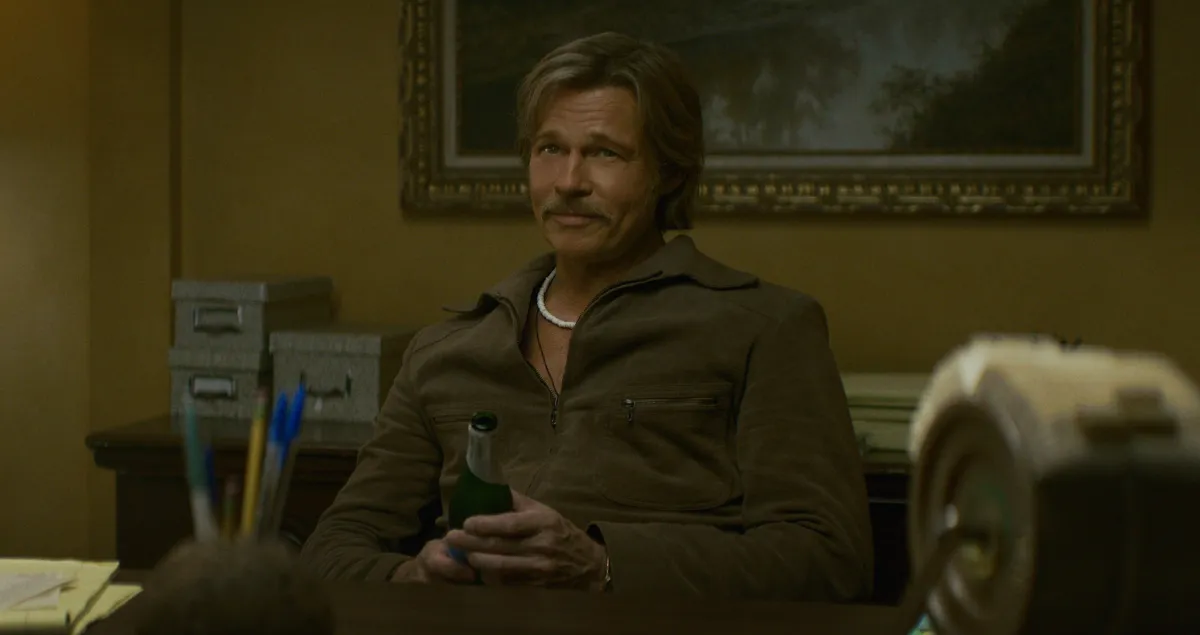
The Further Mis-Adventures of Cliff Booth is set in 1977, roughly a decade after Once Upon a Time in Hollywood. Brad Pitt returns as Cliff Booth, now working as a Hollywood fixer. The plot also includes Elizabeth Debicki as Karen Crosby, a critic-turned-talent agent and Booth’s romantic interest, along with Scott Caan as Charlie Peters, a TV actor who hires Booth, and Carla Gugino as Peters’ wife.
The sequel framing matters because it places the film inside a recognizable universe while still shifting the timeline and the stakes. That kind of continuation can invite close visual comparison, especially when audiences are already familiar with the original film’s carefully controlled look.
What critics are saying
For the moment, the public conversation appears split into three camps: people convinced they are seeing AI, people who think the visual problems are just weak CGI, and people waiting for the studio to speak. The Verge says other viewers echoed the AI concerns, which suggests the suspicion was not isolated to one screening or one reaction.
The uncertainty is part of why the story has traveled. If a few shots are perceived as synthetic, the whole film can be pulled into a larger argument about authenticity. In prestige filmmaking, that is a particularly damaging association, because viewers expect craftsmanship to be invisible, not debated.
There is also a practical issue. If trailer shots are suspected of being AI-generated, as Tomasso claimed, the promotional campaign itself can become the focus rather than the movie’s story or performances. That can create a feedback loop: more scrutiny leads to more freeze-framing, which leads to more speculation.
By the numbers
| Detail | What the fact sheet says | Why it matters |
|---|---|---|
| Nov. 25, 2026 | Scheduled premiere date | Leaves little time for speculation to fade before release |
| Last week | Critics screenings were held | That is when the AI rumors began circulating |
| Around $600 million | Netflix’s price for InterPositive | Signals major investment in AI tooling |
| 1977 | The film’s setting | Places the story about a decade after the original film |
| About a decade | Gap from Once Upon a Time in Hollywood | Raises the visual expectations of continuity and style |
What happens next?
The immediate question is whether Netflix or Fincher will address the speculation directly before the Nov. 25 premiere. So far, the studio has not confirmed or denied AI use, which leaves the conversation in a vacuum that online viewers are happy to fill.
Another open question is whether the trailers contain AI-generated footage, as Tomasso alleged, or whether those images are simply unusual CGI or post-production choices. If the film arrives without any explanation, viewers are likely to continue dissecting shots frame by frame.
There is also a broader industry question: how much AI, if any, will audiences tolerate in a prestige movie before the perception of authorship starts to erode? That question is likely to follow not just this film, but future releases from studios that are betting on AI-enhanced workflows behind the scenes.
Background context: why the reaction feels bigger than one movie
Film audiences have long accepted invisible intervention in post-production, from digital makeup to compositing to cleanup work. What has changed is the label attached to the tools. “AI” now carries cultural baggage, and that makes even routine alterations seem more controversial than they might once have been.
Fincher’s own reputation sharpens the issue. Because he is known for carefully controlled filmmaking, viewers are more likely to believe that anything unusual is intentional. When that control appears to fail, whether because of AI, bad CGI or another technical misfire, the disappointment can be louder than it would be for a less exacting director.
Netflix has a similar problem. The company is both a distributor of prestige content and a large-scale technology platform with a history of investing in production tools. That dual identity makes it a convenient target whenever the line between artistic judgment and technical automation becomes blurry.
There is also a historical irony in the debate. Fincher compared painting history to “40,000 years” and film to “a hundred years,” a reminder that cinema is still a comparatively young art form. In that light, his willingness to experiment with new tools fits a long pattern of artistic change, even if the public is not always comfortable with the pace of it.
Who is at the center of the story?
The key players are David Fincher, Netflix and Patrick Tomasso, whose reactions helped push the issue into public view. Brad Pitt is also central because he anchors the sequel as Cliff Booth, making the film a recognizable continuation of a major recent title.
Who is Patrick Tomasso? He is a YouTuber and director who attended the screening and became one of the most outspoken voices raising concerns about AI use. His comments gave the online debate a named source and helped move it beyond vague internet chatter.
Who is David Fincher in this context? He is the director whose work is under scrutiny, but he is also a filmmaker who has publicly argued that new tools should not be dismissed out of hand. That makes him central to both the artistic and technological sides of the dispute.
Key questions still unanswered
- Whether the film actually used generative AI at all
- Whether trailer shots are AI-generated or simply unusual CGI
- Whether Netflix or Fincher will address the claims before release
- How much AI, if any, was used in post-production
- Whether audience suspicion will affect the film’s early reception
What to watch before premiere day
The most important development will be any response from Netflix or Fincher before Nov. 25. A clarification could calm the speculation, but silence may make the debate louder. Either way, the film is likely to arrive with a layer of controversy already attached to it.
For now, the story is less about proof than perception. The reactions from early screenings show how quickly a few visually suspect moments can become a referendum on AI, studio transparency and the future of post-production. In that sense, The Further Mis-Adventures of Cliff Booth has already become part of a much larger industry argument, even before the public has fully seen it.
Frequently asked questions
Did Netflix confirm AI was used in The Further Mis-Adventures of Cliff Booth?
No. Netflix has not confirmed or denied AI use in the film, leaving the issue unsettled as online speculation continues after early screenings.
Why are viewers accusing the film of using AI?
Viewers are reacting to visuals they describe as uncanny, inconsistent and low-quality. Some critics think those artifacts look like generative AI, while others say the problems could simply be weak CGI or other post-production effects.
When is The Further Mis-Adventures of Cliff Booth coming out?
The film is scheduled to premiere on Nov. 25, 2026, just days after the early screenings that sparked the online debate.
What has David Fincher said about AI?
Fincher recently defended AI as a creative tool in an interview with the Los Angeles Times. He said, “I’m not a Luddite, so I don’t fear the unknown.”
What is Netflix’s connection to AI in filmmaking?
Netflix has previously incorporated AI into movies and series, and it bought Ben Affleck’s startup InterPositive for around $600 million earlier in 2026. The company said the startup’s tools were meant to tweak lighting and remove unwanted background elements.