Updated November 20, 2026 4:24 pm
In short
Signal has rolled out screenshot blocking on iOS 27 and Android to stop Siri, Gemini and other assistants from reading chats on screen, while warning the protection is incomplete and urging Apple, Google and Microsoft to give developers stronger controls over AI data access.
- Signal is adding mobile screenshot restrictions to protect chats from AI assistants.
- The Verge says the company believes OS-level AI agents undermine app-level privacy.
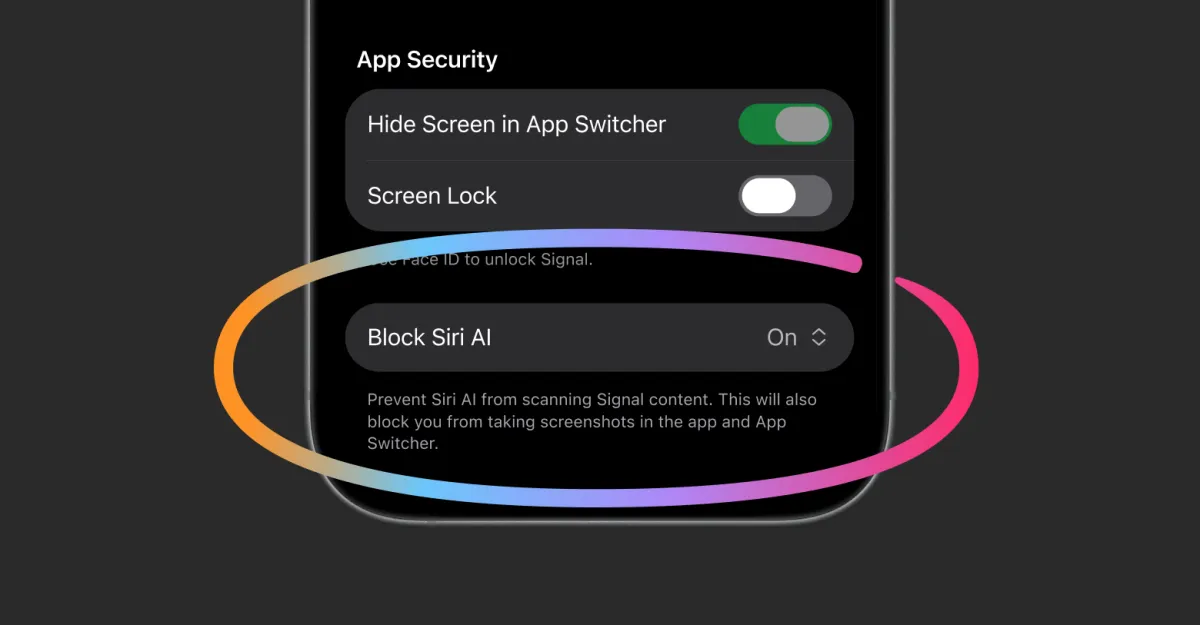
- Android Authority reported automatic Screen security on Android and a Block Siri AI setting on iOS 27.
- Signal says the protection is incomplete and cannot be replicated the same way on macOS.
- The company is pressing Apple, Google and Microsoft for better technical controls and developer documentation.
Update — November 20, 2026 4:24 pm
Signal says the screenshot block is now active on iOS 27 and Android specifically to keep Siri, Gemini and other built-in assistants from reading what’s on screen. Users can turn the protection back off in Signal’s settings, but the company says that would put message content back at risk.
Meredith Whittaker also said the fix is only partial. Signal says AI tools may still be able to reach app data through other routes, including the device file system, and that it still lacks the technical controls it wants from Apple, Google and Microsoft.
The company also extended its criticism beyond Siri and Gemini, warning that third-party agents using deep accessibility access could act like a “skeleton key” to sensitive data. Signal says it wants simpler developer tools and clearer documentation so apps can better limit what AI systems can access.
Signal is blocking screenshots on iPhone and Android to keep AI assistants such as Siri and Gemini from reading conversations on screen, escalating a privacy fight with the companies that control mobile operating systems. The move matters because Signal is arguing that end-to-end encryption no longer guarantees privacy once platform-level AI can inspect what is displayed on a device.
Signal’s newest privacy wall is aimed at AI, not just people
The encrypted messaging app said it is adding screenshot restrictions in its mobile apps to reduce the chance that AI agents can read chat content through the screen, according to The Verge. Signal’s position is blunt: if the operating system itself can see what is on display, the app cannot fully protect the messages people exchange inside it.
That distinction is important. End-to-end encryption protects messages while they travel between devices and servers, but it does not automatically stop content from being copied once it is rendered on a phone screen. As mobile operating systems add assistants that can interpret or summarize what is visible, app makers are suddenly dealing with a new kind of access problem.
Why it matters
Signal has built its reputation on refusing to collect unnecessary user data and on treating privacy as the product, not a feature. If a secure messaging app feels compelled to block screenshots because the platform may be reading the display, that is a warning sign for the wider app ecosystem.
For users, the immediate concern is simple: private messages could be exposed to on-device AI tools without any obvious sign that it is happening. For developers, the problem is broader. If an app cannot control what an operating system can inspect, then privacy promises become harder to keep and harder to explain.
The issue also reaches beyond Signal itself. Any app that handles sensitive conversations, documents, health information, financial details or legal material could face the same pressure if AI agents gain broad access to the screen. That is why Signal president Meredith Whittaker has framed the issue as more than a narrow product tweak.
How the protections work on iPhone and Android
On Android, Android Authority reported that Signal automatically turns on Screen security when it detects an AI assistant reading the screen. The same outlet said Signal also added a Block Siri AI setting on iOS 27. In both cases, the app’s protections are meant to make it harder for assistants to inspect chats by limiting screenshots inside the app.
But the measures are not absolute. The Verge reported that users can disable the iOS and Android protections in Signal settings, and that doing so may expose chat content to AI agents. Android Authority likewise said the app’s protections can be turned off. That means the feature is a safeguard, not a hard lock.
Signal also warned that its approach is incomplete. According to The Verge, the company said screenshot blocking does not close every path to the data, and that other access routes, including the device filesystem, may still be available. In other words, the company is trying to narrow exposure, not claim total invulnerability.
What Signal can block, and what it cannot
Signal’s own concern is not limited to screenshots alone. The app appears to be responding to a wider class of system-level access that can read what is happening on the screen, whether through assistant features, accessibility hooks or other platform integrations.
That is why the company’s stance is as much about infrastructure as about product design. Signal is not saying that screenshots are the only risk. It is saying that operating system controls have become part of the privacy problem.
| Topic | What the fact sheet says | Source |
|---|---|---|
| Mobile screenshot blocking | Signal is blocking screenshots on iOS and Android to limit AI assistants reading chats | The Verge |
| Android behavior | Screen security turns on automatically when an AI assistant is detected reading the screen | Android Authority |
| iPhone behavior | Signal added a Block Siri AI setting on iOS 27 | Android Authority |
| User control | Users can disable the protection in settings, but that may expose content | The Verge / Android Authority |
| Mac limitation | Signal says it cannot implement the same protections on macOS | The Verge |
Who is driving the pushback?
Meredith Whittaker, Signal’s president, has emerged as one of the clearest critics of platform AI access. The Verge reported that she described AI agents as a serious privacy problem for Signal and other apps, and argued that app developers do not have robust tools to stop them from undermining application-level privacy.
One of the quotes the fact sheet attributes to Whittaker captures the scale of her concern: “a serious problem that Signal – and application developers beyond – lack robust tools to prevent AI agents from undermining application-level privacy.”
Trending Topics added a sharper version of the company’s frustration, quoting Whittaker as saying, “It is fucked up what is happening.” The language signals how strongly Signal believes the privacy boundary has shifted beneath app developers’ feet.
Whittaker has also warned publicly about the same issue before. According to the timeline in the fact sheet, she raised concerns in summer 2026 that AI agents could break Signal’s privacy guarantees. The current mobile changes follow that warning rather than appearing out of nowhere.
Background: how Signal and the platforms got here
Signal has long been known as an encrypted messaging app built around minimal data retention and strong privacy defaults. That reputation helps explain why the company reacts quickly when platform vendors introduce features that could widen access to what users see on their screens.
Modern operating systems increasingly ship with AI assistants capable of analyzing on-screen content. That creates a new layer of exposure that older privacy assumptions did not have to address. The app’s core encryption model can protect transit, but it cannot stop the device itself from becoming a potential reader.
The fact sheet points to accessibility and screen-reading tools as part of the broader problem. Those tools can give apps or agents broad access to on-device content, which makes the operating system not just a platform but also a privacy gatekeeper.
Signal has already tried to meet platform features head-on before. The Verge reported that the company previously moved against Microsoft Recall to keep secured chats from being captured. Trending Topics said Signal has blocked Microsoft Recall screenshots on Windows since 2025. That history shows the current dispute is part of an ongoing pattern, not a one-off reaction.
How do Apple, Google and Microsoft fit in?
They are the platform companies that control the rules Signal is trying to work around. The Verge said Signal is pressing Apple, Google and Microsoft for better technical controls and documentation for developers, which suggests the company believes platform-level fixes are the real answer.
The differences among outlets are useful here. The Verge emphasized the company’s broad concern that OS-level AI agents undermine app privacy. Android Authority focused more on the specific in-app protections Signal has introduced on mobile, including the automatic detection of screen-reading assistants on Android and the Block Siri AI setting on iOS 27. Trending Topics highlighted the limitations on Mac and the company’s view that platform confidential-computing approaches do not fully solve the problem.
That reporting gap points to the same conclusion from different angles: Signal does not appear to think a single toggle in one app can solve a platform-wide privacy shift.
Why macOS is different
The Verge reported that Signal says it cannot implement the same protections on macOS. Trending Topics added that Signal cannot reliably block screenshots on Mac and recommends excluding the app from Siri in macOS settings.
This matters because desktop systems often handle screenshots and assistant access differently from phones. If Signal cannot enforce the same guardrails on Mac, the company’s privacy posture becomes uneven across devices, which is exactly the sort of inconsistency that privacy-focused users notice quickly.
What the timeline shows
Signal’s latest move is part of a clear sequence that has unfolded over time. The company has been warning about screen capture and assistant access for at least a year, and the new protections follow from that concern rather than replacing it.
| Date | Event |
|---|---|
| 2025 | Signal blocked Microsoft Recall screenshot capture on Windows |
| Summer 2026 | Whittaker publicly warned AI agents could break Signal’s privacy guarantees |
| 2026-11-20 | Signal announced mobile screenshot-blocking protections for AI assistants |
What happens next?
The immediate question is whether the screenshot blocks are enough to matter in practice. The fact sheet makes clear they are not comprehensive, and that other access paths may remain open. The real test will be whether platform vendors tighten those pathways or whether app developers keep stacking workarounds on top of them.
There are several open questions to watch:
- How effective the screenshot blocks are against alternative capture methods.
- Whether Apple, Google or Microsoft add better developer controls or clearer documentation.
- Whether Signal can extend similar protections to macOS.
- Which Android devices or assistants Signal cannot reliably detect.
- Whether platform changes eventually reduce the need for Signal’s workaround.
If platform companies respond with stronger controls, the issue could fade into the background as a technical adjustment. If they do not, this may become a recurring battle: secure apps trying to fence off sensitive content while operating systems keep expanding what their assistants can see.
That is the core conflict Signal is trying to force into the open. The company is not just blocking screenshots. It is challenging the assumption that a messaging app can still guarantee privacy when the phone itself has become an intelligent observer.
What the reporting agrees on — and where it differs
Across The Verge, Android Authority and Trending Topics, the broad story is consistent: Signal is tightening mobile protections because AI assistants may be able to read chats on screen. The outlets differ mainly in emphasis.
- The Verge focused on Signal’s privacy argument and its push for platform-level fixes.
- Android Authority highlighted the user-facing settings and automatic screen protection behavior.
- Trending Topics stressed the Mac limitation and Signal’s broader critique of platform approaches.
Those differences do not change the central point. They sharpen it. The privacy conflict is no longer theoretical. It is now being handled inside the app, one protection layer at a time.
“potentially expose your (and your contacts’) Signal content to these AI agents”
That warning, attributed to Whittaker by The Verge, is the cleanest summary of why Signal is acting now. If mobile assistants can inspect what users see, then privacy is no longer only about encryption on the wire. It is also about what the device is allowed to notice once the message arrives.
Frequently asked questions
Why is Signal blocking screenshots on iPhone and Android?
Signal is blocking screenshots to reduce the chance that AI assistants like Siri and Gemini can read chats displayed on the screen. The company says operating-system-level AI can undermine the privacy guarantees that encrypted messaging is supposed to provide.
Can users turn off Signal’s new screenshot protections?
Yes. The fact sheet says the protections can be disabled in Signal’s settings on iOS and Android. Signal warns that turning them off may expose chat content to AI agents and other on-device access paths.
Does Signal’s screenshot block fully solve the privacy problem?
No. Signal says the protection is incomplete and that other access routes, including the device filesystem, may still expose data. The company is trying to reduce risk, not claim perfect security.
Why can’t Signal use the same protections on macOS?
Signal says it cannot implement the same protections on macOS, which means the company cannot enforce identical controls across desktop and mobile. Trending Topics says the app may need to be excluded from Siri in macOS settings.
What are Apple, Google and Microsoft supposed to do?
Signal wants better technical controls and documentation from Apple, Google and Microsoft so developers can better protect sensitive apps. The company appears to believe the fix needs to happen at the platform level, not only inside Signal.