In short
Ring has launched a new robotics division with an indoor security drone for homes and a rover robot for businesses. The products begin U.S. rollout on Dec. 16, 2026 and Jan. 27, 2027, respectively, and raise new questions about privacy and usefulness.
- Ring is entering robotics with an indoor security drone and a business rover.
- Drone Cam launches Jan. 27, 2027; Rover Cam begins shipping Dec. 16, 2026.
- The products use AI Pilot for autonomous navigation, mapping, and vision processing.
- Privacy and certification remain open questions, especially for the indoor drone.
Ring is moving beyond fixed cameras and doorbells into autonomous security robots, announcing a new Robotics division and two products for homes and businesses. The company says the U.S. launches begin Dec. 16 for its Rover Cam business robot and Jan. 27 for its Drone Cam indoor flying camera, a shift that could reshape how consumers think about monitoring the inside of a home.
The move matters because Ring is not just adding new hardware; it is trying to make surveillance mobile. Instead of watching from one corner, Ring’s new devices can move through a space, respond to alarms, and map their surroundings with AI-assisted navigation. That is a more ambitious pitch than a traditional camera, and one that will almost certainly raise the stakes on privacy, safety, and usefulness.
Ring’s robotics push starts with two very different machines
Ring announced a new Robotics division and used it to introduce two devices aimed at separate markets. Drone Cam is an indoor security drone for homes. Rover Cam is a rolling security robot aimed at businesses.
The products share a common idea: security gear that can go where a fixed camera cannot. In Ring’s framing, the drone can sit docked until it is needed, then take off to investigate alarms or other triggers. The rover, by contrast, stays on the ground and patrols business spaces while streaming video continuously.
What is Drone Cam?
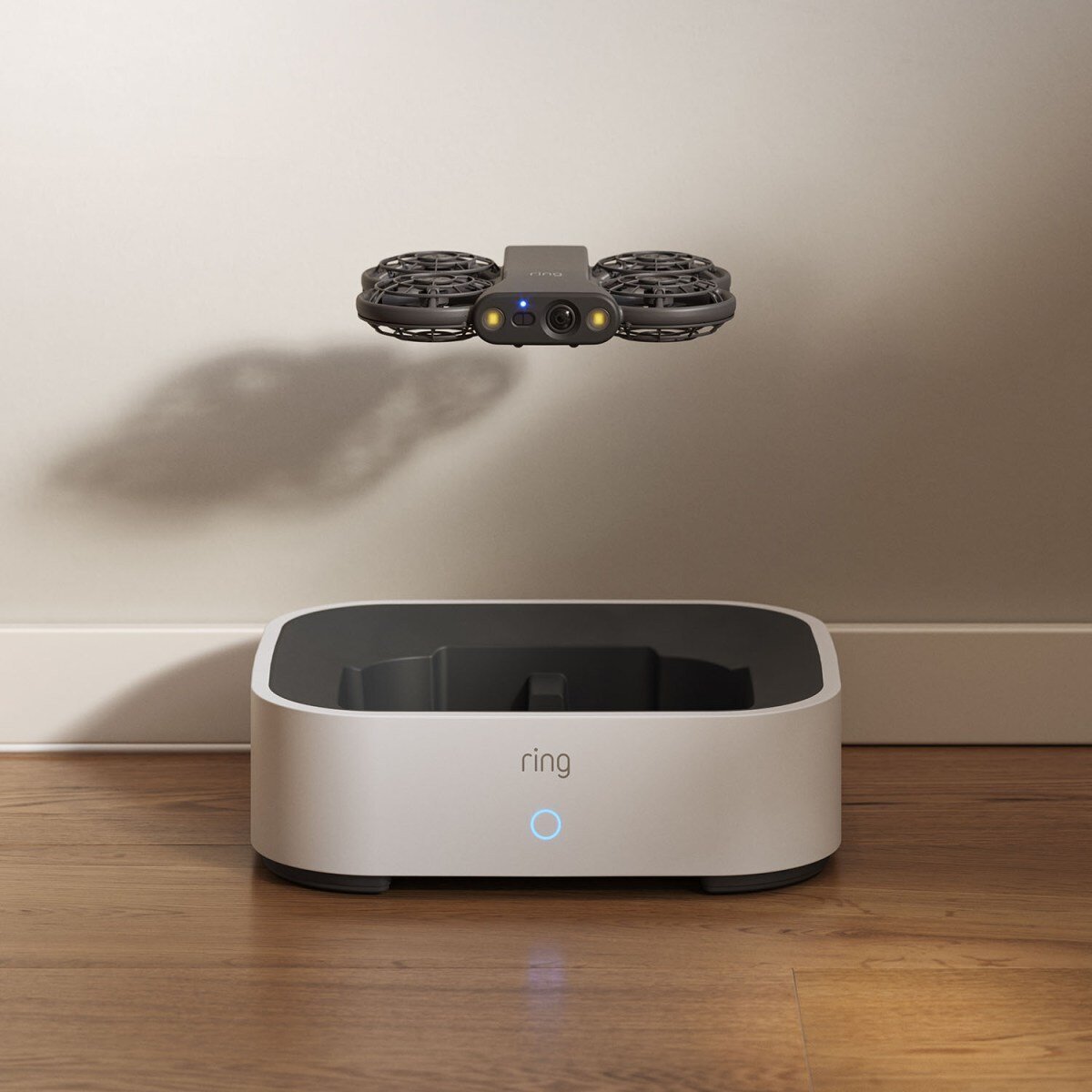
Drone Cam is Ring’s flying indoor security camera for home patrols. According to TechCrunch, it can dock when idle, then fly when an alarm or other event needs attention. It integrates with Ring’s alarm system and other home security gear, and it streams 2K video with LEDs for low-light coverage.
The Verge added more detail on the device’s design and limits. It reported that the drone weighs 165 grams, is smaller than an earlier prototype, and only works indoors while flying. When it is docked, its camera shutters. The Verge also said the battery lasts five to eight minutes, with roughly eight minutes of charging needed for each minute of flight.
What is Rover Cam?
Rover Cam is Ring’s security robot for business use. TechCrunch described it as an enterprise security robot that can roam and monitor commercial spaces. It streams continuous 4K video, can automatically record when it detects a human, and includes a periscope camera and two-way audio.
The Verge reported that Rover is built on Amazon’s Astro home robot, which is notable because it suggests Ring is not starting from scratch. Amazon’s earlier robot effort, Astro, launched in 2021 and was later repositioned toward business and security use. Ring’s new rover appears to build on that foundation rather than reinvent it.
How does Ring say the robots work?
Ring says both devices rely on AI Pilot for autonomous navigation, mapping, and vision processing. That means the machines are not simply remote-controlled cameras; they are meant to move and interpret their surroundings on their own.
The Verge quoted Jamie Siminoff, Ring’s founder, saying,
“Truly, it’s like an AI agent that’s controlling the robot”
. That language is important because it captures the company’s larger ambition: to present the products not as gadgets with wheels or rotors, but as semi-autonomous security agents.
Drone Cam is controlled through Alexa Home Map and can be scheduled for patrols. That places the product inside Amazon’s broader smart-home ecosystem, where voice control, mapping, and connected security already overlap. Rover Cam, meanwhile, is aimed at business environments where persistent monitoring and roaming coverage may be easier to justify than in a private residence.
What are the prices and release dates?
Ring’s timeline is split between the two products. Rover Cam is first out of the gate, with availability beginning Dec. 16, 2026. Drone Cam follows on Jan. 27, 2027.
The pricing differs slightly depending on which outlet is cited. TechCrunch reported Drone Cam at $270 and Rover Cam at $1,000. The Verge reported Drone Cam at $249.99 and Rover Cam at $999.99. The discrepancy appears to be a matter of presentation and rounding, but both outlets place the devices firmly in the premium tier.
| Product | Use case | Video | Availability | Price |
|---|---|---|---|---|
| Drone Cam | Indoor home security drone | 2K | Jan. 27, 2027 | $270 / $249.99 |
| Rover Cam | Business security robot | 4K continuous | Dec. 16, 2026 | $1,000 / $999.99 |
The split is telling. Ring is positioning the drone as a high-end consumer device with a later shipping date, while the rover arrives first and is priced for business buyers who may expect more from a security system than a home user would.
Why it matters
Ring has long been associated with fixed cameras, doorbells, and the broader surveillance tradeoffs that come with connected home security. Mobile robots change that equation. A camera that can move through a room and investigate a trigger is more useful in some situations, but it also expands the reach of surveillance inside private spaces.
That matters for three reasons.
- For consumers: Ring is asking homeowners to trust an indoor flying camera that maps, navigates, and responds autonomously.
- For businesses: Rover Cam suggests a new class of roaming security hardware that may replace some static camera coverage.
- For the market: the launch tests whether people will pay premium prices for security robots rather than conventional cameras.
There is also a practical question at the center of the pitch: whether mobile monitoring actually improves security enough to justify the added complexity. A fixed camera never has to charge mid-patrol. A drone that flies for only a few minutes at a time has to prove it can still be useful when the moment counts.
How did Ring get here?
Ring is Amazon-owned and best known for connected doorbells and home security cameras. That business made the company a household name, but it also put Ring under recurring scrutiny over privacy and police access to camera footage. Those concerns form part of the backdrop to this launch, whether or not Ring explicitly addressed them in the announcement.
The company’s robotics work also has a longer internal history. The Verge reported that Siminoff said development on the drone began in 2016, and that there were two earlier versions that came close to shipping but did not make it to market. That makes the current announcement less like a sudden experiment and more like the latest attempt to turn a long-running concept into a product.
Amazon’s own robotics efforts are relevant too. In 2021, Amazon launched Astro, a home robot that was later redirected toward business and security use. Rover Cam’s use of Astro as a base underscores how Amazon and Ring are trying to reuse their robotics work across consumer and commercial security applications.
Background: Ring’s surveillance business has always been about reach
Ring built its reputation on making it easier to see what is happening at a front door, on a porch, or around a property. The new robotics line extends that logic inward. Instead of seeing one doorway, Ring wants to let users monitor a room, hallway, or business floor with a device that can move when needed.
That ambition makes the company’s latest move easy to understand and hard to dismiss. It is a logical extension of connected security. It is also a far more intrusive one.
What the two outlets agree on — and where they differ
TechCrunch and The Verge largely tell the same story: Ring has launched a robotics division, introduced an indoor flying camera for homes and a rolling robot for businesses, and placed both products on a 2026-2027 release schedule. But they differ on some useful specifics.
| Detail | TechCrunch | The Verge |
|---|---|---|
| Drone price | $270 | $249.99 |
| Rover price | $1,000 | $999.99 |
| Drone availability | Jan. 27, 2027 | Jan. 27th, 2027 |
| Rover availability | Dec. 16, 2026 | Shipping starts Dec. 16, 2026 |
| Drone design details | 2K video, LEDs, Alexa Home Map control | 165 grams, 5-8 minute flight time, indoor-only while flying |
Those differences do not change the basic picture, but they do sharpen it. TechCrunch focused more on product positioning and features. The Verge focused more on constraints, certification, and the hardware’s physical realities.
Privacy and security are still the defining questions
Ring says both products include privacy and security protections, and The Verge reported that the company claims TAKE encryption rotates encryption keys every five minutes and deletes Ring copies after 24 hours. The Verge also said Ring stated Drone Cam is still undergoing FCC certification.
Those details matter because the products are not just recording devices; they are moving networked sensors. A camera that patrols a home or a business raises more questions than a static lens: where it records, when it stores footage, who can access it, and how the system behaves if something goes wrong.
One of the most obvious unanswered questions is whether local video storage will be offered. Another is how the drone will behave around pets, clutter, and obstacles that are common in real homes. Those are not minor edge cases; they are the difference between a useful product and a novelty.
What happens next?
The immediate next step is the rollout itself. Rover Cam is scheduled to begin shipping on Dec. 16, 2026, while Drone Cam is due on Jan. 27, 2027. Between now and then, the key issue is whether the products clear certification, remain on schedule, and persuade buyers that autonomous monitoring is worth the cost.
Several questions will shape the story from here:
- Will Ring offer local storage or rely entirely on its cloud and encryption framework?
- How useful is a drone with only five to eight minutes of flight time?
- Can the rover justify a four-figure price in a crowded security market?
- Will consumers embrace a cloud-mapped indoor camera that can move through their homes?
- Will privacy critics see this as an incremental update or a deeper step into ambient surveillance?
For now, Ring is betting that autonomy will make security feel smarter and more responsive. The harder question is whether it will also make it feel more acceptable. That is the real test hidden inside the launch dates, the pricing, and the AI language around the products.
By the numbers
The launch package is easiest to understand when the headline figures are placed side by side.
| Metric | Drone Cam | Rover Cam |
|---|---|---|
| Video quality | 2K | 4K continuous |
| Price | $270 / $249.99 | $1,000 / $999.99 |
| Availability | Jan. 27, 2027 | Dec. 16, 2026 |
| Weight | 165 grams | Not specified |
| Flight time | 5 to 8 minutes | Not applicable |
| Charging time | About 8 minutes per minute of flight | Not specified |
Those numbers show the core tradeoff. Ring is selling motion, but motion is costly. The drone’s short airtime and the rover’s premium price both suggest this is an early-stage category rather than a mature one. If customers buy in, Ring may be defining a new product class. If they do not, the launch may end up looking like an expensive proof of concept.
Bottom line
Ring is making one of its boldest hardware bets yet: transforming home and business security from fixed cameras into autonomous robots. The company’s drone and rover are designed to patrol, map, detect, and record, but the products also bring fresh questions about privacy, utility, certification, and whether consumers want a camera that can move on its own inside the places they live and work.
Frequently asked questions
What did Ring announce?
Ring announced a new Robotics division and two products: Drone Cam, an indoor security drone for homes, and Rover Cam, a roving security robot for businesses. The company says both use AI Pilot for autonomous navigation, mapping, and vision processing.
When will Ring’s new robots be available?
Rover Cam is scheduled to begin shipping on Dec. 16, 2026, while Drone Cam is set to launch on Jan. 27, 2027. The launch timing was reported by both TechCrunch and The Verge, though the outlets presented some pricing details differently.
How much do the Ring robots cost?
TechCrunch reported Drone Cam at $270 and Rover Cam at $1,000. The Verge reported slightly different figures: $249.99 for Drone Cam and $999.99 for Rover Cam. Either way, both products sit in the premium price range.
Why is Ring’s robotics launch significant?
Ring’s robotics launch matters because it moves the company from fixed surveillance hardware to mobile, autonomous monitoring. That creates new possibilities for security, but it also raises sharper privacy concerns because the devices can patrol and map indoor spaces.
Does the Drone Cam work outdoors?
No. The Verge reported that Drone Cam works only indoors and only while flying, and that its camera shutters when docked. Ring is positioning it as an indoor patrol device rather than a general-purpose drone.