Updated October 29, 2026 11:53 pm
In short
Rivian’s Volkswagen partnership is now expanding from vehicle architecture into AI assistant licensing, with the assistant first rolling out across Rivian models in 2026 and VW’s ID EVERY1 still the leading candidate to get it next.
- Rivian is licensing AI voice-assistant technology to Volkswagen through their joint venture.
- The joint venture’s value has risen to $5.8 billion from an initial up-to-$5 billion deal.
- Rivian says its software platform and in-house agentic framework can support broader licensing and future AI integrations.
- Volkswagen has not disclosed which models will get the assistant or what the commercial terms are.
Update — October 29, 2026 11:53 pm
TechCrunch says Rivian’s assistant did not arrive in a single launch: it first rolled out in May 2026 to the R1S and R1T, then reached the midsize R2 in October.
The updated source also says Rivian is presenting the software push as part of a broader vertical-integration strategy, arguing that control over the full stack lets it deliver more extensive over-the-air updates and build vehicles better suited to advanced software and driver-assist computing.
Volkswagen’s first likely candidate for the technology remains the ID EVERY1, which TechCrunch says is still the leading possibility for both Rivian’s architecture and the assistant.
Rivian is widening its Volkswagen partnership beyond vehicle architecture and into artificial intelligence, licensing voice-assistant technology to VW through their joint venture. The move gives Rivian a fresh way to monetize its software stack while Volkswagen continues its push to improve the electronics and software underpinning its next generation of EVs.
What Rivian and Volkswagen just changed
The latest expansion folds AI voice-assistant elements into a joint venture that first centered on Rivian’s electrical architecture and software. According to TechCrunch, the agreement has now grown to a value of $5.8 billion, up from an initial arrangement announced at up to $5 billion.
The companies have not said which Volkswagen models will get the assistant, how much VW will pay for the licensing, or how those payments will be structured. TechCrunch reported that the low-cost VW ID EVERY1 is a possible first candidate to use Rivian software and electrical architecture, but that remains undisclosed.
Rivian framed the expansion as evidence that its in-house platform can support more than its own vehicles. The company described the move as “a proof point for the extensibility of the platform we’ve built in-house.”
Why it matters
This is more than a narrow feature swap between two automakers. It signals that Rivian is trying to turn software capability into a second business line, not just a feature inside its own trucks and SUVs.
For Volkswagen, the deal offers another route to improve the software experience in its EV lineup without building everything from scratch. For Rivian, it opens a path to earn from the architecture and software foundation it has spent years developing, even as vehicle sales and capital needs remain front and center.
The stakes are especially high because software-defined vehicles depend on centralized computing, frequent updates and tight integration across hardware and software. A company that can prove it can sell that stack to another automaker gains leverage far beyond the number of cars it sells itself.
That is why analysts cited by Mint said the venture could become a leading Western platform apart from Tesla, while also easing a meaningful portion of Rivian’s capital concerns.
How did Rivian get here?
The Rivian-Volkswagen relationship began as a joint venture formed in 2024, with TechCrunch saying the independent JV formally kicked off in November 2024. Its original purpose was straightforward: bring Rivian’s electrical architecture and software to Volkswagen’s next-generation vehicles.
Rivian’s pitch rests on vertical integration. The company says its new architecture reduced electronic control units, or ECUs, from 17 to 7 and cut down on wiring. That matters because fewer ECUs and less wiring can reduce weight, simplify manufacturing and make the vehicle’s software easier to manage from a single computing layer.
Rivian also says that full-stack control lets it push rapid over-the-air updates across the vehicle, rather than limiting changes to isolated systems. That is the same logic now being extended to the voice assistant.
The AI assistant inside Rivian’s own vehicles
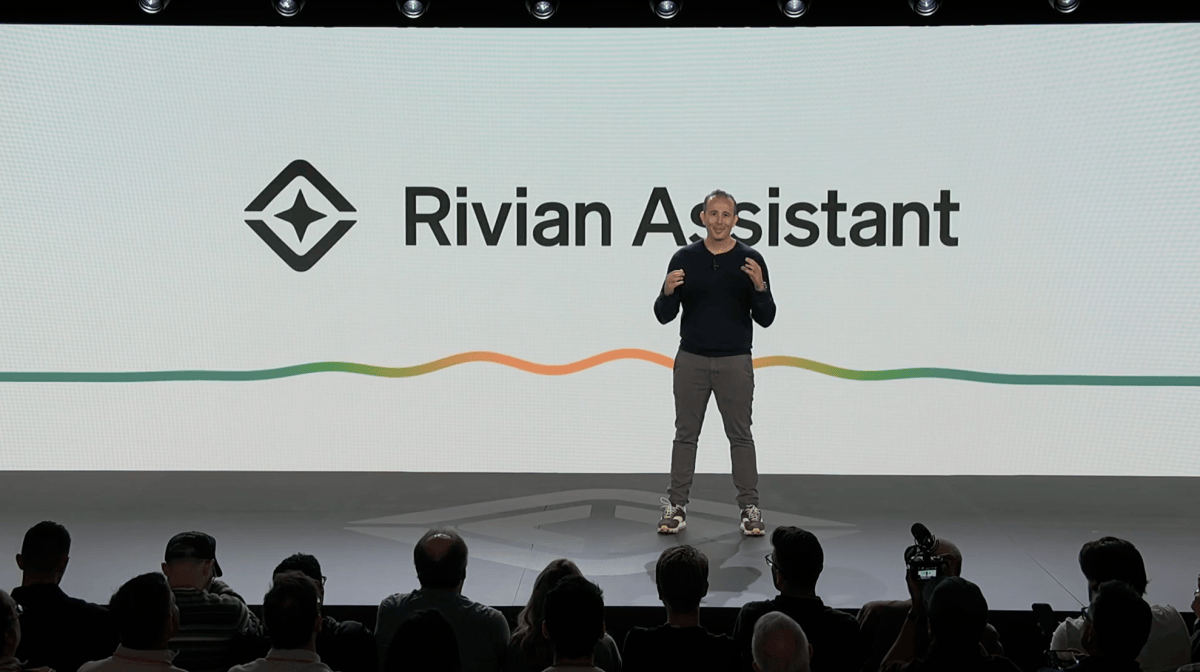
Before the Volkswagen licensing news, Rivian had already spent roughly two years building its own assistant. TechCrunch reported that the assistant rolled out in September 2026 to the R1S, R1T and R2.
RJ Scaringe, Rivian’s founder and chief executive, said the company built its own internal system to route requests to the right software layer in the car. He said, “we have created our own in-house agentic framework”.
That framing matters because it suggests Rivian is not just bolting on a generic chatbot. It is building a framework that can interpret a driver’s request and determine which vehicle functions should respond, a more integrated model than simple voice commands.
Scaringe also said Rivian vehicles could eventually run third-party AI agents, including Anthropic’s. That possibility is still future-facing, but it shows Rivian sees the car as a platform for outside AI services, not only its own software.
How does the Volkswagen licensing deal fit into Rivian’s strategy?
The licensing expansion looks like a direct test of whether Rivian can sell software infrastructure to the wider industry. The company is no longer talking only about installing its systems in Volkswagen vehicles through a joint venture; it is talking about letting Volkswagen access the assistant technology itself.
According to TechCrunch, Rivian has not disclosed licensing fees, payment terms or the exact VW models that will receive the assistant. That makes it difficult to measure the near-term revenue impact, but the strategic direction is clear: Rivian wants to be paid for the intelligence layer of the car, not just the hardware relationship.
Mint added another dimension to the story, reporting that the Rivian-VW JV is in talks with other automakers about supplying software and electrical architecture. Wassym Bensaid, Rivian’s chief software officer and JV co-CEO, said “many other OEMs are knocking on our door”. He declined to name the interested automakers or say how far those conversations have progressed.
Why Volkswagen is interested
Volkswagen has been trying to strengthen the software and electronics stack across its EV lineup, and Rivian offers a ready-made path into a more centralized, software-defined vehicle architecture. That architecture is designed to make cars easier to update, easier to simplify and potentially faster to bring to market.
The ID EVERY1, a low-cost EV mentioned by TechCrunch, illustrates why that matters. Entry-level vehicles can be especially sensitive to cost, complexity and software reliability. A more efficient electronic architecture could help Volkswagen bring lower-priced EVs to market with fewer technical compromises.
For VW, the assistant licensing also suggests a broader ambition: not just to buy a platform, but to tap into an interface layer that can shape how drivers interact with the car.
By the numbers
| Metric | Figure | What it refers to |
|---|---|---|
| Joint venture value | $5.8 billion | VW’s increased commitment to the Rivian partnership |
| Initial announced deal | Up to $5 billion | Earlier value before VW increased its commitment |
| ECUs in Rivian’s prior setup | 17 | Electronic control units before the new architecture |
| ECUs in the new architecture | 7 | Electronic control units in Rivian’s newer system |
| Assistant development time | About two years | Time Rivian spent building the AI assistant before launch |
| Assistant rollout | September 2026 | Launch month for R1S, R1T and R2 |
What the companies are saying
Rivian has repeatedly emphasized that the deal is about more than one product. The company says its architecture is built for extensibility, and it points to the assistant expansion as evidence that the platform can support additional layers of software.
“many other OEMs are knocking on our door”
That line from Wassym Bensaid is notable not because Rivian named a long list of suitors — it did not — but because it suggests the company believes the architecture has value outside the VW relationship. Mint reported that Bensaid would not identify the interested automakers or the stage of those discussions.
Rivian also says the broader architecture and its vertical integration give it the ability to roll out updates quickly across the vehicle. That is important if the company hopes to keep its own vehicles competitive while also supporting other brands through the JV.
Background: how software-defined cars changed the stakes
The auto industry has spent years moving toward software-defined vehicles, where centralized computing replaces a patchwork of separate control units and allows over-the-air updates to reach more systems at once. Rivian’s setup is built around that idea.
In practical terms, fewer ECUs and less wiring can simplify the manufacturing process and reduce weight. But just as importantly, it can make the vehicle easier to evolve after it leaves the factory. That helps explain why software architecture has become a strategic asset, not just an engineering choice.
Rivian is a U.S. EV maker known for SUVs and pickup trucks. Volkswagen, meanwhile, has been trying to improve its software and electronics across an EV portfolio that spans multiple brands and price points. That makes the partnership a fit on paper: one side has a software stack it wants to commercialize, and the other needs a faster route to a more modern vehicle platform.
The assistant licensing now gives that relationship a second layer. It is no longer only about the plumbing of the vehicle. It is also about the voice layer that customers will touch every day.
How is this different from a standard supplier deal?
It is different because Rivian is not just shipping a component or a one-off feature. The company is trying to license part of a broader in-house platform through a joint venture, which means the relationship sits closer to a strategic software partnership than to a routine parts contract.
That is also why the unanswered questions matter so much. The market still does not know which VW models will use the assistant, how the economics will work, or whether Rivian’s tech will spread beyond Volkswagen-branded vehicles into other brands under the wider VW umbrella.
The possibility of third-party AI agents adds another layer of complexity. If Rivian supports outside assistants later, the company could potentially create a more open software environment in its vehicles. But that remains an open question, not a confirmed product plan.
What happens next
The next phase will depend on which vehicles receive the assistant, how quickly Volkswagen can integrate the technology and whether the JV broadens its customer base.
- Model rollout: VW has not said which specific vehicles will use Rivian’s AI assistant.
- Commercial terms: Licensing fees and payment details remain undisclosed.
- JV expansion: Rivian and Volkswagen are reportedly talking with other automakers about software and architecture supply.
- 2027 focus: Bensaid said priority through 2027 is the R2 launch and integrating tech into other Volkswagen brands.
- AI ecosystem: Rivian has left open the possibility of supporting third-party AI agents in the future.
The most immediate benchmark will be whether Rivian can turn this partnership into repeatable revenue rather than a one-off alliance. If the assistant spreads to more VW vehicles and the JV signs additional automakers, it would strengthen the case that Rivian’s software stack is becoming a product line in its own right.
For now, the disclosure is enough to show the direction of travel: Rivian is using its Volkswagen relationship to move from EV maker to software platform provider, while Volkswagen gets access to technology that could help modernize its vehicles faster.
Bottom line
The headline is not simply that Rivian and Volkswagen are collaborating. It is that Rivian is attempting to convert its vehicle software, including an AI voice assistant, into a licensable asset with value beyond its own cars. If that strategy works, the VW joint venture could become both a technical bridge and a commercial model for how automakers buy software in the AI era.
Frequently asked questions
What is Rivian doing with Volkswagen now?
Rivian is expanding its Volkswagen joint venture to license AI voice-assistant technology to VW, adding a software layer to a deal that originally focused on Rivian’s electrical architecture and vehicle software.
How much is the Rivian-Volkswagen joint venture worth?
The joint venture is now valued at $5.8 billion, according to TechCrunch, after Volkswagen increased its commitment from an initial arrangement worth up to $5 billion.
Which Volkswagen models will get Rivian’s AI assistant?
Volkswagen has not said which models will receive the assistant. TechCrunch said the low-cost ID EVERY1 could be a possible first vehicle to use Rivian software and electrical architecture, but that is not confirmed.
Will Rivian support other automakers besides Volkswagen?
Possibly. Mint reported that the Rivian-VW joint venture is in talks with other automakers about supplying software and electrical architecture, though Rivian has not named any interested companies or given a timeline.
Why does this deal matter for Rivian?
It matters because it could help Rivian turn its in-house software stack into a licensed product, creating a revenue stream beyond its own vehicle sales while reinforcing its claim that its platform can scale to other brands.