In short
Anthropic has filed to go public on Nasdaq, with bankers reportedly weighing a $1.5 trillion to $2 trillion valuation and a possible trading debut as soon as next month. The filing highlights surging revenue, massive losses and the central question of whether AI growth can justify a mega-cap price tag.
- Anthropic filed an S-1 to list on Nasdaq, with a possible trading start as soon as next month.
- Bankers are reportedly considering a $1.5 trillion to $2 trillion valuation range.
- The WealthAdvisor says first-half 2026 revenue reached $16.3 billion, while net loss hit $80.7 billion.
- SemiAnalysis, cited by The Verge, says Anthropic reached more than $70 billion in ARR and improved inference gross margin to 85%.
Anthropic has filed to go public on Nasdaq, setting up one of the most closely watched AI listings yet and opening the door to a possible trading debut as soon as next month. The filing, an S-1, arrives as bankers reportedly weigh a valuation range as high as $1.5 trillion to $2 trillion, a scale that would put the Claude maker among the most valuable companies in the world.
The prospectus gives public investors their first detailed look at the business behind Anthropic’s rapid ascent. It also sharpens the central question around the company and the AI market more broadly: can explosive enterprise demand and improving efficiency justify a mega-cap valuation while losses remain enormous and compute costs stay high?
What Anthropic filed and why it matters
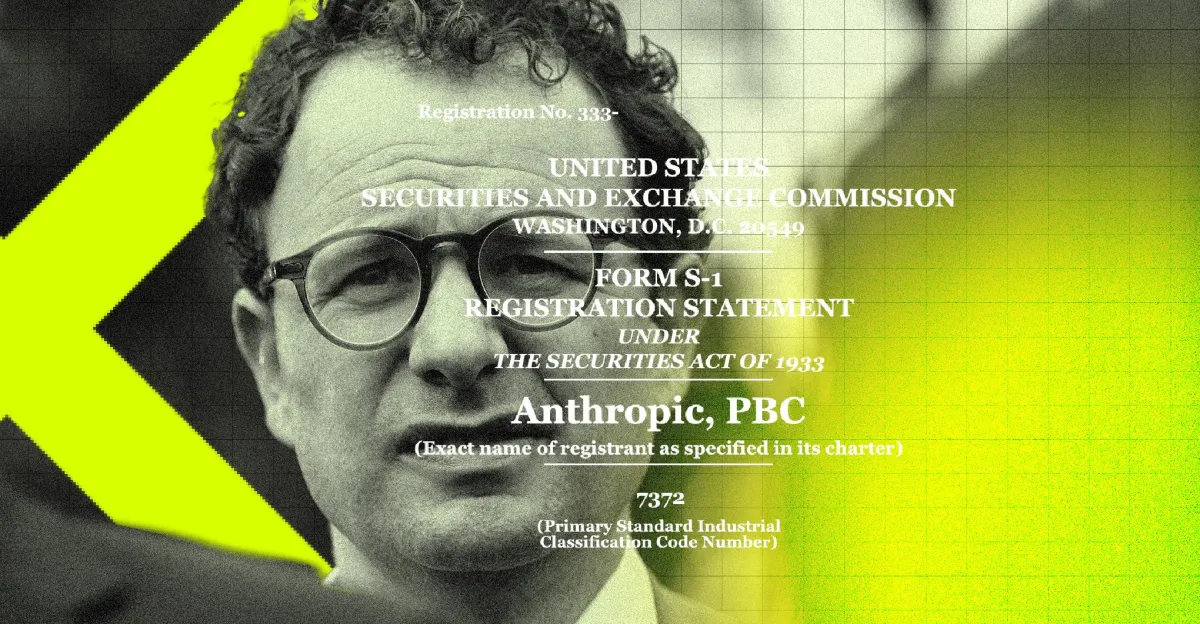
Anthropic submitted its IPO registration filing to the U.S. Securities and Exchange Commission, the standard first step before a public listing in the United States. According to The Verge, the company is targeting Nasdaq and could begin trading as soon as next month, though the timing is still fluid. The WealthAdvisor reported that the filing came Monday and that public investors are only now getting their first look at the prospectus.
The size of the discussion around the offering is what makes it unusual. A potential $1.5 trillion to $2 trillion valuation would place Anthropic in a tier usually reserved for the largest public companies, even though it remains a private AI lab best known for Claude and enterprise software sales. The WealthAdvisor noted that a valuation near $2 trillion would make Anthropic one of the most valuable companies in the market.
How high could the valuation go?
Bankers are reportedly weighing a range between $1.5 trillion and $2 trillion, though that is not the same as a final offer price. The WealthAdvisor said investor Jared Carmel would prefer a listing price closer to $1.3 trillion to $1.5 trillion, reflecting the tension between enthusiasm for the company and the challenge of pricing it in a public market.
“I don’t think $2 trillion is crazy”
That line, attributed to Jared Carmel of Manhattan Venture Partners, captures the mood around the deal: intense optimism, but also a recognition that even the most bullish expectations are being stress-tested by a market that knows how expensive AI infrastructure can be.
By the numbers
Anthropic’s filing lands against a backdrop of rapid growth, heavy spending and sharply debated margins. The company’s reported figures, along with outside estimates cited by The Verge and The WealthAdvisor, show a business expanding at extraordinary speed.
| Metric | Figure | Context | Source |
|---|---|---|---|
| Possible IPO valuation | $1.5T-$2T | Range bankers are reportedly weighing | The Verge |
| Preferred IPO range | $1.3T-$1.5T | Range Jared Carmel would prefer | The WealthAdvisor |
| First-half 2026 revenue | $16.3B | Up from $1.1B a year earlier | The WealthAdvisor |
| First-half 2026 net loss | $80.7B | Reported in the filing materials cited by The WealthAdvisor | The WealthAdvisor |
| ARR cited by SemiAnalysis | $70B-plus | Estimated level reached by Anthropic | The Verge |
| Inference gross margin | 85% | Up from negative 94% two years earlier | The Verge |
| Revenue per inference megawatt | $65M | Current estimate cited by SemiAnalysis | The Verge |
| Compute cost per megawatt | Just over $10M | Average inference compute cost | The Verge |
| Trainium throughput | 5x-10x | Year-over-year token throughput increase | The Verge |
What the filing suggests about Anthropic’s business
The clearest takeaway from the prospectus, as summarized by The Verge and outside analysis, is that Anthropic is no longer being valued solely as a chatbot company. The WealthAdvisor reported that Carmel views it as a critical enterprise AI supplier. That distinction matters because enterprise demand is more durable, more scalable and potentially more lucrative than consumer-facing chatbot traffic alone.
SemiAnalysis, cited by The Verge, said Anthropic reached more than $70 billion in annual recurring revenue on a valuation above $1 trillion and did so with unusually strong operational efficiency for an AI lab. The same analysis pointed to an 11% non-GAAP EBITA margin, strong gross margin trends, and improving free cash flow dynamics, all of which would help support a lofty IPO price if public investors believe the trend is sustainable.
Why the margin story is so important
For AI companies, growth can be easy to admire and hard to translate into a public-market valuation unless the economics improve. Anthropic’s filing becomes especially significant because it suggests the company is not just spending its way into revenue; it is also showing more favorable unit economics on inference, the stage where models answer user requests and generate ongoing costs.
According to SemiAnalysis, Anthropic’s inference gross margin is now 85%, compared with negative 94% two years ago. That change is dramatic, and it goes to the heart of the IPO case. If a company can keep improving margins while maintaining strong growth, investors may be willing to look past current losses. If not, the valuation math gets harder fast.
How did Anthropic get here?
Anthropic is one of the leading frontier AI labs and is best known for Claude, its large language model family. Like its peers, it has had to spend aggressively on training and inference compute, and it has relied on the economics of cloud infrastructure and chips to scale its products.
That is the structural backdrop for nearly every frontier-model company going public. Investors are not just buying software revenue; they are buying a bet on whether the company can continue to outgrow its infrastructure bill. The public markets will now have to decide whether Anthropic’s rate of expansion justifies the capital intensity that comes with it.
SemiAnalysis, as quoted by The Verge, said Anthropic’s first-half growth came from a relatively narrow market led by coding use cases. That matters because the company’s early revenue acceleration may have been powered by a concentrated demand pocket rather than a broad-based wave across all enterprise categories. If coding continues to scale, the revenue base could deepen. If not, the growth curve may flatten sooner than bulls expect.
What changed in the market around it?
The competitive backdrop is shifting too. The Verge reported that SemiAnalysis sees OpenAI catching up in coding by the third quarter of 2026, while Anthropic captured 90% of industry net new ARR in the first half. That combination suggests a market that is still being carved up quickly, with one company temporarily dominating fresh demand while rivals close the gap.
In other words, Anthropic’s IPO is not happening in a vacuum. It is arriving amid an intense contest for enterprise AI contracts, model usage and developer loyalty, all of which will influence how investors think about future growth.
Why it matters
This filing is important well beyond a single company because it tests whether the public markets are ready to underwrite AI at the scale of a mature mega-cap platform company, even while the underlying economics remain expensive and volatile.
For readers, the implications break down into several layers:
- For the AI market: A successful Anthropic IPO could reset expectations for how much investors will pay for frontier AI revenue.
- For enterprise buyers: The filing reinforces that AI vendors are increasingly competing to become core enterprise suppliers, not just novelty products.
- For rivals: OpenAI and other labs may face a more visible benchmark for valuation and business quality.
- For public investors: The deal could become a referendum on whether growth, margins and recurring revenue can offset enormous reported losses.
It also raises a broader question for the technology sector: if Anthropic can command a valuation in the trillions before listing, what does that imply about investor appetite for compute-heavy AI companies that are still early in monetizing their platforms? The answer will shape how future AI offerings are priced and how much capital they can raise without going public.
What the numbers say about the business model
Anthropic’s reported first-half 2026 revenue of $16.3 billion, up from $1.1 billion a year earlier, signals astonishing growth. But The WealthAdvisor’s report also points to a first-half net loss of $80.7 billion, showing that revenue acceleration has not yet translated into profitability.
That gap is the core tension in the story. High revenue growth tells investors there is demand. Massive losses remind them that the cost of serving that demand is still enormous, especially when AI inference and training require expensive hardware, electricity and cloud capacity.
SemiAnalysis’ figures, cited by The Verge, are meant to show that the economics are improving under the hood:
- Inference gross margin improved from negative 94% to 85% over two years.
- Average inference compute cost is now just over $10 million per megawatt.
- Revenue per inference megawatt is around $65 million, versus the mid-teens last year.
- Token throughput on Trainium chips rose 5x to 10x year over year.
If those trends hold, they offer a plausible path to stronger profitability over time. But public investors will want to know whether they are durable, repeatable and broad enough to survive a more competitive market.
How do The Verge and The WealthAdvisor frame the deal differently?
They agree on the big picture, but each outlet emphasizes a different angle. The Verge focused on the IPO mechanics, the valuation chatter and the outside analysis from SemiAnalysis, presenting the filing as a major test of AI economics and market enthusiasm. The WealthAdvisor focused more on the public filing itself, the revenue and loss figures, and investor reaction to the scale of the valuation.
That split is useful. One view treats the story as a market signal about the future of AI. The other treats it as a hard financial event, with numbers that investors can now scrutinize line by line. Together, they show why Anthropic’s filing has become such a focal point: it sits at the intersection of story, strategy and balance sheet reality.
Background and context
An S-1 is the registration statement companies file before a U.S. IPO. It is the document that gives public investors the first formal look at a private company’s financials, risk factors and business model. For Anthropic, that means its long-guarded growth story is moving into a new phase of scrutiny.
The company has become one of the clearest symbols of the frontier AI race. Its Claude models have established a place in the market, particularly with businesses that want an AI supplier they view as dependable and more deeply integrated into work processes. That positioning helps explain why investors are talking about Anthropic in enterprise terms, not just as a consumer chatbot brand.
But the company also reflects a broader truth about frontier AI: the largest players are spending enormous sums to build and serve models that consume substantial compute. That means valuation is being judged not only on growth, but on whether the firm can convert technical progress into a sustainable margin structure.
SemiAnalysis’ comments, as cited by The Verge, lean in Anthropic’s favor. Its estimate that Anthropic has already crossed $70 billion in ARR on a $1 trillion-plus valuation suggests a business of remarkable scale. The same analysis argues that the company has scaled efficiently, with strong gross margin, compute margin and free cash flow trends. Those are precisely the kinds of data points that can anchor a bullish IPO narrative.
What happens next
The next phase will be about pricing, timing and investor appetite. The main open questions are straightforward, but they carry significant consequences for the deal and for the AI sector as a whole.
- Final IPO valuation: Will the deal be priced closer to $1.3 trillion, $1.5 trillion or the upper end near $2 trillion?
- Listing timing: Will trading begin next month, or will the process slip beyond the current window?
- Profitability trajectory: Can Anthropic keep growing revenue while narrowing losses and improving unit economics?
- Demand mix: Will coding remain the primary growth engine, or will broader enterprise use cases take over?
- Competitive pressure: How quickly will rivals, including OpenAI, catch up in high-value use cases?
For now, the S-1 gives the market a first look, not a final answer. If the IPO proceeds on the current timetable, investors will soon have to decide whether Anthropic is a richly priced AI leader with unusually strong economics, or a very expensive bet on a still-unsettled market.
What is clear already is that the company has reached a scale where its valuation debate is no longer niche. The filing has turned Anthropic into a public-market case study in how much investors are willing to pay for AI growth, how much weight they place on improved margins, and how much risk they are prepared to absorb while the sector’s economics are still being written.
Frequently asked questions
What did Anthropic file with the SEC?
Anthropic filed an S-1, the standard registration statement companies submit before a U.S. initial public offering. According to The Verge, the filing sets up a Nasdaq listing and could lead to trading as soon as next month, although the timing is still under discussion.
How much is Anthropic expected to be worth in the IPO?
Bankers are reportedly weighing a valuation range of $1.5 trillion to $2 trillion. The WealthAdvisor said investor Jared Carmel would prefer a price closer to $1.3 trillion to $1.5 trillion, showing that the final pricing could still move materially.
Why is Anthropic’s IPO such a big deal?
Anthropic’s IPO is a major test of whether investors will pay a mega-cap valuation for an AI company still posting huge losses. The deal will help answer whether explosive revenue growth, improving margins and enterprise demand can outweigh the heavy compute costs behind frontier AI.
How fast is Anthropic growing?
The WealthAdvisor said Anthropic’s first-half 2026 revenue reached $16.3 billion, up from $1.1 billion a year earlier. SemiAnalysis, as cited by The Verge, also said the company reached more than $70 billion in annual recurring revenue, underscoring the pace of expansion.
What are the biggest risks for Anthropic after the filing?
The biggest risks are pricing, timing and whether the company can keep scaling efficiently. Investors will watch if coding remains the main growth engine, whether competition erodes pricing power and whether Anthropic can sustain strong margins while losses and compute spending remain high.