In short
Jensen Huang used Nvidia’s Berlin conference to argue that Europe should build its own AI economy using modular data centers, robotics, and AI agents. The company unveiled a preassembled DSX Pod data center and new robotics plans as it deepened its push into industrial AI.
- Nvidia CEO Jensen Huang said Europe should produce AI infrastructure, not just consume it.
- The company unveiled DSX Pod, a modular AI data center that can reportedly be online in about 14 days.
- Huang framed humanoid robotics and AI agents as the next major growth engines for compute demand.
- Nvidia announced a full-stack robotics platform and a reference robot called Agile One.
- The pitch ties Europe’s manufacturing base and auto industry to Nvidia’s broader AI ecosystem.
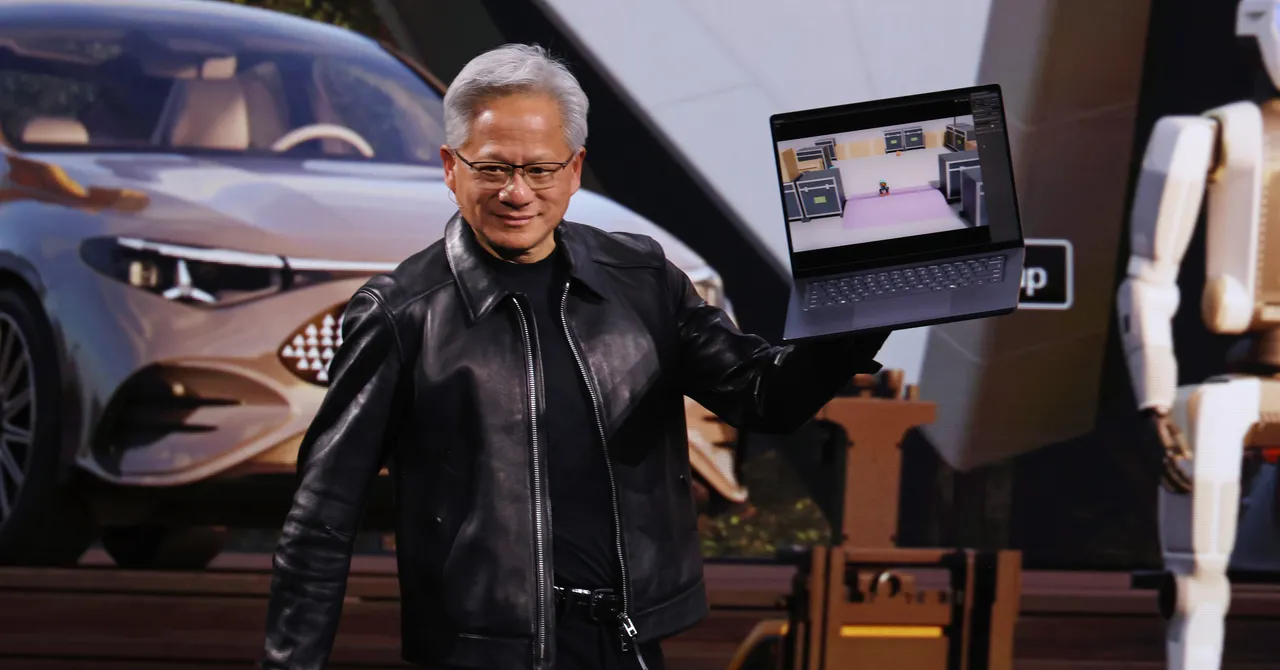
Nvidia chief executive Jensen Huang used the company’s Berlin GTC event on Wednesday to argue that Europe can do more than consume artificial intelligence—it can build and export it. His pitch centered on robotics, AI agents, and a new generation of modular data centers designed to go live in about two weeks, a message aimed at a region where power access, permitting, and construction timelines often slow major tech projects.
The event mattered because Huang’s vision was not just a product launch. It was a broader sales argument for how Europe could compete in the next phase of the AI boom: by pairing industrial strength with Nvidia hardware, software, and infrastructure. In his telling, the continent’s manufacturing base, engineering talent, and automotive sector give it a real opening—if companies and governments can move quickly enough.
What Huang told Europe’s AI audience in Berlin
Huang’s central message was that Europe should aim to produce AI, not merely rely on systems built elsewhere. Speaking before a crowd of roughly 4,000 at Nvidia’s global conference in Berlin, he framed the region as a place where the full stack of AI infrastructure could be built, from data centers to robots to software agents.
That framing matches Nvidia’s broader business strategy. The company has spent years moving from being known mainly as a chipmaker to positioning itself as the underlying platform for modern AI computing. In Berlin, Huang presented that platform as essential to Europe’s competitiveness in an era when AI is becoming infrastructure rather than just software.
Huang argued that countries and companies that want to participate in the AI economy should not only use AI tools, but build them locally, adding that Europe has the capability to do so.
The Berlin stop came seven months after Nvidia’s last GTC in San Jose, and the emphasis had shifted. Earlier this year, Huang focused on AI inference and more efficient compute. In Germany, the spotlight moved to energy, agents, and physical AI—the combination of software intelligence and machines that act in the physical world.
Why modular data centers were the headline announcement
The most consequential product announcement was Nvidia’s DSX Pod, a modular “AI factory” that Huang described as a plug-and-play data center. Instead of building a facility from the ground up over many months or years, buyers would receive a preassembled system shipped inside a large metal container, already fitted with Nvidia’s latest Vera Rubin compute racks.
Nvidia says the system can be operational in around 14 days. That speed matters because AI deployments are increasingly constrained by real-world bottlenecks: land, power, grid connections, construction delays, and local permitting. In Europe, those hurdles can be especially hard to clear.
Huang’s pitch was that a fast-deployed, standardised module could remove some of the friction that has slowed AI infrastructure investment. The pod format, he suggested, would also reduce the amount of computing capacity that sits unused while installations wait to come online.
For Nvidia, this is a strategic extension of its influence. The company is no longer selling only GPUs or servers. It is selling the blueprint for how to build AI infrastructure at scale.
| Announcement | What it is | Why it matters | Timeline |
|---|---|---|---|
| DSX Pod | Preassembled modular AI data center | Could speed up AI capacity deployment and reduce construction delays | Promised online in about 14 days |
| Full-stack robotics platform | Standardised system for humanoid robot development | Aims to make physical AI easier to build and deploy | Announced in Berlin |
| Agile One | Reference humanoid robot for developers | Gives builders a ready-made starting point for physical AI systems | Expected in Q1 next year |
| European partnerships | Work with Volkswagen and Mercedes on autonomous vehicles | Signals Nvidia’s push into industrial and automotive AI | Announced at GTC Berlin |
How Europe fits into Nvidia’s AI strategy
Europe is central to Huang’s argument because it has assets Nvidia believes can be converted into AI leadership. The region has a dense industrial base, deep automotive expertise, and a strong tradition of advanced manufacturing. Huang repeatedly pointed to those strengths as reasons Europe could help define the physical side of AI.
That is a significant departure from the usual narrative, which often casts Europe as a lagging force in digital infrastructure. In Huang’s view, the continent’s slower pace on permitting and data-center construction may be a weakness today, but modular systems could turn that weakness into a market opportunity.
Why the manufacturing argument matters
The manufacturing argument matters because robotics is becoming one of the clearest commercial frontiers for AI. Huang described humanoid robotics as the “next great industry,” and he suggested Europe is particularly well positioned to lead because of its industrial heritage.
That claim is both optimistic and strategic. Europe’s industrial companies are among the most likely customers for robot-assisted production, warehouse automation, and factory intelligence. If AI moves from chat interfaces into physical systems, the region’s factories, supply chains, and carmakers become prime test beds.
Huang also widened the definition of physical AI beyond robots alone. He said telecommunications operators are beginning to place Nvidia GPUs in cell towers, a sign that the company sees AI compute spreading across network infrastructure rather than remaining confined to large centralized data centers.
What Nvidia is saying about robots and physical AI
Nvidia is now treating robotics as a platform business, not just a research curiosity. In Berlin, Huang announced a full-stack robotics platform intended to standardize how humanoid systems are configured and developed. The goal is to make it easier for companies to build machines that can perceive, reason, and act in the real world.
Alongside that platform, Nvidia said it plans to release a reference robot called Agile One in the first quarter of next year. The idea is to give developers a ready-made starting point so they can focus on software, training, and use cases rather than assembling everything from scratch.
That approach mirrors how the company has long operated in computing: make the hardware stack, supply the software layer, and encourage an ecosystem of builders around it. In robotics, Nvidia is trying to do the same thing before competing standards settle into place.
Why robots matter to the AI market
Robots matter because they could extend the AI boom from digital services into factories, logistics, healthcare, transportation, and consumer devices. If current AI models can automate writing, coding, and analysis, physical AI can potentially automate movement, inspection, assembly, and maintenance.
That makes robotics not only a technical challenge but a market expansion strategy. Nvidia’s role is to provide the compute, simulation, training tools, and deployment layers needed to make those systems work at scale.
- Humanoid robots may become a key new customer base for AI hardware.
- Industrial firms could use robots to handle repetitive and hazardous tasks.
- Standardized reference systems may lower the barrier for developers entering the field.
- Physical AI could drive demand for more powerful chips, networking, and inference capacity.
How AI agents changed the conversation
AI agents were another major pillar of Huang’s pitch. He said future software environments would include more users of tools than ever before, because agents can reason, iterate, and take actions on behalf of people and businesses. In his view, that shift will increase the number of tasks performed inside software systems and push demand for computation higher.
That has direct implications for Nvidia. More agentic behavior means more model calls, more reasoning steps, and more token consumption. Each of those steps requires compute, which in turn strengthens demand for the GPUs and systems Nvidia sells.
The agent narrative also helps explain why the company is pushing so aggressively into infrastructure. If AI systems increasingly work on behalf of users rather than merely responding to prompts, then the amount of processing needed per workflow rises. Huang’s argument is that the next wave of AI demand will be even more compute-intensive than the last.
What Huang said about model choice
Huang said companies will likely rely on both closed and open models, depending on their needs, and then customize them for their own data and workflows. That is a practical position, reflecting how enterprise AI adoption is unfolding: businesses want flexibility, control, and a way to combine external models with proprietary information.
He also showcased Nvidia’s own open models, arguing that they can reach frontier-level performance when fine-tuned on company-specific data. The message to European enterprises was clear: Nvidia wants to be part of whichever model stack they choose, not just the chip supplier underneath it.
Huang’s message on models was that the future is unlikely to be a binary choice between open and closed systems; instead, most companies will mix both and adapt them to their own data.
Why the event matters for Europe’s data-center race
The DSX Pod announcement is especially relevant in Europe because the region’s data-center market faces chronic friction. Large infrastructure projects can take years to plan and build, often running into grid limitations, local opposition, and regulatory complexity. A modular system that can be installed in days offers a different path.
That does not mean the idea removes all obstacles. Power still has to come from somewhere, and the broader infrastructure must still exist to support expansion. But Nvidia is clearly betting that customers will value speed, predictability, and lower deployment risk enough to adopt modular AI factories at scale.
For governments and investors, this approach could also change the economics of AI infrastructure. A shorter build cycle can reduce capital tied up in projects that are not yet producing returns. It may also make it easier for smaller or more cautious buyers to enter the market.
What happened on stage in Berlin?
The presentation took place at Tempodrom, one of Berlin’s more distinctive venues, and the staging matched Nvidia’s increasingly theatrical product launches. Huang moved between technical explanations, big-picture forecasts, and product demonstrations over the course of roughly 90 minutes.
At one point, the event briefly turned political when Greenpeace protesters stood and displayed a banner criticizing the company’s environmental record. Huang told security to be gentle with them as they were escorted out, a moment that highlighted the tensions surrounding the energy demands of AI infrastructure.
The setting was also a reminder that Nvidia now occupies a role far beyond the traditional chip business. Its events resemble a blend of technology conference, industrial roadshow, and strategic briefing. The company is not just selling products; it is trying to shape how enterprises, utilities, governments, and developers think about AI deployment.
How Nvidia is connecting AI to Europe’s industrial base
Nvidia is tying together several sectors that often operate separately: data centers, telecoms, automotive manufacturing, and robotics. In Berlin, Huang pointed to partnerships with Volkswagen and Mercedes-Benz on autonomous vehicles, reinforcing the company’s message that AI compute belongs not only in cloud environments but in the machines and systems that move through the world.
That industrial positioning is especially powerful in Europe, where carmakers, machine builders, and automation firms already have deep technical know-how. Nvidia is essentially arguing that the continent’s existing strengths can be repurposed for the AI era if the right compute infrastructure is made available.
The company’s approach also reflects a broader industry trend: the line between software, hardware, and industrial systems is blurring. In that context, Huang’s Europe pitch is less about a single product and more about the architecture of the next economy.
Where telecoms fit in
Telecom operators may seem like an unusual part of the AI story, but Huang used them as another example of physical AI spreading outward. By placing GPUs in cell towers, networks can potentially process data closer to where it is generated, improving responsiveness and enabling new types of edge computing applications.
That idea fits Nvidia’s broader narrative about distributed AI infrastructure. If computing moves closer to end users, the market for Nvidia hardware and software expands beyond hyperscale data centers into the edge, the factory floor, and the transportation network.
How should investors and enterprises read the signal?
Investors should read the Berlin event as a sign that Nvidia believes the AI market is broadening rather than slowing. Huang is positioning the company for a world where demand is driven not just by model training, but by inference, agents, robotics, and localized compute.
Enterprises, meanwhile, should take the event as a signal that AI procurement is entering a more infrastructure-heavy phase. Buying access to an AI model is increasingly only part of the equation; deploying the compute, power, data center space, and integration layers may matter just as much.
For Europe in particular, the question is whether businesses and policymakers can move quickly enough to match Nvidia’s ambitions. If they do, the region could become a stronger player in AI production. If they do not, the result may be another cycle in which Europe remains an important market but not a center of gravity.
A quick timeline of Nvidia’s shifting AI message
The Berlin event showed how fast Nvidia’s story has evolved over the past year. The company is still selling chips, but it is now speaking the language of platforms, systems, and industrial transformation.
| Event | Focus | Takeaway |
|---|---|---|
| March GTC in San Jose | AI inference and more efficient compute | Nvidia emphasized how to run AI more efficiently |
| October GTC in Berlin | Power, agents, physical AI, modular data centers | Nvidia shifted toward infrastructure and real-world deployment |
| Next quarter | Agile One reference robot planned | Nvidia is preparing to standardize the robotics stack |
The bigger picture: AI as industrial infrastructure
Huang’s Berlin message was ultimately about scale. He wants Europe to think of AI not as a service imported from elsewhere, but as a manufacturing sector in its own right—one that includes chips, servers, data centers, robots, and industrial applications. That is why the event mixed product news with strategic language about production and sovereignty.
Whether Europe embraces that vision will depend on more than enthusiasm. It will require cheap and reliable power, faster approvals, better grid capacity, and a willingness from companies to invest in the tools needed to build local AI infrastructure. Nvidia can sell the architecture, but it cannot single-handedly remove the barriers that slow deployment.
Still, the direction of travel is clear. AI is moving from the screen into the physical economy, and Nvidia wants to be the company powering that transition. In Berlin, Huang made the case that Europe should not watch that shift from the sidelines. It should help engineer it.
What comes next
The next test will be whether Huang’s modular, industrialized vision can turn into actual European deployments. If customers adopt the DSX Pod model, if Agile One becomes a useful reference platform, and if major manufacturers lean further into Nvidia’s ecosystem, the company’s Berlin pitch could become a blueprint for a new phase of AI infrastructure.
If not, the event will still have served an important purpose: it made clear that Nvidia no longer sees AI as a software market alone. It sees a continent-wide economic opportunity built on power, compute, robotics, and speed.
Frequently asked questions
What did Jensen Huang announce in Berlin?
Jensen Huang announced a modular AI data center called DSX Pod, a new full-stack robotics platform, and plans for a reference humanoid robot named Agile One. He also highlighted partnerships with Volkswagen and Mercedes on autonomous vehicles.
Why is the DSX Pod important?
The DSX Pod is important because it could make AI infrastructure faster to deploy in Europe, where data-center projects often face long construction and permitting delays. Nvidia says the system can be brought online in about 14 days, which could reduce idle compute and speed up AI rollouts.
How does Nvidia see Europe fitting into the AI economy?
Nvidia sees Europe as a place that can build AI systems, not just buy them. Huang said the region has manufacturing strength, industrial expertise, and automotive know-how that could support robotics, AI infrastructure, and other physical AI applications.
What are AI agents doing for Nvidia’s business?
AI agents are expected to increase demand for computation because they reason, iterate, and use tools more than traditional software. That means more model calls and token consumption, which in turn supports higher demand for Nvidia GPUs and related infrastructure.
What is Agile One?
Agile One is Nvidia’s planned reference robot for developers. It is meant to give companies a standardized starting point for building humanoid and other physical AI systems, with availability expected in the first quarter of next year.