In short
SpaceX says artificial intelligence now accounts for 52% of its income, making it the company’s biggest business line. The filing shows strong quarterly revenue and profit growth, but also massive spending on data centers, compute and Starship.
- SpaceX’s AI division now generates 52% of company income.
- The company reported $14.6 billion in third-quarter revenue and $4.4 billion in net income.
- Capital spending hit $19.6 billion as SpaceX built data centers and funded Starship.
- Musk says annual recurring revenue could reach $500 billion to $1 trillion by the end of 2027.
- Year-to-date profits remain negative despite the strong quarter.
SpaceX said its artificial intelligence business has become the company’s largest source of income, accounting for 52% of total revenue in the latest quarter, as Elon Musk’s aerospace giant leans harder into data centers, AI agents and cloud-style compute infrastructure. The disclosure matters because it marks a sharp evolution for a company once defined almost entirely by rockets and satellites, and it shows how central AI has become to Musk’s wider corporate strategy.
In a regulatory filing released Tuesday, SpaceX reported $14.6 billion in revenue for the third quarter and returned to profitability with $4.4 billion in net income. The result was powered by growth across the business, but especially by the company’s newly renamed “Super Intelligence” division, which now includes the Cursor coding tool, the Grok chatbot and a fast-expanding neocloud operation backed by 1.7 gigawatts of compute capacity.
That surge came despite heavy spending. SpaceX said capital expenditures reached $19.6 billion as it pushed ahead with Colossus II, a second major data center project, and continued investing in Starship, the huge rocket program that Musk sees as essential to future Starlink satellites and, eventually, orbital data centers.
The quarter suggests SpaceX is no longer just a launch company with satellite internet attached. It is increasingly behaving like a vertically integrated infrastructure business that happens to include rockets, telecom, and AI compute under one roof. For investors, the headline is not only that SpaceX is making more money, but that its most lucrative growth engine now sits squarely inside AI.
What did SpaceX report in the latest quarter?
SpaceX reported $14.6 billion in third-quarter revenue, with artificial intelligence responsible for just over half of that total. The filing also showed a sharp turnaround in profitability, even after the company absorbed enormous spending on infrastructure and next-generation launch systems.
The company’s numbers point to a business that is scaling quickly in multiple directions at once. Its traditional space operations remain important, but the filing makes clear that compute-heavy services and AI products are now playing an outsized role in the top line.
| Metric | Latest Quarter | Prior-Year Comparison | What It Signals |
|---|---|---|---|
| Revenue | $14.6 billion | Not specified in the filing summary | Strong quarterly growth across the business |
| AI share of income | 52% | Not disclosed | AI is now the company’s dominant revenue source |
| Net income | $4.4 billion | $1 billion loss | A major profitability rebound |
| Capital expenditures | $19.6 billion | Higher than last year | Massive ongoing investment in infrastructure |
| Compute capacity | 1.7 GW | Growing | Neocloud ambitions are scaling rapidly |
| First nine months net income | -$413 million | Not specified | The year-to-date picture is still volatile |
How did AI become SpaceX’s biggest business?
AI became SpaceX’s biggest business because the company has been building a growing stack of services around compute, software and data centers, not just aerospace hardware. The Super Intelligence division now bundles several products and assets that together generate substantial revenue, including a coding tool, a chatbot and the company’s neocloud operation.
The filing suggests SpaceX has moved from selling access to orbital infrastructure to selling access to the digital infrastructure powering AI systems. That is an important shift because the economics of AI infrastructure can be recurring and scalable in ways that resemble cloud computing more than traditional space hardware sales.
The role of Grok, Cursor and neocloud services
SpaceX’s AI revenue is tied to a mix of products and services rather than a single breakthrough product. The Grok bot adds a consumer-facing and enterprise-facing software layer, Cursor brings in a popular coding workflow tool, and the neocloud business gives the company a large-scale compute platform that can be sold to customers building or running AI systems.
Of those pieces, the compute business appears to be the most strategically significant. In AI, access to large clusters of GPUs and reliable power is often the bottleneck. By reporting 1.7 GW of compute capacity, SpaceX is positioning itself as a serious infrastructure provider rather than a peripheral software vendor.
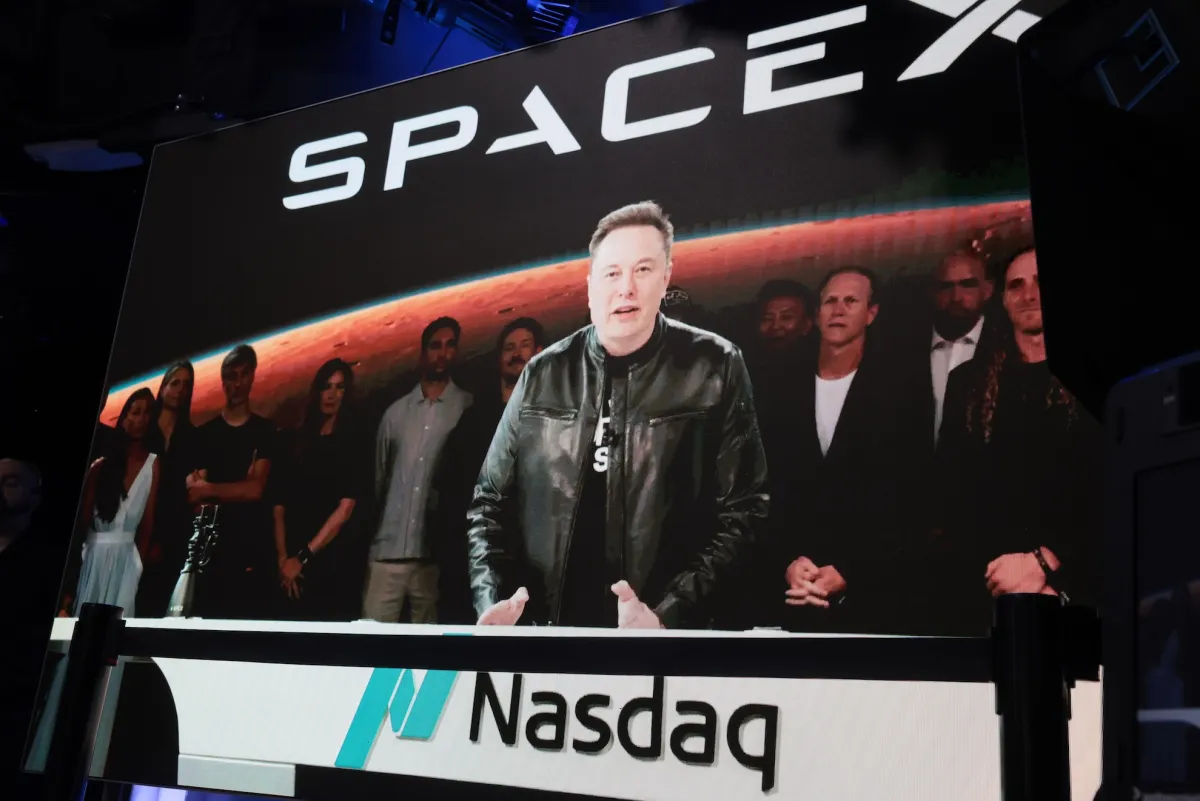
Elon Musk told investors and observers that he expects the company’s annual recurring revenue by the end of 2027 to land “somewhere between $500 billion and $1 trillion,” signaling just how aggressively he is framing the business’s future.
Why does the capital spending matter so much?
The spending matters because SpaceX is using a huge amount of cash to build capacity for businesses that may not fully pay off for years. The company’s $19.6 billion in capital expenditures underscores how expensive it is to expand AI infrastructure, push ahead with new data centers and continue developing the rockets needed to support future satellite and orbital ambitions.
Investors are therefore looking at a familiar Musk pattern: high burn today, large bets on platform control tomorrow. The difference is that the company is now spreading those bets across both the physical and digital layers of infrastructure.
Colossus II and the scale of the buildout
One of the clearest examples is Colossus II, SpaceX’s second major data center project. The filing does not detail the full timeline for completion, but the project indicates that the company is not satisfied with a modest footprint. It is building at a scale designed to support frontier AI workloads and potentially long-term enterprise customers.
That approach also helps explain why the company’s revenue can rise while spending remains enormous. In the AI market, growth often depends on securing power, land, cooling and networking before monetization fully catches up. SpaceX appears to be following that playbook, but with the added complexity of operating rockets and satellites at the same time.
How profitable is SpaceX right now?
SpaceX was profitable in the quarter, but its year-to-date position remains mixed. The company posted $4.4 billion in net income for the third quarter, a sharp improvement from the roughly $1 billion loss it recorded in the same quarter last year. Over the first nine months of the year, however, it still showed a cumulative net loss of $413 million.
That combination tells a more nuanced story than the quarterly headline alone. The business is clearly capable of generating substantial earnings in a strong period, but its overall financial performance still depends on the timing of large projects, the pace of capital spending and the contribution from non-core income sources.
What boosted the bottom line?
SpaceX’s reported profitability was helped by more than just operating revenue. Roughly $1 billion in income was tied to the recovery of bitcoin prices and an unspecified related-party item that may be linked to a SpaceX investment in another company. Those items complicate the picture, because they are not the same as organic revenue from selling products or services.
Even so, the numbers show that the company’s core business and adjacent bets are now large enough to absorb heavy investment and still deliver a quarterly profit.
What does this say about Elon Musk’s strategy?
It suggests Musk is recasting SpaceX as part of a broader AI and infrastructure empire, rather than treating it as a standalone aerospace firm. The company’s internal language is revealing: “Super Intelligence” is not a space label, but an AI one. That branding choice shows where the company believes future value lies.
Musk has long favored vertically integrated companies that control both the product and the underlying infrastructure. With SpaceX, that means satellites, launch capability, data centers, software tools and compute networks are now all part of one extended strategy. The result is a company that can support its own systems while also selling capacity to others.
From launch provider to infrastructure platform
SpaceX is still deeply tied to rockets and satellites, but the filing shows a business increasingly built around the digital backbone of the AI economy. The company is investing in Starship not only because of launch ambitions, but because it sees the rocket as central to deploying new Starlink satellites and, ultimately, to building orbital data centers.
That is where the space business and AI business begin to overlap. If the company succeeds, SpaceX could control a chain that runs from launch services to satellite connectivity to AI compute hosted on Earth and possibly in orbit.
- SpaceX’s AI unit now generates more than half of company income.
- The company reported $14.6 billion in quarterly revenue.
- Net income reached $4.4 billion after a year-earlier loss.
- Capital expenditures were $19.6 billion, reflecting a massive buildout.
- The company says it now has 1.7 GW of compute capacity.
What are the biggest risks behind the growth?
The biggest risks are execution, capital intensity and dependence on emerging markets that can change quickly. Building data centers at scale is expensive, and SpaceX is doing so while also funding a demanding rocket roadmap. That means the company is exposed to delays, cost overruns and shifts in AI demand.
There is also a valuation risk. Musk’s prediction of up to $1 trillion in annual recurring revenue by the end of 2027 is extraordinarily ambitious. Even for a company with SpaceX’s momentum, that figure would require a dramatic increase in customers, infrastructure utilization and monetization across both AI and space-related businesses.
Why investors are watching closely
Investors are watching because SpaceX is increasingly competing with companies that do not share its legacy. On one side are cloud and AI infrastructure players; on the other are aerospace and satellite firms. SpaceX now sits across both sectors, which creates upside if its integrated model works, but also makes it harder to benchmark the company against any one industry.
That ambiguity can be attractive in the market, especially when a company is showing revenue growth and profitability. But it also means the path to sustained returns may be more volatile than the latest quarter suggests.
Where the story goes next
SpaceX’s next phase will likely be defined by whether it can convert its current momentum into durable recurring revenue. The company is clearly building for scale, and it is doing so at a pace that few rivals can match. If the neocloud business grows as planned and Starship continues to advance, the company’s AI ambitions could expand even faster than the market currently expects.
For now, the takeaway is straightforward: SpaceX is no longer just a space company that happens to dabble in AI. Its latest filing shows AI has become the core commercial engine of the business, even as the company keeps spending heavily on the rockets and data centers meant to support its long-term expansion.
Key figures at a glance
| Item | Figure | Context |
|---|---|---|
| Third-quarter revenue | $14.6 billion | Driven by growth across all major segments |
| AI share of income | 52% | AI is now the largest contributor |
| Net income | $4.4 billion | Reversal from last year’s loss |
| Capital expenditures | $19.6 billion | Includes Colossus II and Starship investment |
| Compute capacity | 1.7 GW | Supports neocloud and AI growth |
| Year-to-date net income | -$413 million | Still negative for the first nine months |
SpaceX’s latest filing offers a rare look at how fast the company’s center of gravity is shifting. The numbers are impressive, but the bigger story is strategic: Musk’s company is using its space expertise, cash generation and infrastructure ambitions to build an AI business that is already larger than its legacy identity would suggest.
Frequently asked questions
How did SpaceX’s AI business become so important?
SpaceX’s AI business became important by combining software, chatbot products and large-scale compute infrastructure into one revenue engine. The company says that mix now makes up 52% of income, showing that AI has moved from a side bet to its main growth driver.
Did SpaceX make money in the latest quarter?
Yes. SpaceX reported $4.4 billion in net income for the third quarter, reversing a $1 billion loss in the same period a year earlier. Even so, the company still showed a $413 million net loss over the first nine months of the year.
What is Super Intelligence at SpaceX?
Super Intelligence is SpaceX’s renamed business line for its AI-focused operations. It includes the Cursor coding tool, the Grok chatbot and the company’s neocloud and compute infrastructure, which together are now central to its revenue growth.
Why is SpaceX spending so much on data centers?
SpaceX is spending heavily because it is building the infrastructure needed for AI workloads and future satellite-related ambitions. The company said capital expenditures reached $19.6 billion, including work on Colossus II and continued investment in Starship.
What revenue does Elon Musk expect by 2027?
Elon Musk said he expects annual recurring revenue to reach somewhere between $500 billion and $1 trillion by the end of 2027. That is an extremely ambitious target and would require rapid expansion across both AI and SpaceX’s broader infrastructure businesses.