Updated July 20, 2026 9:25 pm
In short
Jensen Huang’s Tokyo trip expanded Nvidia’s reach across Japan’s AI stack, from a sovereign AI factory and robotics partnerships to new chip-material supply deals, as Japan pushes hard to dominate physical AI by 2040.
- Nvidia expanded its Japan strategy with deals spanning robotics, automotive and national AI infrastructure.
- Japan is betting on physical AI to offset labor shortages and strengthen industrial competitiveness.
- The Noetra project aims to build sovereign AI models while relying on Nvidia hardware and data-center plans.
- Major Japanese manufacturers including Toyota, Fanuc and Yaskawa are aligning with Nvidia’s Cosmos platform.
- The visit underscores the growing importance of factory-floor AI and edge computing in the next phase of the industry.
Update — July 20, 2026 9:25 pm
The updated source adds a new part of Huang’s Tokyo agenda: Nvidia also struck deals with Japanese chip-material suppliers, extending its reach beyond robotics and into the inputs that help make its next-generation AI chips.
It also says Japan’s AI Robotics Strategy is targeting more than 30% of the global AI robotics market by 2040, a market Tokyo values at about ¥20 trillion ($133 billion).
The source further reports that Huang met with a wider circle of Japanese industry leaders, including Toyota, Fanuc, Yaskawa, Fujitsu and Kawasaki, underscoring how broadly Nvidia is now embedded across Japan’s tech and manufacturing ecosystem.
Update — July 20, 2026 12:53 am
New details in the updated source suggest Huang’s Tokyo trip went beyond AI and robotics. Nvidia also secured agreements with Japanese chip-material suppliers, widening the company’s reach into the supply chain behind its next generation of AI chips.
The story also adds more color on Japan’s broader policy push: the government’s AI Robotics Strategy aims to capture more than 30% of the global AI robotics market by 2040, a market Tokyo values at about ¥20 trillion ($133 billion).
Huang was also reported to have met directly with top Japanese tech and industrial leaders, including Toyota, Fanuc, Yaskawa, Fujitsu and Kawasaki, underscoring how broadly Nvidia is now embedded across the country’s tech ecosystem.
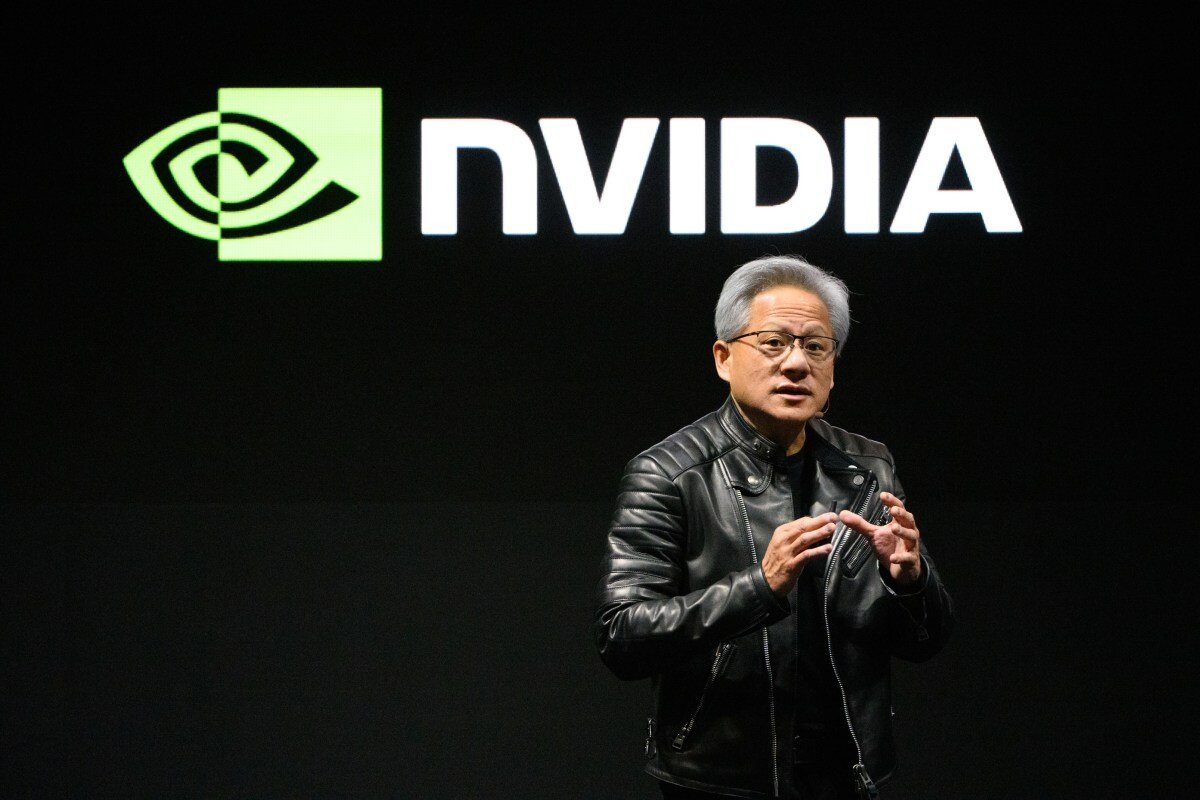
Nvidia chief executive Jensen Huang’s two-day visit to Tokyo this week marked a major escalation in the company’s push into Japan’s manufacturing sector, with new partnerships spanning robotics, chip materials and a national AI infrastructure project. The trip matters because it ties Nvidia’s next wave of growth to Japan’s effort to build “physical AI” for factories, machines and robots.
Huang spent July 15 and 16 meeting with some of Japan’s most influential industrial groups and left with agreements that connect Nvidia more deeply to the country’s semiconductor supply chain and robotics ecosystem. The visit also sharpened the political and strategic stakes: Japan wants more control over its AI stack at a time when the United States and China are dominating large-scale model development, while Nvidia wants Japan’s factories, data and manufacturing expertise to help define the next phase of AI.
At the center of the trip is a simple idea: the next big AI market may not be chatbots or office software, but machines that can perceive, reason and act in the physical world. Japan, which faces demographic pressure and a shrinking workforce, is betting that AI-enabled robotics can help it stay competitive. Nvidia is betting that it can supply the chips, software and model infrastructure that make that shift possible.
What did Jensen Huang secure in Tokyo?
Huang returned from Tokyo with a set of announcements that reach across Japan’s technology stack, from national AI infrastructure to industrial robots and automotive systems. The deals are notable not only for their size but also for how closely they align Nvidia with the country’s industrial strategy.
A national AI effort built around Noetra
The most ambitious project is Noetra, Japan’s sovereign AI initiative. Backed by roughly 44 domestic companies, including SoftBank, Sony, NEC and Honda, the project is designed to give Japan a homegrown AI foundation for robots, vehicles and factory systems rather than relying on foreign platforms.
Tokyo has committed up to 1 trillion yen, or about $6.2 billion, over five years to support the effort. The goal is to build “physical AI” models that can run machines and industrial systems in Japanese settings, with control over the software stack staying largely inside the country.
Nvidia will still play a central role. The company is building what it describes as a Vera Rubin AI factory, a huge data center meant to train the models that Noetra wants to develop. The planned facility is expected to come online in 2028 and is designed around 13,750 Vera CPUs, 27,500 Rubin GPUs and 140 megawatts of power capacity.
Japan’s robotics coalition rallies around Cosmos
Nvidia also widened its robotics alliances. A group that includes Fanuc, Yaskawa, Kawasaki Heavy Industries, Fujitsu, Hitachi, NEC, Sony, SoftBank, Kubota and robotics consortium AIRoA said it plans to build on Nvidia’s Cosmos model family.
Cosmos is Nvidia’s open-model initiative for physical AI, launched in May with participation from several global AI laboratories. In Tokyo, Nvidia introduced Cosmos 3 Edge, a version designed to run on Jetson Thor chips directly inside machines. That matters because edge-based AI can process data locally inside robots and industrial equipment instead of sending everything to the cloud.
Toyota deepens its Nvidia dependency
Toyota is also extending its use of Nvidia technology beyond car development. The automaker already committed to Nvidia’s Drive platform for future vehicles, and the new work expands that relationship into manufacturing simulation, in-vehicle software and traffic interpretation systems.
The company’s current approach centers on advanced driver assistance rather than fully driverless operation. That places Toyota in a more cautious lane than companies such as Waymo and Tesla, which are pursuing systems that rely less on human intervention.
Why is Japan investing so heavily in physical AI?
Japan is investing in physical AI because its industrial base is strong, its population is aging and its workforce is shrinking. The country’s leaders see robotics and AI as tools to preserve productivity, improve manufacturing and reduce the pressure of labor shortages across multiple sectors.
The government has set an ambitious target: 10 million AI-equipped robots across 18 industries by 2040. Public and private investment in physical AI is expected to reach $65 billion as Japan tries to turn manufacturing strength into a long-term strategic advantage.
There is also a competitive reason. Japan wants to avoid becoming dependent on AI systems built and controlled by the U.S. or China. By backing a domestic effort such as Noetra, the country hopes to retain ownership of the data, models and deployment environment that will shape future industrial automation.
Huang said Nvidia believes the next major phase of AI will play out in the real world, not just on screens, describing the industrial and robotics opportunity in Japan as a once-in-a-generation chance to modernize manufacturing for intelligent systems.
That message resonated because Japan is already one of the world’s manufacturing powerhouses. If AI systems are trained on factory data and deployed in factories, the country can potentially export not just products, but the models and methods that power them.
How does Noetra fit into Japan’s AI sovereignty goals?
Noetra is both an industrial project and a sovereignty play. The government wants a national AI system that can serve factories, vehicles and robots without relying on infrastructure it does not control. That makes compute capacity, data governance and model ownership central issues, not technical side notes.
The project is being developed in stages. First, Japan wants a reasoning model with strong Japanese-language capabilities beginning in fiscal 2026. Next, it plans an omni-modal system by 2028 that can handle text, images, video and audio. By 2030, the aim is to create “Real-world Native AI” designed specifically for robots and open it in phases to outside developers.
That roadmap is significant because it shows Japan is not simply trying to import AI tools. It wants to build a domestic ecosystem that can support machine learning at scale, from training to deployment. The Nvidia data center is the hardware backbone, but the policy ambition is larger: strategic independence through industrial AI.
| Project | Main participants | Purpose | Timeline | Notable detail |
|---|---|---|---|---|
| Noetra | 44 domestic firms including SoftBank, Sony, NEC, Honda | National AI for robots, vehicles and factories | 2026-2030 | Backed by up to ¥1 trillion in state support |
| Vera Rubin AI factory | Nvidia and Noetra | Training infrastructure for large physical-AI models | Expected 2028 | Planned 140 MW data center with 27,500 Rubin GPUs |
| Cosmos 3 Edge | Fanuc, Yaskawa, Kawasaki Heavy, Fujitsu, Hitachi and others | Edge AI for robots and industrial machines | Rolling out now | Runs on Jetson Thor chips inside devices |
| Toyota integration | Toyota and Nvidia | Vehicles, simulation and manufacturing software | Ongoing | Extends Nvidia beyond cars into production systems |
Why are Japan’s manufacturers getting behind Nvidia?
Japan’s manufacturers are backing Nvidia because the company now offers something more than chip supply: it provides an end-to-end stack for building AI that can work in physical environments. That includes training models, running inference in machines and connecting factory systems to simulation and software tooling.
For major industrial groups, the attraction is clear. Nvidia’s platform allows robotics and manufacturing companies to accelerate development without starting from scratch on every layer of the technology stack. It also gives them access to hardware and model infrastructure powerful enough to support next-generation automation.
What changes with edge AI?
Edge AI changes the economics and practicality of industrial automation because it moves intelligence closer to the machine. Instead of depending entirely on distant cloud servers, robots and equipment can make decisions faster and with lower latency.
That is especially important for settings such as factory floors, warehouses and vehicle systems, where split-second responses matter. Cosmos 3 Edge is Nvidia’s attempt to make that capability easier to deploy at scale.
How big is Nvidia’s Japan strategy?
Nvidia’s Japan strategy is big enough to touch multiple sectors at once. It reaches into semiconductors, manufacturing, robotics, automotive systems and government-backed AI infrastructure. That breadth is part of the company’s advantage: it is selling a platform, not a single product.
The timing is also important. Huang was in Japan only weeks after a keynote in Taiwan and months after a trip to South Korea. In each case, he has been building relationships with the Asian industrial base that supplies, manufactures and increasingly deploys the technologies Nvidia needs.
Japan is especially significant because of its historical expertise in robotics and precision manufacturing. If Nvidia can anchor its physical-AI strategy there, it gains credibility in one of the world’s most advanced industrial economies. That could help the company shape how robots are built, trained and controlled globally.
How does Toyota’s move compare with other autonomous vehicle efforts?
Toyota’s approach is more measured than the fully self-driving strategies pursued by some rivals. The company is focused on advanced driver assistance systems that support steering and braking while still keeping a human driver in the loop.
By contrast, Waymo is pursuing more fully autonomous ride-hailing, while Tesla continues to push software-driven autonomy in its consumer vehicles. Toyota’s pace reflects its broader corporate style: gradual, highly integrated and cautious about safety and deployment risk.
Even so, the relationship with Nvidia suggests Toyota is not standing still. The company is using the chipmaker’s tools in simulation, software and traffic interpretation, signaling that AI will be central not only to future products but also to how those products are designed and built.
What does Japan gain from Nvidia’s data center plan?
Japan gains the compute power needed to train large-scale models for industrial use, and that may be the single most important bottleneck in the entire strategy. Training models with trillions of parameters requires enormous infrastructure, electricity and technical expertise.
The planned Vera Rubin AI factory would give Noetra a domestic training base with the scale needed for advanced physical AI. That matters because Japan cannot build a sovereign AI ecosystem without the hardware to support it. For now, sovereignty depends in part on American silicon.
The arrangement is a compromise, but one that may be practical. Japan gets local control over the data and model direction, while Nvidia provides the infrastructure needed to make the project viable. In strategic terms, that gives Tokyo a bridge toward independence without forcing an immediate break from global supply chains.
Timeline: how the Japan strategy is unfolding
The current wave of deals did not appear overnight. It fits into a broader sequence of Nvidia courtship across Asia.
- March 2026: Japan’s AI Robotics Strategy is released, setting a 2040 target for global market share and robot deployment.
- May 2026: Nvidia launches its Cosmos open-model effort for physical AI.
- July 15-16, 2026: Huang visits Tokyo and meets with industrial leaders, government officials and supply-chain executives.
- During the visit: Nvidia announces Cosmos 3 Edge and advances the Noetra and robotics partnerships.
- 2028: Nvidia’s planned Vera Rubin AI factory is expected to launch.
- 2030 and beyond: Japan aims to deploy “Real-world Native AI” and scale industrial robotics across the economy.
What are the risks and unanswered questions?
There are still serious questions about execution, cost and governance. Large-scale AI infrastructure projects are expensive, technically complex and politically sensitive. Japan’s plan assumes that its industrial data and manufacturing expertise can be turned into a global advantage, but that transformation is not guaranteed.
Another question is whether Japan can preserve the spirit of sovereignty while relying on Nvidia’s chips and systems. The answer may depend on how much control Noetra retains over model design, deployment and data access once the infrastructure is built.
There is also the broader market question: will physical AI develop as quickly as advocates expect? Factory automation, robotic dexterity and real-world reasoning are much harder problems than text generation. If the technology matures slowly, the economic payoff may take years longer than policymakers hope.
What could slow the rollout?
Several factors could delay the plan, including energy constraints, model-development complexity, integration challenges and shifting political priorities. Building a large AI factory and deploying robots across 18 sectors will require sustained coordination between government, industry and technology providers.
Why Huang’s Tokyo visit matters beyond Japan
Huang’s Tokyo trip is important beyond Japan because it highlights where the AI industry may be headed next. The hottest race is no longer only about model size or chatbot popularity. It is increasingly about whether AI can control machines, improve manufacturing and move from the digital layer into the physical world.
Nvidia is positioning itself at the center of that transition. By aligning with Japan’s industrial giants, it is not just selling chips. It is helping define an operating system for the factory floor, the robot arm and the autonomous vehicle.
For Japan, the opportunity is equally large. If Noetra and the robotics partnerships succeed, the country could turn industrial depth into AI leadership. That would give it a rare strategic edge: a way to shape the next era of automation using the strengths it has built over decades.
Thirty years ago, a small investment from Sega helped Nvidia survive an early crisis. Today, the relationship between Nvidia and Japan has reversed into something much larger: a mutual bet on the future of intelligent machines.
In Tokyo, Huang made the case that the next chapter of AI belongs on factory floors, in robots and inside the systems that make and move physical things. Japan, for now, appears ready to build that future with him.
Additional reporting context: Nvidia’s recent Asia tour has included high-profile stops in Taiwan and South Korea, underscoring the company’s effort to secure both the supply chain and the demand side of physical AI.
Frequently asked questions
What did Jensen Huang announce in Japan?
Jensen Huang’s Japan trip produced partnerships tied to a national AI project, industrial robotics and automotive technology. Nvidia also unveiled Cosmos 3 Edge and advanced plans for a large AI factory to support Japan’s physical AI ambitions.
What is Noetra in Japan’s AI plan?
Noetra is Japan’s sovereign AI initiative aimed at building domestic models for robots, vehicles and factories. It is backed by about 44 companies and supported by up to 1 trillion yen in public funding over five years.
Why is physical AI important for Japan?
Physical AI is important for Japan because the country faces a shrinking workforce and wants to protect its manufacturing edge. AI-powered robots and machines could help preserve productivity across industries while reducing dependence on foreign AI infrastructure.
How is Nvidia involved in Japan’s robotics strategy?
Nvidia is involved through its Cosmos model family, Jetson Thor chips and planned AI infrastructure. Japanese robotics and manufacturing companies are building on Nvidia’s tools to develop machines that can process data and act locally inside factories.
What role does Toyota play in Nvidia’s Japan push?
Toyota is extending its relationship with Nvidia beyond vehicle development into manufacturing simulation, software and traffic systems. The automaker is using Nvidia technology to support advanced driver assistance and broader industrial AI work.