Updated July 21, 2026 9:24 pm
In short
BloombergNEF still sees U.S. data centers consuming about one-fifth of electricity by 2035, but its latest outlook also points to 1,935 TWh of added global demand by 2033 and even heavier strain on PJM and ERCOT.
- BloombergNEF now sees U.S. data centers using 20% of electricity by 2035.
- AI training and inference are expected to account for nearly half of new data center capacity.
- PJM and ERCOT are among the most exposed grids as demand surges.
- The forecast is sharply higher than BloombergNEF’s December estimate and in line with other upward revisions.
- Global data center demand could add 1,935 TWh by 2033 if AI adoption stays aggressive.
Update — July 21, 2026 9:24 pm
BloombergNEF’s latest outlook also says the worldwide ripple effect could be larger than the U.S. alone. If AI adoption keeps accelerating, data centers are projected to add 1,935 terawatt-hours of new electricity demand globally by 2033, nearly matching India’s annual usage.
The report also sharpens the regional picture: PJM is now expected to send 34% of its power to data centers by the middle of the next decade, while ERCOT could dedicate 22% of its generation capacity to those facilities.
U.S. data centers are on track to use about one-fifth of all electricity generated in the country by 2035, according to a new BloombergNEF forecast that highlights how quickly artificial intelligence is remaking power demand. The consultancy says the AI boom could drive data center capacity to nearly 200 gigawatts within the next decade, with the vast majority of the buildup still centered in the United States.
The findings matter because they point to a coming collision between the AI industry’s appetite for compute and an electricity system that is already under strain in many regions. BloombergNEF’s latest outlook suggests utilities, grid operators and policymakers may have to prepare for demand growth that is faster, broader and more concentrated than many earlier estimates anticipated.
AI is turning data centers into a power-sector story
Data centers are no longer a niche infrastructure issue. They have become one of the most important drivers of electricity demand in the United States as companies race to build the computing capacity needed to train and run large AI models.
BloombergNEF estimates that by 2035, data centers will account for 20% of U.S. electricity generation, roughly four times their current share. The report says the expansion is being propelled by demand for both model training and inference, the two processes that underpin modern AI products.
In plain terms, training is the energy-intensive work of building a model, while inference is the continuous electricity consumption required to use it at scale. As AI assistants, enterprise tools and consumer-facing applications become more common, the load does not stop when a model is finished training. It keeps growing as more queries, more applications and more users are added.
Why the forecast has changed so quickly
BloombergNEF says its new 2035 electricity estimate is 83% higher than the projection it issued in December. That jump reflects how quickly developers have moved to add server capacity, and how aggressively major technology companies are pursuing AI infrastructure.
The consultancy is not alone in revising its assumptions upward. Other institutions have also increased their estimates as evidence mounts that AI-related demand is arriving sooner and at a larger scale than previously expected.
- EPRI, the electric power research nonprofit, has more than doubled its 2024 forecast.
- S&P’s outlook rose by more than one-third between October and April.
- BloombergNEF says the pace of data center development has outstripped earlier assumptions.
Taken together, the revisions suggest the industry is entering a period where the true constraint may not be computing hardware, but the power required to run it.
How big could the buildout become?
BloombergNEF expects data center capacity to approach 200 gigawatts over the next decade, a scale that would require a massive expansion in generation, transmission and grid interconnection. Nearly half of that capacity is expected to be used for AI training and inference.
The report also says the U.S. will remain the central hub for AI compute. By 2033, the country is projected to host 64% of AI chips by power demand, showing how much of the global buildout is still expected to cluster around American markets, campuses and utility territories.
That concentration is important because it means the strain will not be spread evenly. Instead, the burden will fall heavily on specific regions already facing long queues for power connections, transformer shortages and transmission bottlenecks.
| Metric | BloombergNEF forecast | Why it matters |
|---|---|---|
| U.S. electricity share used by data centers in 2035 | 20% | Signals a major shift in national power demand |
| Increase versus today | About 4x | Shows the speed of the expected expansion |
| Estimated data center capacity by 2035 | Nearly 200 GW | Indicates the scale of infrastructure needed |
| Share of capacity for AI training and inference | Nearly 50% | Links power demand directly to AI workloads |
| U.S. share of AI chips by power demand in 2033 | 64% | Shows the U.S. remains the dominant AI compute center |
| Global new electricity demand from data centers by 2033 | 1,935 TWh | Approaches India’s annual electricity use |
Where will the grid feel the pressure first?
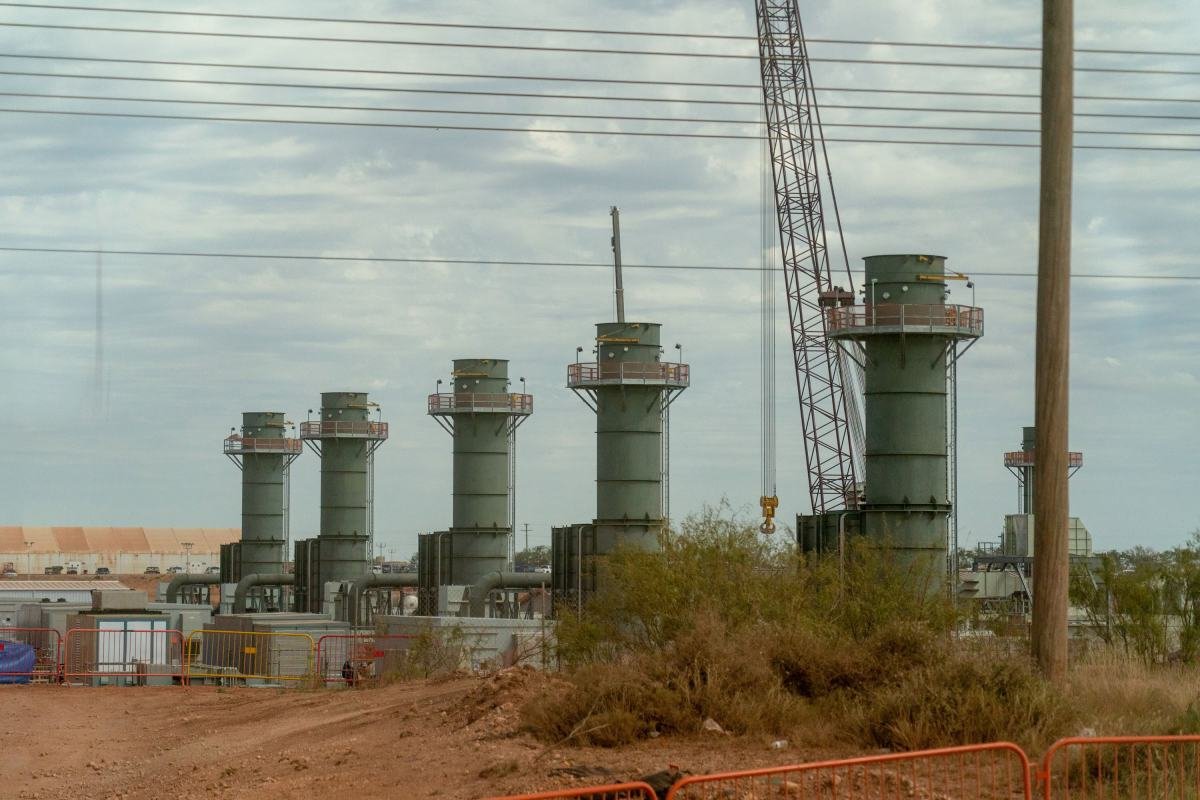
The pressure will be felt most acutely in regions where data center growth is colliding with already crowded transmission systems. BloombergNEF identifies PJM Interconnection and ERCOT as two of the most exposed grids in the country.
PJM, which stretches from Virginia through parts of the Midwest, is forecast to send 34% of its electricity to data centers by the middle of the next decade. ERCOT, which covers most of Texas, is projected to devote 22% of its generating capacity to those facilities.
Those shares are striking because they imply that in some of the nation’s largest power markets, data centers could become one of the biggest single sources of demand on the system.
What is PJM’s problem?
PJM is struggling because the grid already has a large number of data centers and has not been able to keep up with the volume of connection requests from both new power plants and large electricity users.
The organization paused applications for new generating resources for four years, leaving the region in a difficult position as demand continued to rise. It reopened the queue for new generation in April, but the backlog and market tension have not disappeared.
One major utility in the PJM region, American Electric Power, has warned that it may leave the interconnection process, underscoring how severe the strain has become.
The imbalance between supply and demand has already driven up electricity prices in the region. BloombergNEF reports that prices have increased 76% over the past year.
Even with rising costs and congestion, however, data center operators still want access to PJM. They accounted for 38% of charges in the grid manager’s latest capacity auction, a sign of just how valuable grid access remains in high-demand markets.
Why data centers are still clustering in strained regions
Data centers tend to follow the cheapest mix of land, fiber, tax incentives and power access, but in practice they also gravitate toward established hubs where the digital economy is already concentrated. That dynamic is helping reinforce growth in regions that are already under pressure.
In many cases, the same infrastructure features that attract one facility draw more in the future. Once a cluster is established, companies can benefit from proximity to networking infrastructure, skilled labor, suppliers and customers. But the electric grid does not scale as quickly as cloud demand.
That mismatch is becoming more visible as AI computing grows faster than the systems meant to support it. Grid operators are not only trying to approve new load; they are also trying to avoid destabilizing existing customers or pushing costs higher for households and businesses that are not directly connected to the AI economy.
How AI demand changes the economics of power
AI has changed the economics of data center expansion because it increases both the size and the intensity of the load. Traditional cloud services already consumed substantial power, but AI training clusters and high-volume inference workloads can require far more electricity per facility.
That creates three major challenges for utilities:
- They must secure enough generation to serve rapid load growth.
- They must expand transmission and distribution capacity to deliver that power.
- They must manage rate impacts so existing customers do not absorb too much of the cost.
When demand surges faster than infrastructure can be built, prices tend to rise. That is one reason the PJM region has become a warning case for the rest of the country.
How does the global picture compare with the U.S.?
The U.S. may dominate AI compute, but the electricity consequences will not stop at its borders. BloombergNEF expects data centers around the world to add 1,935 terawatt-hours of demand by 2033 if AI adoption keeps advancing quickly.
That amount is nearly equal to India’s annual electricity consumption, illustrating how large AI’s energy footprint could become on a global basis.
Internationally, the growth story is likely to look different from the U.S. version. Some countries may face land and cooling constraints, others may struggle with regulatory approval, and many will rely more heavily on imported equipment and grid upgrades. But the same basic tension will apply: AI growth depends on energy systems that were not designed for this scale of digital expansion.
| Region / system | Projected AI-related electricity impact | Key takeaway |
|---|---|---|
| United States | 20% of national electricity generation by 2035 | Primary center of AI compute and data center buildout |
| PJM Interconnection | 34% of electricity to data centers | Among the most strained U.S. grids |
| ERCOT | 22% of generating capacity to data centers | Texas faces major load growth pressure |
| Global | 1,935 TWh of new demand by 2033 | AI expansion could rival national electricity use |
What this means for utilities, investors and policymakers
The report is likely to sharpen the debate over who pays for the next wave of power infrastructure. Utilities want certainty before they commit billions to new generation and grid upgrades. Developers want speed, because AI infrastructure loses value when projects stall. Regulators are being asked to reconcile both goals at once.
For investors, the forecast suggests that power availability may become as strategically important as chip supply or data center real estate. For policymakers, it raises uncomfortable questions about whether current permitting and interconnection systems are capable of supporting the next phase of digital growth.
There is also a broader climate and energy transition angle. If the U.S. is going to support a surge in AI-driven demand while also retiring fossil fuel generation and electrifying more of the economy, it will need much faster deployment of clean power, storage and transmission than it has managed so far.
That does not necessarily mean AI growth is incompatible with decarbonization, but it does mean the margin for delay is shrinking. Every new server hall, every training cluster and every megawatt of additional load adds urgency to a grid already trying to catch up with multiple transitions at once.
What comes next?
The next few years will likely determine whether the AI industry’s expansion is matched by a parallel buildout in generation and transmission, or whether bottlenecks begin to slow growth, raise prices and push projects to less constrained regions.
BloombergNEF’s forecast suggests the answer will depend less on whether demand materializes and more on whether the power system can adapt quickly enough to serve it. If current trends hold, the electricity footprint of AI will be one of the defining infrastructure stories of the next decade.
For now, the message from the report is clear: the AI revolution is no longer just a computing story. It is becoming one of the largest electricity challenges in the United States and, increasingly, in the world.
Frequently asked questions
How much electricity could U.S. data centers use by 2035?
U.S. data centers could use about 20% of the country’s electricity generation by 2035, according to BloombergNEF. That would be roughly four times their current share and reflects a rapid expansion in AI-related computing demand.
Why are data centers driving so much new power demand?
Data centers are driving more demand because AI systems need electricity both to train large models and to run them continuously at scale. As more users and enterprise applications rely on AI, the energy needed for inference keeps rising even after training is complete.
Which power grids are most exposed to the surge?
PJM Interconnection and ERCOT are among the most exposed grids. BloombergNEF says PJM could see 34% of its electricity go to data centers, while ERCOT may need to devote 22% of its generating capacity to them.
How has BloombergNEF’s forecast changed?
BloombergNEF’s new estimate is 83% higher than the one it published in December. The consultancy says the revision reflects faster-than-expected data center development and a much stronger AI compute buildout across the U.S.
Will the data center boom be limited to the United States?
No. The U.S. is expected to remain the dominant AI compute hub, but BloombergNEF says data centers worldwide could add 1,935 terawatt-hours of new electricity demand by 2033 if aggressive AI adoption continues.