In short
A new Pew global survey finds that most people expect AI to destroy more jobs than it creates and to widen inequality. The poll also shows mixed feelings overall, with many respondents both concerned and excited about AI’s growing role in daily life.
- Pew surveyed 42,151 adults in 37 countries and found widespread concern about AI’s impact on jobs.
- In 34 countries, more respondents believed AI would cause job losses than create employment over the next 20 years.
- People in wealthier countries were especially likely to worry about AI widening income inequality.
- Older adults were generally more concerned, while younger adults showed mixed but increasingly anxious views.
- Public sentiment is not wholly negative: many respondents feel both excited and concerned about AI.
People around the world are increasingly worried that artificial intelligence will eliminate more jobs than it creates, widen the gap between rich and poor, and make everyday life more unsettling. A new Pew Research Center survey of 42,151 adults in 37 countries shows that concern about AI is now stronger than optimism in most places, with the sharpest alarm concentrated in wealthier economies.
The findings matter because they capture public opinion before the latest wave of high-profile warnings from AI executives and policymakers, suggesting that anxiety about automation, inequality and social disruption was already well established. Even so, the survey also shows that attitudes are far from uniformly negative: many people feel both excited and uneasy about AI’s spread.
What Pew’s new survey says about AI fear
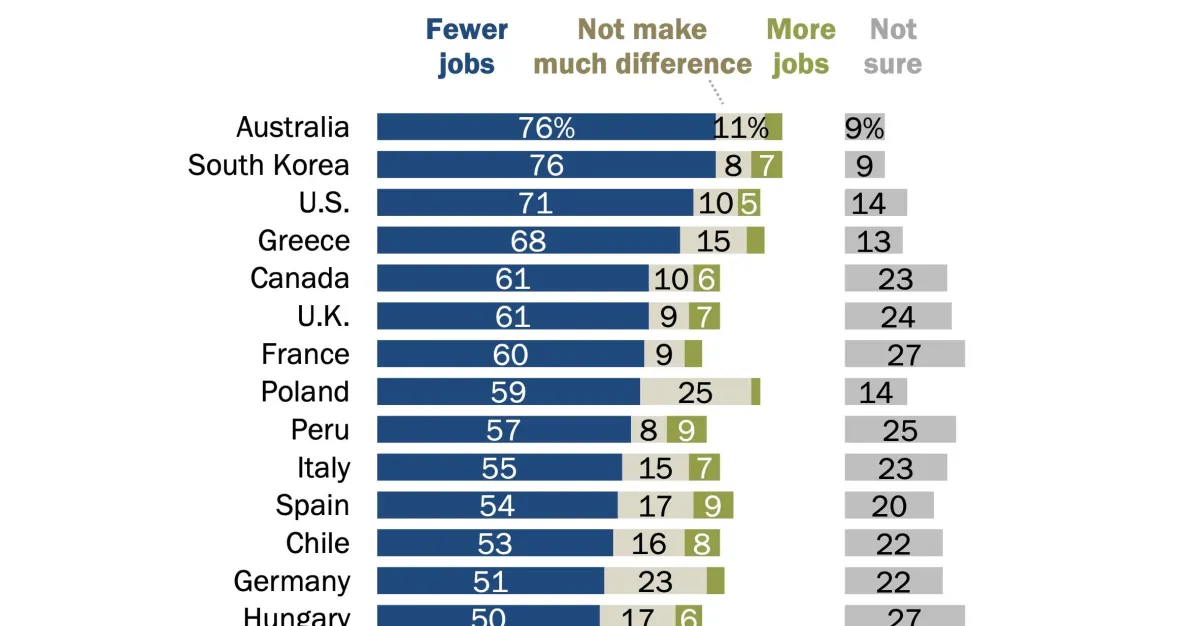
The clearest takeaway from Pew’s global poll is that most respondents expect artificial intelligence to be a net destroyer of jobs rather than a creator of them over the next 20 years. In 34 of the 37 countries surveyed, more people said AI would reduce employment than said it would generate new work.
That view is especially strong in higher-income countries. Australia and South Korea each recorded 76% of respondents saying AI is more likely to cost jobs than add them, while the U.S. registered 71%. Those numbers place public sentiment squarely in the middle of the broader debate over whether generative AI and related systems will automate routine work, reshape office jobs, or simply redistribute tasks.
Pew’s results suggest that job displacement is no longer a niche worry among technologists and labor economists. It has become a mainstream public concern across much of the world.
The survey was conducted between February 8 and May 13, well before some of the most recent dramatic public warnings from AI leaders. That timing matters: it means these attitudes were formed during a period of rapid product launches, workplace experimentation and growing media attention, but before the latest round of apocalyptic messaging intensified the conversation.
How worried are people about AI replacing workers?
People are worried enough that job loss has become one of the defining public narratives around AI. The Pew data show that fear is not limited to one region, one language group or one political culture. Instead, the expectation that AI will replace workers appears in country after country, especially where knowledge work and office-based employment are common parts of the economy.
That concern aligns with a broader industry debate. Some executives and researchers argue that AI will augment workers, boost productivity and create entirely new categories of work. Others say the transition could be painful, especially for entry-level roles and routine white-collar tasks. Anthropic chief executive Dario Amodei has recently warned that AI could wipe out a significant share of entry-level white-collar jobs, a claim that has sharpened public attention to the labor-market side of the story.
For many respondents, the fear is not abstract. AI is increasingly visible in customer service, software development, content production, administrative workflows and other roles that once seemed relatively insulated from automation. The Pew findings indicate that the public is now connecting those changes to broader questions about economic security and social mobility.
Which countries are most concerned?
Wealthier countries expressed the highest levels of concern, with Australia, South Korea and the United States among the most worried about job losses. That pattern suggests that societies with advanced service economies may be especially sensitive to AI-driven labor disruption, because so many workers depend on digital, clerical and information-based jobs.
At the same time, Pew’s cross-national data show that anxiety is not confined to rich countries alone. The breadth of the concern indicates that AI’s public image has shifted from novelty to risk almost everywhere the technology is becoming visible in daily life.
Why do people think AI will increase inequality?
Because many respondents believe AI will concentrate gains among companies and highly skilled workers while putting pressure on everyone else, the survey finds broad concern that the technology will widen income inequality. Across countries, people are more likely to say AI will increase the gap between rich and poor than to believe it will reduce it.
This is a crucial part of the story. The public does not only fear unemployment; it fears that the economic benefits of AI may flow upward, leaving ordinary workers with fewer opportunities and less bargaining power. In countries with stronger left-leaning political cultures and higher incomes, that belief is particularly pronounced.
The concern over inequality reflects a familiar pattern in technology adoption. When productivity tools spread unevenly, the first and largest gains often go to firms that already have capital, data, talent and scale. The worry, as many respondents seem to recognize, is that AI could amplify those advantages rather than spread them broadly.
| Survey item | Key finding | Notable examples |
|---|---|---|
| Countries surveyed | 37 | Global sample spanning multiple regions |
| Total respondents | 42,151 | Adults surveyed between Feb. 8 and May 13 |
| Job-loss concern | Majority in 34 countries | Australia 76%, South Korea 76%, U.S. 71% |
| Attitude balance | 41% equally concerned and excited | 37% primarily concerned, 13% primarily excited |
| Younger adults | More mixed but increasingly anxious | Rising concern in several countries over the past year |
How age shapes opinions on AI
Age plays a major role in how people respond to AI, according to Pew. Older adults are generally more worried about how AI will affect everyday life, while younger adults are more likely to hold mixed feelings rather than outright hostility.
But younger people are not especially calm. Pew found that adults aged 18 to 34 are increasingly anxious, particularly in countries including Sweden, Poland, Japan, Australia, Brazil and the United States. In those places, concern among younger respondents has climbed sharply over the past year.
That trend is important because younger adults are the group most likely to live with AI for decades to come. They are also the people most exposed to the possibility that entry-level jobs, internship pathways and early-career white-collar roles could be transformed first.
What explains the generational divide?
The divide likely reflects both experience and expectation. Older adults may focus on the immediate discomfort of rapid technological change, while younger adults may be weighing opportunity against uncertainty. The mixed response among younger respondents suggests curiosity and caution are coexisting rather than canceling each other out.
For students and early-career workers, AI is not just a consumer product. It is a force that could affect hiring, training, wages and professional identity. Pew’s data suggest that this reality is becoming harder to ignore.
What the survey reveals about public mood
Despite the widespread anxiety, Pew’s results are not a verdict of total rejection. The global mood is mixed, not uniformly bleak. A median of 41% of respondents say they feel equally concerned and excited about AI’s increasing presence in daily life.
By comparison, 37% say they are primarily concerned, while 13% are primarily excited. That leaves a substantial share of the public in a state of ambivalence rather than outright opposition or enthusiasm.
This balance helps explain why AI companies continue to attract users and investment even as skepticism grows. People may distrust the long-term consequences while still using the tools because they are useful, convenient or already embedded in work and communication.
Many people appear willing to experiment with AI, but they remain unconvinced that its social and economic effects will be broadly positive.
Why the timing of the Pew poll matters
The survey was fielded before the latest round of especially dramatic public warnings about AI’s dangers. That makes the findings more revealing, not less. They show that concern about job losses and inequality was already deeply rooted before the debate became even more heated.
In other words, the skepticism did not begin with the newest headlines. It predates them. Pew’s data suggest that public opinion is responding to the technology’s spread itself: the more AI appears in products, workplaces and media, the more people appear to be questioning who benefits and who pays the price.
That matters for policymakers because the political response to AI will depend in part on whether citizens see the technology as a growth engine, a labor threat or both. If public anxiety keeps rising, governments may face greater pressure to regulate workplace automation, expand retraining programs or rethink social safety nets.
How AI concerns differ by country and political outlook
Pew found that residents of wealthier, more left-leaning countries are most likely to believe AI will increase inequality. That pattern suggests public opinion is shaped not only by exposure to the technology, but also by broader views about markets, labor protections and the role of government in shaping economic outcomes.
Countries with strong social safety nets may still worry about disruption, but they may also have more institutional trust in the ability of the state to cushion the blow. In more market-driven economies, however, AI may be viewed as another force that can intensify competition and reward the already advantaged.
The survey does not settle the question of whether those fears will prove accurate. But it does show that many people have already decided which way the risk points.
What this means for the AI industry
For AI companies, the Pew results are a warning that product adoption does not equal public trust. Users may enjoy AI tools while still believing the overall social impact will be harmful. That gap creates a credibility problem for an industry that often sells itself on productivity, convenience and transformation.
It also suggests that the messaging battle around AI is shifting. Developers and executives can no longer assume that the public will accept broad claims about innovation and efficiency without asking tougher questions about wages, job quality and distribution of gains.
As AI systems become more capable, their social legitimacy may depend less on technical progress than on whether ordinary people can see clear benefits in their lives. If the public concludes that the technology mainly enriches a small group while endangering broader economic security, resistance will likely grow.
Key facts from Pew’s global AI survey
- Pew surveyed 42,151 adults across 37 countries.
- Fieldwork ran from February 8 to May 13.
- In 34 countries, more people expected AI to cause job losses than job gains over the next 20 years.
- Australia, South Korea and the U.S. were among the countries with the highest concern about job displacement.
- A global median of 41% said they were both concerned and excited about AI.
- Older adults were generally more worried about AI’s effect on daily life.
- Younger adults showed mixed feelings, but anxiety has risen in several countries over the past year.
The bigger picture
Pew’s survey offers a snapshot of a world that is not rejecting AI, but is increasingly wary of what it may do to work, wealth and social stability. The technology is advancing quickly, yet public confidence is not keeping pace. Instead, many people are watching the AI boom and asking a basic question: who wins, and who loses?
That question is likely to shape the next phase of the AI debate as much as model capability, product launches or competitive pressure among major tech companies. The story is no longer just about what AI can do. It is about whether ordinary people believe they will share in the benefits.
For now, Pew’s answer is clear: around the world, the fear of AI is real, widespread and growing, even as curiosity and excitement remain part of the picture.
Frequently asked questions
What did Pew’s global AI survey find?
Pew’s global AI survey found that most respondents expect artificial intelligence to destroy more jobs than it creates over the next 20 years, while also believing it will increase income inequality. The poll also showed that many people feel both excited and concerned about AI’s spread.
Which countries were most worried about AI job losses?
Australia, South Korea and the United States were among the most worried countries. In each of those places, around three-quarters or more of respondents said AI is more likely to eliminate jobs than create them.
Does Pew’s survey show people hate AI?
No, Pew’s survey shows mixed feelings rather than outright rejection. A global median of 41% said they were equally concerned and excited about AI, compared with 37% who were mainly concerned and 13% who were mainly excited.
Why are people worried AI will increase inequality?
People worry AI will increase inequality because they think the financial gains will flow mostly to companies and highly skilled workers, while middle- and lower-income workers face displacement, weaker bargaining power and fewer opportunities.
How does age affect opinions on AI?
Age affects opinions strongly: older adults are generally more concerned about AI’s effect on daily life, while younger adults are more mixed but increasingly anxious, especially in several countries where concern has risen sharply over the past year.