South Korea Bets Big on AI: 260,000 NVIDIA GPUs to Power National Leap
In a move poised to redefine the global AI arms race, NVIDIA has announced an unprecedented partnership with the South Korean government and major national conglomerates to deploy over 260,000 AI GPUs, marking one of the largest national AI infrastructure deals in history.
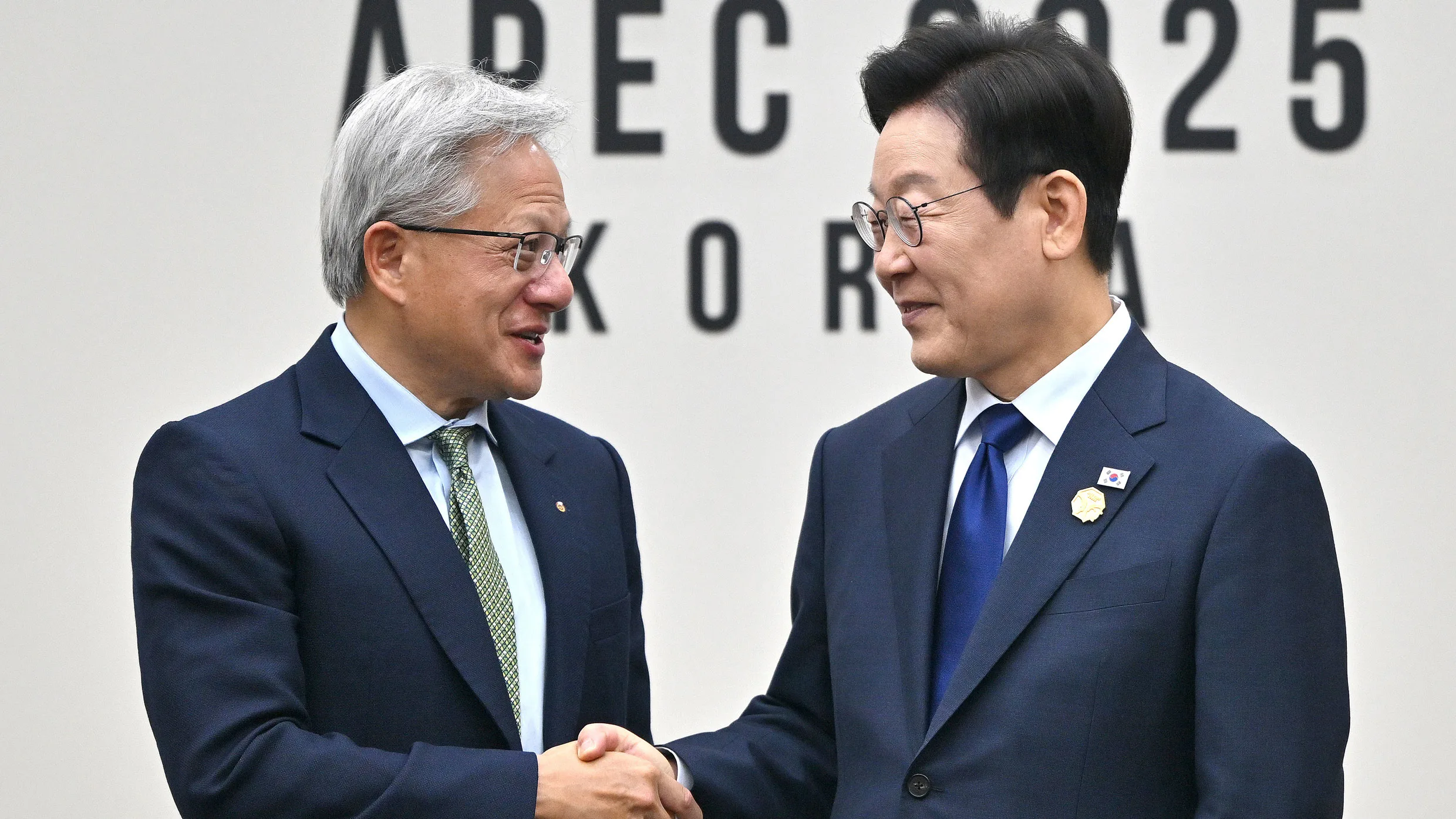
Unveiled during the 2025 APEC CEO Summit in Gyeongju, the collaboration brings together NVIDIA and industrial giants including Samsung Electronics, SK Group, Hyundai Motor Group, and Naver Cloud, all backed by South Korea’s Ministry of Science and ICT (MSIT). The initiative is designed to transform South Korea into a full-spectrum AI superpower—extending from data centers to manufacturing floors and intelligent mobility ecosystems.
“This investment will make Korea a global powerhouse in AI,” said NVIDIA CEO Jensen Huang during the summit, highlighting the geopolitical and technological significance of the deal.
Dissecting the Deal: Who Gets What?
The agreement allocates NVIDIA’s cutting-edge Blackwell AI chips across both the public and private sectors. While precise unit specifications remain undisclosed, the distribution is estimated as follows:
- Government/Public Sector (MSIT): ~50,000 GPUs to fuel sovereign cloud, national AI centers, and foundational model R&D.
- Samsung Electronics: ~50,000 GPUs focused on industrial AI for chip fabrication, smart factories, and robotics.
- SK Group: ~50,000 GPUs to scale industrial AI, cloud services, and quantum-class compute centers.
- Hyundai Motor Group: ~50,000 GPUs powering AI-driven mobility platforms, autonomous vehicles, and advanced robotics.
- Naver Cloud: ~60,000 GPUs for Korean-language LLMs, cloud infrastructure, and enterprise AI offerings.
The aggregate value of this national deployment is estimated to exceed ₩14.8 trillion (USD $10 billion), making it one of the largest GPU investments by any single country in the world.
Strategic Objectives Behind South Korea’s AI Expansion
1. Building a Sovereign AI Infrastructure
With growing concerns about data security, algorithmic sovereignty, and geopolitical instability, South Korea’s sovereign AI architecture is a foundational component of this deal. The MSIT plans to use its GPU share to develop Korean-centric large language models (LLMs), cross-sectoral AI platforms, and open AI frameworks not dependent on foreign cloud providers.
This builds resilience and ensures local control over data, models, and strategic technologies—vital in an era of rising techno-nationalism.
2. Industrial AI Factories and Smart Manufacturing
South Korea’s industrial behemoths are set to leverage NVIDIA’s GPUs to build “AI factories”—intelligent, automated production lines that integrate real-time decision-making, predictive analytics, and generative AI capabilities.
- Samsung will apply these in chip design and testing, materials optimization, and robotics integration within its fabs.
- SK Group is developing data-intensive energy and materials platforms powered by physical AI and digital twin models.
- Hyundai will integrate the GPUs into its autonomous driving stack and robotics R&D for future mobility and logistics.
These efforts signify a shift from traditional smart manufacturing to fully AI-native factories that learn, adapt, and self-optimize.
3. Scaling the Korean AI Cloud Ecosystem
Naver Cloud—already a leader in Korean-language models—plans to deploy its GPUs for training multilingual LLMs, enterprise-grade AI services, and robotic control systems. This infrastructure will also underpin the “K-AI Cloud,” a sovereign compute platform jointly supported by Kakao, NHN, and other local players.
4. AI Model Development and Research Leadership
Collaborating with leading Korean institutions including LG AI Research, Upstage, NC AI, and SNU AI Labs, the project includes developing foundation models tailored to Korean language, healthcare, robotics, and edge AI. NVIDIA will provide direct support via CUDA ecosystem integration, optimization libraries, and training programs for researchers and engineers.
Global Implications and Geopolitical Dimensions
1. NVIDIA’s Strategic Realignment
Amid U.S. export restrictions on AI chip shipments to China, South Korea becomes a vital strategic partner for NVIDIA to maintain access to East Asia’s tech corridor. The deal enables NVIDIA to expand GPU demand in an allied, geopolitically stable market—without risking national security backlash.
2. Korea’s Bid to Outpace Japan and Challenge Europe
This infrastructure leap gives South Korea a real chance to surpass Japan’s fragmented AI landscape and challenge the EU’s regulatory-heavy AI trajectory. With both hardware and software scaling rapidly, South Korea is staking its future on becoming a world-leading AI producer—not just a consumer.
3. A Challenge to US and EU AI Dominance
South Korea’s sovereign AI ambitions, backed by this scale of GPU firepower, may inspire similar moves in other mid-sized tech economies. This is especially relevant amid debates over U.S. cloud dependencies and Europe’s energy constraints in powering large AI clusters.
Challenges Ahead
Despite its ambition, the initiative faces notable risks and obstacles:
- Infrastructure Readiness: Power supply, cooling systems, and data center construction for 260,000 GPUs pose serious logistical and environmental challenges.
- Talent Bottleneck: Scaling AI engineering talent—especially in LLM architecture, systems engineering, and robotics—is a known constraint in South Korea.
- Model Safety and Governance: Large-scale deployment of powerful models demands robust governance structures. Regulatory frameworks and ethical AI oversight remain underdeveloped.
- Hardware Delivery and Delays: Supply chain disruptions, chip fabrication cycles, and potential geopolitical tensions may delay full deployment.
- AI Fragmentation Risk: A surge in sovereign LLMs globally could lead to greater fragmentation in AI model interoperability, raising concerns over cross-border standardization.
What’s Next? Signals to Watch
- First GPU Shipments: Expected by early Q2 2026. Monitoring rollout timelines will reveal how fast the infrastructure comes online.
- Model Releases: Look for announcements from Naver, LG AI Research, or Upstage regarding new LLMs and robotics systems trained on Blackwell hardware.
- APEC 2026 in Shenzhen: With China also proposing a global AI body (WAICO), the next APEC summit may bring further AI governance competition to the fore.
- Korea’s National AI Act: The government is reportedly drafting new AI governance and data protection laws to match its infrastructure scale—an essential step for responsible scaling.
Final Thoughts: A National Leap Toward AI Supremacy
This historic GPU deployment marks a defining moment in South Korea’s industrial and technological evolution. What sets this apart isn’t just scale—it’s integration. By weaving AI directly into its industrial, mobility, and digital infrastructure, Korea is building a new national AI fabric, supported by the world’s leading compute provider.
For NVIDIA, it’s more than a contract—it’s a blueprint for global AI deployment in an era of political caution, economic competition, and technological bifurcation.
South Korea now stands as a model for how nations can mobilize public-private coalitions to build sovereign AI capabilities at world scale. The question is: who will follow next?