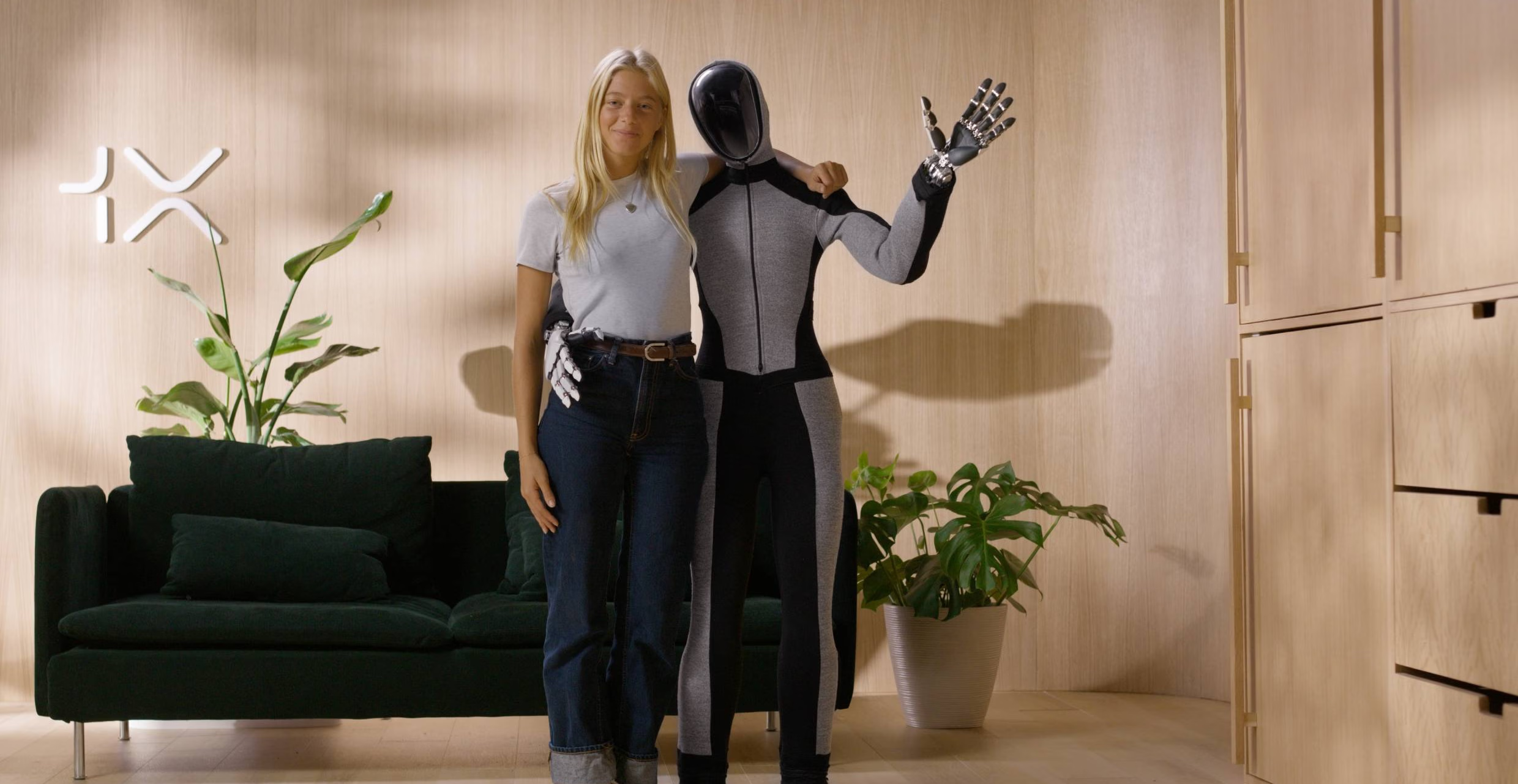
Superintelligence News — In a leap toward human-robot coexistence, Norway-born robotics firm 1X Technologies (formerly Halodi Robotics) has launched its consumer-facing humanoid robot, NEO, engineered specifically for real-world domestic environments. At a time when many tech giants are focused on digital AI agents, 1X is pioneering the physical embodiment of AI through humanoid robots intended to live, work, and assist in human homes.
With funding from high-profile backers including the OpenAI Startup Fund, 1X is positioning NEO as a new class of AI assistant—one that doesn’t live in your phone, but walks, perceives, and manipulates the world around you.
From Halodi to 1X: The Evolution Toward Human Environments
Founded in 2014 under the name Halodi Robotics, the company originally focused on safe actuation systems and industrial robotics. Rebranding as 1X Technologies in 2022 marked a philosophical shift: the transition from industrial to human-centric robots.
NEO represents the culmination of nearly a decade of research and development in robotics mechanics, AI autonomy, and safety. The robot is the company’s first humanoid designed to navigate and interact in unstructured, cluttered domestic spaces, rather than clean, predictable factory floors.
1X’s guiding vision? “A robot that can live among us”—sharing our physical spaces and eventually assisting in daily tasks ranging from cleaning to companionship.
NEO Unveiled: Anatomy of a Humanoid Assistant
The newly revealed NEO robot is the company’s flagship product, designed to be both functional and safe for home use. Here’s what sets NEO apart from previous humanoid robots:
1. Human-Inspired Hardware
- NEO features a tendon-driven actuation system that mimics human muscles and joints, delivering smooth, compliant, and quiet motion.
- Its physical structure is designed to be safe for close human interaction, especially in family settings, avoiding the rigid mechanics typical of many industrial robots.
- The robot uses proprietary motors such as the “Revo1,” engineered for high torque with minimal gearing—ideal for agile, lightweight motion.
2. Sensor & Vision Stack
- Equipped with advanced stereo cameras, depth sensors, and inertial measurement units (IMUs), NEO builds a dynamic 3D understanding of its surroundings.
- It processes this input through onboard AI models to identify objects, recognize people, and navigate safely in complex, cluttered spaces like kitchens, bedrooms, or living rooms.
3. Cognitive Layer: Generative World Modeling
- The real innovation lies in the robot’s mind. 1X has developed a world-model-based AI system that allows NEO to simulate possible outcomes before taking physical actions—a crucial capability in unpredictable environments.
- A technical report, “Generative World Modeling for Humanoids”, details how these AI systems help NEO learn from sparse data and generalize actions, a key step toward true autonomy. (arXiv)
4. Human-AI Interaction
- Unlike passive voice assistants, NEO is designed to engage physically and socially with users.
- It incorporates reinforcement learning and imitation learning from human demonstrations to adapt to each user’s preferences and household routines.
- The robot can also be remotely operated when needed, blending AI autonomy with human supervision as part of a hybrid architecture.
Consumer Rollout: Pricing, Availability, and Use Cases
1X opened pre-orders for NEO in late 2025, offering two pricing models:
- $19,999 upfront, or
- $499/month subscription, aimed at early adopters and pilot programs.
Initial deployments are expected to begin in the U.S. in mid-2026, followed by broader international release through 2027. The company is targeting not just affluent tech-savvy homes, but eldercare facilities, assisted living environments, and disability support contexts.
Early-Stage Use Cases:
- Household support: Loading laundry, fetching objects, cleaning surfaces.
- Eldercare: Monitoring for falls, assisting in mobility, medication reminders.
- Social companionship: Holding conversations, alerting caregivers, even playing games.
- Learning agents: Adaptive, task-learning bots personalized to user environments.
Investor Confidence: Who’s Backing 1X?
1X has raised tens of millions in capital, including investments from:
- OpenAI Startup Fund
- EQT Ventures
- Samsung NEXT
- Skagerak Capital
- Kahoot! co-founders
This level of backing reflects a growing conviction that the next frontier in AI is not just software—but embodied intelligence, where robots interact directly with the physical world.
Challenges on the Road Ahead
Despite the excitement, 1X and its NEO platform face formidable hurdles:
1. Autonomy vs Telepresence
Much of NEO’s current functionality relies on a mix of autonomy and human-in-the-loop control. True general-purpose autonomy remains elusive, and 1X acknowledges that teleoperation may be needed for edge cases.
2. Cost vs Mass Adoption
At $20,000, NEO remains prohibitively expensive for mainstream homes. 1X must reduce cost and complexity through scale and streamlined manufacturing to reach a broader audience.
3. Safety, Trust & Regulation
Robots in private homes raise significant ethical and legal questions—from surveillance concerns to physical safety and liability. Transparent policies and rigorous certifications will be key.
4. Durability & Maintenance
Maintaining humanoid robots with complex actuators and AI systems in consumer homes demands a service infrastructure that doesn’t yet exist at scale.
Strategic Edge: What Makes 1X Different?
While other humanoid robotics companies such as Tesla Optimus, Agility Robotics, and Boston Dynamics focus on industrial applications or warehouse automation, 1X is singularly focused on domestic human environments.
Their combination of:
- human-safe actuation,
- sensor-rich design,
- AI-driven cognition, and
- home-first strategy
sets them apart in a market that’s just beginning to materialize.
Final Analysis: Are We Ready for Robots in Our Homes?
1X’s NEO is more than a mechanical assistant—it’s a test case for a future in which robots aren’t locked in labs or factories, but live with us, support us, and learn from us.
The road to fully autonomous humanoid home assistants is long, and littered with technical, financial, and ethical challenges. But 1X has taken a bold step forward, not by waiting for AI to “solve embodiment,” but by building the embodiment—and letting the AI evolve into it.
If the gamble pays off, NEO may mark the beginning of the robot-as-roommate era.